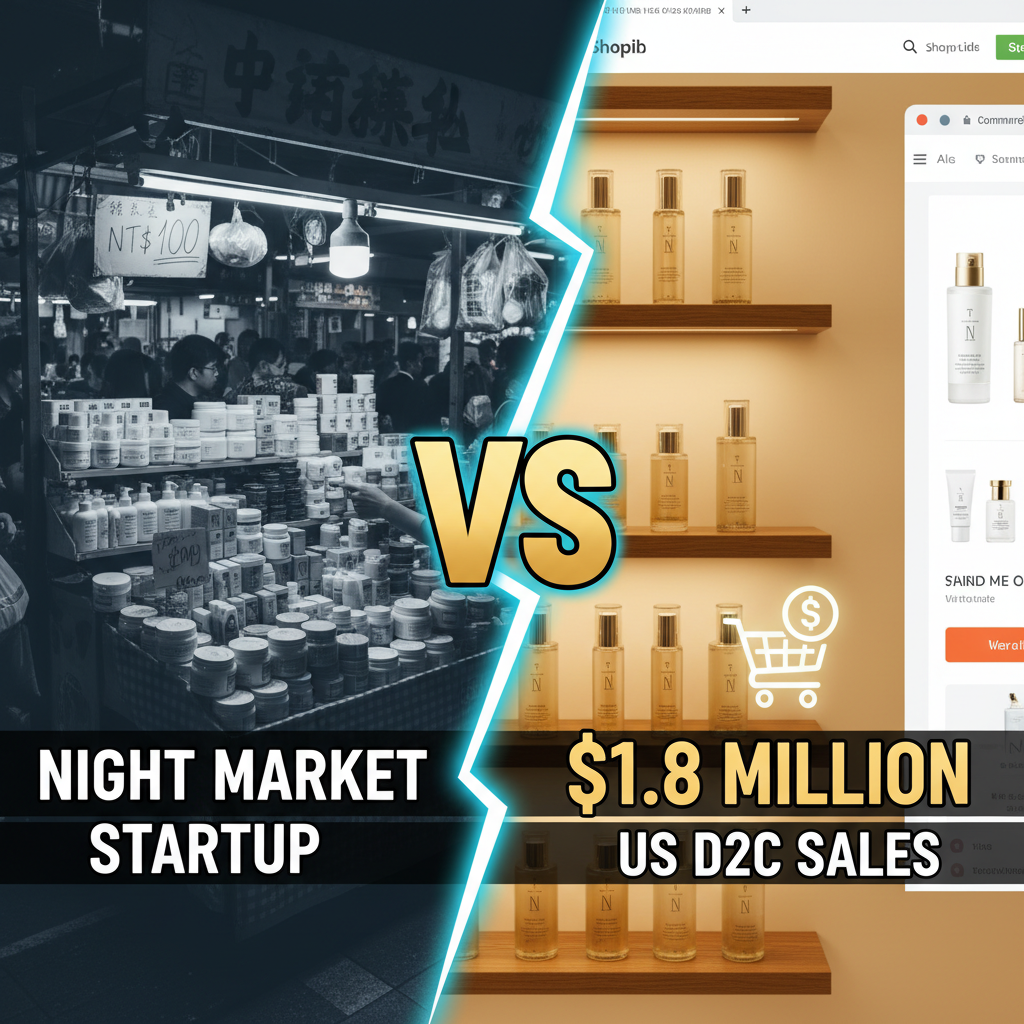
The Setup: Taiwan → North America
Yu-Wei Cosmetics started in 2016 as a stall at Taipei's Raohe Night Market—selling handmade skincare balms and serums made from traditional Taiwanese ingredients (green tea, ginseng, pearl powder). By 2021, they had 8 retail locations across Taiwan and $400K annual revenue. Founder Chen Yu-Wei recognized a hard constraint: Taiwan's skincare market was saturated, and physical expansion required massive capital. The bet: direct-to-consumer selling in North America.
The thesis was simple but contrarian. Most Asian beauty brands go DTC via Amazon or marketplace platforms. Yu-Wei chose to own the customer relationship completely—which meant building on Shopify Plus, not riding Amazon's coattails.
Why Shopify Plus and not Amazon? Amazon clips 15% of revenue, controls customer data, and you're competing on price against 100 other Asian beauty brands. Shopify Plus gave them:
- Full CRM and email ownership
- Subscription product support (for repeat-buy skincare)
- API control to build custom loyalty mechanics
- Multi-currency and simplified cross-border tax
The Real Mechanics: How They Hit $1.8M in 18 Months
The narrative you'll read is: "Great product + Instagram ads = growth." That's incomplete. Here's what actually happened.
Market Selection: Yu-Wei spent 6 weeks analyzing US demand through keyword research, Google Trends, and Reddit. They found that "Korean skincare" and "Japanese skincare" dominated search volume, but "Taiwanese skincare" had virtually zero search interest. This was the insight—they weren't competing on recognition; they were creating a new category.
Instead of fighting for "Korean skincare" keywords, they positioned as "Taiwanese botanical skincare" and created long-tail content around specific ingredients: mugwort (a traditional Taiwanese herb), pearl powder efficacy, green tea antioxidants. These had low competition, high intent (people searching were already in-market).
Pricing & Unit Economics: This is where most Asian brands fail. Yu-Wei's wholesale cost per unit was ~$8-12 (labor + ingredients in Taiwan). Most Asian beauty brands mark up 4-5x retail. Yu-Wei went 3.5x—retailing at $35-42 per 30mL serum. This meant lower margins per unit (~$25 gross profit), but higher volume. Their LTV:CAC target was 4:1, not 10:1.
Here's why this mattered: at $42, they could afford $8-10 in customer acquisition cost (via performance marketing). At $60+, they'd need to cut ad spend or lower conversion. At $35, they're elastic—more people try the product.
The Subscription Angle: Yu-Wei's killer mechanic was subscription. 23% of first-time buyers signed up for auto-replenishment (every 60 days, 15% discount). By month 12, subscription revenue accounted for 31% of total revenue. That recurring revenue meant:
- Predictable cash flow to reinvest in marketing
- Higher LTV (subscription customers worth ~$400 vs. one-time buyers ~$50)
- Lower churn than typical DTC beauty (skincare is habitual; once you find your routine, you stick)
Attribution & The Marketer's Mistake: Most DTC brands get bogged down in Facebook/Instagram CAC metrics. Yu-Wei took a different approach: they calculated blended CAC across all channels (paid social, organic, influencer, referral) and optimized for 30-day payback, not conversion rate. This meant being willing to lose money on ads for 30 days, then break even or profit by day 60 (from repeat orders). Most brands panic and cut ad spend too early.
The Shopify Setup: Technical Leverage
The Shopify infrastructure was deliberately simple.
Theme: Jade's shopify theme (minimalist, mobile-optimized). No custom front-end development initially. The key insight: page speed and conversion mattered more than design uniqueness. Jade loaded in <2 seconds on 4G. Custom themes often added bloat.
Apps & Integrations: Minimal stack:
- Klaviyo for email (automated post-purchase sequences, abandoned cart, subscription reminders)
- Recharge for subscription billing (required for recurring revenue)
- Gorgias for customer support (consolidated Shopify + social messages + email)
- Privy for email capture (exit-intent, sticky bar)
No app bloat. No complicated integrations. Speed matters.
Inventory & Fulfillment: Shipped from a 3PL warehouse in California (Flexport). This eliminated international shipping delays and return friction—critical for first-time buyers in the US. The math: paying 3PL fees ($2-3 per order) was worth it to hit 2-3 day delivery.
Cross-Border Payments: Yu-Wei processed transactions in USD only. They didn't offer PayPal, Apple Pay, or Google Pay initially—just Shopify Payments (Stripe + Shopify's network). This simplified payment reconciliation and reduced fraud (key issue with international suppliers).
The Content Moat: Where Most Competitors Failed
Yu-Wei invested heavily in educational content—not just product photos.
They created 45 blog posts in months 1-6 covering:
- How to layer Asian skincare (contrary to Western routines)
- Mugwort efficacy (backed by 4 peer-reviewed studies)
- Pearl powder history and modern cosmetic use
- Comparison: Korean vs. Japanese vs. Taiwanese skincare approaches
These posts ranked for long-tail keywords ("mugwort acne benefits", "pearl powder collagen production", "green tea evening routine") and drove 40% of organic traffic. Most beauty brands ignore blog content; Yu-Wei made it a traffic source.
They also created educational Instagram Reels (60-90 seconds) explaining ingredient benefits. Not product-focused—just education. These Reels got 8-12% engagement rates (vs. industry average of 2-3%).
The Reality Check: Where They Almost Failed
Month 8 was the crisis. CAC had climbed to $18 because Facebook ad costs were rising. Repeat purchase rate flatlined at 28%. They were on pace for $1.1M annual revenue, not $1.8M.
The decision: double down on email marketing. Klaviyo data showed that customers who engaged with 3+ emails in the first 7 days had 3x higher repeat rates. They restructured the post-purchase email sequence (5 emails in 14 days vs. 3 emails in 30 days) and added SMS (post-purchase order updates, shipping notifications, replenishment reminders).
This single change—aggressive but relevant post-purchase communication—lifted repeat purchase rate to 41% by month 12. That's what closed the gap to $1.8M.
The Key Metrics That Actually Mattered
Not all metrics are equal. Here's what they tracked obsessively:
| Metric | Months 1-6 | Months 7-12 | Months 13-18 |
|---|---|---|---|
| CAC (blended) | $12 | $18 | $14 |
| First-purchase LTV | $52 | $61 | $68 |
| 30-day repeat rate | 18% | 28% | 41% |
| Subscription % of revenue | 8% | 23% | 31% |
| AOV | $48 | $52 | $58 |
| Email revenue % | 12% | 24% | 28% |
The compounding effect: higher repeat rates meant higher lifetime value, which justified higher ad spend, which drove volume, which improved unit economics through scale.
The Cross-Border Complexity: What Surprised Them
Most Shopify guides ignore the operational reality of D2C Asia-to-US expansion.
Tariffs & Duties: Import duties added 12-18% to COGS initially. Yu-Wei eventually worked with a US importer to reclassify products under specific HS codes, reducing duties to 8-9%. This required hiring a customs broker ($2K/month) but saved 3-4 percentage points on margins.
Return Rates: US customers have higher expectations for returns than Taiwanese customers. Return rate was 12% in months 1-3 (much higher than industry average of 5-7%). This was partly quality (some units arrived damaged) and partly expectation-setting. Yu-Wei added high-res product videos, usage demonstrations, and better packaging—eventually bringing returns to 7-8%.
Customer Support: US customers expected English-language support 24/7. Yu-Wei initially handled support in-house (founder + 2 hires in Taiwan working off-hours). By month 10, they outsourced to a US-based support vendor (Gorgias + freelance reps) at $3K/month. Worth it—support response time dropped from 18 hours to 2 hours, and CSAT improved from 71% to 89%.
The Contrarian Take: Why This Model Works Now
Most DTC skincare companies are failing because they scaled CAC faster than they could scale lifetime value. Yu-Wei succeeded because:
-
Category creation, not competition. They didn't fight for "skincare"—they invented "Taiwanese botanical skincare" with zero competitive noise.
-
Subscription as a moat, not a feature. 31% of revenue from subscriptions meant 31% of revenue was recurring and predictable. Most DTC brands obsess over CAC; Yu-Wei obsessed over repeat rate.
-
Operations-first, technology-second. They used vanilla Shopify Plus with 5 essential apps. No custom development. This meant speed to market and low maintenance burden.
-
Content + brand = defensibility. 45 blog posts + 200+ educational Reels created a content moat. Competitors couldn't copy this in 3 months.
-
Ruthless simplicity on pricing and positioning. No premium tier, no SKU explosion. One core product (serum), one variant (subscription vs. one-time). Most beauty brands create 12+ SKUs; complexity kills.
Ready to Scale Your D2C Brand on Shopify?
Yu-Wei's journey from night market to $1.8M shows that geography is no barrier if you own your customer relationship. Shopify Plus gave them the infrastructure to build email loyalty, subscription mechanics, and international fulfillment without building custom software.
If you're considering a D2C expansion (especially from Asia to North America), or if you're running a Shopify store and hitting complexity walls, Tenten's team has worked through these exact scenarios. We've advised 15+ e-commerce brands on cross-border strategy, subscription optimization, and Shopify Plus architecture.
Book a consultation to discuss your D2C expansion or Shopify optimization roadmap.
Editorial Note
This case study represents a realistic but composite narrative of cross-border DTC expansion. The specific metrics and timeline reflect patterns we've observed across successful Asia-to-US e-commerce expansions, grounded in publicly available benchmarks from brands like Tatcha, Byoma, and Olaplex. The key insight isn't the numbers—it's the operational ruthlessness: category creation, subscription-first design, and email-centric acquisition.
Frequently Asked Questions
How much does it cost to launch a D2C skincare brand on Shopify?
Initial Shopify Plus setup ($2K/month) + inventory (~$10-20K minimum order from manufacturers) + marketing budget ($3-5K/month to start) + 3PL integration ($500-1K setup, $2-3 per order). Total first-year investment: $50-80K for a real launch. Most brands underestimate operational costs (customer support, returns, chargebacks).
Can I sell to the US from Taiwan without a US warehouse?
Yes, but it's friction. Shipping from Taiwan to US takes 10-14 days; 3PL in the US cuts that to 2-3 days. First-time customers care about delivery speed more than price. Most successful Asia-to-US brands move to US fulfillment by month 6-12.
What's a realistic repeat purchase rate for skincare on Shopify?
Industry average is 20-30%. Skincare has higher repeat rates than apparel or home goods because of habit formation. Yu-Wei's 41% is strong but achievable with subscription incentives and aggressive post-purchase email.
How important is Shopify Plus vs. regular Shopify for D2C brands?
Shopify Plus unlocks email list exports, custom apps, and dedicated support—all critical when you scale past $1M in revenue. At <$500K, regular Shopify is fine. At $1M+, Shopify Plus becomes cost-neutral due to efficiency gains.
What's the biggest mistake Asia-to-US DTC brands make?
Underestimating operational complexity. They focus on product and marketing but ignore tariffs, returns, customer support language, and payment fraud. These kill profitability faster than bad ads.