Why Most D2C Brands Fail at Retention
You're burning money acquiring customers while 80% never buy again. That's not a customer acquisition problem—it's a retention architecture problem.
Here's the mechanics: A typical D2C brand spends $40-80 acquiring a customer worth $120 first-purchase value. If that customer never returns, unit economics collapse. You're stuck on a treadmill: acquire at $50, sell at $120, make $70 gross, and spend that $70 acquiring the next customer. Margins vanish.
But retention flips the entire game. Get 30% of customers to buy twice, and your CAC payback cuts in half. Get them to buy 3x, and you've built a sustainable business that compounds.
Most merchants skip this because retention feels hard. It requires building systems, not just running ads. Here's how to actually do it.
The Retention Equation: Three Levers
Retention isn't about sending more emails. It's about controlling three levers that compound retention rates:
| Lever | Mechanism | Typical Impact |
|---|---|---|
| Post-Purchase Experience | Thank you sequences, order tracking, smart follow-ups | 15-25% lift in repeat rate |
| Product Replenishment Logic | Identify repeat-purchase products (beauty, supplements, apparel) + trigger timing | 20-35% lift for replenishable categories |
| Exclusive Access | Loyalty tiers, early-access drops, VIP communities | 12-18% lift in AOV + 10-15% repeat rate improvement |
| Win-Back Campaigns | Re-engage lapsed customers (30-90 days silent) with targeted incentives | 5-12% win-back rate (3-5% of total customer base) |
Each lever is independent. You don't need all four. But stacking two or three creates a multiplier effect.
The math: If your baseline repeat rate is 20% and you implement post-purchase + product replenishment logic, you're looking at realistic 35-40% repeat rates within 6 months. For a $2M revenue store (16,667 customers), that's 2,667 additional repeat customers—roughly $300K+ in incremental annual revenue.
Lever 1: Design the Post-Purchase Experience (Days 1-14)
The first two weeks after purchase are your highest-attention window. Customers are thinking about the product, experiencing it, and forming opinions about your brand. Most merchants waste this window with templated shipping notifications.
Here's what actually works:
Day 1 (Confirmation): Send order confirmation, but make it personal. Include product photo, what to expect, and a micro-CTA that builds brand affinity. Good example: "Your [product name] is on the way. Check out how others style this [link to Instagram or UGC]."
Day 3-5 (Delivery + Unboxing): Once the package arrives, send a follow-up: "Got it? Here's how to [use product properly]. DM us your unboxing—we feature the best ones." Unboxing content is viral gold. It also signals that your product is experiential, not transactional.
Day 7 (Value Extraction): By now, the customer has used the product. This is when you educate them on advanced use cases or complementary products. "Thinking about expanding? Here's a curated bundle for [use case]." No hard sell—just relevant context.
Day 14 (Feedback + Loyalty Invite): Ask for a review. If they've left one, thank them and invite them into your loyalty program: "Join [loyalty program]—your next purchase earns [reward]."
The key insight: This isn't five emails. It's one per touchpoint, timed to customer behavior, not your calendar. Most merchants send everything in 24 hours, creating email fatigue.
Lever 2: Implement Product Replenishment Logic
Some products are repeat-purchase gold. Supplements sell every 30 days. Skincare every 45 days. Apparel restocks every season. But most Shopify merchants treat every product the same, missing millions in predictable revenue.
Replenishment logic means flagging which products are consumables or seasonally repeatable—then automating customer reminders at the right moment.
How to identify replenishment products:
Look at your repeat-customer base. Which products show up in multiple orders? Rank them by frequency.
Example data (fictional store): - Vitamin supplements: 68% of repeat customers repurchase within 45 days - Face masks: 52% within 60 days - Apparel (seasonal): 41% within 180 days - One-time tools: 8% repurchase rate (not replenishable)
Implementation:
Build a "Replenish" SMS or email workflow for flagged products:
| Product Category | Trigger Timing | Message Template | Expected Repeat Rate |
|---|---|---|---|
| Consumables (30-45 days) | Day 30-35 after purchase | "Running low on [product]? Reorder now + get 15% off" | 35-50% |
| Skincare (45-60 days) | Day 45-50 after purchase | "[Product] typically lasts 6 weeks. Ready to refresh?" | 25-40% |
| Apparel (seasonal) | 90-150 days after season shift | "New [season] collection just dropped—here's what matches your style" | 15-25% |
| Complementary Products | Day 7-10 after initial purchase | "Customers who bought [product] love pairing it with [related product]" | 12-20% |
SMS outperforms email for replenishment by 40-60% because it hits at the right moment (people check SMS within minutes). Email gets batched and forgotten.
Tools: Klaviyo, Attentive, or custom Zapier workflows connected to Shopify order data. If you're doing this manually, you're leaving 15-25% repeat revenue on the table.
Lever 3: Build Exclusive Access (Loyalty Tiers + Community)
Loyalty programs are massively overbuilt and underutilized. Most merchants slap points on every order and wonder why nobody engages. The trap: making loyalty feel transactional instead of exclusive.
Real loyalty builds when customers feel they're part of something scarce. VIP tiers with early product access, exclusive discounts, or private community access create behavioral loops that compound retention.
The architecture:
- Tier 1 (VIP): Customers who've spent $500+ or purchased 3+ times. Get: 20% off all orders, early access to drops (48 hours), monthly personal styling call.
- Tier 2 (Member): Customers in their first repeat purchase. Get: 10% off, access to member-only products.
- Tier 3 (Founder): Selected customers (top 5-10% engagement or feedback contributors). Get: 30% off, invite to product design calls, first access to new lines.
Notice what's missing: points. Points are noise. Exclusive access is the motivator.
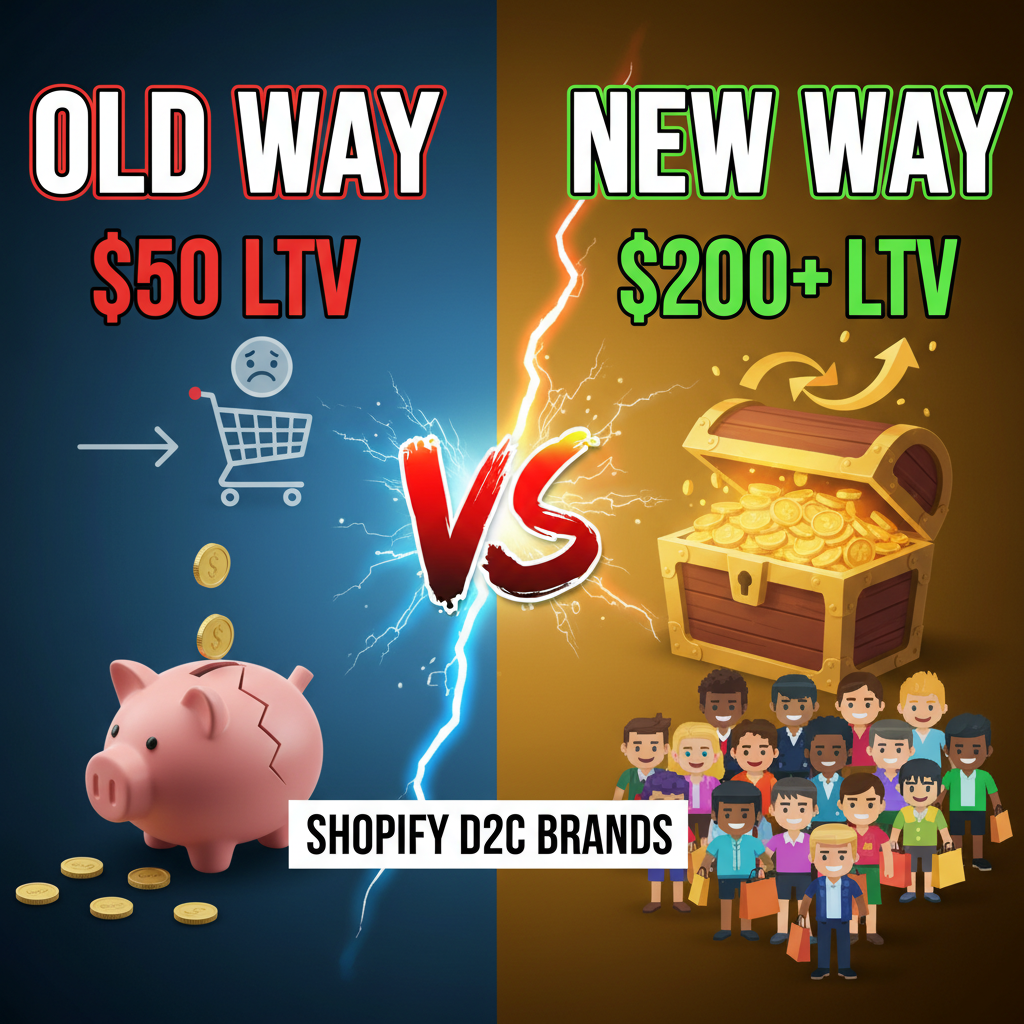
Data point from a $3M apparel brand: Implementing three-tier loyalty lifted repeat rate from 18% to 31%, AOV on repeat customers from $95 to $168 (that's +77%), and customer lifetime value from $280 to $520. That's a 85% increase in CLV from one program change.
Lever 4: Win Back Lapsed Customers (30-90 Days Silent)
A customer who hasn't ordered in 60 days isn't dead—they're just low priority. A win-back campaign targets these people with urgency and relevance.
Segmentation:
- 30-60 days silent: Send one email: "Hey [name]—we released [new product aligned to their purchase history]. Exclusive 20% for you inside."
- 60-90 days silent: Add SMS: "[Product name] is almost sold out. Last chance to grab it at 15% off."
- 90+ days silent: Final email + SMS: "You've been missed. Here's $25 off your next order—no minimum. Valid 7 days."
The conversion rate on win-back varies wildly (3-15%), but the ROI is insanely high because these are existing customers—your acquisition cost is already sunk, and you're just reactivating them at near-zero marginal cost.
Expected results: For a 5,000-customer base with 20% baseline repeat rate, targeting the 40% of customers in the 60-90 day silence bucket (2,000 people) yields 60-240 reactivations depending on product quality and timing. At average order value of $120, that's $7,200-$28,800 in recovered revenue.
Build the Tech Stack (Minimal Viable)
You don't need a CDP or fancy martech. Three tools can handle everything:
- Klaviyo ($20-$300/month): Email + SMS, behavioral triggers, segmentation. Post-purchase sequences + replenishment automation run here.
- Zapier ($19-$624/month): Connects Shopify order data to Slack/Airtable/Google Sheets for tracking, alerts, and manual workflows.
- Shopify Metafields (free): Store custom data on products (replenishment_days, tier_eligibility) and customers (loyalty_tier, last_purchase_date). Use Liquid to power dynamic content.
Advanced teams layer in Segment or Rudderstack for unified customer data, but that's overhead if you're under $5M revenue.
Common Retention Mistakes to Avoid
Mistake 1: Over-segmentation. You don't need 20 email segments. Build three: high-value repeat customers, first-time buyers, and lapsed customers. Optimize within those buckets.
Mistake 2: Ignoring SMS. SMS gets 99% open rates. Email gets 15-25%. If you're doing retention purely via email, you're losing money. SMS should be 30-40% of your retention mix.
Mistake 3: Loyalty programs without exclusivity. Points make people feel nickeled-and-dimed. Exclusive access (early drops, private sales, VIP experiences) feels premium and compounds retention by 2-3x.
Mistake 4: Not tracking repeat rate by cohort. You should know the repeat rate of customers acquired in March vs. August, from Google Ads vs. Instagram, by product category, etc. Cohort analysis reveals which acquisition channels actually produce repeaters—not just first-time buyers.
Mistake 5: Retention without product fit. If customers don't love your product, no email sequence saves you. Retention strategy only works if the product is legitimately repeatable. If your repeat rate is <15% across the board, fix product-market fit first.
Ready to Build Your Retention Engine?
Retention isn't a tactic—it's an architecture. Start with the highest-ROI lever for your business:
- If you're losing customers after first purchase: build the post-purchase experience first.
- If you have repeat-purchase products: implement replenishment logic immediately.
- If you have a mature customer base: layer in loyalty tiers and win-back campaigns.
Tenten helps DTC brands design and implement retention systems that compound over time. We've built cohort-based analytics, loyalty infrastructure, and automated win-back campaigns for founders doing $1M-$50M revenue. Let's talk about your retention challenge.
Editorial Note
Retention is the lever most DTC founders neglect because it's not sexy. Paid ads feel like growth. Email feels like operations. But retention is where compounding happens. A 2% improvement in repeat rate on a $2M store is $40K+ in incremental annual revenue, and it requires zero additional ad spend. The math wins. —Tenten Team
Frequently Asked Questions
What's the difference between retention and loyalty?
Retention measures whether customers buy again (yes/no). Loyalty measures how emotionally invested they are (exclusive access, community, belonging). Retention is the metric; loyalty is the mechanism. You can have high retention with low loyalty (transactional repeat purchases). The opposite (high loyalty, low retention) means customers love your brand but aren't buying. Build loyalty to drive retention.
How long does it take to see retention improvements?
Post-purchase sequences show lifts in 30-45 days. Replenishment logic takes 60-90 days (the replenishment window). Loyalty tiers take 90-120 days because tier benefits compound over time. Win-back campaigns show results in 7-14 days. Stack these and you'll see 20-40% retention improvement within 6 months.
What's a good repeat purchase rate for D2C?
Baseline for most e-commerce is 15-20%. Mature D2C brands (apparel, supplements, beauty) hit 35-50%. Luxury hits 30-45%. One-time-purchase categories (furniture, appliances) sit at 5-10%. If you're below 15%, your product or price point may not support repeats—or your post-purchase experience is broken. Benchmark against your category, not overall averages.
Can I run retention if I only have SMS, not email?
Yes. SMS outperforms email for replenishment and win-back. But you lose the ability to nurture with educational content (how-to guides, lookbooks, storytelling). Ideal: 60% SMS, 40% email. SMS for transactional/urgency, email for education/narrative.
How do I know if my retention investments are actually profitable?
Track LTV (lifetime value) by cohort over time. Compare customers acquired before vs. after you launched retention initiatives. Your repeat customers should have 2-3x higher LTV. Also calculate CAC payback: (acquisition cost) / (gross profit per customer). If CAC payback was 8 months before retention, and 4 months after, your retention is working. If it stayed flat, your retention program is overhead, not leverage.