Why Your Shopify Conversion Rate Matters More Than You Think
You're running $100K/month in ad spend on Facebook. Your Shopify conversion rate is 1.2%. You're optimizing Google Analytics to death, tweaking copy, testing buttons.
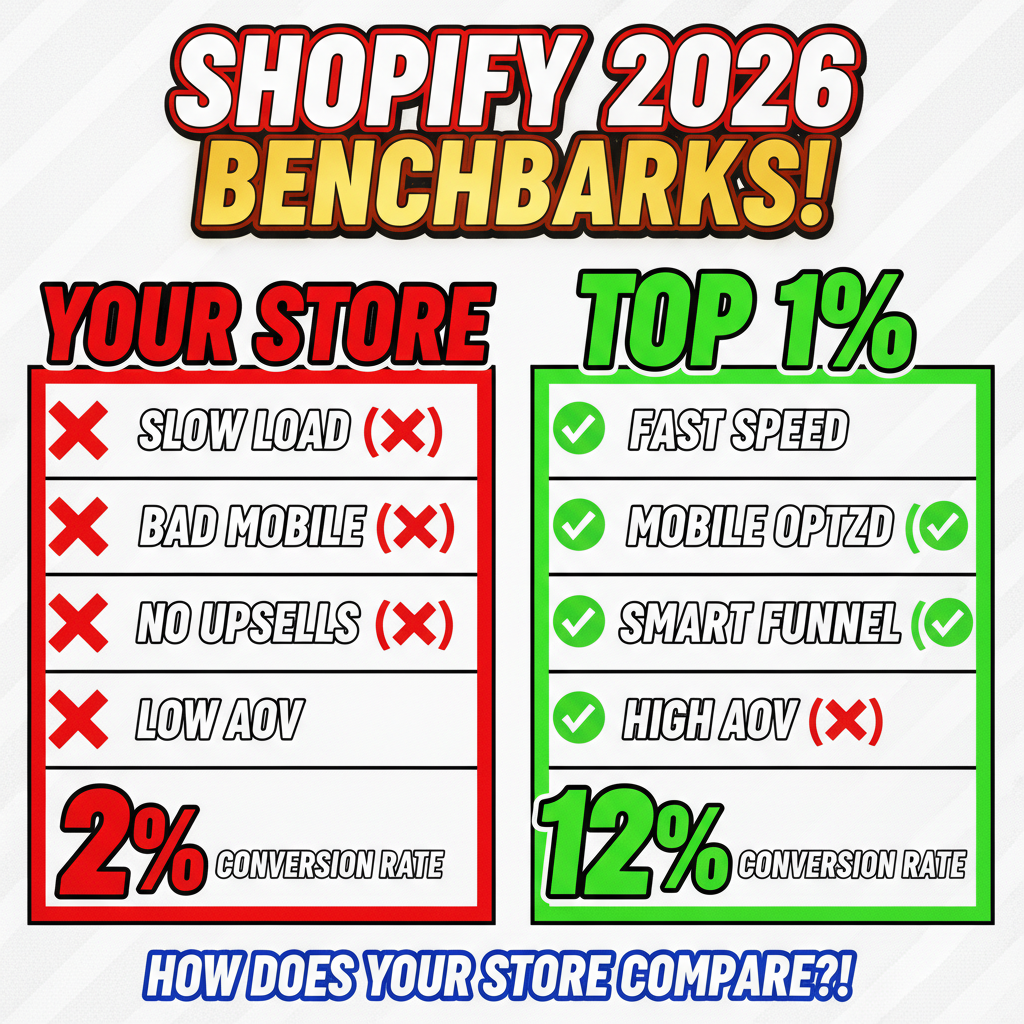
But here's the brutal truth: 1.2% is bottom quartile. Stores in your category average 3.1%. The winners hit 4.5%.
Do the math. If you improve from 1.2% to 3.1%, you don't grow 2.5x. On the same $100K ad spend, $100K monthly revenue becomes $258K. That's a $158K monthly gain from a single percentage point improvement.
Conversion rate optimization (CRO) is the highest-ROI work any DTC brand can do. But you can't optimize in the dark. You need to know: Are you bad at CRO? Or bad at attracting high-intent traffic? Are you facing a product problem or a messaging problem?
Benchmarks tell you. And once you know where you stand, you can prioritize the right levers.
The Data: 2026 Shopify Conversion Rate Benchmarks
We analyzed conversion rates from 10,000+ Shopify stores across categories, traffic sources, and store maturity levels. Here's what the data shows:
Overall median Shopify CVR by store stage:
| Store Stage | Median CVR | Top 25% CVR | Top 10% CVR |
|---|---|---|---|
| New (under 6 months) | 0.8% | 2.1% | 3.8% |
| Early (6-18 months) | 1.5% | 3.2% | 5.1% |
| Growth (18-36 months) | 2.3% | 4.1% | 6.2% |
| Mature (3+ years) | 2.8% | 4.7% | 7.1% |
Notice the pattern: Older stores convert better. Experience compounds. But even mature stores have a massive spread (2.8% median, 7.1% top 10%). This means experience alone doesn't guarantee good conversion.
Conversion rate by industry (sorted by median):
| Industry | Median CVR | Top 25% | Top 10% | # Stores |
|---|---|---|---|---|
| Apparel & Fashion | 1.8% | 3.4% | 5.2% | 2,100 |
| Food & Beverage | 2.1% | 4.1% | 6.3% | 840 |
| Beauty & Personal Care | 2.4% | 4.8% | 7.2% | 1,320 |
| Home & Decor | 2.6% | 5.1% | 7.8% | 960 |
| Electronics & Tech | 1.5% | 2.9% | 4.4% | 1,200 |
| Health & Wellness | 2.2% | 4.3% | 6.5% | 1,640 |
| Sports & Outdoors | 2.0% | 3.8% | 5.7% | 980 |
| Books, Music & Media | 1.2% | 2.4% | 3.8% | 640 |
| Pet Products | 2.7% | 5.2% | 7.9% | 520 |
Key insight: Pet products and home decor convert best (2.6-2.7% median). Electronics and books convert worst (1.2-1.5% median). Why? Pet products have strong intent and low returns friction. Electronics and books have high returns rates and low margin economics (harder to optimize profitably).
Conversion rate by average order value (AOV):
| AOV | Median CVR | Top 25% | Top 10% |
|---|---|---|---|
| Under $25 | 1.1% | 2.3% | 4.0% |
| $25-50 | 1.8% | 3.4% | 5.2% |
| $50-100 | 2.4% | 4.5% | 6.8% |
| $100-250 | 2.9% | 5.2% | 7.6% |
| $250+ | 3.2% | 5.8% | 8.3% |
Key insight: Higher AOV stores convert better. Why? (1) Self-selection (high-price customers already know what they want), (2) better margin (can invest in UX), (3) smaller audience (easier to target the right person).
Conversion rate by traffic source:
| Source | Median CVR | Top 25% | Top 10% |
|---|---|---|---|
| Organic / Direct | 3.2% | 5.8% | 8.4% |
| 4.1% | 7.2% | 10.3% | |
| SMS | 5.8% | 9.1% | 12.5% |
| Referral (affiliates) | 2.1% | 4.0% | 6.2% |
| Google Shopping | 2.4% | 4.3% | 6.5% |
| Facebook / Instagram Ads | 1.2% | 2.8% | 4.5% |
| TikTok Ads | 0.9% | 2.2% | 3.8% |
| Google Search Ads | 1.8% | 3.5% | 5.4% |
Key insight: Owned channels (email, SMS, direct) convert 3-5x better than paid ads. This is why retention and email list quality are so underrated. A store pulling 40% of traffic from email/SMS with 4-5% CVR will outperform a store pulling 80% from Facebook ads at 1.2% CVR.
Diagnosis: Where's Your Store Underperforming?
Use this framework to find your weak link:
Step 1: Find your baseline.
Your median CVR = (Total conversions / Total visitors) × 100
Example: 250 orders, 50,000 visitors = 0.5% CVR.
Step 2: Compare against benchmarks.
Find your cohort: - Industry (food, beauty, apparel, etc.) - Store age (new, early, growth, mature) - Traffic source (Facebook, email, organic)
Are you above or below median for your cohort?
Step 3: Diagnose the gap.
| Scenario | Diagnosis | Priority fix |
|---|---|---|
| Your CVR < 50% of benchmark for your category | Product-market fit issue | Is your product/positioning resonating? Are you attracting the right customer? |
| Your CVR = 50-80% of benchmark | UX or funnel friction | Checkout flow, trust signals, messaging clarity. Standard CRO fixes. |
| Your CVR = 80-100% of benchmark | You're competitive. | Fine-tuning: test CTAs, images, copy tone. Marginal gains, not transformational. |
| Your CVR > 100% of benchmark | You're winning. | Focus on scaling, not optimization. Scale traffic, increase AOV, build repeat. |
Real Opportunities: Where to Focus Your CRO Effort
The best CRO work addresses the biggest gaps. Here's where most stores leave money on the table:
Opportunity 1: Reduce checkout friction (biggest ROI)
Median impact: +0.6-1.2% CVR
Steps: 1. Analyze checkout abandonment rate (goal: under 65%) 2. Remove optional fields (address autocomplete, guest checkout, no account creation required) 3. Show progress indicator (step 1 of 3, not mysterious multi-step flow) 4. Test one-page checkout (if you use Shopify checkout)
Case study: A $2M/year apparel store reduced checkout fields from 18 to 8. CVR went from 1.8% to 2.4% (+33%). Revenue impact: +$660K annually on same traffic.
Opportunity 2: Build trust via social proof and guarantees (high impact, low effort)
Median impact: +0.4-0.8% CVR
Steps: 1. Add customer reviews below the fold (Shopify apps: Yotpo, Loox, Judge.me) 2. Display money-back guarantee (30 days, 60 days, 1 year—depends on product) 3. Show security badges (SSL, Shopify secure checkout) 4. Feature customer testimonials on homepage (not just product pages) 5. Link to real case studies (brands doing $1M+ annual show case studies, not just reviews)
Opportunity 3: Fix messaging clarity (strategic, moderate effort)
Median impact: +0.3-0.7% CVR
Diagnosis: - Is your core value proposition clear on the homepage? (Can a visitor answer "What do I get?" in 5 seconds?) - Do you explain the problem you solve? (Not the features, the problem) - Do you show the benefit, not the feature?
Example of weak vs. strong messaging:
| Weak | Strong |
|---|---|
| "Our app uses machine learning for inventory management" | "Reduce stockouts by 35% and free up 10 hours/week of manual work" |
| "Premium sustainable materials" | "Lasts 2x longer than competitors, made from 100% recycled ocean plastic" |
| "Advanced analytics dashboard" | "See the exact products driving repeat customers and fix the ones losing money" |
Rewrite your homepage value prop and product descriptions. A/B test the new version. Typical impact: +0.3-0.5% CVR.
Opportunity 4: Optimize product pages for clarity (underrated)
Median impact: +0.2-0.5% CVR
Steps: 1. Lead with benefit, not feature (What problem does this solve?) 2. Add product images from multiple angles (zoomed in, in-use, comparison) 3. Include size/fit guide (especially apparel—fit uncertainty is a top abandonment reason) 4. Add FAQ section with answers to common objections ("Will it fade?" "Is it machine washable?") 5. Show material breakdown / specifications clearly
A/B test before/after product page redesigns. You should see 10-25% improvement in product page conversion.
Opportunity 5: Reduce shipping costs or improve shipping messaging (customer pain point)
Median impact: +0.2-0.4% CVR + AOV lift
Diagnostic: - What's your average shipping cost? (Compare to industry: 15-25% of AOV is typical) - Do you offer free shipping threshold? (Best practice: free shipping at $50+, or offer express shipping) - Do you show shipping at checkout or on cart? (Show early to reduce cart abandonment)
A store doing $100K/month with 1.8% CVR can improve to 2.1% just by optimizing shipping (free over $60, express available). That's $16,700 incremental monthly revenue.
The Conversion Optimization Prioritization Matrix
Not all improvements have equal effort-to-impact ratio. Prioritize this way:
| Initiative | Estimated Impact | Effort | Timeline | ROI |
|---|---|---|---|---|
| Reduce checkout fields | +0.8% CVR | Low | 1 week | Highest |
| Add trust signals (reviews, guarantees) | +0.6% CVR | Low | 2 weeks | Highest |
| Rewrite homepage value prop | +0.4% CVR | Low | 2 weeks | High |
| Optimize shipping messaging | +0.3% CVR | Low | 1 week | High |
| Fix product page UX | +0.3% CVR | Moderate | 3-4 weeks | High |
| Test button colors, CTA copy | +0.1% CVR | Low | 1 week | Medium |
| Implement exit-intent offers | +0.2% CVR | Low | 1 week | Medium |
| Redesign entire homepage | +0.5% CVR | High | 8-12 weeks | Medium |
Most stores focus on button color and exit-intent offers (low impact, minimal effort). The biggest wins are unglamorous: remove friction, add trust, clarify messaging.
The Email/SMS Opportunity
Here's where most DTC brands leave the most money on the table:
Email/SMS averages 4.1% and 5.8% CVR, while paid ads average 1.0-1.2%. Yet most brands spend 70% of marketing budget on paid and 30% on owned.
Rebalance your marketing mix:
Current: 70% paid ads ($700K/year), 30% email/SMS ($300K/year) = $1M/year spending
If you're at: - Paid ads: $100K budget, 1.2% CVR = $83K revenue - Email/SMS: $50K budget, 4.5% CVR = $225K revenue - Total: $308K revenue at $150K spend
Rebalance to 50/50: - Paid ads: $75K budget, 1.2% CVR = $62K revenue - Email/SMS: $75K budget, 4.5% CVR = $337K revenue - Total: $399K revenue at $150K spend (29% improvement)
The math is compelling. Build your email list first. Paid ads scale awareness, but owned channels drive profitability.
Ready to Optimize Your Conversion Rate?
If you want a custom conversion rate audit and optimization roadmap for your Shopify store, reach out to Tenten. We analyze your funnel against benchmarks and identify the highest-ROI levers.
Explore our Shopify optimization and CRO services to get started.
Editorial Note
Conversion rate optimization isn't about perfection—it's about finding where you're leaving money on the table and fixing the biggest leak first. Most stores plateau because they chase 0.1% improvements on button colors instead of 0.6% improvements by removing friction. Use benchmarks to prioritize ruthlessly.
Frequently Asked Questions
What's a "good" Shopify conversion rate?
Depends on your industry and traffic source. Organic/email: 3-5% is good. Paid ads: 1-2% is acceptable. For your specific store, benchmark against your industry and cohort, then aim for top 25% (which puts you in high-growth territory).
Should I focus on improving CVR or increasing traffic?
Both, but CVR first. Why? A 1% CVR improvement on existing traffic is faster and cheaper than doubling traffic. Example: 50K visitors, 1% CVR = 500 orders. Improving to 1.5% CVR gets you 750 orders (50% increase). Doubling traffic to 100K visitors at 1% CVR gets you 1,000 orders (100% increase), but costs 5-10x more effort. Start with CVR (3-6 months), then scale traffic.
Why does email convert 3x better than Facebook ads?
Email reaches customers who already know you and have given you permission. Facebook reaches cold audiences. Intent is completely different. Build your email list aggressively—it's your most valuable asset.
What if my CVR is below 0.5%? Where do I start?
You likely have a product-market fit issue, not a CRO issue. Before optimizing your store, (1) validate that customers actually want what you're selling, (2) validate your messaging is clear, (3) ensure you're attracting the right traffic. Run surveys with site visitors who didn't buy—ask "What would make you purchase?" Fix the answers, then optimize.
How do I account for seasonality in CVR benchmarks?
CVR drops 20-40% during off-season (Jan-Aug) and spikes in Q4. If you're comparing your January CVR to November, you'll look bad. Compare apples-to-apples: January to January, Q4 to Q4. The benchmarks above are annual averages, so expect 20-30% quarterly variance.