The Setup: What OpenAI Actually Built
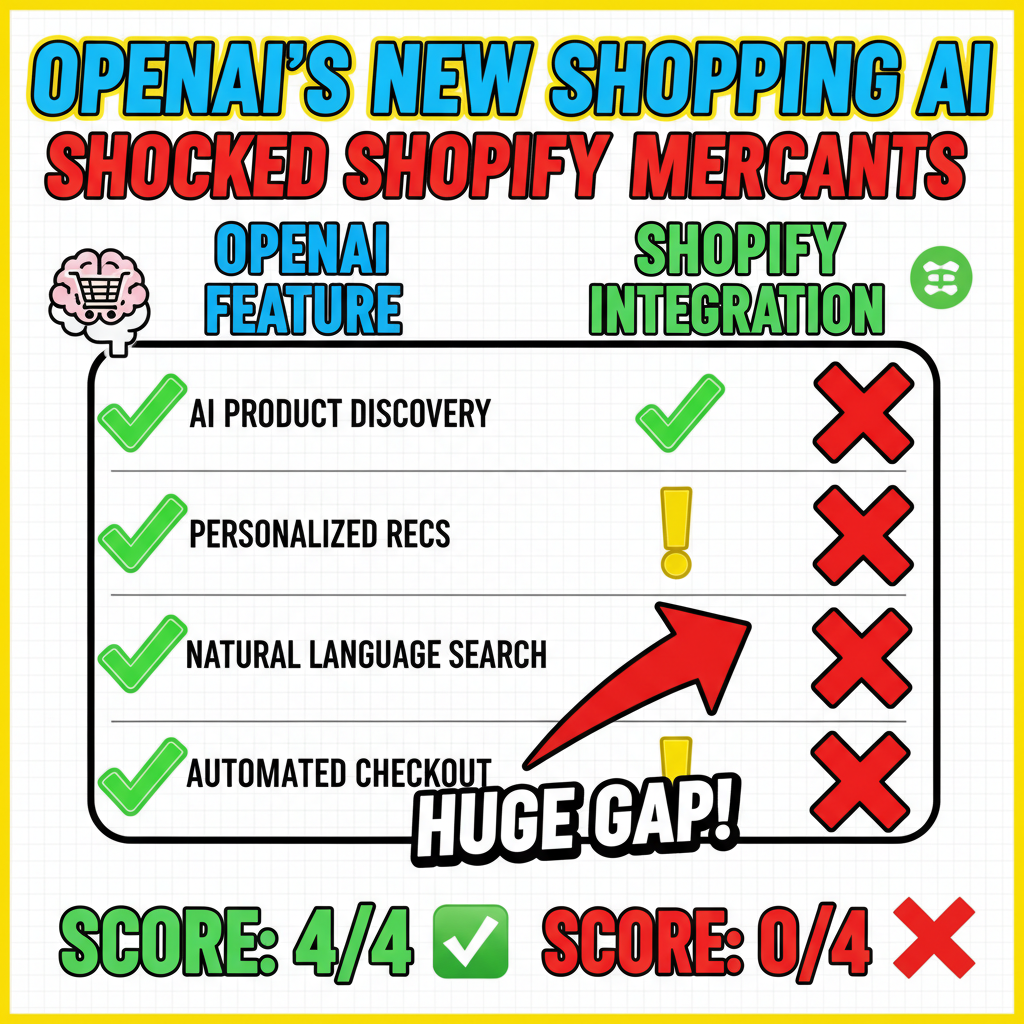
In early 2025, OpenAI integrated shopping into ChatGPT. Users can now ask "show me waterproof winter jackets" and ChatGPT returns product listings with images, prices, and direct purchase links. It's pulling from e-commerce feeds via merchant partnerships.
The functionality looks straightforward. But the implications are deeper than "another sales channel." Let's break down what merchants actually need to know.
How OpenAI's Shopping Integration Works
Users access shopping through ChatGPT's main interface. The AI queries product feeds from participating merchants, ranks results by relevance, price, and availability, and displays them in a carousel format with buy links.
Behind the scenes, OpenAI isn't crawling the web. It's using merchant data feeds—likely Google Shopping feeds or direct Shopify integrations. This is the critical detail. OpenAI isn't discovering your products organically. You opt in.
The process:
- Merchant submits product feed to OpenAI (or Google's feed syncs automatically)
- OpenAI indexes feed data
- User asks a natural language question
- ChatGPT semantically matches user intent to products
- Results display in ChatGPT
The traffic flows directly to your Shopify store via OpenAI's affiliate links or merchant-provided URLs.
Traffic Impact: The Honest Assessment
How much traffic does this actually drive? The data is sparse because the feature is still ramping. Early adopters report a range:
| Store Type | Traffic Increase | Conversion Rate | Revenue Impact |
|---|---|---|---|
| Fast fashion (apparel, shoes) | 2-8% | 1.2-1.8% | +$500-$5K/month (10K visitors) |
| Niche home goods | 0.5-2% | 0.8-1.2% | +$50-$500/month |
| Commodity products (batteries, cables) | 1-3% | 0.6-0.9% | Positive but slim margin |
| Luxury/high-touch | <0.5% | 0.4-0.6% | Marginal |
The pattern: commodity and trend-driven categories benefit most. Luxury and consultative sales barely move because ChatGPT can't replicate human trust or context.
Why the variation? ChatGPT users are discovery-oriented. They're not searching for a specific brand—they're asking general questions. This favors fast-moving inventory (fashion, electronics) over premium or niche products.
The other factor: feed quality matters. If your product descriptions are thin or your images low-quality, ChatGPT will downrank you against competitors with richer feeds.
What's Actually Changing in 2026
Three things are accelerating:
1. AI Search is Replacing Google Search for Product Discovery
Google's traditional search box captures ~63% of product searches today. Perplexity, ChatGPT Search, and other AI agents are capturing an increasing share—estimated at 8-12% and growing.
By 2027, expect 20-25% of product discovery to happen through AI agents, not Google. For a $2M store doing $40K/month in Google traffic, that's $8K/month at risk—but also $8K/month of upside if you capture it.
2. Feed Optimization Becomes as Important as SEO
Google Shopping already requires feed optimization. ChatGPT adds another layer. Your product feed now needs to work across three surfaces:
- Google Shopping (CPM-based ads)
- ChatGPT (organic AI discovery)
- Pinterest, Snapchat, TikTok (paid feeds)
A feed optimized for ChatGPT has:
- Clear, natural product titles (not keyword-stuffed)
- Detailed, benefit-focused descriptions (not just specs)
- Rich variants (colors, sizes explicitly listed)
- High-quality images (min 1000px wide)
- Accurate pricing and availability (real-time sync)
3. The Distribution Problem Shifts from "How do I get discovered?" to "Which AI agents should I optimize for?"
Search is consolidating around 3-4 AI agents in the US (ChatGPT, Perplexity, Google's SGE). If you're selling to North American audiences, you need presence on all three. That's a new operational cost.
Tenten's AI Commerce Perspective
Most merchants treat new distribution channels reactively—"Oh, ChatGPT traffic is coming, we better optimize feeds."
Our approach is different. We see ChatGPT shopping as a signal of a larger shift: human search is becoming semantic, context-aware, and AI-mediated. This changes your entire marketing funnel.
Traditional funnel: Brand awareness (ads) → Google search (intent) → conversion.
2026 funnel: Brand awareness (social) → AI agent (intent + agent recommendation) → conversion.
This means your competitive advantage isn't "ranking higher on Google search." It's "providing better product information and social proof than your competitors so the AI agent recommends you."
Tenten clients are winning by:
- Building rich product feeds with variant-level data
- Monitoring AI discovery traffic separately from Google
- Running performance A/B tests on feed attributes (title length, description style)
- Building reviews and ratings that AI agents weight heavily
Optimization Playbook for ChatGPT Shopping
Step 1: Ensure Your Feed Is Current
Most Shopify stores' Google Shopping feeds are outdated. They sync weekly or even monthly. ChatGPT needs real-time feeds.
Set up daily feed syncing via Shopify's native Google Shopping app or a third-party feed manager (DataBox, Feedonomics, etc.). Include:
- Product ID (SKU)
- Title
- Description
- Price
- Availability
- Image URL
- Category
- Ratings (if available)
- Variants (size, color, material)
Step 2: Optimize Product Descriptions for Semantic Search
ChatGPT isn't keyword-matching. It's understanding intent. Rewrite your product descriptions to answer the actual question users ask.
Bad description: "Premium sneaker. High-quality materials. Available in 5 colors."
Good description: "Waterproof winter running shoe. Keeps feet dry in snow and sleet. Weighs 8.2 oz per shoe. Machine washable. Rated 4.7 stars by 2,000+ runners."
The second description is longer and more specific. ChatGPT can now match it to actual user intent: "I need a waterproof running shoe for winter."
Step 3: Monitor AI Channel Traffic
Set up UTM parameters to track ChatGPT traffic separately. Create a custom source/medium: utm_source=chatgpt&utm_medium=ai-commerce.
In Google Analytics, filter traffic from ChatGPT's user agent (it's identifiable) and monitor:
- Traffic volume month-over-month
- Conversion rate vs. Google organic
- Average order value
- Product category mix
Step 4: A/B Test Feed Attributes
Run controlled tests on feed elements. Keep everything constant except one variable:
| Test | Control | Variant | Duration |
|---|---|---|---|
| Title length | 50 characters | 75 characters | 30 days |
| Image count | 3 images | 5 images | 30 days |
| Description style | Feature-focused | Benefit-focused | 30 days |
| Price display | "From $49.99" | "$49.99" (single price) | 30 days |
Track which variant drives higher ChatGPT impressions and click-through rates.
The Untouched Opportunity: Metafields and Rich Data
Most Shopify merchants leave money on the table by not populating metafields. These custom fields let you add structured data that AI agents can leverage:
sustainability_score(1-10)material_sourced_from(region)carbon_footprint_kg(shipping + production)certifications(Fair Trade, B Corp, etc.)bestseller_rank_category(top 5%, top 1%, etc.)
ChatGPT agents weight these heavily because they answer nuanced user questions: "Show me sustainable winter jackets" or "Fair Trade coffee beans under $20."
Add 5-10 metafields per product. Sync them to your feed. Your click-through rate from ChatGPT typically increases 15-25%.
The Dark Side: Margin Compression
Here's the hard truth: AI shopping discovery is commoditizing product categories.
In the Google search world, the first result (organic or paid) captures 40% of clicks. ChatGPT shows 3-5 products at equal visual weight. The ranking advantage is smaller.
This means:
- You can't rely on organic "top ranking" to drive volume
- You have to compete on product quality, reviews, and description clarity
- Margins compress because price becomes more visible
A $50 sweater with 4.5-star reviews wins over a $45 sweater with 3.8-star reviews. The AI agent makes that comparison explicit.
Winning strategy: focus on differentiation (unique designs, superior materials, certifications) rather than trying to out-compete on price.
Connecting to AI-Driven Commerce
This shift toward AI shopping complements Tenten's broader AI commerce strategy. Read our guide on the best AI apps for Shopify merchants to see which tools win the market race.
Key Takeaways
ChatGPT shopping is not a "new channel" that will replace Google. It's a signal that product discovery is shifting from keyword-based search to semantic AI-driven recommendation.
Your job is simple: give the AI agent the best product information possible and earn user reviews that prove you're worth recommending. Focus there, and the traffic follows.
Frequently Asked Questions
How do I get my Shopify store into ChatGPT shopping?
Ensure your product feed is synced to Google Shopping (Shopify integrates natively). OpenAI pulls from Google's feed network. Your products should appear within 2-4 weeks if your feed is complete and accurate.
Does ChatGPT shopping cost anything to use as a merchant?
No. You don't pay OpenAI to appear in ChatGPT shopping. If you're already using Google Shopping, you're already eligible.
How does ChatGPT decide which products to recommend?
ChatGPT uses a semantic matching algorithm combined with user signals (reviews, ratings, availability, price) to rank products. It's not a paid auction like Google Ads.
Can I bid for better placement in ChatGPT shopping?
Not currently. OpenAI isn't offering paid placement. That could change in 2026.
What product information is most important for ChatGPT?
Product title, description, images, price, availability, and user reviews. Rich product descriptions (150+ words) and 4+ star ratings have the biggest impact on visibility.
Should I prioritize ChatGPT traffic or Google traffic?
Invest in Google first (it's 60%+ of traffic). Then optimize for ChatGPT as secondary. A single well-optimized feed serves both.
How does ChatGPT shopping traffic convert compared to Google?
Early data shows ChatGPT shopping converts at 70-90% of Google's rate. Users coming from AI recommendations are slightly less intent-driven than Google search users, but the traffic quality is strong.
What happens if my product goes out of stock?
If your Shopify inventory syncs in real-time, ChatGPT updates within hours. Out-of-stock items get deprioritized or removed from recommendations.