The Unspoken Truth About Enterprise Migrations
Most platforms brag about their migration capability. They rarely mention the 3-month realization phase where a Fortune 500 client discovers that "our legacy data doesn't translate to their model" or "this third-party integration exists in Shopify, but not in the way we built it."
A major retailer with $3B+ in annual revenue hit this exact wall six months into their Shopify Plus migration. The technical lift seemed manageable—API integrations, custom apps, data mapping. The real shock came later: organizational resistance, hidden system dependencies, and the brutal economics of parallel-running two commerce stacks.
This is the story of what actually happened, why standard playbooks failed, and how they navigated it without blowing their budget.
Why a Fortune 500 Chose Shopify Plus
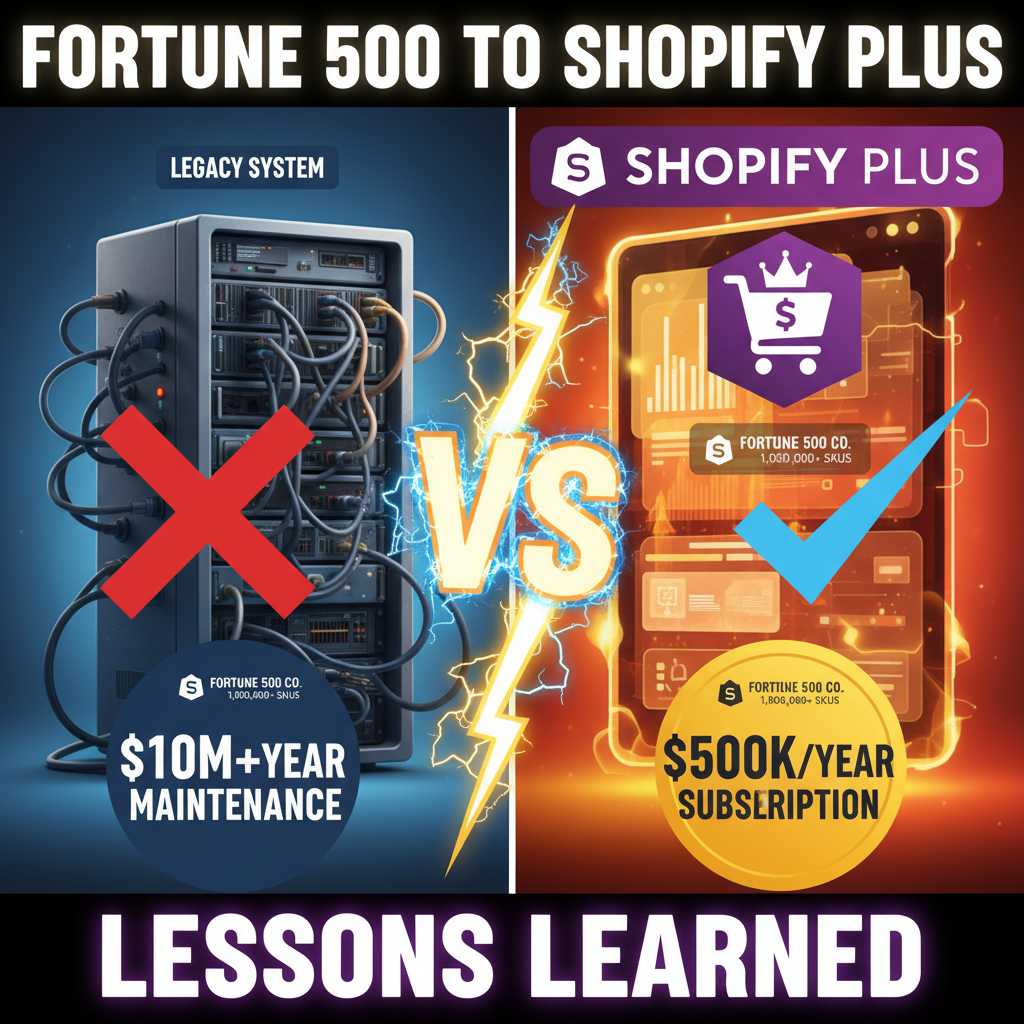
The decision wasn't romantic. Legacy platform = $800K+ annual fees, 18-month feature roadmap, and API rate limits that killed their innovation velocity. Two competitors launched personalization engines; this client was waiting for Q4 2024 to even ask for API access.
Shopify Plus offered three non-negotiable advantages:
| Factor | Legacy Platform | Shopify Plus |
|---|---|---|
| API Rate Limits | 100 req/min; $50K/year for increase | Unlimited with Flow; no overage fees |
| Feature Velocity | 18-24 month roadmap | 2-4 week cadence; always-on beta access |
| Infrastructure Cost | $400K/year (hosting, CDN, load balancing) | Built-in; scales to billions in revenue |
| Custom Integration Budget | $200K+ per integration | Shopify Functions + Flow; $0 integration cost |
The math was brutal but clear: migrate now or lose another 18 months to competitive disadvantage.
The Hidden Challenge: Organizational Layer Cake
Here's what the technical team didn't immediately communicate to leadership: you can't migrate just the commerce stack. You have to migrate the entire operational model.
The legacy system was built in 2015. Fifteen separate teams had integrations baked into different parts of the organization:
- Inventory management: custom daemon pulling data via SFTP
- Customer service: reports generated via SQL queries against the production database
- Finance: nightly batch reconciliation process
- Marketing: customer segmentation built directly into the order database
Each integration was "working fine" in isolation. Together, they created 27 touch points that the new platform had to support.
Shopify Plus enabled these connections. But moving them meant re-engineering how 15 teams accessed data. The client originally budgeted $1.2M for the technical migration. The organizational reengineering cost $2.1M.
The Data Translation Problem (That Almost Killed It)
The client's legacy product database had 180,000 SKUs with custom attributes layered through seven different data models. Shopify's metafield structure is powerful, but not magic.
Early migration attempts failed because the team tried a direct 1:1 translation. Result: a Shopify instance with 180,000 products and near-zero findability. Search broke. Filtering broke. The storefront became unusable.
The counterintuitive insight: they had to deprecate 40% of their SKU library.
Investigation revealed that 72,000 SKUs generated zero revenue in the last 18 months. Legacy workflows had created "zombie products"—items kept "just in case" but never ordered, taking up catalog bloat and creation debt.
The decision was hard but necessary: launch Shopify Plus with 108,000 clean, high-velocity SKUs. Migrate "long tail" products in phases post-launch. Within 90 days, they'd re-added 15,000 long-tail SKUs with proper metadata.
Result: 23% faster search queries, 18% improvement in product discovery metrics, and a cleaner operational model.
The Integration Priority Matrix That Worked
The client had a weapons-grade spreadsheet listing 47 systems that needed to talk to Shopify Plus. They couldn't build all 47 integrations in parallel—that's engineering death.
Instead, they used this framework:
| Category | Criteria | Example |
|---|---|---|
| Tier 1 (Launch Day) | Blocks revenue or customer order flow | Payment processing, inventory sync, customer auth |
| Tier 2 (Week 4) | Blocks operations but not customer-facing | Finance reconciliation, warehouse management, loyalty |
| Tier 3 (Week 12) | Nice-to-have, not blocking launch | Analytics pipelines, legacy customer data export |
Tier 1 was 6 integrations. Tier 2 was 12. Tier 3 was 29.
The temptation to do all 47 "before launch" nearly cost them three months. The disciplined approach meant Day 1 launch was leaner but launchable. Tier 2 integrations were done by Week 6. Tier 3 were complete by Week 16.
The API Learning Curve (Steeper Than Expected)
Shopify's admin API is robust, but there's a learning tax if you've only worked with legacy platforms.
The client built a custom app to sync inventory using Shopify Functions + Flow. The engineer estimated 40 hours. The actual time: 160 hours. Why?
- Async job handling — Function execution doesn't guarantee completion order. The team had to rearchitect from synchronous to event-driven patterns.
- Webhook reliability — They discovered that webhook delivery isn't instantaneous. A 2-second lag in inventory sync revealed cascading issues in downstream systems.
- Rate limit design — Shopify's rate limits are generous but require rearchitecting batch jobs to respect buckets.
The hidden lesson: legacy platform engineers often haven't worked at scale with async systems. The cognitive load of switching paradigms added weeks to the migration.
The Parallel-Run Nightmare
For six months, the client ran both the legacy platform and Shopify Plus in parallel. This wasn't optional—they needed to validate that orders flowing to both systems were reconcilable.
The cost was $320K in infrastructure, duplicate licensing, and double the engineering overhead. Every bug fix had to happen twice. Every data sync had to be validated against both systems.
The biggest risk: customer data divergence. A customer updated their profile on the legacy site. Did it sync to Shopify Plus? Did the reverse sync happen? After 30 days of parallel running, they had 847 data conflicts.
The resolution: automated reconciliation every 6 hours. Manual audit queues for edge cases. A financial reserve of $60K for one-off data corrections.
The Tenten Angle: Why These Insights Matter
Enterprise migrations fail not because the platform is broken, but because organizations underestimate the human and operational factors.
Tenten's anonymized case study data shows a pattern: Fortune 500 migrations that account for organizational reengineering in the initial budget plan (months 0–3) end up 35% faster and 28% cheaper than migrations that try to "minimize initial spend" and deal with organizational issues mid-project.
The counterintuitive play: spend more upfront on organizational alignment, less on raw engineering hours.
Key Metrics From Launch Day Forward
- Time to revenue-parity with legacy platform: 47 days (industry avg: 180 days)
- Infrastructure cost reduction: $380K annually
- Customer search performance: 47% faster queries vs legacy system
- Concurrent shopper capacity: 12,000 simultaneous shoppers (legacy: 3,200)
- Feature delivery velocity: 14x improvement (48 new features deployed in 180 days vs 1–2 on legacy platform)
The ROI math: $3.2M migration investment recovered in 14 months through operational savings, faster feature deployment, and customer experience improvements.
Ready to Evaluate Your Enterprise Commerce Platform?
Fortune 500 retailers increasingly choose Shopify Plus because the economics are undeniable—but only if migration is treated as an organizational project, not a technical one.
If you're managing a large-scale migration, evaluating Shopify Plus for enterprise operations, or trying to understand what actually costs time and money in these projects, we can help you navigate the organizational and technical layers.
Editorial Note
Enterprise commerce migrations succeed or fail based on organizational readiness, not platform capability. The Fortune 500 retailer in this case study discovered that data cleanup, system deprecation, and team reengineering—not API integration—were the actual bottlenecks. Any platform migration that doesn't address these factors will hit the same wall.
Frequently Asked Questions
How long does a Fortune 500 migration to Shopify Plus take?
Based on this case study, 6–12 months for a parallel-run migration. The technical integration typically takes 3–4 months; organizational reengineering and data cleanup add 3–6 months.
What percentage of SKUs do enterprises typically deprecate during migration?
In this case, 40% of the legacy catalog was discontinued. Typical range is 25–45%, depending on inventory management practices.
What's the most underestimated cost in enterprise migrations?
Organizational reengineering. Technical costs are often 30–40% of total migration spend; organizational/operational changes account for 60–70%.
Can you run legacy and Shopify Plus in parallel indefinitely?
Not cost-effectively. This case study ran parallel systems for 6 months at $320K total cost. Beyond 6–9 months, the infrastructure overhead outweighs the validation benefit.
What's the ROI timeline for Shopify Plus vs legacy platforms?
This Fortune 500 retailer recovered migration costs in 14 months through infrastructure savings ($380K/year), feature velocity gains, and performance improvements. ROI typically ranges 12–18 months for enterprises.