The Ground Is Shifting Under Your Feet
It's April 2026. If you're running an e-commerce operation—whether you're bootstrapped at $100K MRR or managing $50M in annual revenue—you've already felt it. Customer acquisition costs keep rising. Conversion rates plateau despite better targeting. Loyalty programs work less reliably. The channels that made you money three years ago are getting crowded and expensive.
What you're sensing isn't random noise. It's the sound of five structural shifts converging. By 2027, your competitive position will depend on preparing for these moves now.
This isn't a list of nice-to-haves. This is what's coming to your business whether you plan for it or not.
Prediction 1: AI Agents Will Own the Purchase Decision (15% of Volume by 2027)
The first prediction is the boldest: autonomous AI shopping agents will drive 15% of U.S. e-commerce volume by the end of 2027. Not "AI-assisted"—not recommendations or chatbots. Agents that make the actual purchase decision.
Here's the mechanism. OpenAI, Google, Anthropic, and Amazon are all shipping agentic systems optimized for commerce. These aren't API experiments. They're shipping to millions of users. A customer tells their AI agent: "I need running shoes for a half-marathon in six weeks. I care about cushioning, not weight. Budget is under $200."
The agent: searches across retailers, reads reviews, checks inventory, compares features, runs the decision tree through learned patterns about that customer's past behavior, and either recommends three options or—in the most advanced versions—completes the purchase directly.
Why this matters: Merchants who can't surface product data to these agents will become invisible. You need structured product feeds (Schema.org, API-readable specs, real-time inventory). Your product detail page copy needs to answer the exact questions agents ask. Traditional SEO—ranking for "running shoes"—becomes a secondary channel.
What $150B in GMV through agents means for you: If agents capture 15% of e-commerce, and 2027 U.S. e-commerce hits $1T, that's $150B routed through systems you don't control. Your top 10 customers might disappear overnight if an agent-platform decides to shift volume to a competitor with better data structure.
Action required NOW: - Audit your product data structure. Can you feed Google Shopping, Product Schema, and API clients full specs (materials, dimensions, performance metrics)? - Rewrite product descriptions from customer-speak ("looks great in any room") to agent-comprehensible specs ("polycarbonate enclosure, 92 dB SPL, compatible with USB-C and 3.5mm"). - Test your product data in agent systems. Anthropic's API is available. Build and test a bot that "shops" your store.
Related: AI Disruption in the E-commerce Value Chain
Prediction 2: Social Commerce Will Reach $80B+ in U.S. Alone, With TikTok Shop as #3 Marketplace
Social commerce will stop being a growth channel and become the growth channel. TikTok Shop will pass eBay to become the #3 marketplace in the U.S. by GMV.
Let's ground this in data: - 2025 social commerce in the U.S.: ~$60B - 2026 growth projection: +18–22% - 2027 forecast: $80–95B - TikTok Shop entering the U.S. hard in 2025, projected $15–20B GMV by 2027
Why TikTok? Three reasons. First: TikTok's supply-side economics make seller onboarding frictionless. Second: commission structures beat Amazon (Amazon takes 15%; TikTok takes 5–10%). Third: the algo works. TikTok users spend 95 minutes per day on the platform. They don't leave to shop—they shop while they're there.
But TikTok is only part of it. Instagram Reels, YouTube Shorts, BeReal, and Pinterest are all building native checkout. By 2027, users will buy without ever leaving the social feed.
Bigger picture: This isn't about running TikTok ads anymore. This is about building a catalog-first, content-second distribution model. A brand that can't make a product go viral on TikTok Shop will lose share to one that can.
Three data points: - Live shopping on TikTok is up 300% YoY in 2025 - Average conversion rate on TikTok Shop is 8–12% (vs. 2–3% on traditional e-commerce) - Brands doing $5M+ annual TikTok Shop revenue report 40% lower CAC than paid ads
Action required NOW: - Onboard to TikTok Shop if you haven't. Verify your account now (it'll take 2–4 weeks). - Hire or partner with someone who can produce short-form content 3–5x per week. This is mandatory, not optional. - Build a TikTok-native SKU strategy. Which 20% of products will perform best on short-form video? Prioritize those. - Set up inventory sync between TikTok Shop and your primary fulfillment. Stock outs kill your algorithm ranking.
Related: Social Commerce 2026: From Trend to Survival
Prediction 3: Sustainability Regulation Will Force Operational Redesign
The EU Digital Product Passport (DPP) regulation goes into effect in 2026. It requires brands to disclose the environmental impact of every product sold—from sourcing to disposal. Companies not in compliance face fines of 5–10% of global revenue.
The U.S. won't be far behind. California is already drafting similar rules. The FTC is signaling stronger enforcement on "greenwashing" claims.
Here's what this means operationally: - You need to track (or source from suppliers) the carbon footprint of every product. - You need to disclose product lifespan, repair accessibility, recyclability, and end-of-life disposal. - You need to be ready to prove these claims with supply chain data. - Product pages will need to display this data prominently.
Market impact: Brands that build carbon transparency into their supply chain now will have a 2-3 year competitive advantage. Brands caught scrambling in 2026 will face massive operational cost spikes.
Subscription shift: Sustainability regulation is also accelerating the shift to subscription and circular commerce models. Instead of selling a product once, brands rent or resell it. This model is 2x more profitable per customer lifecycle and 70% more efficient from a sustainability standpoint.
Data: 35% of D2C revenue will come from subscription models by 2027 (up from 18% in 2024). Luxury and apparel brands are leading here, but the pattern will spread.
Action required NOW: - Map your supply chain end-to-end. Where is carbon data missing? Start conversations with suppliers now. - Pilot carbon labeling on your top 20 SKUs. Get feedback from customers. - Explore circular revenue models: product rentals, take-back programs, refurbished resale. These will be competitive necessities, not differentiators, by 2027. - Budget for supply chain data infrastructure. This isn't cheap, but it's cheaper now than in 2026.
Prediction 4: Headless Commerce Will Move From 15% to 40% of Top 1,000 Stores
Headless commerce isn't a trend anymore. By 2027, 40% of the top 1,000 e-commerce stores will run on headless or composable commerce architecture (up from ~15% today). The $2.3B headless commerce market will grow to $5B+.
Why? Monolithic platforms (traditional Shopify, WooCommerce, Magento) can't move fast enough. A brand that wants to push a social commerce experience, an AI agent integration, a voice shopping feature, and a customized checkout—all simultaneously—needs to decouple the frontend from the commerce core.
Headless lets you do this. You control the storefront(s). The payment processor, inventory, and CRM are plugged in via APIs. You can ship new features weekly instead of quarterly.
Financial impact: Brands that move to headless report: - 35% reduction in time-to-market for new features - 25% improvement in conversion rate (custom UX optimization) - 45% reduction in tech debt (no forced upgrades, old code doesn't accrue)
Adoption curve: Top 500 brands → 60% headless by 2027. Top 1,000 brands → 40% headless. Mid-market (100–1,000 employees) → 20%. SMBs → <5% (still too expensive and operationally complex).
The skill gap: This is the hard part. Headless requires stronger engineering. You need a team that can manage multiple third-party integrations, orchestrate APIs, and handle deployment pipelines. This is why many brands are moving to composable commerce platforms (BigCommerce Enterprise, Shopify Plus Hydrogen, or best-of-breed stacks like Contentful + Stripe + Klaviyo).
Action required NOW: - If you're top 500 by GMV: evaluate your headless roadmap. Start small (checkout or PDP first). Hire or partner with headless-native shops like Tenten. - If you're top 500–10K by GMV: stay on Shopify Plus or WooCommerce. The headless complexity-to-benefit ratio isn't there yet. But stay monitoring. - Build API literacy in your product team. The future is API-first, not UI-first.
Prediction 5: Voice Commerce Will Hit $15B+ GMV, Driven by Reordering and Subscriptions
Voice commerce has been "the future" for five years. In 2027, it finally becomes present.
The shift: voice commerce won't win on impulse purchases (you're not buying a new sofa by speaking into Alexa). But reordering? Voice is dominant. "Alexa, reorder my regular coffee" or "Alexa, increase my protein powder to 2x per month."
Market size: Voice-driven e-commerce hits $12–18B by 2027. Amazon controls 70% of this (Echo, Alexa). Google and Apple split the rest.
Real usage: Consumers place voice orders primarily in these categories: - Recurring consumables (coffee, dog food, vitamins, paper products): 55% of voice orders - Smart home supplies (bulbs, batteries): 25% - Food and beverage: 15% - Everything else: <5%
What this requires from merchants: - Your products must be in Alexa Shopping (Amazon's voice commerce network). Verify your ASINs now. - Subscription products outperform one-time buys by 8:1 in voice commerce. - Reorder buttons and smart replenishment logic (AI predicts when you'll run out) are table stakes by 2027.
Why this matters: Voice reduces friction to near-zero for existing customers. Repeat customer acquisition cost drops by 70% when you move someone to voice-enabled reordering.
Action required NOW: - Audit your subscription strategy. Which products should you move to auto-replenishment? - Ensure full product data in Amazon's Alexa Shopping feed. - Build or integrate smart replenishment logic. This is where you win—predicting when a customer needs to reorder.
Three Things NOT Happening (But You Probably Think They Are)
Before we close, let's address the false predictions:
Metaverse Commerce: Dead. VR headset adoption is stalling (Meta's losing billions on this). Virtual shopping will remain a novelty through 2027. Ignore this entirely unless you're selling to Gen Z fashion brands (and even then, focus on real social commerce first).
Crypto and NFTs: Not E-commerce. Yes, blockchain networks will see transaction growth. But commerce (goods + shipping + customer service + returns) isn't happening at scale on blockchain. Don't allocate budget here.
Live Shopping Replacing Traditional Checkout: Unlikely. Live streaming is growing (TikTok, Instagram), but it's an acquisition channel, not a replacement for checkout. By 2027, live will be 8–12% of total social commerce GMV, not 50%+.
The Operational Shift: What You're Actually Preparing For
These five predictions aren't independent. They're symptoms of one larger shift: e-commerce is moving from channel-centric to customer-centric.
For 30 years, you built for the channel: Google Search, Facebook Ads, Shopify store, Amazon marketplace. You optimized for discovery on that channel's terms.
By 2027, the channel becomes invisible. Customers interact with systems—AI agents, social feeds, voice assistants, regulatory systems—that route them to your products based on fit, not brand awareness. Your job is to optimize for discovery within those systems.
Here's the operational implication:
| Driver | Today (2025) | 2027 |
|---|---|---|
| Data Structure | Spreadsheets, basic product feeds | Real-time APIs, structured product intelligence |
| Content Creation | Long-form SEO blog, paid ads | Short-form video, agent-friendly specs, compliance docs |
| Fulfillment | Centralized warehouses | Distributed inventory, local fulfillment, rental/circular models |
| Team Skills | Marketing, customer service, operations | Engineering, data science, compliance, supply chain |
| Competitive Advantage | Brand strength, paid spend | Product data quality, agile operations, regulatory compliance |
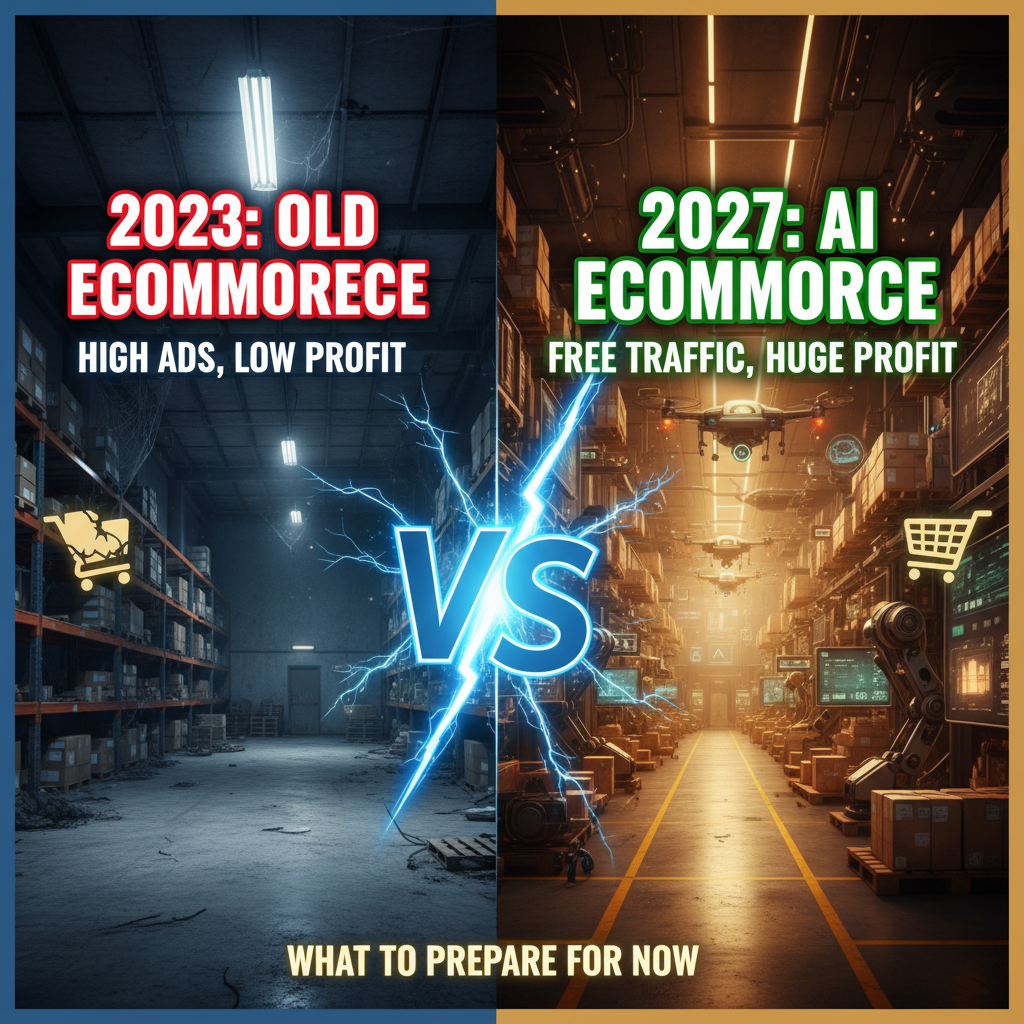
The brands winning in 2027 will be the ones rebuilding today.
FAQ
Q: How do I know if my business is big enough to need headless commerce? A: Rule of thumb: if you're doing under $5M annual revenue, stay on Shopify or WooCommerce. If you're $5–50M, evaluate headless but don't rush. If you're over $50M, you should already be planning or executing a headless migration.
Q: My products don't fit the AI agent buying decision model. Should I ignore this? A: No. Even if agents don't drive direct purchases, they drive discovery and influence traditional searches. Ensure your product data is agent-readable anyway. The cost is minimal; the upside is substantial.
Q: How long until sustainability regulation actually affects my business? A: If you sell in the EU, immediately (DPP goes live in 2026). If you're U.S.-only, you have until 2028–2029 for comparable regulation to land. But supply chain transparency is becoming a customer expectation, not just regulatory requirement.
Q: Should I build or buy voice reorder functionality? A: Buy, for now. Shopify has subscription apps. Amazon's Alexa Shopping API handles the integration. Building from scratch costs more than licensing existing solutions.
Q: My category doesn't work on TikTok. What do I do? A: Question that assumption. B2B software, heavy machinery, and industrial supplies don't perform well. But most consumer products do. If your analysis is accurate, allocate your resources to Instagram Reels and YouTube Shorts (older audiences, lower CAC). But test TikTok anyway—the upside is worth the experiment cost.
What To Do Monday Morning
This isn't theoretical. Here's your action plan for next week:
-
Audit product data. Spend one day mapping what data you have vs. what AI agents and social commerce platforms require. Document the gaps.
-
Onboard to one new platform. TikTok Shop or Alexa Shopping. Pick the one that matches your product category best. Get your catalog live in 30 days.
-
Hire one contractor. A short-form video producer. One person, part-time, can generate 4–5 pieces of content per week. This is non-negotiable for social commerce.
-
Start supply chain mapping. Schedule calls with your top 5 suppliers. Ask them about carbon footprint data and transparency standards. This isn't optional by 2027.
-
Explore headless platforms. Even if you're not moving yet, get familiar with Hydrogen, Medusa, or Take. Understand the trade-offs.
The next 18 months will determine whether you're leading or following in 2027. The brands that move now will have options. The ones that wait will be in crisis mode.