What Composable Commerce Actually Means
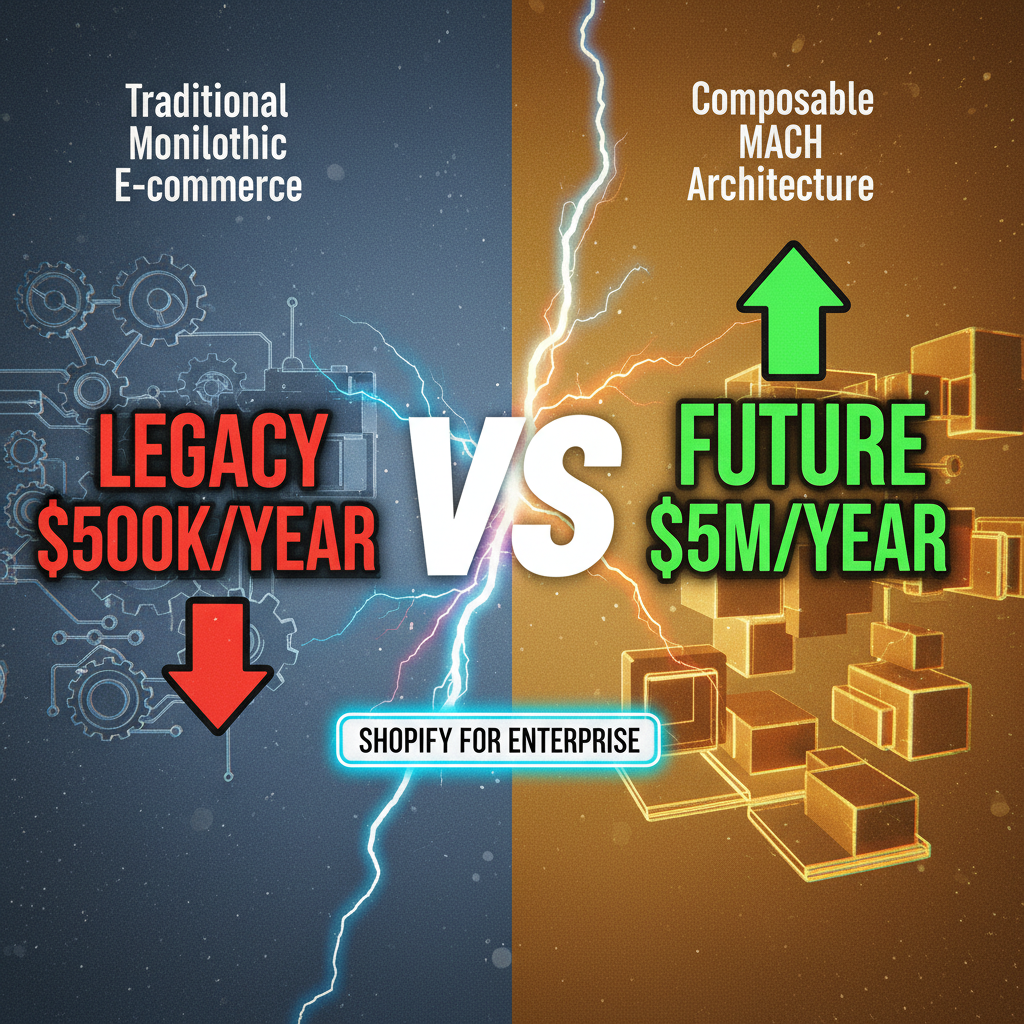
Composable commerce sounds like enterprise jargon, but it's solving a real problem: monolithic e-commerce platforms are rigid.
Here's the problem: You build your store on Shopify. You need a custom recommendation engine. You integrate an app. That app breaks during your peak sales day. Your entire checkout goes down because you're running a tightly coupled system where one broken component crashes the whole thing.
Composable commerce flips this. You pick best-of-breed point solutions for each layer: Shopify for the core commerce engine, separate microservices for recommendations, search, personalization, payments. They communicate via APIs. If the recommendation service goes down, your checkout still works. Your store is resilient by architecture.
MACH is the framework: Microservices, APIs, Cloud-native, Headless.
- Microservices: Each function (search, recommendations, inventory, payments) runs independently
- APIs: Services talk to each other through well-defined APIs, not database queries
- Cloud-native: Services run on scalable cloud infrastructure (AWS, GCP, Azure), not dedicated servers
- Headless: Your storefront is decoupled from the commerce backend
This isn't theoretical. Nike, Adidas, and Luxury brands use this. They run Shopify Plus or custom commerce backends with Hydrogen frontends, microservice recommendations, CDP integrations, and headless checkout.
Why Shopify Fits (and Doesn't) in MACH
Shopify is excellent at being the commerce backbone but less flexible as the headless frontend layer. This matters.
Shopify's role in MACH: - Commerce engine: Order management, inventory, fulfillment, customer accounts—world-class - Storefront API: Excellent GraphQL API for custom frontends (Hydrogen, Next.js, Nuxt) - Webhook system: Your store can trigger events to external services when products are created, inventory changes, orders are placed
What Shopify can't do: - Run custom recommendation algorithms in real-time (need a third-party CDP like Segment or mParticle) - Handle true A/B testing at scale (use a dedicated service like Convert or Optimizely) - Manage complex customer data unification (need a CDP to aggregate first-party data from 10+ sources)
The operator's take: Shopify Plus is 80% of what you need for composable commerce. You'll layer on 2-3 specialized services (recommendations, CDP, experimentation platform). That's the MACH stack.
For comparison: A Nike-scale operation might use Salesforce Commerce Cloud as the core (not Shopify), Oracle Recommendation Engine, Salesforce DMP (CDP), and a custom Nuxt storefront. Budget: $500K+/year in software. For brands under $50M revenue, Shopify Plus + 2-3 specialized services is 90% as good at 20% of the cost.
Microservices in Action: The Recommendation Layer
Let's make this concrete. You're a $10M athletic apparel brand. You want personalized product recommendations on your product page.
Monolithic approach (bad): Build recommendation logic inside Shopify's theme. Query last 100 orders, find similar products, display. This breaks at scale because you're running database queries inside theme render, which slows your page to 2-3 seconds.
MACH approach (good):
- Shopify sends product view events to a third-party recommendation service (Klaviyo, Segment, or Personalize by Sumo Logic) via webhooks
- The recommendation service processes events asynchronously, builds user profiles, and pre-computes recommendations
- Your Hydrogen frontend makes a single API call to the recommendation service (10-50ms response time)
- Recommendations render server-side before the page loads
- If the recommendation service is slow or down, your page still loads (you show "bestsellers" as fallback)
This architecture is resilient, fast, and scalable. You're not dependent on Shopify's performance. You're not coupled to one vendor. You can swap recommendation engines without redeploying your storefront.
Headless Hydrogen: The Strategic Choice
Shopify's Hydrogen framework is built for composable commerce. It's React + Remix on the edge, calling Shopify's Storefront API + other microservices.
When to use Hydrogen: - You need fast page loads (Hydrogen is server-side rendered, sub-800ms TTFB) - You're building a custom experience unique to your brand (not a generic Shopify theme) - You have 3+ engineers available for frontend maintenance - You need integration with external services (CDP, recommendation engine, personalization platform)
When NOT to use Hydrogen: - Your brand is under $2M revenue and has 1 engineer (too much maintenance) - You need point-and-click customization (Hydrogen requires code) - Your products don't benefit from personalization (commodities, simple catalogs) - Your marketing team needs to build landing pages without engineering (use Shopify's native theme builder)
Reality check: Hydrogen adoption is still under 5% of Shopify Plus merchants. Why? The learning curve is steep. You need React expertise. Bugs in your Remix code crash your storefront. Most brands start with Shopify's native theme builder, realize they need customization, then adopt Hydrogen.
If you're considering Hydrogen, budget 3-6 months for frontend migration. It's not a drop-in replacement. It's a fundamental rebuild of your customer-facing layer.
The Data Layer: CDPs and First-Party Data
MACH architecture means you're collecting first-party data from multiple sources: - Shopify order data - Website behavior (analytics) - Email engagement (Klaviyo, Klaviyo) - SMS (Attentive, Postscript) - CRM (HubSpot, Salesforce) - Offline sales (POS system)
A CDP unifies this data and makes it accessible to your entire marketing and commerce stack. Segment, mParticle, and Treasure Data are the leaders here.
Why this matters for Shopify: Your Shopify store can't see email engagement or offline sales. A CDP creates a complete customer view. Your recommendation engine uses this unified data to make better suggestions. Your email platform uses purchase data to trigger campaigns. Your support team sees the full customer journey.
Cost: $500-2000/month depending on data volume. Worth it if you're making $3M+ annually because it multiplies the ROI of all your other tools.
Smaller brands (under $3M) often skip CDPs and use Shopify's native integrations. This works, but you're leaving 15-20% revenue on the table because you're not using complete customer data for personalization.
APIs: The Connective Tissue
MACH architecture is all about APIs. Your Shopify Storefront API, your recommendation API, your CDP API, your payment processor API—they all talk to each other via REST or GraphQL.
| API Type | Use Case | Shopify Capability |
|---|---|---|
| Storefront API (GraphQL) | Query products, inventory, customer data from custom frontends | Excellent—built for headless |
| Admin API (REST + GraphQL) | Create orders, sync inventory, update customers | Excellent—most complete |
| Webhooks | React to events (product created, order placed) | Good—limited event types |
| Fulfillment API | Sync fulfillment data from 3PLs | Adequate—basic functionality |
| Inventory API | Real-time inventory sync across channels | Adequate—5-10 second delays |
The critical pattern: Use Shopify's APIs to read product and customer data. Use webhooks to listen to commerce events. Use external services for compute-intensive tasks (search, recommendations, analytics).
This keeps Shopify as your source of truth without overloading it with custom logic.
When Composable Commerce Pays Off
Composable isn't always better. It's more expensive. It requires more engineering. It's worth it when:
You're doing $5M+ revenue: You can afford 2-3 engineers for composable architecture and justify the cost of specialized services.
You need personalization at scale: Every visitor sees different content based on their history, location, device. This requires a CDP + recommendation engine + experimentation platform.
You operate in multiple channels: Your products live on Shopify, Amazon, TikTok, and wholesale. A CDP unifies inventory and customer data across all channels.
Your customer acquisition cost is high: If you're spending $20+ to acquire a customer, personalization that increases lifetime value by 10% ($50 LTV increase) pays for itself in 2-3 months.
If none of these apply, use Shopify's native theme builder. You'll ship faster, spend less, and still get 85% of the value.
Architecture Decision: Build vs. Buy
You have three paths:
- Shopify Plus + Native features ($8K-40K/month)
- Pros: Fast to launch, lower engineering cost, Shopify handles most operations
-
Cons: Less customization, limited by Shopify's feature roadmap
-
Shopify Plus + MACH stack ($12K-60K/month including external services)
- Pros: Custom experience, best-of-breed tools, flexible scaling
-
Cons: 3-5 engineers required, complex deployment, higher operational overhead
-
Custom commerce platform + MACH ($20K-100K/month)
- Pros: Maximum control, no platform limitations
- Cons: You own all operational burden, slower feature velocity, higher risk
For most brands, path 2 (Shopify Plus + MACH) is the sweet spot. You get Shopify's reliability and storefront quality, plus the flexibility of microservices for differentiation.
FAQ
Q: Is composable commerce the same as headless? A: No. Headless means your storefront is separate from the commerce backend (you're using Hydrogen with Shopify Storefront API). Composable means you're using best-of-breed point solutions across your entire stack. You can be headless without being composable. You can't be truly composable without being headless.
Q: Do I need a custom Hydrogen frontend or can I use Shopify's theme builder? A: If you're personalization-heavy and operating at scale ($10M+), Hydrogen is worth it. If you're under $5M, Shopify's theme builder with apps is faster and cheaper. The tipping point is when you need custom logic that apps can't do.
Q: What's the difference between composable commerce and PWA? A: Progressive Web Apps (PWAs) are a frontend technology—your store works offline and loads like a mobile app. Composable is an architecture where multiple services work together. You can build a Hydrogen app as a PWA, but PWA doesn't require composable architecture (a Shopify theme can be a PWA).
Q: Can Shopify handle MACH architecture at our size? A: If you're under $10M revenue, yes. Shopify Plus is built to scale to $100M+. Your constraint won't be Shopify's performance—it'll be your engineering team's bandwidth. Start with Shopify + 1-2 external services. Scale to 3-5 as you grow.
Q: How do I migrate from a Shopify theme to Hydrogen? A: 3-6 month project. You're rebuilding your entire storefront. Plan for your engineering team to be heads-down on this. During migration, run both in parallel so you don't lose traffic. Test recommendation engines and integrations in staging before going live.
Q: What happens if my recommendation service goes down in a MACH architecture? A: Your Hydrogen frontend has fallbacks. You show bestsellers, new arrivals, or seasonal collections instead. Your checkout and core shopping experience are unaffected. This is why composable architecture is more resilient than monoliths.
CTA
Building a composable e-commerce platform means orchestrating Shopify, Hydrogen, CDPs, and specialized services. It's powerful, but the architecture decisions matter.
Ready to build composable commerce? Tenten has helped Shopify Plus merchants design and implement MACH stacks. We handle the architecture (Shopify Plus optimization, Hydrogen setup, CDP integration), microservice integration, and ongoing performance tuning. Contact us to discuss your composable strategy.
Or explore our guide to headless vs. traditional Shopify performance to understand the trade-offs before you commit to architecture changes.
Editorial Note: Composable commerce is where the industry is heading, but it's not for everyone. Many brands overengineer their stack and end up with expensive technical debt. The best MACH implementations are boring—simple, well-documented, and focused on the 2-3 services that actually drive business value.
Frequently Asked Questions
Should we go composable if we're at $3M revenue?
Not yet. Focus on Shopify Plus with 1-2 specialized services (recommendations or CDP). Revisit composable at $5M when engineering becomes a bottleneck.
Does composable commerce mean we have to use Hydrogen?
No, but Hydrogen is the easiest path on Shopify. You could use Next.js, Vue, or custom React. Hydrogen is just Shopify's opinionated choice, optimized for their Storefront API.
What's the biggest risk of going composable?
Over-reliance on third-party services. If your recommendation vendor goes down, or your CDP has an outage, your experience degrades. Build fallbacks and monitor external services religiously.
How long does a MACH migration take?
Hydrogen migration: 3-6 months. CDP integration: 4-8 weeks. Recommendation engine: 2-4 weeks. Budget 6-9 months total for a full MACH stack implementation.
Can we do MACH on Shopify Basic or Standard?
Technically yes, but not advisable. You'll hit API rate limits. Shopify Plus removes these limits. Start with Plus if you're serious about MACH.
Is composable architecture worth the complexity?
Only if you're investing in personalization, omnichannel retail, or complex integrations. If your store is straightforward product catalog + checkout, stay simple. Complexity should serve business value, not be an end goal.