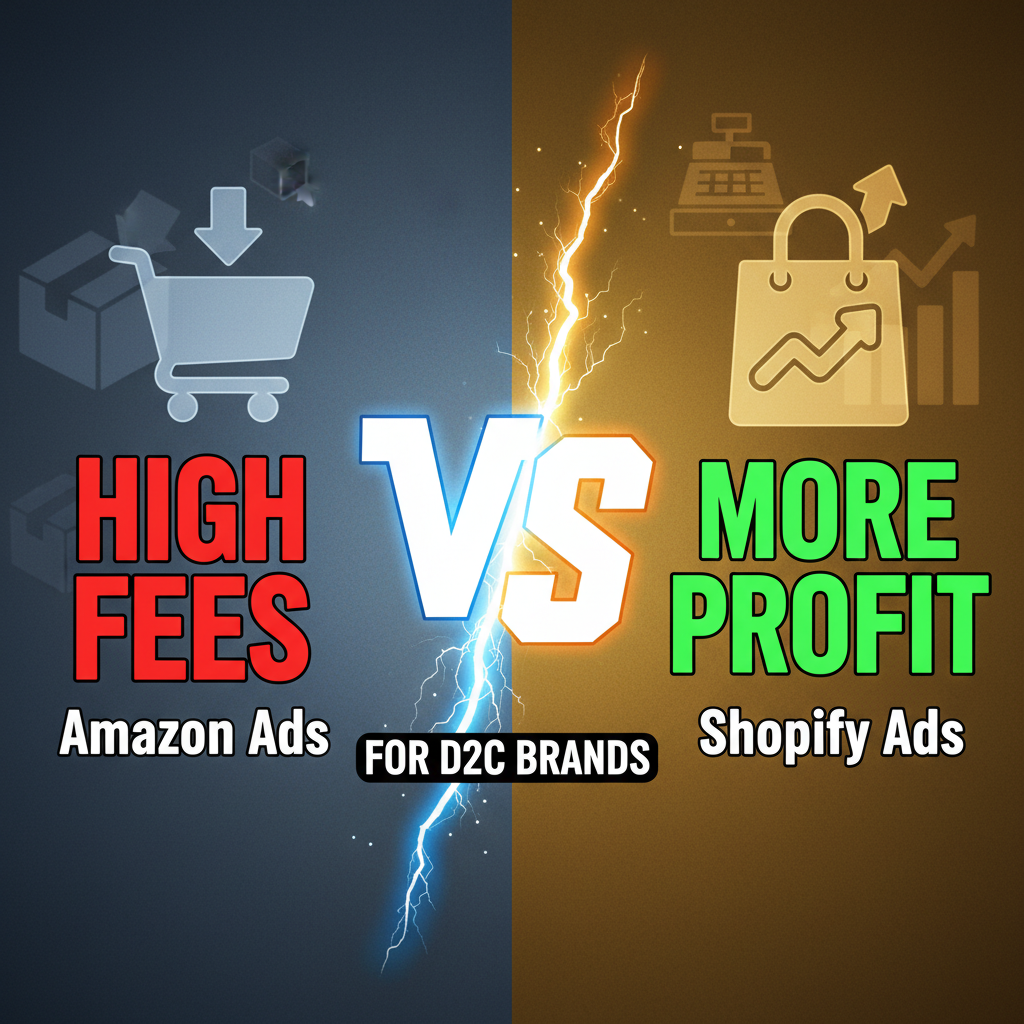
Amazon Ads vs Shopify Ads: Channel Strategy for D2C Brands
Slug
amazon-ads-vs-shopify-ads-d2c-strategy
Excerpt
Learn how DTC brands choose between Amazon Ads and Shopify Ads. Compare performance, costs, and audience reach to build your multichannel strategy.
SEO Meta Data
- Title: Amazon Ads vs Shopify Ads: Which Channel Wins for D2C Brands
- Description: Understand the differences between Amazon Ads and Shopify Ads. Compare costs, audience targeting, ROI, and decide the right channel mix for your DTC brand.
- Canonical URL: https://tenten.co/shopify/amazon-ads-vs-shopify-ads-d2c-strategy
Rich Text Content
Understanding Your Audience: Where Are Your Customers?
The first rule of paid advertising: reach people who want to buy, not people who might someday consider it.
Amazon Ads reach customers who are already shopping. On Amazon, 94% of users visit with purchase intent—they're searching for product solutions, comparing options, and ready to spend. Your ads appear inside a commerce ecosystem built around transactions.
Shopify Ads reach a broader audience but with lower immediate intent. These are customers you can reach on Google, Instagram, TikTok, and Facebook through Shopify's unified platform. They're not yet shopping—they're discovering, learning, and potentially converting elsewhere if you don't capture them.
This distinction shapes everything: budget allocation, creative strategy, timeline to ROI.
D2C brands operating on a limited budget (under $5K/month ad spend) should start with Shopify Ads. Why? Lower barrier to entry, unified dashboard, and direct traffic to your own store. Established brands ($10K+ monthly spend) often run both channels simultaneously—Amazon for immediate conversions, Shopify channels for brand awareness and email list growth.
Direct Performance Metrics: CPM, CPC, and ROAS
The cost structure differs dramatically between platforms.
Amazon Ads pricing (Sponsored Brands & Sponsored Products):
- Average CPC: $0.50 to $3.00 (highly competitive niches hit $5+)
- Average ROAS: 2:1 to 5:1 (depends on product margin and competition)
- Fee structure: Pay-per-click + Amazon takes 15-45% commission on sales
- Advantage: Customer acquisition costs are transparent. You know the exact cost per conversion.
Shopify Ads pricing (via Google, Facebook, Instagram, TikTok):
- Average CPC: $0.20 to $2.50 (varies by platform and audience)
- Average ROAS: 1.5:1 to 4:1 (typically lower initially, improves with data)
- Fee structure: Pay-per-click to ad networks; Shopify takes no commission on sales
- Advantage: Shopify retains 100% of your margins. No platform commission.
| Metric | Amazon Ads | Shopify Ads |
|---|---|---|
| Customer Intent | High (94% shopping mode) | Medium (cold to warm audience) |
| Average CPC | $0.50-$3.00 | $0.20-$2.50 |
| Platform Commission | 15-45% of sale | 0% of sale |
| Initial ROAS | 2:1-5:1 | 1.5:1-4:1 |
| Profit Margin Retained | 55-85% | 100% |
| Time to Profitability | 30-60 days | 60-90 days |
The hidden factor: margin impact. On Amazon, even if your ROAS looks healthy (3:1), the 30% commission eats 30% of revenue. A product with 50% gross margin becomes 35% after Amazon takes its cut. On Shopify Ads, you keep 100% of margins—meaning lower ROAS still hits profitability faster.
Example: A $100 product with $60 gross margin ($40 profit).
- Amazon: $20 ad spend, $100 revenue, -$30 Amazon commission = $10 actual profit. ROAS 5:1 looks great but your profit is only $10.
- Shopify: $20 ad spend, $100 revenue, $0 commission = $40 actual profit. ROAS 5:1 produces real money.
Audience Targeting & Reach: Who Do You Actually Talk To?
Amazon's audience is smaller but warmer. Shopify's audience is massive but colder.
Amazon Ads strengths:
- Audience built on purchase history and product searches
- Keyword targeting mirrors Google Shopping but with higher purchase intent
- Competitor targeting (capture customers searching for rival products)
- Minimal wasted spend on unqualified browsers
- Best for: Direct response, bottom-of-funnel conversions, established products with existing reviews
Shopify Ads strengths:
- Access to Google, Instagram, TikTok, Facebook audiences simultaneously
- Audience building via lookalike and custom audiences
- Retargeting capabilities across all platforms
- Full-funnel targeting (awareness → consideration → conversion)
- Best for: New brand launches, audience building, sequential campaigns, content marketing
DTC brands scaling Instagram and TikTok need Shopify Ads. You can't run a serious TikTok Shop campaign through Amazon. If your audience lives on TikTok or Pinterest, you have no choice—Shopify's integration is mandatory.
If your audience is shopping on Amazon—looking for commodity products, supplements, fitness gear—Amazon Ads dominate. Supplement brands report 3-8X ROAS on Amazon. Fitness equipment? Same pattern. These categories have established search behavior on Amazon, making keyword targeting highly predictable.
Budget Allocation: The Strategic Mix
Most profitable D2C brands run both channels with a deliberate budget split.
For brands doing $100K-$500K monthly revenue:
- 60% to Shopify Ads (across Google, TikTok, Instagram)
- 40% to Amazon Ads (Sponsored Products + Brands)
- Rationale: Shopify feeds brand awareness and email list. Amazon captures high-intent searchers.
For brands doing $500K-$5M+ monthly revenue:
- 50% to Shopify Ads (now including video, carousel, and influencer integrations)
- 35% to Amazon Ads (aggressive Sponsored Brands + A+ content optimization)
- 15% to other channels (Pinterest, YouTube, TikTok Shop direct)
Why this split works: Amazon brings immediate revenue. Shopify builds long-term moat through email, repeat customers, and brand value. Running only Amazon means you're renting an audience on Amazon's terms—commission rates rise, competition intensifies, margins compress. Running only Shopify means you're spending inefficiently to build awareness for every conversion.
The compound effect: A customer acquired via Shopify Ads for $30 might buy 3X over 12 months, generating $90 lifetime value. That same customer on Amazon pays once and disappears. Shopify Ads customers have higher lifetime value but lower initial conversion. Amazon has high initial conversion but lower repeat purchase.
Profitability Timeline: When Do You Actually Make Money?
This is where real operators differentiate strategy.
Amazon Ads: 30-60 days to positive ROI if you're disciplined. Why? High-intent audience, fast feedback loops, clear winner/loser products within 2-3 weeks.
Shopify Ads: 60-120 days to optimal ROI because platforms need data (at least 50 conversions) to optimize. Google's AI needs time. TikTok's algorithm needs trial time. You're not just buying conversions—you're teaching the algorithm your customer profile.
Impatient operators lose here. They launch Shopify campaigns, see 1.2:1 ROAS for 3 weeks, and shut it down. The platform was still learning. By week 8-12, they'd have hit 3:1 ROAS if they'd been patient and didn't pause.
The Rare Advantage: Owned Data
This is the contrarian insight most agencies won't tell you.
Every customer acquired via Shopify Ads goes directly to your email list and customer database. You own that relationship. You can email them, segment them, and re-target them for 12+ months without paying additional ad costs.
Customers acquired via Amazon Ads are Amazon's customers. Yes, you get their name and email—but Amazon owns the relationship. You cannot email them through your own campaigns about new products. You cannot build email sequences to drive repeat purchases on your store. Amazon controls the communication channel.
Over 12 months, owned customer data becomes dramatically valuable. Your email list becomes your moat—lower customer acquisition costs on repeat purchases, higher lifetime value, and insulation from algorithm changes.
Forward-thinking D2C brands allocate Shopify budget partly based on email list growth, not just immediate conversions.
When to Choose One Channel Over the Other
Run Amazon Ads if:
- Your product category has established Amazon search volume (supplements, electronics, home goods)
- Your current customer base shops on Amazon regularly
- You're chasing quick revenue and have >50% gross margins to absorb commission
- You have 100+ authentic reviews (social proof is required)
Run Shopify Ads if:
- You're a new brand building audience and email list simultaneously
- Your product category is trendy or lifestyle-driven (fashion, beauty, wellness)
- Your target audience hangs out on Instagram, TikTok, or Pinterest
- You want to own customer relationships long-term
- You have <$10K monthly budget (Shopify's lower friction makes it easier to test)
Run both if:
- You're past the $100K monthly revenue threshold
- You have margin (>40%) to invest in paid acquisition
- Your product works across both audiences
- You want to test channel economics and optimize annually
Setting Up Success: Technical Foundations
If you're moving forward with either platform, your foundation matters.
Amazon Ads setup:
Use A+ content. Brands with A+ content (enhanced brand content) see 15-25% higher conversion rates than standard listings. This is not optional—it's the difference between 2:1 and 3:1 ROAS.
Maintain inventory. Amazon deprioritizes slow-moving SKUs. If you run ads but inventory isn't consistent, Amazon's algorithm will throttle impressions month-to-month.
Shopify Ads setup:
Install tracking pixels correctly. Google, Facebook, and TikTok all need accurate conversion data within 48 hours. Misconfigured tracking means the algorithm is blind—you'll waste 30% of budget before it learns.
Build custom audiences. Upload your existing customer list to each platform (Google, Facebook, TikTok) immediately. This 20-minute setup typically unlocks 2X ROAS improvements within weeks.
Test creative regularly. Shopify channels require fresh creative every 3-4 weeks. Amazon is more forgiving—same listings can run for months. If your Facebook ads are 8 weeks old, refresh them. Fatigue kills ROAS.
Ready to Grow Your Shopify Store?
Strategic channel decisions compound. The difference between scattered ad spend and disciplined multi-channel allocation is 40-60% margin improvement over 12 months.
If you're scaling a D2C brand and want to optimize across Amazon, Shopify, and other channels, let's talk. We help merchants move from single-channel dependencies to profitable, diversified customer acquisition engines.
Schedule a consultation and we'll audit your current channels, identify opportunities, and build your acquisition roadmap.
Editorial Note
This article covers the full strategic framework DTC brands need to decide between Amazon Ads and Shopify Ads. It includes commission impact analysis, audience intent comparison, and channel-specific profitability timelines that most guides skip.
Article FAQ
Q: Is Amazon advertising cheaper than Shopify advertising?
A: Not always. Amazon CPC averages $0.50-$3.00 while Shopify (via Google/Facebook/TikTok) averages $0.20-$2.50. However, Amazon's 15-45% commission significantly impacts profit margins, often making Shopify more profitable despite higher CPC in some cases.
Q: Can I use both Amazon Ads and Shopify Ads at the same time?
A: Yes, and most profitable D2C brands do. A typical allocation for $100K+ revenue brands is 60% Shopify / 40% Amazon, with Shopify feeding brand awareness and email list growth while Amazon captures high-intent searchers.
Q: How long does it take to see ROI from Amazon Ads?
A: 30-60 days if your product is competitive. Amazon rewards fast feedback—you typically know within 2-3 weeks if a product is a winner. Shopify Ads take 60-120 days because the algorithms need data to optimize (minimum 50 conversions).
Q: What if my product isn't suitable for Amazon?
A: Focus on Shopify Ads. Categories like fashion, beauty, and lifestyle-driven products perform better on Instagram, TikTok, and Facebook. Not all products fit Amazon's ecosystem, and forcing it wastes budget.
Q: Should I prioritize email list growth or immediate conversions?
A: Both, but sequence them. Start with email list growth via Shopify Ads (broader reach, lower intent), then re-target and nurture those subscribers with Amazon Ads once they're warm. Owned data compounds over 12 months.