AI Agents Are Already Shopping for Your Customers
Agentic commerce is the shift from humans browsing stores to AI agents browsing stores on their behalf. Instead of your customer scrolling through product pages, comparing prices, and clicking "Add to Cart," an AI agent does it for them — autonomously finding products, evaluating options, negotiating deals, and completing transactions.
This isn't a theoretical future. Adobe reported that traffic to US retail sites from generative AI browsers and chat services increased 4,700% year-over-year in July 2025. On Black Friday 2025, AI-referred traffic to US retail sites grew 805% year-over-year. And shoppers arriving from AI services are 38% more likely to buy than those from traditional channels.
McKinsey's October 2025 research estimates this shift could redirect $3 trillion to $5 trillion in global retail spend by 2030, with nearly $1 trillion coming from the US alone. For Shopify merchants, the question isn't whether agentic commerce matters. It's whether your store is ready for it.
What Exactly Is Agentic Commerce?
Agentic commerce is a model where AI agents act as autonomous intermediaries between consumers and merchants. These agents don't just recommend products — they execute multistep purchase workflows independently.
Here's how McKinsey defines it: AI anticipates consumer needs, navigates shopping options, negotiates deals, and executes transactions, all in alignment with human intent yet acting independently via multistep chains of actions enabled by reasoning models.
Think of it as the difference between a search engine and a personal shopper. A search engine shows you ten blue links. An agentic system reads your calendar, notices you have a camping trip next weekend, checks the weather forecast for your destination, identifies gear gaps in your purchase history, finds the best-rated options within your budget, and places the order — all before you've opened a browser tab.
The key components that make this work:
Intent recognition. Agents pick up on signals — a conversation about a birthday party, a calendar entry for travel, a low-supplies notification from a smart device. These trigger shopping actions without explicit commands.
Autonomous execution. Unlike chatbots that answer questions and wait for you to click "buy," agentic systems handle the full workflow: product search, comparison, checkout, and payment.
Machine-readable catalogs. For any of this to work, your product data needs to be structured so agents can parse it. If your catalog isn't machine-readable, agents can't find you — and neither can the customers they serve.
How Shopify Is Building for Agentic Commerce
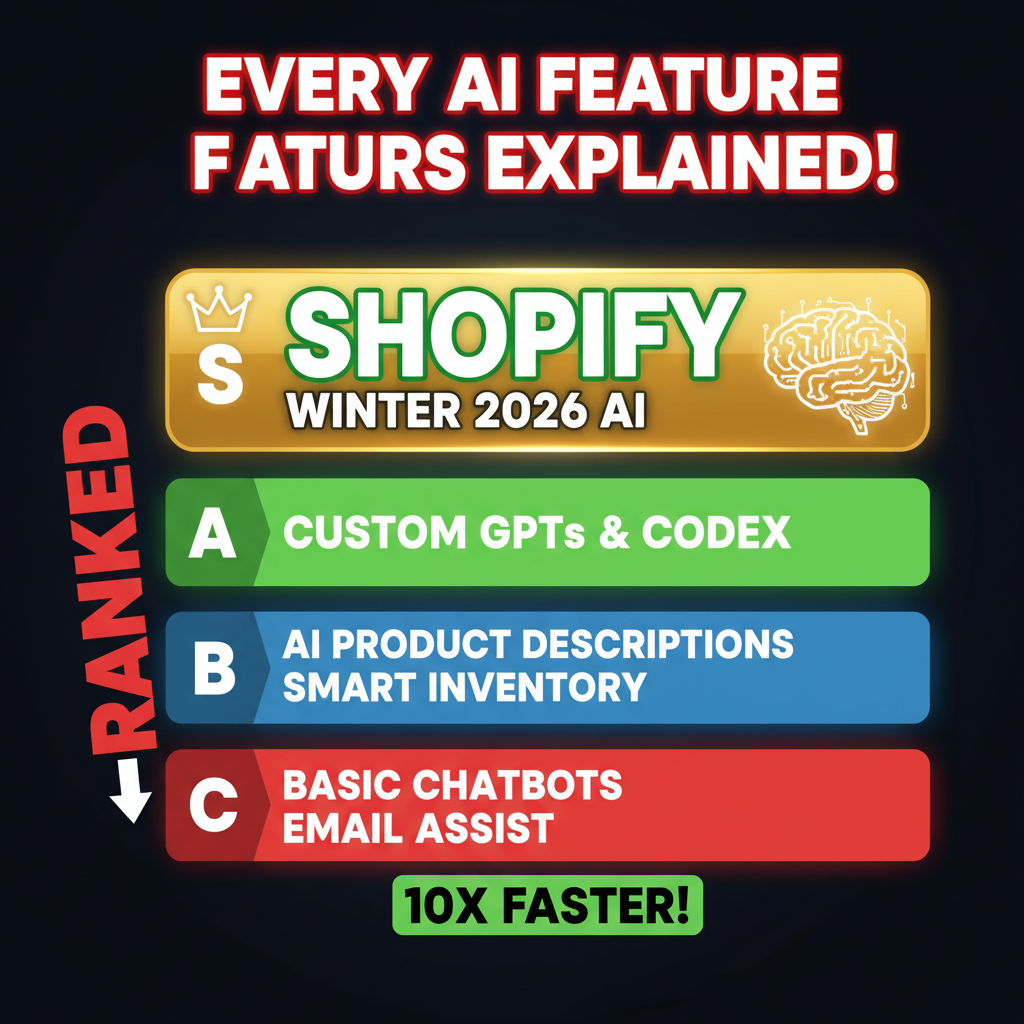
Shopify moved fast on this. In the Winter '26 Edition, they launched Agentic Storefronts — a system that packages your product catalog, checkout flow, and brand information so AI platforms can surface them natively inside conversations.
As of March 2026, Shopify agentic storefronts are available to millions of merchants. The storefronts connect your store to major AI channels: ChatGPT, Microsoft Copilot, AI Mode in Google Search, and the Gemini app — all managed from your Shopify Admin.
Here's what that looks like in practice. A customer asks ChatGPT: "I need running shoes under $150 with good arch support." ChatGPT queries Shopify's catalog infrastructure, surfaces relevant products from multiple merchants, and the customer can complete checkout without leaving the conversation.
Shopify also co-developed the Universal Commerce Protocol (UCP) with Google, launched at NRF in January 2026. UCP is an open standard that lets any AI agent interact with merchant catalogs and complete purchases through a single protocol. Separately, OpenAI and Stripe launched the Agentic Commerce Protocol (ACP) for checkout inside ChatGPT.
The takeaway: the infrastructure is being built by the biggest companies in tech, and Shopify merchants have a front-row seat.
Why This Changes the Rules for Product Discovery
Traditional e-commerce product discovery works like this: SEO drives organic traffic, paid ads drive direct traffic, and social media drives referral traffic. All three assume a human is doing the browsing.
Agentic commerce rewrites that playbook. When an AI agent shops for a customer, it doesn't look at your hero banner or scroll through your homepage collection. It queries structured data. It reads product specs, reviews pricing APIs, and evaluates return policies — all programmatically.
This means three things for Shopify merchants:
Structured product data becomes your new storefront. Every product attribute — materials, dimensions, compatibility, shipping speeds — needs to be accurate and complete. Gaps in structured data mean your products are invisible to agents.
Brand loyalty gets tested. AI agents optimize for the customer's stated criteria: price, quality, availability, delivery speed. If a competitor matches your specs at a lower price with faster shipping, the agent may not even surface your product. Brand preference has to be earned at the data layer, not just the emotional layer.
Content still matters, but differently. Blog posts, guides, and reviews feed the large language models that power these agents. Google's AI Mode and Perplexity pull context from web content to inform purchase recommendations. Your content strategy becomes an input to the AI's decision-making process.

The $5 Trillion Opportunity — and What It Means for Your Store
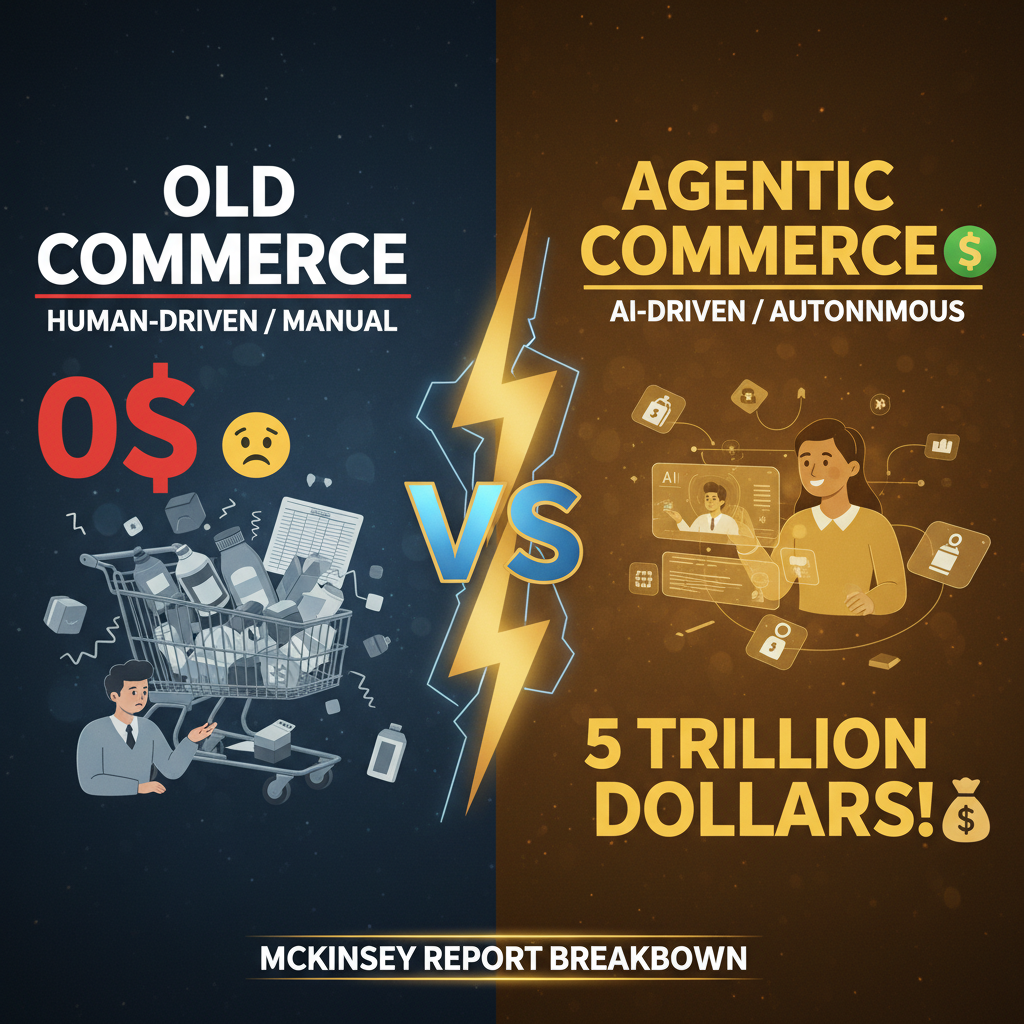
McKinsey projects the US B2C retail market alone could represent $900 billion to $1 trillion in agentic commerce revenue by 2030. Globally, that figure ranges from $3 trillion to $5 trillion. These are redirected dollars — spending that shifts from traditional channels to AI-mediated transactions.
For a Shopify merchant doing $1 million in annual revenue, even capturing a small share of this shift matters. If 10% of your target customers start using AI agents for purchases by 2028, and your store isn't optimized for agent discovery, you're leaving revenue on the table that goes straight to competitors who prepared earlier.
The merchants seeing early traction are already reporting results. Shopify noted that AI-driven orders increased 15-fold in 2025. Brands like Keen Footwear and Pura Vida are selling through Microsoft's Copilot Checkout. These aren't experimental pilots — they're production revenue channels.
How to Prepare Your Shopify Store for Agentic Commerce
You don't need to overhaul your entire business. But you do need to make specific, practical changes. Here's a prioritized roadmap.
Step 1: Enable Agentic Storefronts in Shopify Admin. If you're on Shopify, this is now available. Go to your Sales Channels and activate Agentic Storefronts. This packages your catalog for ChatGPT, Copilot, Google AI Mode, and Gemini. If you're not on Shopify but want AI channel access, Shopify's new Agentic plan lets you add products to Shopify Catalog specifically for this purpose.
Step 2: Audit your product data. AI agents are only as good as the data they read. Check every product listing for: complete titles with key specs (material, size, use case), accurate pricing with clear currency formatting, detailed descriptions that answer common purchase questions, high-quality images with descriptive alt text, and correct inventory and shipping information.
Step 3: Structure your metadata for machine readability. Use JSON-LD structured data on product pages. Include Schema.org Product markup with offers, reviews, availability, and shipping details. This is what agents parse when they evaluate your catalog.
Step 4: Optimize your content for AI citation. Write blog posts and guides that answer specific purchase-related questions. The content that performs best with AI agents follows a clear pattern: a direct answer in the first two sentences, supporting data in the body, and a specific recommendation at the end.
Step 5: Monitor your AI channel performance. Shopify's analytics now include AI-referred traffic. Track which AI platforms send visitors, what products they surface, and how conversion rates compare to traditional channels. This data will guide where you invest next.
What Agentic Commerce Doesn't Change
For all the disruption agentic commerce brings, some fundamentals stay the same.
Product quality still wins. An AI agent can find your product and complete the transaction, but if the product arrives damaged or doesn't match the description, the customer won't let the agent buy from you again. Trust at the product level compounds — agents learn from return rates and review sentiment.
Customer experience after purchase still matters. Shipping speed, packaging quality, return ease — these factors feed back into the AI's ranking algorithms over time. A store with 4.8-star reviews and two-day shipping will outperform a cheaper alternative with 3.5 stars and seven-day shipping, even in an agent-mediated transaction.
Brand building still has value. Agents consider brand reputation as a signal. When a customer tells their AI assistant "I prefer Nike for running shoes," the agent respects that preference. Strong brands create preference signals that override pure price optimization.
Ready to Make Your Shopify Store AI-Agent Ready?
Agentic commerce is moving fast, and the infrastructure is already live. If you want help optimizing your Shopify store for AI-driven discovery and sales — from structured data audits to Agentic Storefront setup — talk to our Shopify experts. We work with merchants to build stores that perform for both human shoppers and AI agents. Explore our full range of Shopify development services to see how we can help.
Editorial Note
The Tenten editorial team has been tracking agentic commerce since Shopify's Winter '26 Edition announcement. What strikes us most is the speed of adoption — 4,700% traffic growth from AI services in a single year signals a genuine behavioral shift, not a hype cycle. Merchants who treat this as a "wait and see" moment risk falling behind stores that are already optimizing for agent discovery. The good news: Shopify has made the entry point accessible, so preparation doesn't require a massive technical lift.