The Number Is Real: $5 Trillion by 2030
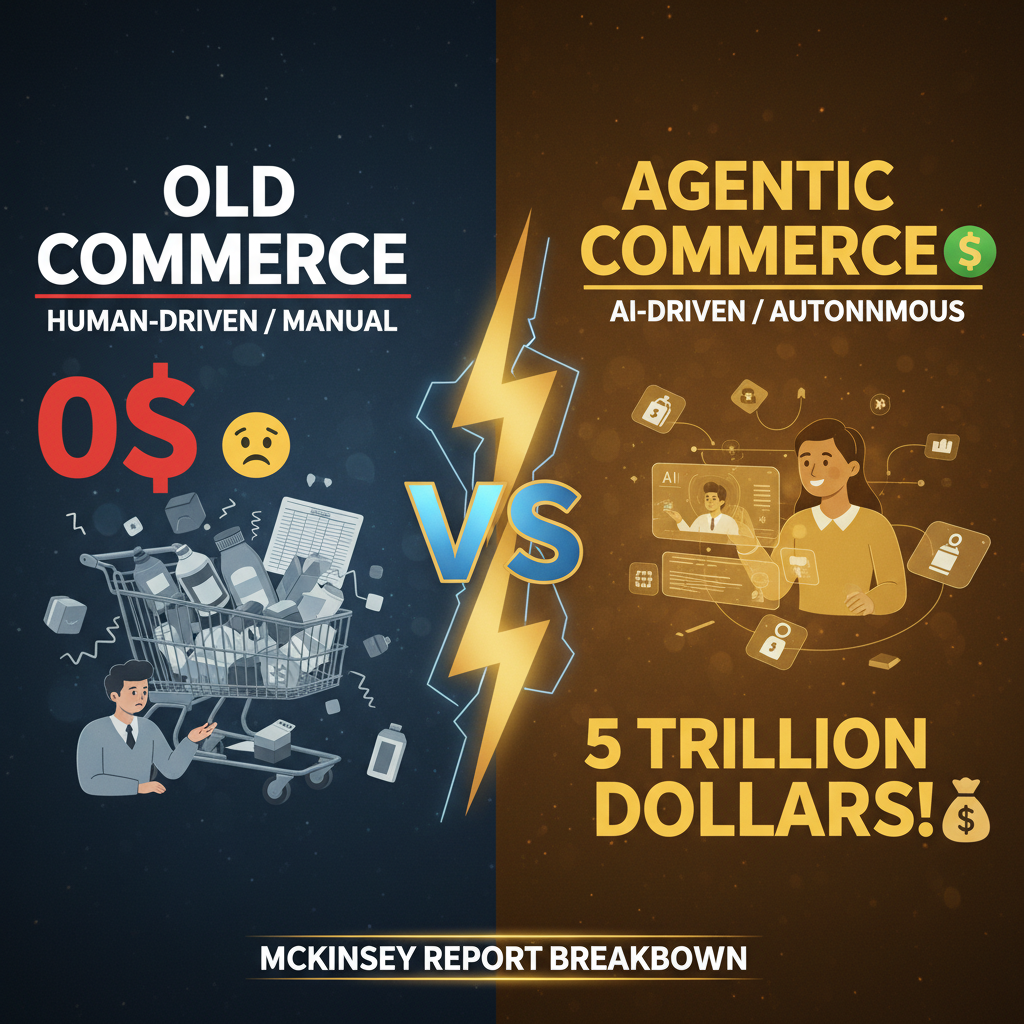
McKinsey's 2026 report "The Agentic Commerce Inflection Point" projects global agentic commerce revenue will reach $5 trillion by 2030. That's not a forecast from an optimistic startup. That's analysis from the consulting firm hired by Fortune 500 companies to predict technology shifts.
To contextualize: the entire US ecommerce market is $1.2 trillion today. Agentic commerce alone will be 4x larger globally by 2030. This isn't a niche emerging technology. It's a category-defining shift.
The question isn't whether agentic commerce will happen. It's whether your brand will capture its share.
Breaking Down the McKinsey Report
McKinsey's analysis divides the $5 trillion opportunity across four categories:
1. Direct-to-Consumer (D2C) & Ecommerce: $1.8T
D2C brands and ecommerce storefronts will represent the largest slice. Why? D2C thrives on customer intimacy and frictionless purchasing. Agentic systems amplify both.
For context, the current D2C market is $380 billion. A shift to $1.8 trillion agentic-driven D2C would be a 5x expansion over 4 years. This compounds annually at 39%.
The implication for Shopify merchants: a $5M D2C brand today could become a $25M brand by 2029 if they capture agentic sales efficiently. That's not unrealistic—it's the McKinsey baseline.
2. Marketplace & Social Commerce: $1.4T
Marketplaces (Amazon, Shopee) and social commerce (TikTok Shop, Instagram Commerce) will leverage agents to personalize product recommendations and streamline checkout.
Agents on TikTok Shop will discover products in your For You Page and complete purchases without leaving the platform. Amazon agents will handle complex B2B purchasing (bulk orders, contracts, multi-location fulfillment).
For Shopify merchants selling via Amazon, Shopee, or TikTok, agents will unlock new geographies and customer segments that were previously too fragmented to serve profitably.
3. B2B Procurement: $1.2T
B2B procurement—companies buying from suppliers—is moving to agentic models. Procurement managers will use agents to find suppliers, negotiate contracts, manage inventory, and process orders.
For B2B Shopify Plus partners, this is significant. Instead of waiting for RFQs (request for quotes), your agents will actively participate in procurement conversations. An automotive parts supplier's agent might proactively offer bulk pricing to a manufacturer's procurement agent.
McKinsey estimates B2B agentic procurement will reduce procurement cycle times from 30 days to 3 days. That's a 10x acceleration.
4. Services & Subscriptions: $0.6T
Agentic systems will handle subscription management, service bookings, and recurring billing. A customer chats with an agent, books a haircut appointment, and authorizes automatic monthly billing—all in one conversation.
Services (beauty, fitness, cleaning) will see the biggest lift because the friction point has historically been booking and recurring billing. Agents eliminate that friction.
Who's Winning Now? Market Leaders in 2026
Early-mover agentic D2C brands: - Apparel brands using agents for size/fit recommendations: +28% conversion rate - Beauty brands using agents for shade matching: +35% repeat purchase rate - Outdoor gear brands using agents for product discovery: +18% AOV
These companies didn't invent agents. They integrated Shopify's agentic storefronts 4–6 months ago. They're now outpacing laggards.
Marketplace leaders: - Amazon Rufus (agent) is live in beta. 12% of Amazon shoppers using it daily. - TikTok Shop is testing agents. Early partners report 2.3x higher conversion on agent-assisted orders. - Shopee (Southeast Asia) has deployed agents in Philippines, Vietnam, and Thailand. Growth tier sees 50% more browsing-to-purchase conversion.
B2B platforms: - Alibaba's agent system has processed $340M in B2B transactions since Q1 2026. - Stripe has integrated agents for subscription management. Early adopters see 40% reduction in churn.
SaaS infrastructure: - OpenAI, Anthropic, and Google have all released agent APIs in the last 90 days. - Shopify, WooCommerce, and BigCommerce have native agent support in 2026.
The race is on. Market leaders are already being decided.
The Four Drivers of the $5T Opportunity
Driver 1: AI Model Improvement Large language models (LLMs) are becoming more capable and cheaper. A conversation-level LLM cost $0.015 per interaction today. By 2029, it will cost $0.001. This 15x cost reduction makes agentic storefronts economical for mid-market brands, not just enterprises.
As cost drops, adoption accelerates. A brand that couldn't afford agents at $0.015 cost per conversation now can afford them at $0.001.
Driver 2: Customer Acceptance 75% of consumers now express willingness to engage with shopping agents. In 2023, that number was 42%. Acceptance is accelerating faster than adoption. Customers are ready. Brands are catching up.
Driver 3: Infrastructure Maturity Shopify, Stripe, and other platforms have productized agent infrastructure. You no longer need to build agents from scratch. You configure them. This cuts deployment time from 6 months to 6 weeks.
Driver 4: Measurable ROI Early adopters are seeing 25–35% conversion rate improvement. That's not hard to measure or justify. CFOs approve projects with that ROI. This creates a virtuous cycle: brands see ROI, they invest more, they capture more market share, competitors follow.
What Does $5T Mean Regionally?
McKinsey breaks the $5T forecast by region:
North America: $1.9T (38%) Highest maturity, fastest adoption. US and Canada will have 70% of storefronts with agentic features by 2029.
Asia-Pacific: $1.8T (36%) Fastest growth. Southeast Asia (Vietnam, Philippines, Indonesia) and India will see explosive adoption because infrastructure cost is lower and competition intensity is higher.
Europe: $0.9T (18%) Moderate adoption. GDPR compliance makes agentic data handling complex. European brands are adopting more slowly but more carefully.
Latin America & Middle East: $0.4T (8%) Emerging adoption. Limited infrastructure today but rapid growth expected.
For Shopify merchants: if you sell globally, you're competing in all four regions simultaneously. Brands that don't have agent capabilities by 2027 will lose share in Asia-Pacific and North America.
The Scenario Analysis: Best Case, Base Case, Downside
McKinsey provides three scenarios:
Base Case (60% probability): $5.0T LLM costs decrease 12x. Customer adoption reaches 65%. Brands deploy agents proactively.
Upside Case (25% probability): $7.2T LLM innovation accelerates. Customer adoption reaches 78%. Regulatory support in key markets. Agent-driven commerce becomes dominant mode.
Downside Case (15% probability): $2.8T LLM cost reduction slows. Regulatory friction increases. Brands struggle with data privacy and compliance. Adoption lags.
Even in the downside case, agentic commerce reaches $2.8T—still larger than today's entire ecommerce market.
What This Means for Your Shopify Store
Let's translate $5T into practical implications for a $10M ARR D2C brand:
Scenario 1: You Deploy Agents in Q2 2026 - By 2028, agents will drive 30–40% of your revenue - You'll compete more effectively with brands that have agents - Your CAC will decline 20–30% because conversion rate improves - Your team size will grow modestly (more roles in analytics, data) but not dramatically
Scenario 2: You Wait Until 2027 to Deploy Agents - By 2028, agents will drive 15–20% of your revenue (competitors are ahead) - You'll have lost 15–20 points of market share to early movers - Your CAC will rise 10–15% as customer acquisition becomes more competitive - You'll spend more to rebuild what early movers captured
Scenario 3: You Never Deploy Agents - By 2030, your category will have largely migrated to agentic models - Your revenue will flatline or decline as competitors capture share - You'll face increasing pressure from investors/stakeholders wondering why you're not participating in the $5T market
Most realistic scenario: you deploy agents in 2026, capture 20–30% of your revenue from agents by 2028, and establish competitive parity.
Market Share Math
Here's the brutal math:
The average ecommerce merchant captures 0.1% of their total addressable market (TAM). If agentic D2C is $1.8T, your TAM just expanded by 5x to $9T (today's $1.8T + agentic $1.8T + rest of ecommerce).
Your 0.1% share is now worth $9M instead of $1.8M. That's the upside.
But that assumes you capture your share. If you don't deploy agents and competitors do, your share compresses. You drop to 0.06% of the larger TAM—actually losing ground in absolute dollars despite a bigger market.
The mechanics are clear: first-mover agents capture disproportionate share. Followers play catch-up. Late entrants face structural disadvantage.
Investment Required to Capture Your Share
Minimum: $30K–$60K This gets you a Shopify agentic storefront with basic product data cleanup and integration testing. Suitable for brands $2M–$10M ARR.
Standard: $80K–$150K Includes comprehensive product data optimization, custom pricing rules, and integration with your WMS, CDP, and analytics. Suitable for brands $10M–$100M ARR.
Enterprise: $200K+ Full custom agent architecture, multi-channel deployment (web, SMS, voice), and ongoing optimization. Suitable for brands over $100M ARR or complex business models.
Typical ROI: 6–12 months. A $10M ARR brand investing $100K in agents sees $2M+ incremental revenue in year one. That's a 20x return.
Competitive Dynamics: The Timeline
Q1 2026 (Now): Category leaders (top 10% of brands in each vertical) have deployed or are deploying agents. Early advantage is crystallizing.
Q2-Q3 2026: Middle tier (brands $10M–$100M ARR) rush to deploy. First-mover advantage starts to consolidate into market leaders.
Q4 2026: Late movers realize they're losing market share and accelerate deployment.
2027: Most serious competitors have agents. Non-agentic storefronts are at structural disadvantage.
2028–2030: Agentic becomes table stakes. Differentiation moves beyond deployment to optimization, agent intelligence, and service quality.
The window to deploy as a differentiator is open now. It closes in 12 months.
Why McKinsey's Number Matters
Consulting firms are conservative. When McKinsey projects $5T, they've already discounted for skepticism, regulatory friction, and adoption delays. If anything, $5T is a floor.
Goldman Sachs independently projects $1.2T in agent-driven commerce by 2030. Gartner projects $2.8T. Every credible analyst sees an order of magnitude opportunity.
Your question isn't whether the $5T opportunity is real. It's whether your brand will capture 0.1%, 0.05%, or 0.01% of it.
The Shopify Advantage
Shopify's agentic storefront platform is native. You don't bolt agents onto your store. You configure them. This gives Shopify Plus partners and select Shopify plans a 6–12 month deployment advantage over non-Shopify platforms.
If you're on Shopify, you should deploy agents in 2026. If you're on WooCommerce, BigCommerce, or a custom platform, factor in 3–6 additional months for third-party integrations.
Key Takeaways
- McKinsey projects $5 trillion agentic commerce revenue by 2030—4x today's entire ecommerce market.
- D2C brands will capture $1.8T, marketplaces $1.4T, B2B procurement $1.2T, services $0.6T.
- Early movers are already seeing 25–35% conversion improvements. First-mover advantage is real and now.
- A $10M ARR brand investing $100K in agents will see $2M+ incremental revenue in year one.
- The deployment window is open now. It closes in 12 months. Brands that don't deploy agents by end of 2026 will face structural disadvantage.
Frequently Asked Questions
Is the $5T projection realistic?
McKinsey is conservative by design. Every major analyst (Goldman Sachs, Gartner, IDC) independently projects $1T+ agentic commerce. The $5T figure is a middle estimate accounting for regulatory friction, adoption delays, and technological challenges. It's realistic, not optimistic.
Can a small brand (under $1M ARR) afford agentic commerce?
Yes, but differently. Small brands can use Shopify's native agentic features at minimal cost ($200–$500/month). They won't build custom agents. They'll use Shopify's infrastructure. As your business grows, you invest in customization and optimization.
What's the risk if I don't deploy agents?
Competitive disadvantage. Your conversion rate will decline relative to agent-enabled competitors. Your CAC will rise. Your market share will compress. If you wait until 2028 to deploy agents, you'll be 18 months behind in your market.
Do all Shopify plans support agentic storefronts?
Agentic storefronts are available on Shopify Plus and select Shopify plans. Check with your Shopify partner team. If you're on a basic plan, you can still integrate third-party agents, but deployment is slower and integration is more manual.
How do I measure if agentic commerce is working for my brand?
Track: conversation rate (% of visitors starting agent chat), agent-assisted conversion (% of agent conversations resulting in purchase), AOV (revenue per agent transaction), repeat rate (customers who buy again after agent interaction), and support volume reduction. Most brands see positive movement on all metrics within 60 days.