The Engagement Model Decision Determines ROI
When you hire a Shopify agency, you're not just paying for hours—you're buying a framework for decision-making. That framework comes in two shapes: retainer or project-based. Pick the wrong one, and you'll overpay or underdeliver. Pick the right one, and you compress 6 months of work into 12 weeks and cut your CAC by 20%.
This comparison cuts through agency sales-speak and shows you exactly what each model costs, when each one makes sense, and the hidden trade-offs.
What Is a Retainer Engagement?
A retainer is a fixed monthly fee ($2,000–$15,000+) for ongoing strategic and tactical work. You get:
- Dedicated account access and prioritized support
- Planned hours per month (typically 40–160 hours)
- Continuous optimization and iteration
- Monthly strategy reviews and course correction
A retainer assumes ongoing work. The agency commits staff bandwidth. You commit predictable spend.
What Is a Project-Based Engagement?
A project is a fixed deliverable with a scope, timeline, and fixed price ($5,000–$50,000+). Common examples:
- Store redesign and conversion optimization
- Custom app development or integration
- Migration from another platform
- Quarterly content or strategy overhaul
Project work is discrete. Once the deliverable ships, the engagement ends. Your agency is paid for output, not hours.
Side-by-Side Comparison: Costs, Timelines, and Trade-offs
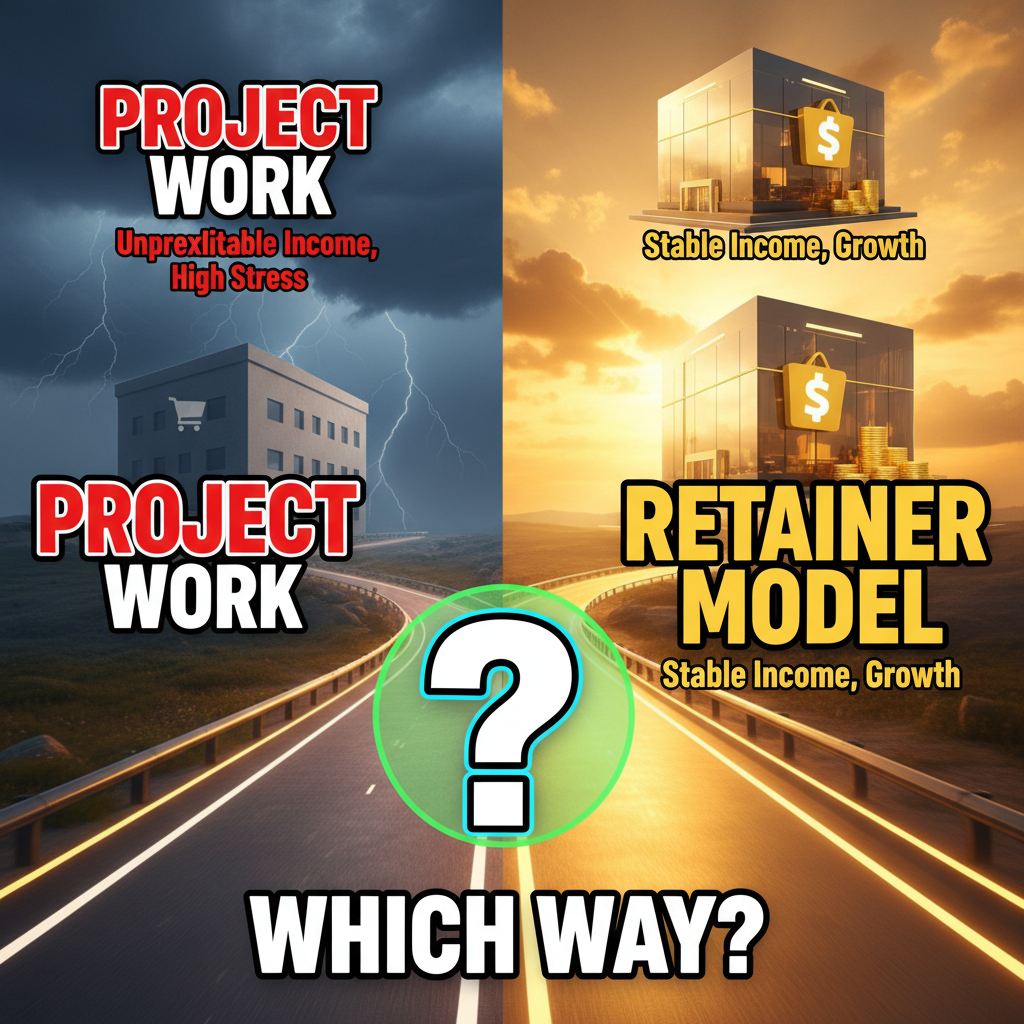
Retainer Model
| Factor | Details |
|---|---|
| Monthly Cost Range | $2,000–$15,000/mo (agencies vary by team size and seniority) |
| Typical Duration | 6–24 months (many merchants stay 2+ years) |
| Ideal for Merchants | Growing stores ($500K–$5M ARR); need ongoing optimization, testing, strategy updates |
| Included Hours | 40–160 hours/month (depends on tier) |
| Break-even Timeline | 3–6 months (you see compounding optimization gains) |
| ROI Profile | High upside if you execute on recommendations; low downside (you can pause/cancel anytime) |
| Who Succeeds | Merchants willing to iterate. Stores with $100K+/mo revenue where 2-3% gain = real money |
Real Numbers:
Tenten worked with a $1.2M/year athletic apparel brand on a 6-month retainer ($4,500/mo). Monthly optimization work:
- Conversion rate audit (week 1–2)
- A/B test execution on product pages, checkout, email flows
- Inventory forecasting and demand planning
- Quarterly strategy reviews
After 6 months, their conversion rate climbed from 2.1% to 3.2%. That's $115K in incremental annual revenue from $27K invested.
Project-Based Model
| Factor | Details |
|---|---|
| Fixed Price Range | $5,000–$50,000+ (depends on scope) |
| Timeline | 4–16 weeks (usually defined upfront) |
| Ideal for Merchants | Stores with one specific need: migration, redesign, integration, or launch |
| What You Get | Fixed deliverable, defined scope, clear end date |
| ROI Profile | Predictable; you know costs upfront. High risk if scope creeps |
| Who Succeeds | Merchants with a clear problem and realistic expectations |
| Hidden Cost | If project uncovers larger issues mid-way, scope creep kills budget |
Real Example:
A $600K/year direct-to-consumer skincare brand needed a migration from WooCommerce to Shopify Plus. Fixed project scope:
- Data migration and product sync
- Custom liquid templates and checkout customization
- 30-day post-launch support
Cost: $22,000 | Timeline: 10 weeks | Outcome: 18% traffic increase post-launch (improved site speed, better mobile UX). Paid for itself in 6 weeks.
Which Model Delivers More ROI? The Data
Retainer Advantage: Compounding Optimization
Retainers win on cumulative improvement. Here's why:
Month 1–2: Audit and quick wins (checkout friction, product page clarity). ROI: 15–25% uplift.
Month 3–4: A/B testing on higher-stakes changes. ROI: 5–10% additional uplift.
Month 5–6: Predictive optimization (demand forecasting, customer segmentation, retention flows). ROI: 3–8% additional uplift.
By month 6, you've stacked $200K–$300K in incremental revenue from a $27K investment.
The catch: This only works if you execute recommendations. If your retainer team proposes changes and you ignore them, you're paying for advice you don't take.
Project-Based Advantage: Defined Outcome, Lower Risk
Projects win on specificity. You know exactly what you're paying for and when it ends. There's no "ongoing work" ambiguity.
Ideal scenario: You have a defined problem (bad site performance, missing payment integration). The agency solves it. You move on.
Reality: Projects often uncover larger issues. A migration discovers that your product data is corrupted. A redesign project surfaces the need for API customization. Scope creep is real. Many merchants end up paying 20–30% more than quoted.
The Hidden Trade-off: Continuity vs. Certainty
Retainer Trade-off
Pros:
- Continuous optimization compounds over time
- Agency stays embedded in your business, understands nuance
- Flexible scope (you can add or reduce hours based on season)
Cons:
- Sunk cost if results don't materialize (you're locked into monthly payments)
- Requires active participation; if you ignore recommendations, money wasted
- Ongoing expense hits P&L (harder to justify to finance teams)
Project Trade-off
Pros:
- Fixed cost. Predictable spend. Easier to budget.
- Clear deliverable and timeline
- One-time expense (easier stakeholder buy-in)
Cons:
- Ends when project ends. No continuity. You're on your own after launch.
- Scope creep is common; final cost often exceeds quote by 15–30%
- Requires clear definition upfront; if requirements shift mid-project, conflict erupts
The Hybrid Model: Project + Retainer
Smart merchants often combine both:
- Initial project: Migration, redesign, or integration ($10K–$30K). 8–12 weeks.
- Follow-on retainer: 3–6 month optimization phase ($3,000–$8,000/mo).
This model reduces risk. You get the certainty of a defined project outcome, then the compounding gains of a retainer phase.
Tenten uses this approach for most Shopify Plus clients. Projects deliver the infrastructure and strategy. Retainers optimize and iterate.
How to Choose: Three Decision Factors
1. Revenue and Scale
Retainer makes sense if:
- You're doing $500K+/year revenue
- A 2–3% improvement = $10K–$50K annually
- You have budget headroom for optimization
Project makes sense if:
- You're under $500K/year or have one specific problem
- You need a defined outcome (launch, migration, redesign)
- Your business is stable and doesn't need ongoing tweaks
2. Your Bandwidth for Execution
Retainer requires:
- Your team (or a dedicated person) to review recommendations
- Willingness to run A/B tests and iterate
- Ability to say "yes" or "no" to strategic recommendations quickly
Project requires:
- Clear requirements upfront
- Single point of contact from your end
- Realism about scope—build in buffer for unknowns
3. Your Business Stage
Retainer fits:
- Growth-stage brands (Series A/B, or profitable bootstrapped brands)
- Merchants optimizing for margin, not survival
- Stores with multiple levers to pull (pricing, product mix, retention, CAC)
Project fits:
- Pre-launch or migration scenarios
- Stores with one clear technical debt to fix
- Businesses where the problem is external, not internal execution
FAQ: Common Retainer and Project Questions
Q: Can I switch from project to retainer mid-engagement?
Yes. Most agencies will pivot if they see compounding opportunity. Common scenario: a project migration uncovers optimization potential. The agency proposes a follow-on retainer. This is healthy.
Q: What if a project goes over budget?
Establish a change order process upfront. When scope expands, you get quoted additional cost and timeline impact. Never let an agency silently absorb overruns—that's how you get mediocre work. Clear contracts prevent surprise invoices.
Q: How do I measure retainer ROI?
Track month-over-month conversion rate, AOV, CAC, and repeat purchase rate. You should see 2–3% cumulative improvement per month. If you're flat after 3 months, the retainer isn't working. Either your agency isn't good, or you're not executing recommendations.
Q: Can I pause a retainer?
Yes. Most agencies allow 1–3 month pauses. Longer pauses often lead to contract termination, which is fine—you can always restart. Use pauses strategically (e.g., during slow seasons when optimization feels premature).
Q: What happens after a project ends?
The deliverable is yours. You own the code, the design, the documentation. You're responsible for maintenance and iteration after that. A follow-on retainer can cover ongoing maintenance, but it's optional.
Q: How do I know if I'm being overcharged?
Benchmark your agency's rates. Good Shopify agencies cost:
- Retainer: $3,000–$8,000/mo for senior strategic work (team of 2–3 people)
- Project: $100–$250/hour for development; $75–$150/hour for strategy (loaded rates)
If you're paying 50% more, you're overpaying or getting premium expertise. If you're paying 50% less, you might be getting junior resources.
Q: Is there a contract lock-in?
Depends on the agency. Year-long retainer contracts are common for larger agencies. Smaller, hungrier agencies offer 3–6 month terms. Always negotiate terms. Month-to-month is rare but possible.
Tenten's Engagement Philosophy
Retainers work best when both sides play to win. We structure ours as problem-solving partnerships, not time-billing relationships. You get:
- Real-time access to senior consultants (not junior team members)
- Weekly or bi-weekly strategy calls focused on your top 3 problems
- Transparent tracking of ROI (we publish monthly impact reports)
- Flexibility to add or reduce scope based on season
Projects are fixed-scope, with clear deliverables and realistic timelines. We build in 10–15% buffer for unknowns (discovery always finds something). You know what you're paying for upfront.
Most merchants start with a project to solve an immediate problem, then move to a retainer for long-term growth. That pattern works.
Closing: The Real Question
The choice isn't retainer vs. project. It's: "What does my business need right now?"
- Need a specific outcome (launch, migration, redesign)? Project.
- Need continuous optimization and strategic oversight? Retainer.
- Want certainty about spend? Project.
- Want compounding gains? Retainer.
Both work. Both can deliver 15–40% revenue uplift. The difference is cadence: projects deliver a one-time result. Retainers compound improvements over 6–24 months.
Your next step: Audit your top 3 business problems. Can they be solved in 8–12 weeks (project), or do they need 6+ months of iteration (retainer)? That answer tells you your model.
Ready to talk engagement? Let's start with a no-commitment 30-minute strategy call.