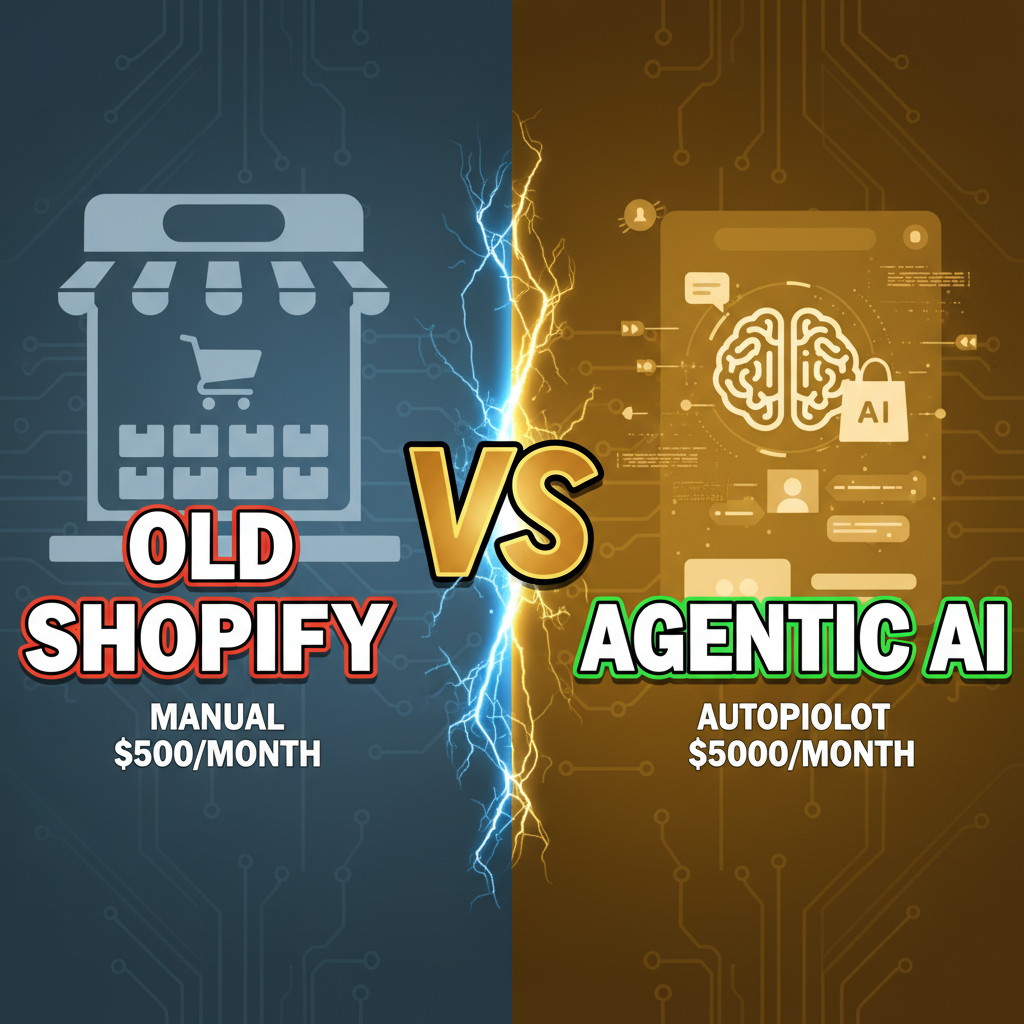
What Is a Shopify Agentic Storefront?
A Shopify agentic storefront is a new architecture pattern that exposes your product catalog, inventory, pricing, and customer data to autonomous AI agents. Instead of customers navigating your storefront UI, agents interact with your APIs directly to discover products, negotiate pricing, apply discounts, and complete transactions on behalf of customers.
Shopify announced agentic storefronts in Q1 2026. The feature is production-ready for Plus partners and select Shopify plans.
This isn't a chatbot bolted onto your existing storefront. It's a fundamental redesign of how inventory, pricing, and customer data flow through your system.
The Core Difference: UI-First vs. API-First
Traditional Shopify storefronts are UI-first: customers see product pages, click add-to-cart, enter checkout. The storefront is the interface layer.
Agentic storefronts are API-first: the agent is the customer interface. Your products, inventory, pricing, and customer service are exposed via APIs. The agent queries these APIs and orchestrates the customer experience.
A customer no longer navigates your website. The agent navigates your APIs on their behalf.
Architecture Overview
Shopify's agentic storefront operates on a three-tier model:
Tier 1: Agent Gateway This is the entry point where customer conversations arrive. It could be a messaging app (WhatsApp, Messenger), voice assistant (Google Assistant, Alexa), email, or in-browser chat. Shopify's gateway routes all channels to a unified agent orchestration layer.
Tier 2: Agent Orchestration The orchestration layer is where Shopify's agent runtime executes. It receives customer intent from the gateway, determines what actions the agent needs to take (product discovery, inventory check, pricing negotiation, checkout), and routes requests to Shopify's commerce APIs.
Tier 3: Commerce APIs These are Shopify's product, inventory, customer, order, and payment APIs. Your agent queries them to fulfill customer requests.
The architecture looks like this:
Customer (Chat/Voice)
    ↓
[Agent Gateway - Receives Intent]
    ↓
[Agent Orchestration - Decides Actions]
    ↓
[Commerce APIs - Executes Actions]
    ↓
Customer Confirmation/Fulfillment
The Three Core Agent Capabilities
1. Product Discovery The agent queries Shopify's Product API with customer intent. Instead of keyword search, the API accepts semantic intent:
- "Show me waterproof hiking boots under $150"
- "I have wide feet and high arches. What running shoes do you have?"
- "What's your best-reviewed insulated jacket for Canadian winters?"
The Product API returns a ranked list. Shopify's AI layer understands product attributes, customer context, and past behavior to refine results. This happens in real-time, not from cached search indexes.
Behind the scenes, Shopify maps product attributes (material, waterproofing rating, insulation type, size range) to customer intent. Your product data must be structured as attributes, not buried in descriptions.
2. Inventory & Pricing Real-Time Query Once the agent selects a product, it queries inventory immediately. If you have 2 units left, the agent knows and can communicate urgency: "We have only 2 in stock. Should I secure one for you?"
Pricing queries are more interesting. Shopify's Pricing API doesn't just return the list price. It evaluates:
- Customer lifetime value (returning customers get loyalty discounts)
- Current inventory level (overstock = dynamic discount opportunity)
- Demand signals (high demand = hold price)
- Promotional eligibility (is this customer eligible for an active promotion?)
- Payment method (certain methods trigger discounts)
The agent receives a real-time price quote that's dynamic. This quote is valid for 5 minutes. If the customer agrees, the agent locks that price at checkout.
3. Transaction Execution Once the customer approves the purchase, the agent hands off to Shopify's Order API. The order is created with:
- Product(s) selected by the agent
- Shipping address (agent confirms with customer)
- Shipping method (agent recommends based on cost/speed tradeoff)
- Payment (agent can store it, use a saved method, or request new payment)
- Billing address
- Any applied discounts or promotions
The agent confirms the order details with the customer one final time: "Shipping 3 units to [address] on 2-day shipping with expedited processing. Total: $247.83. Approve?"
Once approved, the order is locked into your fulfillment system.
Data Flow: How Agent Requests Map to APIs
Let's trace a real request:
User says: "I need white running shoes for trail running in size 10. Budget is $120."
Agent parses intent: product_type="running shoe", terrain="trail", color="white", size="10", max_price="120".
Agent calls Product API:
GET /admin/api/2024-01/products/search
{
  "query": {
    "type": "running_shoe",
    "terrain": "trail",
    "color": "white",
    "size_min": "10",
    "price_max": "120"
  }
}
Shopify returns: 12 products matching criteria, ranked by relevance (stock level, customer rating, fit for terrain).
Agent calls Inventory API for top 3:
GET /admin/api/2024-01/inventory
{
  "product_ids": ["product_1", "product_2", "product_3"]
}
Shopify returns: stock levels, warehouse locations, and restock dates.
Agent presents option: "I found 3 options. Option 1 is in stock, ships today, $89. Option 2 is $65 but ships in 4 days. Option 3 is $119 and a newer model with 4.9 stars. Which interests you?"
Customer picks Option 2.
Agent calls Pricing API:
GET /admin/api/2024-01/pricing/dynamic
{
  "product_id": "product_2",
  "customer_id": "cust_xyz",
  "quantity": "1"
}
Shopify returns: base price $65, loyalty discount eligible = $3.90 (6%), final price $61.10. Quote valid 5 minutes.
Customer approves.
Agent calls Order API:
POST /admin/api/2024-01/orders
{
  "line_items": [{
    "product_id": "product_2",
    "quantity": "1",
    "price": "61.10"
  }],
  "shipping_address": { ... },
  "shipping_lines": [{
    "code": "standard",
    "price": "9.99"
  }],
  "customer": { ... },
  "payment": { ... }
}
Shopify returns: order confirmation, order ID, invoice URL.
Agent confirms with customer: "Order placed. Confirmation sent to your email."
Authentication and Security
Agentic storefronts require elevated API permissions. This is where security gets serious.
Your Shopify agentic storefront uses OAuth 2.0 with private app credentials. The agent has a service account with specific scopes:
read_products- Query product catalogread_inventory- Check stock levelsread_pricing- Get dynamic pricingread_customers- Match agent user to Shopify customer (optional)write_orders- Create orders on agent's behalfread_orders- Retrieve order history (for returns, replacements)
You do not grant the agent full admin access. You grant narrow scopes aligned with agent responsibilities.
All agent API calls are logged in Shopify's audit trail. You can see every product query, every pricing request, and every order the agent created. This is critical for debugging and compliance.
Product Data Requirements
Agentic storefronts demand clean, structured product data.
Traditional Shopify stores can get away with loose product information. A description field with prose: "Our best-selling hiking boot. Waterproof, breathable, great reviews. Available in sizes 6–14."
Agents can't work with that. They need structured attributes:
waterproof: yes/nowaterproof_rating: milliseconds of water resistance (ISO 20811 standard)breathability: fabric breathability rating (grams/m²/24h)insulation_type: synthetic/down/hybridinsulation_rating: temperature comfort rangesize_range: 6–14weight_per_pair_grams: 450lacing_system: traditional/boaarch_support: low/medium/highfit_recommendation: narrow/regular/widerecommended_terrain: hiking/trail/alpinecustomer_review_sentiment: 4.7/5 averagereview_count: 283
The more attributes you populate, the smarter the agent becomes. An agent with full attribute data can answer "I have high arches and wide feet, I'm heading to Colorado in January, and I prefer lightweight boots" immediately. An agent without attributes defaults to simple matching and loses the sale.
Before deploying an agentic storefront, audit your product database. You'll likely need to:
- Add 20–40 new attribute fields per product category
- Populate those attributes for every product (this is the 80% of work)
- Establish governance: who maintains these attributes as products change?
Most Shopify Plus partners need 6–8 weeks to get product data ready.
Pricing Customization
Shopify's pricing API is powerful but not magic. You configure pricing rules in your Shopify admin:
- Base pricing: standard price per variant
- Loyalty tiers: VIP customers get automatic discounts
- Volume discounts: buy 10+, get 15% off
- Promotional rules: "20% off boots from Jan 1–14"
- Inventory-based pricing: when stock < 5 units, increase price; when stock > 100 units, decrease price
- Channel pricing: online price vs. wholesale price
- Market-specific pricing: USD vs. CAD vs. GBP pricing
- Dynamic discounts: let the agent offer discounts to specific customers to drive conversion
The agent queries this config and calculates a real-time price. The price quote is guaranteed for 5 minutes. This prevents "bait and switch"—the customer sees a price and doesn't see it change mid-conversation.
Handling Inventory Conflicts
What happens if an agent quotes a product and the customer approves, but between approval and order creation, another customer bought the last unit?
Shopify handles this with inventory holds. When the agent presents a price quote, Shopify reserves that inventory for 5 minutes. If the customer confirms, the hold converts to an order. If they don't confirm, the hold expires and inventory releases.
This prevents overselling and ensures a smooth customer experience.
Integration Points: How Agents Connect to Your Backend
Agentic storefronts talk to Shopify APIs. But your fulfillment, customer data platform, and analytics live elsewhere.
Most partners need custom integrations:
-
Fulfillment sync: Agent creates an order in Shopify. Your WMS (3PL, custom system) needs to know about it in real-time.
-
Customer data sync: If a customer exists in your CDP or CRM, the agent should know their purchase history, preferences, and fit data. This requires bidirectional sync between Shopify and your CDP.
-
Pricing sync: If your pricing lives in a separate system (Shopify often isn't the source of truth), sync rules to Shopify's Pricing API daily.
-
Product sync: If your product information lives in a PIM (product information management system), sync attributes to Shopify nightly.
-
Analytics: Agent interactions (queries, conversions, avg order value, cart abandonment) should feed your BI system.
Most integrations are built using Shopify's webhooks (real-time) and Flow (no-code automation).
Performance and Scale
Shopify agentic storefronts are built on Shopify's infrastructure. The system is designed for high concurrency.
A single agent can handle 100+ concurrent conversations. Your Shopify store can support 1000+ agents (if you're integrating a third-party agent platform). This scales without additional on-premise infrastructure.
Latency is critical. When a customer asks a question, the agent needs a product search response in under 500ms. Pricing must return in under 300ms. Shopify's APIs hit these targets consistently.
If you've ever felt Shopify admin slow down, the agentic APIs are significantly faster. They're built on Shopify's modern stack, not legacy admin infrastructure.
Monitoring and Observability
Once agents are live, you need visibility. Shopify provides:
- Agent audit log: every API call logged with timestamp, customer ID, action, result
- Agent dashboard: real-time metrics—conversations active, conversion rate, avg order value
- Error tracking: failed API calls, rate limits, timeouts
- Customer journey tracking: see the full conversation flow, what the agent recommended, what the customer bought
You can export these logs to your BI system for deeper analysis. Most partners build custom dashboards showing agent performance vs. traditional website performance.
Deployment Checklist
Before going live with an agentic storefront:
- Product data audit complete (attributes populated for 95%+ of products)
- Pricing rules configured in Shopify
- API credentials created (OAuth 2.0 private app)
- Inventory sync validated (real-time testing)
- Order fulfillment integration tested (test orders flow to WMS)
- Customer data sync validated (agent matches customers to your CRM/CDP)
- Analytics pipeline configured
- Legal review complete (agent transactions are legally binding; ensure terms of service cover this)
- Support training complete (your team knows agent behavior and edge cases)
- Launch with limited traffic (start with 10% of visitors; monitor for issues)
Most Shopify Plus partners complete this checklist in 6–8 weeks.
Key Takeaways
- Agentic storefronts are API-first, not UI-first. Agents orchestrate your commerce APIs to fulfill customer requests.
- Three core capabilities: product discovery, real-time pricing, and transaction execution.
- Clean product data is non-negotiable. You need structured attributes, not prose descriptions.
- Dynamic pricing allows agents to negotiate in real-time based on customer value, inventory, and demand.
- Integration with your existing fulfillment, CDP, and analytics systems is required.
- Scale is handled by Shopify's infrastructure; you don't need new hardware.
Frequently Asked Questions
Do I need to rewrite my entire storefront to use agentic features?
No. Agentic storefronts live alongside your traditional website. Customers can still browse and buy the old way. Agents are an additional channel. You can launch agents while keeping your website exactly as it is.
What if my product data isn't structured yet?
Most partners aren't structured initially. Expect 6–8 weeks to audit, populate, and validate product attributes before agents go live. This upfront work makes agents smarter and your website search better long-term, so it's valuable beyond agentic commerce.
Can agents handle complex use cases like B2B custom pricing?
Yes. Shopify's pricing API supports complex rules: tiered pricing, account-specific discounts, minimum order quantities, contract pricing. Agents execute these rules automatically.
Are agent-created orders treated like normal orders?
Completely. An agent-created order is indistinguishable from a customer-created order in your fulfillment system. It appears in your admin, flows to your WMS, and triggers your normal fulfillment workflow.
What happens if an agent makes an unauthorized order?
Agents operate within scopes you assign. They can't grant discounts unless you configure that rule. They can't bypass payment validation. They can't charge customers more than the current price. If something goes wrong, it's logged and reversible (like a normal return).
How do I handle returns and refunds through agents?
Agents can process refunds on behalf of customers using the Refund API. A customer says "This doesn't fit." The agent offers a refund, prints a return label, processes the refund once the item arrives. Minimal support interaction needed.