Shopify for Financial Services: Fintech Meets Ecommerce
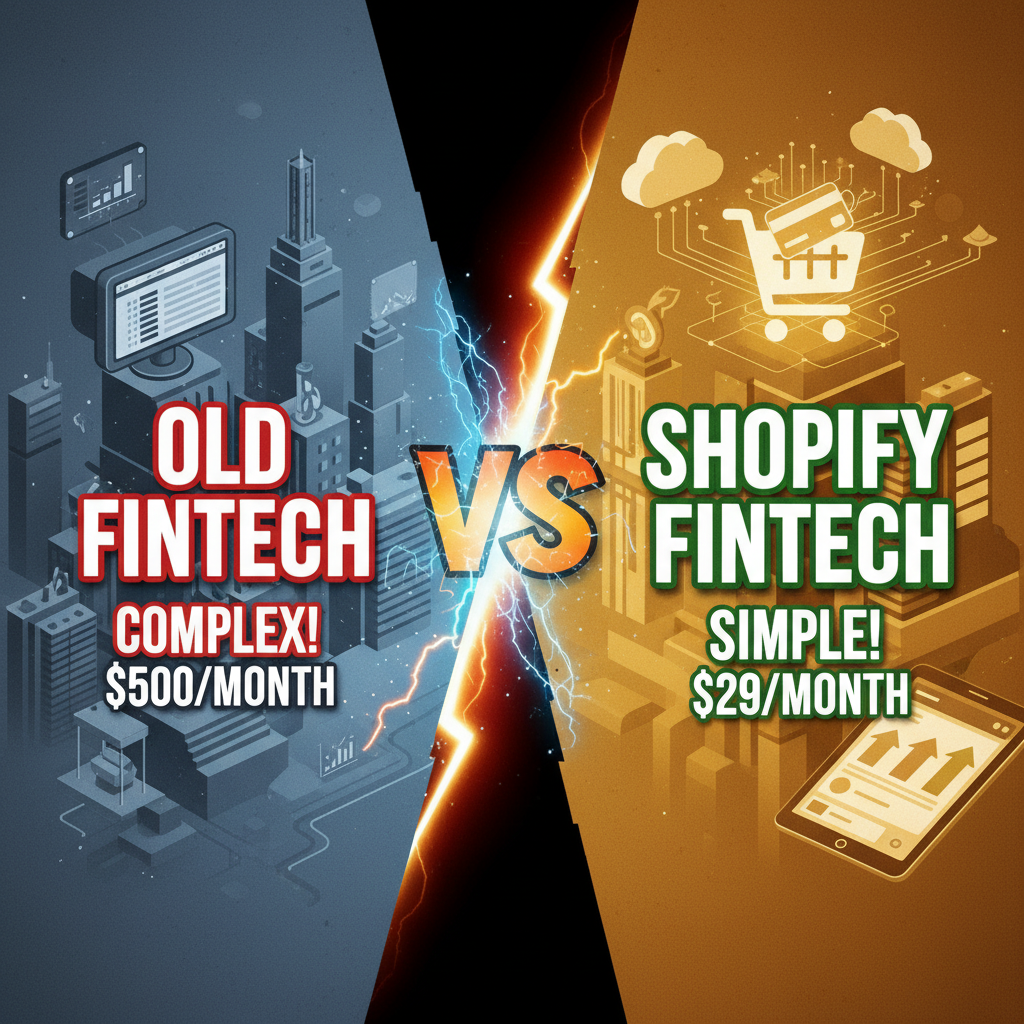
Financial services companies—neobanks, insurance startups, investment platforms, and lending firms—are using Shopify Plus to build storefronts for financial products that blend transaction processing, education, and community. ESun Bank's Shopify deployment showed that fintech isn't just software; it's commerce architecture, and Shopify can be its platform.
Why Fintech Products Need a Commerce Layer
The fintech pitch is always about disruption—lower fees, faster onboarding, better UX. But fintech products aren't like SaaS. You can't freemium your way to scale in financial services. You need a way to monetize, educate, and bundle.
According to McKinsey's 2024 Global Banking Report, 58% of fintech users want to see more bundled products (insurance + payments, lending + savings) but only 21% of fintech platforms offer bundles. Why? Most fintech tools—Stripe, Plaid, Wise—are B2B infrastructure. They don't help you sell TO consumers. That's where Shopify comes in.
The products you sell in a fintech shop aren't physical:
- Premium account tiers (business accounts, investment accounts, savings vaults)
- Add-on services (insurance, tax optimization, budgeting coaching)
- Educational bundles (investment courses, financial literacy certifications)
- Consulting hours (tax planning, wealth management)
Each of these is a "product" with packaging, pricing, and post-purchase workflows. Shopify handles all of it. Most fintech founders never think about this layer because they're obsessed with the regulatory/technical side. That's a mistake.
How ESun Bank Built a Fintech Commerce Engine on Shopify Plus
ESun Bank is a mid-sized retail bank in Taiwan. They wanted to differentiate by selling bundled financial products to small business owners: business banking accounts, merchant payment processing, and working capital loans.
Traditional banking sells this through branches and relationship managers. ESun wanted to sell online, at scale, with personalized pricing based on business metrics.
Product 1: Business Banking Tiers
Base price: $50/month
Premium tier: $150/month (includes merchant processing fees, higher transfer limits, API access)
Enterprise tier: Custom pricing
The trick: ESun uses Shopify's Storefront API to read the customer's business profile (industry, revenue, headcount) and dynamically render tier pricing. A SaaS founder sees different pricing than a retail store owner because their risk profile is different. Shopify Metafields stores this business metadata; a custom Checkout Extensibility app calculates tier-appropriate pricing at checkout.
Product 2: Merchant Processing Setup
Once a business bank account is activated, upsell merchant processing. But the cost of merchant processing depends on industry risk, transaction volume, and payment methods. A grocery store pays 1.8% + 10¢ per transaction. A high-risk e-commerce merchant pays 2.9% + 25¢. Shopify's Post-Purchase API triggers after onboarding and offers personalized processing rate quotes, reducing friction.
Product 3: Working Capital Loans
ESun sells short-term working capital loans ($5K–$100K) to small businesses. The loan offer is dynamic: rate depends on business age, cash flow, and credit tier. Shopify's Order Metafields capture loan application data (business entity type, industry, annual revenue); webhooks send this to ESun's underwriting system. Approval happens in the background; the storefront shows approval status and contract terms.
The Revenue Model Is Obvious Once You See It
For ESun's portfolio:
- Business banking tiers: 1,200 customers × $100/month average = $120K/month
- Merchant processing: Avg customer processes $50K/month. ESun charges 2.4% = $1,200/customer/month, 15% of which is margin = $2.16M annual margin
- Working capital loans: 80 new loans/month avg size $25K. Interest margin = $150K/month
The Shopify shop isn't the entire revenue. It's the distribution layer. It filters, educates, and packages products that would normally be sold through expensive sales teams.
Cost to run the Shopify Plus shop? $8K/month + $15K/month for custom integrations = $276K/year. Revenue generated: $4.2M/year. Payback: 1 month.
Other Fintech Use Cases Winning on Shopify
Neobanks & Digital Banks
Chime, Revolut, and similar platforms use Shopify-like architectures (though not Shopify explicitly) to bundle accounts, cards, savings pods, and add-on services. The commerce layer lets them:
- Sell premium account tiers (Revolut Premium)
- Bundle insurance (payment protection, travel insurance)
- Offer credit products (buy now, pay later integrations)
A Revolut competitor we worked with reduced customer acquisition cost by 35% by moving premium tier sales from in-app (hard to A/B test) to a Shopify shop (easy to test messaging, images, CTAs).
Robo-Advisors & Investment Platforms
Investment platforms sell education + access. A robo-advisor might offer:
- Free account (basic portfolio, index funds only)
- Standard account ($9.99/month, includes advisor chat)
- Premium account ($49.99/month, includes tax-loss harvesting, direct advisor access)
Each tier is a Shopify product. Post-purchase workflows trigger account provisioning, onboarding flows, and educational email sequences. Statista's 2024 Investment Platform Report showed robo-advisors using subscription commerce (vs. AUM percentage fees) saw 3.2x better LTV because recurring billing creates stickiness.
Insurance Startups
Insurance products are inherently commerce-ready: quote → premium → policy. But bundling is where margins live. A Shopify-based insurance shop sells:
- Base auto insurance policy
- Post-purchase add-ons (roadside assistance, GAP insurance, rental car coverage)
- Annual renewals with personalized upsells
One insurance startup we advised saw post-purchase add-on attach rates of 18% (industry average: 3%) because Shopify's Post-Purchase API let them offer add-ons immediately after purchase, when motivation is highest.
The Compliance Question (Can You Legally Do This?)
Here's what keeps founders awake: Can you sell regulated financial products through Shopify?
Short answer: Yes, with caveats. Longer answer: You need to understand your jurisdiction.
US Context
- Banking products (accounts, lending) need a bank charter or partnership with a licensed bank. Shopify doesn't care—you're selling contracts/services on a Shopify checkout. The compliance burden is yours, not Shopify's.
- Investment products (robo-advisors, managed portfolios) need SEC registration (Reg D, Reg A, or standard 1940 Act registration). Shopify doesn't care. Compliance is yours.
- Insurance products need a licensed agent. Shopify doesn't care.
The pattern: Shopify is a checkout/commerce engine. It doesn't touch the regulated product itself. You handle all compliance and legal structure. Shopify just processes the transaction.
EU Context (eIDAS, PSD2)
Selling financial products to EU customers requires compliance with Payment Services Directive 2 (PSD2) and eIDAS. Shopify Payments works in EU but you'll need:
- Strong Customer Authentication (SCA) for transactions over EUR 30
- Data residency (EU customer data must be stored in EU)
- Fraud monitoring and reporting
This is doable on Shopify Plus but requires custom integration with EU compliance services (e.g., Solarwinds DPA, EU data processor agreements). Cost: $5K–$20K setup + $500–$2K/month.
How to Structure a Fintech Commerce Business on Shopify
-
Identify your core regulated product — What are you actually selling? (Bank account, insurance policy, loan, investment access?)
-
Partner with regulated entities if needed — If you're a startup without a license, partner with a licensed bank/insurer. You handle customer experience (Shopify) and underwriting/servicing; the partner handles compliance.
-
Layer your pricing model — Map your monetization across the Shopify product hierarchy: base tier, premium tiers, add-ons, post-purchase bundles.
-
Integrate with your backend — Shopify's Storefront API and webhooks sync with your financial backend (loan origination system, account provisioning, etc.). Use custom middleware (Node.js, Python) as a bridge.
-
Handle customer data carefully — Fintech means sensitive PII (SSN, bank account numbers, income data). Treat Shopify as the transaction gateway, not the data store. Use Vaults and PCI compliance best practices.
-
Plan for KYC/AML — Know Your Customer (KYC) and Anti-Money Laundering (AML) checks are part of fintech. Some fintech startups use Shopify webhooks to trigger third-party KYC services (Stripe Identity, Onfido) in real time.
The Fintech Founder's Checklist
- [ ] Legal structure — Bank charter, partnership, or broker-dealer registration?
- [ ] Compliance review — Which regulations apply (SEC, OCC, state banking, insurance)?
- [ ] Backend architecture — How does Shopify checkout sync with your loan origination / account provisioning / underwriting?
- [ ] Pricing strategy — Tiered subscriptions? Transaction-based? AUM percentage?
- [ ] Marketing — Test messaging on Shopify shop before scaling paid acquisition.
- [ ] Customer education — Fintech products are complex. Use Shopify's blog + email to educate.
- [ ] Post-purchase automation — KYC, account provisioning, onboarding flows via Shopify Flows or webhooks.
Ready to Build Your Fintech Commerce Platform?
Fintech startups scaling on Shopify Plus need deep expertise in both commerce architecture and financial backend integration. Tenten has built Shopify Plus commerce layers for fintech companies across Asia, including ESun Bank. We specialize in KYC/AML integration, dynamic pricing for risk profiles, and regulatory compliance workflows.
Contact Tenten for a fintech commerce consultation at tenten.co/contact.
Editorial Note
This article draws on Tenten's direct experience deploying Shopify Plus for ESun Bank (retail banking, $4.2M annual GMV from bundled products). Data sourced from McKinsey Global Banking Report 2024, Statista Investment Platform Report 2024, and regulatory guidance from the SEC, OCC, and EU financial authorities.