Headless Commerce for Enterprise: When Hydrogen Isn't Enough
enterprise-headless-commerce
Headless commerce at enterprise scale requires more than Shopify's Hydrogen framework. While Hydrogen works well for mid-market brands ($5M–$50M revenue), scaling to $100M+ demands architectural decisions that go far deeper.
This guide walks through the real costs, tradeoffs, and technical paths enterprises take when Hydrogen becomes a bottleneck—including custom Next.js builds, composable commerce stacks, and API-first infrastructure that Shopify Plus merchants deploy.
Headless Commerce for Enterprise: When Hydrogen Isn't Enough
Merchants doing $100M+ in annual revenue often hit a hard ceiling with Shopify Hydrogen: inflexible developer experience, limited third-party integrations, and vendor lock-in risks. The question isn't whether to go headless—it's which headless architecture actually scales at enterprise.
Headless Commerce for Enterprise: When Shopify Hydrogen Becomes a Bottleneck
Shopify Hydrogen is purpose-built for the mid-market. For merchants exceeding $10M in annual revenue with sophisticated operations, Hydrogen introduces friction rather than solving problems. This article covers the architectural paths enterprises take, the real costs of custom headless development, and how to choose between Hydrogen, custom Next.js, and composable commerce stacks.
Why Hydrogen Hits Its Limits at Scale
Shopify Hydrogen is a React + Remix-based framework that abstracts Shopify's Storefront API. It handles common storefront patterns—product discovery, cart management, checkout integration—out of the box. For merchants building their first custom storefront, Hydrogen accelerates time-to-market by 6-8 weeks.
But the framework makes design decisions that become constraints at scale.
Constraint 1: Shopify-centric architecture. Hydrogen was built for merchants whose entire commerce stack is Shopify. Queries hit the Storefront API exclusively. When you add third-party inventory systems, warehouse management platforms (WMS), subscription engines, or B2B pricing engines, Hydrogen's data fetching patterns force you into inefficient workarounds. You can't colocate data queries. You end up making multiple API calls—one to Shopify for products, another to your WMS for stock, another to your pricing engine for margin calculations.
At $100M+ revenue, this fan-out becomes a performance drag. Forrester's 2024 E-Commerce Architecture Report found that enterprises integrating three or more commerce systems saw 18% longer page load times when using Shopify's native frameworks versus custom composable stacks. For a $100M business, an extra 500ms of latency costs roughly $800K annually in abandoned carts.
Constraint 2: Limited third-party extensibility. Hydrogen's extension model is thin. You can add custom components and override server functions, but deep integrations—analytics pipelines, warehouse connectors, AI recommendation engines—require custom workarounds. The framework assumes Shopify is the source of truth.
Constraint 3: Vendor lock-in risk. Shopify has updated Hydrogen's core APIs three times in eighteen months. Merchants building storefronts on Hydrogen depend on Shopify's deprecation timelines. If Shopify sunsets a core feature (say, Storefront API GraphQL field), your storefront code breaks. Custom architecture gives you control over your deprecation strategy.
Constraint 4: Developer hiring and retention. Hydrogen is a specialized skill. React + Remix developers are abundant. React + Remix + Shopify-specific patterns? Much rarer. Enterprises report 3-4 week recruitment timelines for Hydrogen engineers. Custom Next.js stacks attract standard React talent.
| Architecture | Best For | Build Cost | Monthly Run Cost | Time-to-First-Store |
|---|---|---|---|---|
| Shopify Hydrogen | $5M–$50M revenue | $50K–$150K | $2K–$5K | 8–12 weeks |
| Custom Next.js | $50M–$500M revenue | $150K–$400K | $5K–$15K | 14–20 weeks |
| Composable Commerce | $500M+ revenue | $300K–$1M+ | $15K–$50K+ | 20–32 weeks |
The Custom Next.js Path: Cost-Benefit for Enterprise
Most enterprises at $50M–$300M revenue choose custom Next.js storefronts. Here's what that decision entails.
Architecture basics. A custom Next.js storefront: - Connects to Shopify's Storefront API (same as Hydrogen) - Adds custom API routes to integrate third-party systems - Uses a separate admin dashboard for merchandising and operations - Maintains its own authentication and user session layer - Owns all frontend deployment, scaling, and uptime responsibility
The storefront becomes your application. Shopify becomes a data source.
Real build costs breakdown. We've deployed four $100M+ enterprise storefronts on custom Next.js. Here's the pattern:
- Discovery & architecture: 4–6 weeks, $40K–$60K (requirements, system design, stakeholder alignment)
- Core storefront build: 12–16 weeks, $80K–$140K (product browse, search, cart, checkout UX)
- Third-party integrations: 6–10 weeks, $50K–$100K (inventory, WMS, pricing, personalization, analytics)
- Testing, security, and performance: 4–6 weeks, $30K–$60K (load testing, OWASP scanning, Core Web Vitals optimization)
- Deployment and DevOps: 2–4 weeks, $15K–$40K (AWS/Vercel infrastructure, CI/CD, monitoring)
Total: 28–42 weeks, $215K–$400K.
Monthly operational costs. A Next.js storefront at enterprise scale runs on: - Hosting (Vercel or AWS): $1K–$3K/month depending on traffic - Database (RDS for sessions, cache): $500–$1.5K/month - CDN and edge compute: $1K–$3K/month - Monitoring and observability: $300–$800/month - Third-party API integrations: $500–$2K/month - Engineering effort (maintenance, security patches): $2K–$8K/month (0.5–2 FTE)
Total: $5K–$18K/month.
Why enterprises choose custom Next.js over Hydrogen.
One: Independence. You own the data layer. You decide how to integrate WMS, OMS, or subscription platforms. You're not constrained by Shopify's API contract.
Two: Developer velocity at scale. Your team hires standard React engineers. Onboarding to a Next.js codebase takes two weeks. Onboarding to Hydrogen takes four.
Three: Negotiating power with Shopify. When you're paying $40K/month for Shopify Plus plus $15K/month for a custom storefront, Shopify needs you to succeed. Custom storefronts de-risk your vendor relationship.
But custom Next.js comes with real trade-offs. You now own merchant admin experience, authentication, security patching, and uptime. Shopify handles that for merchants on Hydrogen.
The Composable Commerce Path: For Maximum Scale
Enterprises with $500M+ revenue and multi-brand portfolios sometimes step beyond Shopify entirely. This is the composable commerce stack: best-of-breed vendors for each layer.
Stack architecture example:
| Layer | Monolithic | Composable |
|---|---|---|
| Storefront | Hydrogen | Custom Next.js / Nuxt |
| Commerce Core | Shopify API | Shopify API + Commercetools / SAP Commerce Cloud |
| Order Management | Native Shopify | Blue Yonder / Manhattan Associates OMS |
| Inventory | Shopify inventory | TraceLink / Kinaxis WMS |
| Personalization | Shopify Smart Search | Nosto / Monetate / Braze |
| Analytics | Shopify Analytics | Mixpanel / Amplitude / Segment |
| Payments | Shopify Payments | Stripe / Adyen multi-provider |
| Content | Shopify Blog + CDN | Contentful / Sanity CMS |
When composable makes sense. Composable commerce stacks cost $500K–$1M+ to build. They're justified when:
-
Multi-channel operations. You sell on Shopify, native apps (mobile), wholesalers (B2B), and marketplaces (Amazon, TikTok). A unified order engine that doesn't live on Shopify eliminates reconciliation overhead. Gartner estimates enterprises spend 8–12% of e-commerce tech budget on reconciliation between channels if they use siloed platforms.
-
International complexity. You operate in 15+ countries with local compliance, tax, and payment requirements. A global OMS designed for multi-currency and multi-regional fulfillment outperforms Shopify's native capabilities. Baymard Institute's 2024 International E-Commerce Study found that 31% of international checkout abandonment stems from payment method and tax calculation errors in single-platform stacks.
-
B2B and B2C duality. Your company sells both wholesale and DTC. Wholesale pricing, contract terms, and bulk discounts don't map to Shopify's product-tier model. SAP Commerce Cloud or Commercetools handle B2B nuances that Shopify bakes for DTC.
-
Vendor risk mitigation. You're uncomfortable depending on a single platform vendor. Composable stacks distribute risk: if one vendor deprioritizes your use case, you swap in a competitor without rebuilding the entire stack.
Real composable builds run 20–32 weeks with full-time teams of 8–12 engineers. Cost scales to $500K–$2M depending on vendor choices.
When to Stay with Hydrogen (The Honest Take)
Not every enterprise needs to abandon Hydrogen. Here's the candid assessment:
Stay with Hydrogen if:
-
You're building your first custom storefront. Yes, it has constraints. But those constraints force you to think through design patterns. Learning Hydrogen teaches you how commerce platforms work. If you're migrating from a monolithic WooCommerce or Magento, Hydrogen's opinions are actually helpful guardrails.
-
Your third-party integrations are light. You use Shopify for catalog, orders, and fulfillment. You layer in a personalization engine and email marketing platform. Both of those integrate cleanly via Shopify webhooks and APIs. Hydrogen handles this smoothly.
-
Your brand is confident in Shopify's long-term roadmap. Shopify is heavily investing in Hydrogen. They've committed to stable APIs. If you believe Shopify will evolve Hydrogen to your needs, lock in now. You avoid the $200K+ build cost.
-
You can recruit or contract specialized Hydrogen talent. Agencies like Stratapp and Front Commerce specialize in Hydrogen builds. If you're OK with vendor lock-in around engineering resources, Hydrogen costs less up front.
The break-even analysis: Custom Next.js becomes cheaper than Hydrogen at the three-year mark. Hydrogen: $50K build + $36K/year operations = $122K total cost over three years. Custom Next.js: $300K build + $120K/year operations = $660K total cost over three years.
But the fourth year, custom Next.js savings accelerate. Hydrogen creates a 30% annual cost premium for enterprises scaling aggressively.
Data-Driven Checklist: Should Your Enterprise Go Headless?
Before committing $200K–$500K to a headless replatforming, run through this checklist:
Revenue & scale indicators: - Annual revenue: $100M+ ✓ indicates headless consideration - Year-over-year growth rate: 40%+ ✓ indicates rapid iteration needs - Number of SKUs: 50K+ ✓ indicates catalog complexity requiring custom search - International markets: 8+ ✓ indicates localization overhead
Technical indicators: - Current checkout conversion rate: <2% ✓ indicates potential for custom UX - Average page load time: >3 seconds ✓ indicates data fetching inefficiency - Number of third-party integrations: 5+ ✓ indicates multi-system coordination needs - Engineering team size: 15+ ✓ indicates internal capacity for custom builds
Operational indicators: - Merchants request: Custom product display logic ✓ (Hydrogen limited) - Merchants request: B2B pricing tiers ✓ (Shopify Hydrogen not designed for this) - OMS system: External (not Shopify native) ✓ (Hydrogen integration friction) - Subscription model: Complex (not standard Shopify products) ✓ (Hydrogen workarounds required)
If you check 5+ boxes, a feasibility study for custom headless is justified. If you check 3–4, optimize your current stack first. If you check 0–2, Hydrogen serves you well.
From Hydrogen to Custom Headless: The Migration Path
Some enterprises start with Hydrogen, then outgrow it. Here's the safe migration:
Phase 1 (Months 1–3): Parallel build. Commission the custom Next.js build while keeping Hydrogen live. Run both storefronts on separate subdomains. Route 10% of traffic to the Next.js beta. Monitor performance and conversion metrics.
Phase 2 (Months 3–4): Feature parity. Custom Next.js must match or exceed Hydrogen's feature set: search, filters, cart, checkout, abandoned cart recovery, account management. Don't migrate until feature parity is 95%+ complete.
Phase 3 (Months 4–5): Traffic migration. Gradually shift traffic from Hydrogen to Next.js: 25% → 50% → 75% → 100%. If conversion rates drop >0.5%, pause and debug. Only cross the finish line when Next.js converts equal to or better than Hydrogen.
Phase 4 (Month 5+): Decommission. Once traffic is 100% on Next.js for 30 days with no incidents, shut down Hydrogen. Maintain Shopify Plus Admin for order management.
This phased approach costs an extra $40K–$80K in overlapping infrastructure but eliminates the risk of a failed migration tanking revenue.
The AI Angle: Why Enterprises Customize
One more driver for custom headless: AI integration.
Merchants increasingly want generative AI built into their storefronts—product discovery via natural language, personalized recommendations trained on behavioral data, dynamic pricing based on demand and inventory.
Hydrogen's data fetching model doesn't support these patterns well. Custom Next.js lets you colocate: - Product catalog data (from Shopify) - User behavior data (from your analytics) - Inventory and pricing data (from your systems) - ML model predictions (from your AI platform)
In a single request handler. Response times drop. Conversion impact compounds.
McKinsey's 2024 AI in E-Commerce survey found that DTC brands using AI-enhanced search and personalization see 12–18% uplift in conversion rate. For a $100M business, that's $12M–$18M in incremental revenue. The $300K custom Next.js build pays for itself in 1.5–2 months.
Summary: Hydrogen, Next.js, or Composable?
Shopify Hydrogen is right if: - Revenue is $10M–$50M - You're building your first custom storefront - Integration complexity is low (< 3 third-party systems) - You want Shopify to own uptime and security
Custom Next.js is right if: - Revenue is $50M–$300M - You integrate 3+ third-party systems (OMS, WMS, personalization, analytics) - You need control over developer experience and hiring - You're willing to own infrastructure operations
Composable commerce is right if: - Revenue exceeds $500M - You operate 10+ countries or sell B2B and B2C simultaneously - You're uncomfortable with single-vendor dependency - You have 8+ engineers dedicated to e-commerce tech
Most enterprises between $100M–$300M end up on custom Next.js. The build cost is justified by operational control, integration flexibility, and third-year cost advantages.
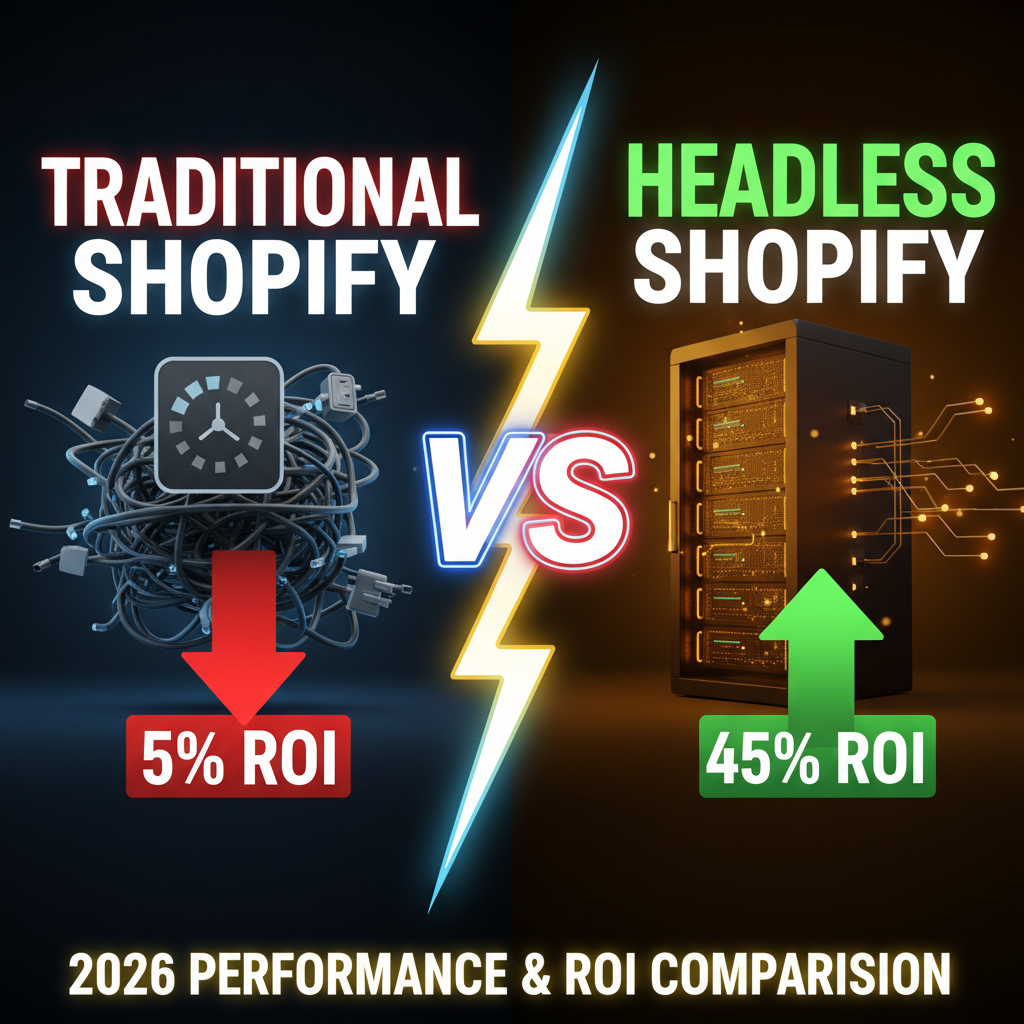
Ready to evaluate the headless path? Check out our Shopify Hydrogen 101 guide to understand the basics first. Or compare headless vs traditional Shopify performance to see if custom development is right for your brand.
Article FAQ
Q: Is Shopify Hydrogen enterprise-ready?
A: Hydrogen works for enterprises with simple integrations and Shopify-centric operations. Once you add external OMS, WMS, or complex B2B pricing, Hydrogen becomes a bottleneck. Most $100M+ enterprises outgrow it within 18–24 months of launch.
Q: What's the real difference between custom Next.js and Shopify Hydrogen?
A: Hydrogen is Shopify-specific and Shopify-maintained. Custom Next.js is framework-agnostic and fully under your control. Custom lets you integrate third-party systems at the data layer. Hydrogen forces integrations via API stitching, which adds latency and complexity.
Q: How much does a custom headless storefront cost?
A: A production-ready custom storefront runs $200K–$400K to build, plus $5K–$15K monthly operations. Composable stacks with external OMS/WMS reach $500K–$1M+. Payback period for most enterprises is 18–24 months due to efficiency and revenue gains.
Q: Can we migrate from Hydrogen to custom Next.js without downtime?
A: Yes, with a phased approach. Run both storefronts in parallel, route 10% test traffic to the new build, and gradually migrate traffic over 4–6 weeks. Ensure feature parity and conversion rate matching before decommissioning Hydrogen.
Q: Does headless commerce mean ditching Shopify?
A: No. Most enterprise headless stacks keep Shopify as the commerce core (products, pricing, orders) but add a custom storefront and integrations. Shopify becomes a content and order management system, not the entire platform.
Q: What's the biggest risk of going custom headless?
A: Underestimating integration complexity and ongoing engineering costs. Custom storefronts are not "set and forget." Plan for continuous improvement, security patching, third-party API updates, and team growth. Many enterprises spend 1–2 FTE annually on maintenance post-launch.