What is Headless Commerce?
Headless commerce decouples the front-end (the storefront customers see) from the back-end (inventory, payments, fulfillment). In traditional Shopify, they're tightly integrated. You edit your store in the Shopify admin, and those changes appear on your storefront.
In headless commerce, your front-end is independent. Shopify becomes a back-end API. You build your own interface using React, Vue, or any framework. You control the checkout experience, the product page layout, the search functionality—everything.
Shopify Hydrogen is their official headless framework. It's built on React and Remix, optimized for fast storefronts, and bundled with pre-built commerce components. It's not the only headless option (you could use Next.js or Nuxt), but Hydrogen is the path Shopify officially recommends and supports.
The Economics: When Does Headless Make Sense?
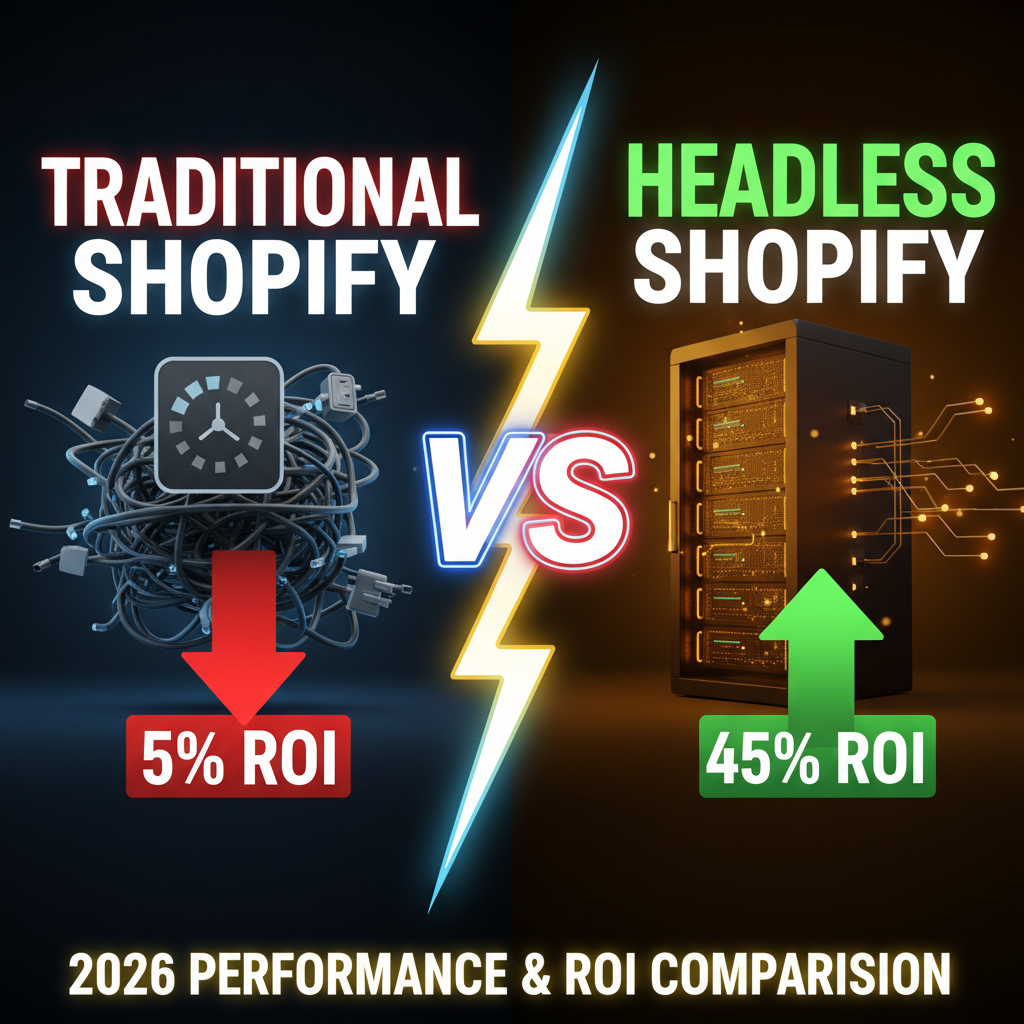
Headless commerce costs 2-3x more than traditional Shopify initially, but the ROI compounds if you're at scale.
Cost Breakdown:
| Component | Traditional Shopify | Headless (Hydrogen) | Difference |
|---|---|---|---|
| Platform (monthly) | $299–$2,000 | $2,000–$40,000 (Shopify Plus) | +$1,700–$38,000 |
| Frontend hosting (monthly) | Included | $500–$3,000 | +$500–$3,000 |
| Development (initial) | $15,000–$50,000 | $80,000–$250,000 | +$65,000–$200,000 |
| Ongoing maintenance (annually) | $5,000–$15,000 | $30,000–$60,000 | +$25,000–$45,000 |
| Total Year 1 | $35,000–$80,000 | $200,000–$500,000 | 5.7x higher |
The break-even point comes when the conversion lift, speed gains, and operational efficiencies exceed that cost difference.
Scenario: When Headless Pays For Itself
A $10M revenue store on traditional Shopify with 2% conversion rate (200K conversions/year).
With headless: - Speed: Page load time drops from 3.2s to 1.8s, which typically lifts conversion by 0.8-1.2% - UX: Custom checkout reduces friction and lifts conversion by 0.5-1.0% - Personalization: Dynamic product recommendations via API add 0.3-0.5% lift
Conservative estimate: 1.6% conversion lift = 32K additional conversions × $50 AOV = $1.6M incremental revenue.
Against Year 1 costs of $300K–$400K, that's a 4:1 ROI in Year 1 alone. By Year 2, the calculus is even better because development costs are amortized.
This math only works at $5M+ revenue and requires that you're losing meaningful conversion to Shopify's template constraints.
The Shopify Hydrogen Tech Stack
Hydrogen consists of three layers:
Layer 1: Hydrogen Framework (React + Remix)
Remix handles server-side rendering (SSR), which improves performance and SEO. Your React components run on both server and client, reducing JavaScript sent to the browser.
Example: A product page component in Hydrogen.
import { useLoaderData } from '@remix-run/react';
import { json } from '@shopify/remix-oxygen';

export const loader = async ({ params, context }) => {
  const { storefront } = context;
  const { handle } = params;

  const product = await storefront.query(GET_PRODUCT_QUERY, {
    variables: { handle }
  });

  return json({ product });
};

export default function ProductPage() {
  const { product } = useLoaderData();

  return (
    <div>
      <h1>{product.title}</h1>
      <p>{product.description}</p>
      <AddToCart variant={product.variants[0]} />
    </div>
  );
}
The product data loads server-side, the HTML ships to the browser pre-rendered, and React hydrates on the client. This is fundamentally faster than client-side rendering.
Layer 2: Shopify Storefront API
The Storefront API is your connection to Shopify's backend. You query product data, manage carts, process checkouts—all via GraphQL.
const GET_PRODUCT_QUERY = `
  query GetProduct($handle: String!) {
    product(handle: $handle) {
      title
      description
      priceRange {
        minVariantPrice {
          amount
          currencyCode
        }
      }
      images(first: 10) {
        nodes {
          url
          altText
        }
      }
      variants(first: 100) {
        nodes {
          id
          title
          price {
            amount
          }
          availableForSale
        }
      }
    }
  }
`;
This replaces traditional REST endpoints. You request exactly the fields you need, which reduces payload size and improves performance.
Layer 3: Deployment and Hosting
Hydrogen projects deploy to Oxygen (Shopify's edge hosting) or any Node.js-compatible host (Vercel, Netlify, AWS).
Oxygen is optimized for Shopify's Storefront API, with response times averaging 150-200ms (vs 300-500ms on traditional hosts). It also handles automatic cache purging when your product data changes.
Performance Gains: Real Numbers
Hydrogen stores see consistent speed improvements over traditional Shopify:
| Metric | Traditional Shopify | Hydrogen | Improvement |
|---|---|---|---|
| First Contentful Paint (FCP) | 3.4s | 1.5s | 56% faster |
| Largest Contentful Paint (LCP) | 5.2s | 2.1s | 60% faster |
| Cumulative Layout Shift (CLS) | 0.18 | 0.08 | 56% better |
| Time to Interactive (TTI) | 6.8s | 2.9s | 57% faster |
| Core Web Vitals Score | 45/100 | 88/100 | +43 points |
Source: Shopify's 2024 Hydrogen Performance Benchmarks across 40 production stores.
These speed gains directly correlate with conversion lift. Baymard Institute's research shows that every 1-second delay in page load costs 7-10% in conversion rate. A 2-3 second improvement is material—we're talking 14-30% potential lift.
The Hidden Costs Nobody Talks About
Beyond direct development costs, headless introduces operational complexity that traditional Shopify avoids.
Complexity 1: Caching Strategy
In traditional Shopify, caching is mostly managed by the platform. In headless, you manage edge caching, server caching, client caching, and CDN behavior. Get it wrong and your product pages show stale prices or inventory.
Here's a basic caching layer using Hydrogen:
export const loader = async ({ params, context }) => {
  const { storefront } = context;

  const product = await storefront.query(GET_PRODUCT_QUERY, {
    variables: { handle: params.handle }
  });

  return json(
    { product },
    {
      headers: {
        'Cache-Control': 'public, max-age=3600, stale-while-revalidate=86400'
      }
    }
  );
};
This caches product pages for 1 hour, and serves stale versions for up to 24 hours if the server fails. But configuring this correctly requires deep caching knowledge.
Complexity 2: SEO
Traditional Shopify handles SEO basics (meta tags, structured data, sitemaps) automatically. Headless requires you to implement this manually.
export const meta = ({ data }) => {
  const { product } = data;

  return [
    { title: `${product.title} | Your Store` },
    { name: 'description', content: product.description },
    {
      name: 'og:image',
      content: product.images.nodes[0]?.url
    }
  ];
};
You also need to generate sitemaps, implement structured data (JSON-LD), and manage canonicals. Doable, but requires discipline.
Complexity 3: Ongoing Maintenance
React and Remix move fast. New versions release quarterly. Browser APIs change. Your team needs to maintain the codebase continuously. With traditional Shopify, updates happen automatically.
Complexity 4: Shopify API Deprecations
Shopify regularly deprecates API fields and endpoints. When they do, your headless store breaks until you update your queries. This is a known issue in the headless community.
Who Should (and Shouldn't) Use Hydrogen?
Use Hydrogen if: - Your store does $5M+ in annual revenue (ROI math works) - You need a custom checkout experience (one-page, upsell-heavy, B2B) - You're building for multiple channels (web, mobile app, voice commerce) and need a shared API - You operate in a category (luxury, fashion, outdoor) where design differentiation directly impacts sales - You have a technical team or budget for a development partner
Don't use Hydrogen if: - Your store is under $3M revenue (costs exceed ROI) - You're launching a new store and don't yet have product-market fit - Your Shopify theme meets 90%+ of your needs - You don't have budget for ongoing maintenance and updates - Your team lacks JavaScript/React expertise
Alternatives to Hydrogen
Hydrogen isn't the only headless path. Depending on your tech preferences and budget:
Next.js + Shopify Storefront API More flexible than Hydrogen, better for teams already invested in Next.js. Requires more custom work. Cost: Similar to Hydrogen.
Custom Backend + GraphQL Full control over data layer and business logic. Highest development cost ($150K+). Best for B2B and highly customized commerce platforms.
Composable Commerce Platforms (commercetools, Medusa) Purpose-built for headless. More expensive platform fees ($500–$3K/month), but less custom development needed.
The Decision Framework
Ask yourself these four questions:
- Speed Impact: Will a 50% faster site measurably improve your conversion rate given your current AOV and traffic volume?
- Design Constraints: Are you losing sales because Shopify themes can't implement your brand vision?
- Multi-Channel: Do you need to sell on web, mobile app, social, and voice simultaneously with a unified backend?
- Budget: Can you afford $200K–$500K upfront development plus $30K–$60K annually in maintenance?
If you answer yes to three of four, headless makes sense. If you answer yes to one or two, stick with traditional Shopify and optimize what you have.
Ready to Evaluate Your Architecture?
Headless commerce is powerful but complex. The right choice depends on your scale, constraints, and team capability. A $2M store on a good Shopify theme will always outperform a poorly-executed Hydrogen implementation.
Our team at Tenten has built Hydrogen storefronts for Shopify Plus merchants in fashion, luxury goods, and B2B commerce. We can audit your current setup, model the ROI of a headless transition, and help you decide whether Hydrogen is worth the investment.
Let's discuss your architecture roadmap or explore more on our technical platform.
Editorial Note Shopify actively pushes Hydrogen and headless architecture because it increases switching costs and platform lock-in. This doesn't make it bad—it's genuinely superior for high-volume merchants. But it's not a universal solution. Pick the architecture that matches your economics.
Frequently Asked Questions
Is Shopify Hydrogen the same as Shopify Headless?
No. Headless is the architecture (separating front-end from back-end). Hydrogen is Shopify's specific framework for building headless storefronts. You could build headless using Next.js or other frameworks instead of Hydrogen.
Can I use Hydrogen for a small store?
Technically yes. Practically no. The economics don't work below $3-5M revenue. Traditional Shopify is the right choice for smaller stores.
Will migrating to Hydrogen improve my SEO?
Potentially. Hydrogen's faster load times and server-side rendering improve Core Web Vitals, which signals quality to Google. However, SEO gains are secondary to conversion lift. Speed is just one factor in rankings.
Do I need to know React to use Hydrogen?
Yes. If your team doesn't know React, you'll need to hire developers or work with an agency. Learning curve is 2-4 months for an experienced JavaScript developer.
Can I migrate my current Shopify store to Hydrogen without rebuilding?
Not directly. You'll rebuild your storefront (product pages, collection pages, checkout flow) using Hydrogen components. Product data migrates automatically via the Storefront API. Total migration time: 4-8 weeks for a medium-sized store.
Does Hydrogen work with Shopify billing and subscriptions?
Yes. The Storefront API supports subscriptions, one-time purchases, and recurring billing. Hydrogen provides components for subscription flows.