Working with Nvidia, TSMC & ASUS: What We Learned About Enterprise Ecommerce
enterprise-ecommerce-nvidia-tsmc
Working with Enterprise Ecommerce: Lessons from Taiwan's Biggest Tech Companies
Enterprise ecommerce isn't a scaled version of SMB ecommerce. It's a different animal. A $100M company doesn't just need 100x the infrastructure—it needs different governance, different tooling, and different operational complexity. We've worked with Taiwan's biggest tech companies (Nvidia, TSMC, ASUS) on their global ecommerce initiatives. The lessons from those engagements are not what you'd expect.
The Enterprise Problem: Not Revenue, But Complexity
When Nvidia wanted to sell GPUs directly to large enterprise customers (clusters, research institutions, cloud providers), they didn't hire more merchants. They hired the wrong team and learned lessons most Shopify operators will never face.
The problem isn't volume—enterprise can handle volume. The problem is contractual complexity, pricing negotiation, order fulfillment variability, and account management dependencies. An enterprise order might involve:
- 6-month payment terms (vs 30 days)
- Volume discounts tiered by quantity AND customer segment
- Custom configurations (SKU explosions)
- Multiple billing addresses and shipping destinations
- Compliance and regulatory requirements (certifications, export licenses)
- Customer success management post-sale
Shopify's default flows are designed for frictionless consumer purchases. Enterprise purchases are intentionally high-friction because friction = control and accountability.
Lesson 1: Your eCommerce System Is Not Your ERP
Nvidia's first mistake: treating their ecommerce platform as the source of truth for enterprise orders. It isn't. An enterprise customer places an order on your website, but that order touches 4-5 systems before fulfillment: financial system (credit check), inventory system (configuration), warehouse management (fulfillment), shipping system (customs), and customer success (onboarding).
Most enterprise problems aren't ecommerce problems—they're integration problems.
What worked: Build your ecommerce system as a customer-facing sales channel only. Orders flow from ecommerce into an order management system, which orchestrates all the backend systems. Your ecommerce platform doesn't know about payment terms, inventory allocation, or fulfillment—it just captures intent and routes orders downstream.
At Nvidia scale, that means Shopify became a front door, not the nervous system. Orders flow through Shopify into NetSuite (ERP), which handles pricing, payment terms, inventory, and fulfillment. Shopify handles discovery, product information, and quote generation—not order management.
For merchants >$50M revenue, Shopify should be your sales channel, not your operational core. Hybrid it with an ERP.
Lesson 2: Custom Pricing Is Your Main Feature, Not a Complexity
Consumer brands think pricing is simple: $99 everywhere. Enterprise thinks pricing is fluid: $99 for volume <100, $85 per unit for 100-500, $70 per unit for 500+. And that changes per customer segment (OEM vs distributor vs reseller vs end-user).
TSMC semiconductor distribution taught us that pricing flexibility is the competitive edge. If your platform can't handle matrix pricing (unit cost × volume × customer type × geography), you lose deals to competitors who can.
What worked: Store custom pricing rules in a separate pricing engine connected to your ecommerce platform. Shopify shows baseline prices; the pricing engine applies rules in real-time. A distributor logs in, prices shift automatically. No negotiation, no quotes—just transparency.
TSMC built this with a custom app (not Shopify native) that queries their pricing database on every add-to-cart. Prices are dynamic. Transparency increases velocity because customers understand margins upfront.
Lesson 3: Quote-to-Order Workflows Trump Buy-Now Buttons
Consumer ecommerce is about impulse. Enterprise ecommerce is about documentation. Enterprise customers need quotes they can share internally, approve, and execute against. A $5M purchase requires 6-9 months of approval cycles.
Shopify's native flows assume instant purchase. Enterprise assumes multi-step approval. That gap creates friction.
What worked: Build a quote engine alongside your ecommerce platform. Customer builds a cart, generates a quote (not a purchase), and shares internally for approval. Once approved, they convert quote to order. The quote lives for 30-60 days (negotiable terms). This is document-driven buying, not impulse buying.
ASUS implemented this for their enterprise partner program. Partners log in, build quotes with custom pricing, share through their procurement system, and convert when approved. Quote-to-order conversion takes 2-6 months, not 30 seconds. But it's predictable and auditable.
Lesson 4: Account Management > Self-Service
Consumer ecommerce optimizes for removing friction. Enterprise ecommerce optimizes for accountability. Those are opposite goals.
Small customers (volume <$50K/year) can self-serve. Large customers (volume >$1M/year) need account managers. Not because they can't click buttons—because one misaligned order costs $50K+ and someone needs to catch it before it happens.
What worked: Segment customers by total contract value. Below $50K/year, self-service ecommerce. Above $50K/year, dedicate an account manager who processes orders through a private portal with higher approval gates. Account managers see order history, payment terms, volume discounts, and can flag anomalies before fulfillment.
This seems backward—serve your biggest customers WITH friction? Yes. Because that friction is verification. An account manager catching a misconfiguration saves 10x what they cost.
Lesson 5: Forecasting Is Your Real Margin Advantage
Consumer merchants optimize for conversion. Enterprise merchants optimize for accuracy. An accurate forecast of next year's demand is more valuable than a 5% conversion improvement this quarter.
Enterprise customers often commit to annual volume forecasts (take-or-pay contracts). If you deliver them accurate inventory, they reorder faster. If you disappoint them with stockouts, they switch vendors.
What worked: Build transparent inventory allocation workflows. Enterprise customers submit annual forecasts. Your system allocates inventory, prioritizes production, and guarantees availability at negotiated prices. Accuracy + certainty > chasing every order.
Nvidia allocated GPUs across distribution channels using annual forecasts from major cloud providers (AWS, Azure, GCP). Those forecasts determined production allocation. Channel partners who met forecasts got priority access; those who over-ordered faced holdbacks. This created discipline and reduced waste.
The Enterprise Playbook: Framework, Not Feature
Enterprise ecommerce succeeds with this framework:
- Tiered Pricing Engine: Rules-based pricing by customer segment, volume, and contract
- Quote Workflow: Approval-driven buying, not impulse checkout
- Order Management System: Shopify → ERP → Fulfillment, not Shopify as monolith
- Account Management Layer: Dedicated contact per high-value customer
- Forecasting Infrastructure: Multi-year planning and allocation
- Compliance Integration: Certifications, export controls, regulatory proofs
- Payment Terms Management: Variable payment timing per contract
- Multi-location Fulfillment: Distribution center routing based on customer location and volume
Shopify handles #1, #2, and part of #3. Everything else requires custom integration.
Comparison: SMB vs Enterprise Ecommerce Architecture
| Element | SMB (Shopify Native) | Enterprise (Shopify + ERP) |
|---|---|---|
| Primary Operator | Store owner / Merchant | Sales ops + Finance + Supply chain |
| Order Cycle Time | 24-48 hours | 2-6 months |
| Pricing Model | Fixed per SKU | Matrix pricing by customer/volume |
| Approval Gates | None (impulse) | 4-6 approval tiers |
| Payment Terms | Net 30 (Shopify Payments) | Net 30-90 or COD |
| Inventory Model | FIFO available | Allocated per contract |
| Customer Touch | Self-service | Dedicated account manager |
| Contract Management | None | Master service agreement + SOW |
| Integration Cost | $0-5K | $100K-500K+ |
| Revenue Predictability | Low (channel volatility) | High (committed forecasts) |
Enterprise operators view unpredictability as risk. SMB operators view unpredictability as opportunity. Those cultures are incompatible on the same platform.
Why Most Shopify Stores Stop at $10M Revenue
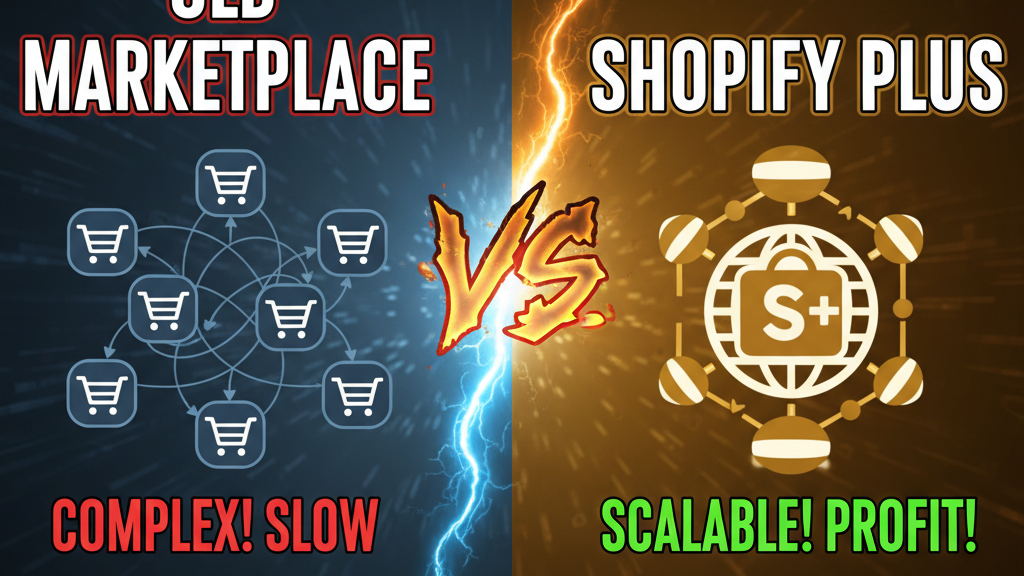
Enterprise customers don't trust SMB platforms for large volume. Shopify is great up to $5M-$10M. Beyond that, sales ops and finance teams demand ERP integration, multi-location fulfillment, and payment orchestration that Shopify doesn't provide natively.
Stores that cross $10M revenue and want to keep growing have three options:
- Keep Shopify + bolt-on integrations (custom development, messy)
- Migrate to Shopify Plus + custom apps (expensive, still limited)
- Build custom ecommerce on top of Shopify API (headless) + native ERP (most robust)
Nvidia chose option 3 around $2B revenue. ASUS chose option 2. Both work, but require different philosophies.
FAQ
Q: Is Shopify Plus enough for enterprise ecommerce?
A: Shopify Plus gets you to ~$50M revenue with custom apps. Beyond that, headless + native ERP is more reliable. Shopify Plus is powerful for brand-focused enterprise (Nike, Allbirds). Not powerful for B2B enterprise (TSMC, Nvidia model).
Q: What's the minimum revenue to justify custom integration?
A: $10M+. Below that, Shopify + manual workflows is fine. Above that, integration costs ($50K-200K) pay for themselves within 12 months.
Q: How long does enterprise ecommerce integration take?
A: 4-8 months for a basic ERP connector. Add quote workflows, pricing engines, and account management: 8-12 months. This isn't fast. Plan accordingly.
Q: Can I use Shopify Plus for multi-brand, multi-region enterprise?
A: Yes, with custom apps. Shopify Plus handles multi-currency, multi-language, and custom workflows. But you'll spend $100K-300K on apps. Might be cheaper to build headless.
Q: Should I sell enterprise and SMB on the same platform?
A: No. Enterprise customers see SMB features as unprofessional. Build two storefronts: one (Shopify) for SMB/DTC, another (custom or Salesforce Commerce) for enterprise. Same inventory, different experience.
Q: What's the most common failure in enterprise ecommerce?
A: Treating it like scaled SMB. Enterprise is not SMB + bigger numbers. It's different buyers, different buying cycles, different success metrics. Most Shopify merchants fail because they try to force SMB processes onto enterprise deals.
Q: How do you handle payment terms for enterprise customers?
A: Outside of Shopify. Use a subscription/recurring billing system (Zuora, Chargebee) or manual invoicing (NetSuite). Shopify Payments is Net 30 only. You need flexibility.
Building enterprise ecommerce on Shopify? Let's talk about integrating your ERP with Shopify Plus and custom workflows. We've built enterprise stacks for Shopify Plus partners and can help you architect the right integration.
For deeper reading on Shopify Plus capabilities, check Shopify Plus vs Salesforce Commerce Cloud comparison.