The D2C Opportunity Is Real, But Fragile
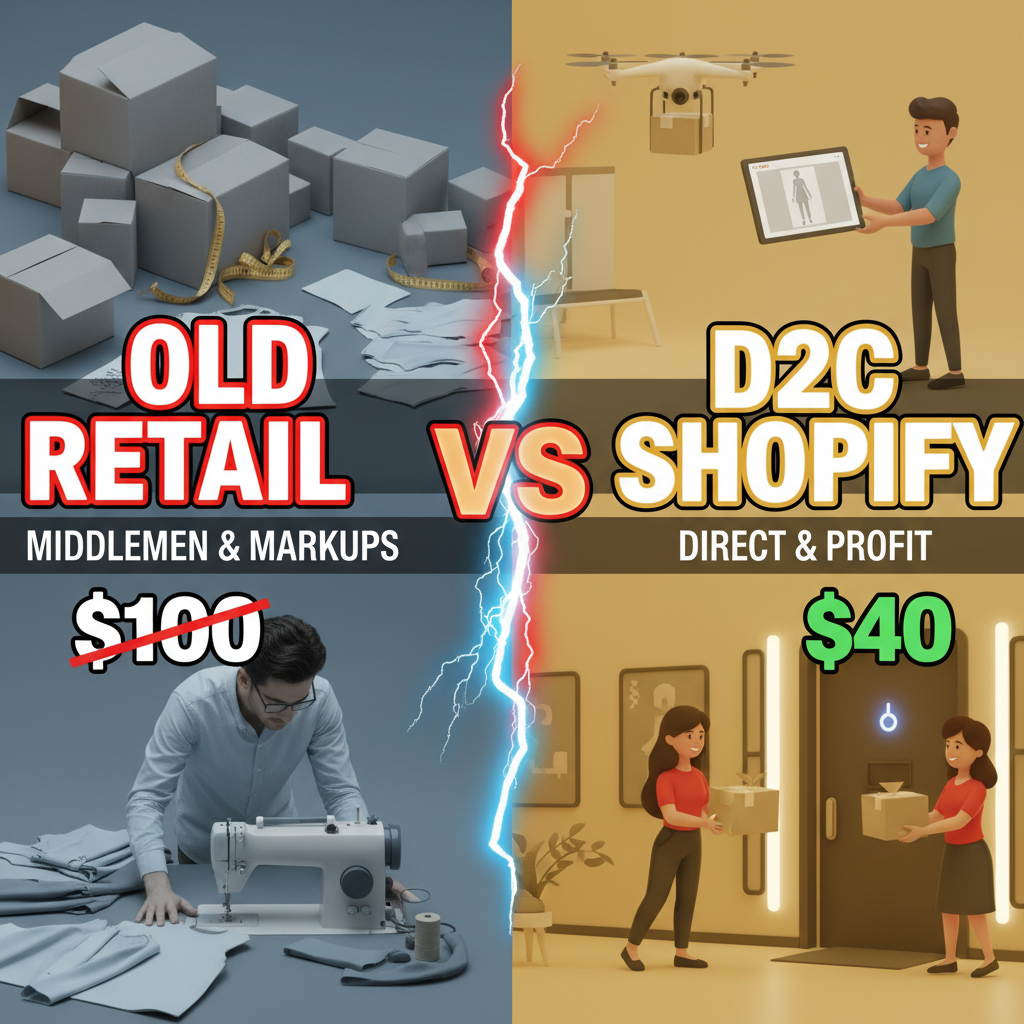
Direct-to-consumer brand building attracts founders because the promise is simple: cut out the middleman, own your customer data, capture full margin. The data backs this up. D2C brands charge 50-200% price premiums over wholesale because they control the narrative, the packaging, and the customer experience. On paper, this looks like gold.
But here's what nobody tells you: most D2C brands fail not because their product is bad—it's because they skip positioning. They launch a Shopify store with a generic brand name, grab inventory, and hope product quality carries them through first sales. This fails because founders confuse product differentiation with brand positioning. A great product in a crowded market still loses to mediocre products with crystal-clear positioning.
Positioning is the decision framework your customer uses to choose you. It comes before the store, before the branding, before the first dollar spent on ads. Get this wrong, and no Shopify optimization will save you.
Why D2C Positioning Beats Generic Branding
Most D2C founders obsess over: logo design, color palettes, taglines, social media aesthetics. These are outputs of positioning, not inputs. Real positioning starts with three hard choices.
1. Who specifically are you not for?
This is the most important decision you'll make. Every mega-brand succeeded by saying no to 90% of the market. Apple said no to low-cost computers. Tesla said no to incremental efficiency gains. YETI said no to budget-conscious cooler buyers.
Your D2C brand must have an enemy. Not a competitor—an enemy value system. If you sell premium skincare, your enemy is the belief that expensive skincare equals "celebrity chemicals." If you build mechanical watches, your enemy is the smartphone takeover narrative.
The brands that grow fastest are those that position against a worldview, not just a competitor. Customers choose your brand because what you stand against matters to them as much as what you stand for.
2. What is the ONE meaningful difference in your product or experience?
Here's where most founders get trapped: they list 5-7 product features as differentiation. "Organic ingredients, fair-trade sourced, sustainably packaged, woman-owned, carbon-neutral shipping."
Each point is good. Together, they're noise. Your customer brain can hold one core difference. One.
For D2C furniture brand Article, it's "mid-century modern design at non-luxury prices"—that's it. For Allbirds, it's "sustainable materials that don't feel like compromise." For Glossier, it's "makeup as self-expression, not mask-wearing."
Find your one meaningful difference. Everything else follows from that.
3. What audience belief is your brand trying to change?
This is the secret most agencies won't tell you: D2C growth compounds when you're shifting how a market thinks, not just selling products.
Peloton didn't just sell expensive bikes. It shifted the belief that fitness + community requires leaving your home. Warby Parker didn't just disrupt eyeglasses; it shifted the belief that buying glasses should involve $300+ price tags and mall appointments.
Before you launch on Shopify, ask: What false belief in your market are we correcting?
| Positioning Layer | Traditional Brands | D2C Brands |
|---|---|---|
| Primary focus | Price, availability | Worldview, belief-shifting |
| Competitor framing | Named competitors | Industry assumption being challenged |
| Brand moat | Distribution, supply chain | Customer conviction and mission alignment |
| Growth pathway | Market expansion | Expand market definition itself |
| Customer motivation | Functional benefit | Identity and values alignment |
Building Your Positioning Statement (The Real Framework)
Once you've answered those three questions, write your positioning statement. This is not marketing copy. It's internal clarity.
Format: "[Our brand] is for [specific customer], because [customer belief], and we're the only ones who [unique approach]."
Example 1: "Lululemon is for ambitious athletes who believe fitness is a lifestyle, not a hobby, and we're the only ones building an entire athletic ecosystem around community."
Example 2: "Allbirds is for conscious consumers who believe sustainable products shouldn't feel like compromise, and we're the only ones making performance footwear from renewable materials."
Your positioning statement should feel specific, slightly controversial, and defensible. If it sounds generic (e.g., "We make high-quality coffee for people who care about quality"), keep refining.

Shopify Setup: Converting Positioning Into Store Architecture
Once positioning is locked, your Shopify store becomes a delivery system for that positioning. This changes how you build.
Theme and template selection: Skip the generic themes. Choose themes that embody your positioning. If your brand positioning is "premium minimalism," Boundless or Prestige theme communicates that in the first 2 seconds. If it's "bold, playful, youth-focused," Pick a theme with strong typography and color flexibility.
Homepage messaging: Your hero section should state your positioning, not your product. "For ambitious athletes building their lifestyle" beats "Premium athletic apparel." Customers already know you sell products. They need to know what you stand for.
Collection organization: Most D2C founders organize collections by product type (men's, women's, accessories). Better: organize by customer behavior or belief. If your positioning is "design + sustainability," collections might be "Investment Pieces," "Everyday Basics," "Limited Editions." This reinforces your positioning at every touchpoint.
Product descriptions: This is where positioning comes alive. Don't describe specs. Describe the belief you're supporting. Instead of "Premium cotton blend with reinforced stitching," write: "Built for daily wear by people who reject fast fashion. Our signature blend balances durability with breathability—the choice of designers who value longevity."
Pre-Launch: The 90-Day Positioning Validation Sprint
Before you spend $5K+ on inventory, validate your positioning. This is free or cheap.
Week 1-2: Customer interviews (10-15 interviews) Talk to people in your target customer segment. Don't pitch. Ask: "What frustrates you about existing solutions?" Listen for the belief you're trying to shift. Does your positioning match what real customers care about? If not, adjust now.
Week 3-4: Landing page test (50 variations) Build a simple landing page around your positioning statement. Drive 500-1000 clicks from paid ads (Facebook, Google, Reddit). Measure email signups, not purchases. Your goal: does your positioning resonate? If signup rate is <5%, your positioning isn't clear enough.
Week 5-8: Community validation Find 2-3 Reddit communities, Facebook groups, or Discord servers where your target customer hangs out. Don't spam. Participate. Share insights. Ask for feedback on your brand idea. Do people light up at your positioning? Or do they shrug?
Week 9-12: Pre-order test Build a minimal Shopify store with 3-5 core products. Run a 2-week pre-order campaign. Goal: 20-30 pre-orders minimum. This proves demand before you commit to full inventory. If you can't get 20 pre-orders, your positioning + product combo isn't compelling enough yet.
Shopify Inventory Strategy for D2C Founders
Here's the math most founders get wrong: they assume "inventory turns 3x per year" is standard. For D2C, it's often 1-1.5x for new brands.
This means buying too much inventory is the fastest way to burn capital. Instead:
Batch 1 (Pre-launch): Buy enough for 100-150 units of your top 3 SKUs. This is testing inventory, not forecasting based on demand you haven't proven yet.
Batch 2 (Month 1-3 post-launch): Based on pre-order data, increase to 300-500 units. Add 1-2 new SKUs if data shows customer demand for variety.
Batch 3 (Month 3-6): Scale to 1000+ units only if you've validated 2+ months of consistent sales and 4-6 week inventory turnover.
Shopify + a good inventory management app (like Stocky or Inventory Planner) is your early-stage safety net. Track inventory turnover weekly. If you're holding 6+ months of inventory for any SKU, you've made a bad bet.
Go-to-Market: Your First 90 Days Post-Launch
Your positioning informs your go-to-market strategy. Here's the playbook:
Week 1-2: Friends and family Sell to people who know you and believe in your positioning. Your goal: 20-30 orders, video testimonials, and unboxing social proof. Use this as content.
Week 3-4: Community-first ads Run small-budget campaigns ($200-500/week) to communities where your target customer hangs out. Not broad-audience Facebook ads. Specific Reddit communities, niche Discord servers, LinkedIn groups. Your message should double-click on your positioning, not your product features.
Week 5-8: Content marketing Write 2-3 blog posts that defend your positioning. "Why we chose sustainability over speed," "The case for ethical labor in fashion," etc. This attracts organic traffic and builds SEO moats. Pair with email nurture sequences.
Week 9-12: Influencer seeding (micro, not macro) Send products to 10-15 micro-influencers (5K-50K followers) in your niche. Don't pay for posts. Send products aligned with their positioning. If they love it, they'll post. If not, you've learned something. Macro influencers (100K+) want money you don't have yet. Micro-influencers want alignment with your values.
| Launch Phase | Key Metric | Target | Why |
|---|---|---|---|
| Week 1-2 | Orders from warm audience | 20-30 | Proof of concept |
| Week 3-4 | Email signups to seed list | 500-1000 | Organic demand signal |
| Week 5-8 | Repeat purchase rate | 10-15% | Product-market fit indicator |
| Week 9-12 | Organic traffic | 100-200/week | SEO and content moat |
The Biggest Mistakes Early D2C Founders Make on Shopify
Mistake 1: Skipping positioning, jumping to ads You'll spend $5K-$10K on Facebook ads before you've validated your positioning. You'll get sales, but your customer acquisition cost will be 3-5x sustainable levels because you're chasing everyone, not the right people. Position first. Ads second.
Mistake 2: Inventory based on hope, not data You fall in love with your product and order 1000 units based on gut. 6 months later, 600 units are sitting in a garage. You've burned capital that should have gone to customer acquisition or product iteration.
Mistake 3: Copying the DTC playbook wrong You see Glossier, YETI, and Warby Parker and think: "I'll do what they do." But you're missing 5 years of brand building. Their "direct-to-consumer" advantage exists because they have a clear positioning and massive audience. You don't. Start with positioning + community, not Facebook ads + brand partnerships.
Mistake 4: Treating Shopify as your only customer touchpoint Your store is 30-40% of your customer journey for early D2C. The other 60% is email, content, community. Shopify is fulfillment engine, not acquisition engine. Build your email list before your sales. This gives you a second life if ads get expensive.
Mistake 5: No data infrastructure on day 1 You launch without UTM tracking, email platform integration, or analytics setup. You get 100 orders by month 3 and have no idea where 50% of them came from. Set up Shopify + Klaviyo + Google Analytics 4 + UTM tracking on day 1. $200 and 2 hours of setup time saves you $10K+ in wasted ad spend later.
Ready to Build Your D2C Brand?
Building a D2C brand on Shopify is achievable for first-time founders. The difference between success and burnout is clarity: positioning clarity, inventory clarity, and customer acquisition clarity.
Start with positioning. Test it with a landing page and pre-orders. Scale inventory only when demand is proven. Then execute your go-to-market with precision, tracking every channel.
If you're raising capital, hired a team, or scaling beyond $1M in revenue, Tenten can help you design a custom Shopify infrastructure that supports international expansion, complex fulfillment, and headless architecture. Schedule a conversation to explore what's possible.
From the Tenten Editorial Team
We've watched dozens of D2C brands launch on Shopify. The ones that survive year two all share one trait: clarity on who they are not. This positioning discipline compounds over time. Early on, it feels like constraint. By year two, it becomes your unfair advantage.
Frequently Asked Questions
How do I know if my D2C positioning is strong enough to launch?
Run pre-order test. If you can't get 20 pre-orders from cold audiences (Reddit, Facebook groups, email lists), your positioning + product combo needs more work. Don't launch until positioning converts at least 2-5% of traffic into email signups or pre-orders.
Should I start with one SKU or multiple products?
Start with 3-5 core SKUs (product variants of your best sellers, not entirely different categories). This gives customers choice without overwhelming your inventory management. Add new categories only after you've hit $50K+ in monthly revenue and have 8+ weeks of sales data per SKU.
How much should I spend on inventory before launch?
$3K-$10K is typical for a first batch (100-150 units). This is enough to test product-market fit without overcommitting. After validation, scale to $15K-$30K per batch.
What's the fastest way to validate market demand?
Landing page + pre-order campaign (4 weeks). Drive 500-1000 paid clicks to a landing page explaining your positioning. If email signup rate is 3%+ and pre-order conversion is 2%+, you have demand signal.
Do I need an expensive designer for my Shopify store?
No. Pick a modern, clean theme ($150-400 one-time) that aligns with your positioning. A good copywriter ($2K-5K) beats a great designer for early D2C. Your positioning + clear messaging will drive sales more than visual design alone.
How long until profitability?
Depends on margins and customer acquisition cost. Most D2C brands aim for 12-18 months to CAC payback. If you're not tracking ROAS (Return on Ad Spend) weekly, you won't know if you're on pace. Set this up in month 1.