The AI Shopper Revolution Is Happening Now
Three years ago, AI-powered shopping was science fiction. Today, it's driving real traffic. ChatGPT Shopping, Perplexity Buy, and Google Gemini each have millions of users making purchasing decisions through AI assistants.
The shift matters for your Shopify store. Your traffic sources are changing. Fewer people start on Google Search. More start with "Hey ChatGPT, find me a sustainable backpack under $150." The AI picks your store—or doesn't.
The data: 34% of US internet users aged 18–34 have used an AI shopping agent to find products (Harris Poll, 2024). For luxury and technical products, the number jumps to 48%. If you're not optimized for AI shopping agents, you're leaving conversions on the table.
But here's the wrinkle: the three platforms have wildly different user bases, recommendation mechanisms, and conversion behavior. Understanding which drives traffic to YOUR store is critical for marketing ROI.
ChatGPT Shopping: The Volume Play
ChatGPT Shopping (integrated with OpenAI's e-commerce partnerships) is the largest by user base: 200M+ monthly active users. It dominates because ChatGPT is where most people start when they want information—shopping is just one use case.
Traffic patterns: - 62% of ChatGPT shopping traffic comes from product research questions ("best budget headphones") - 23% from follow-up purchases (repeat customers, brand loyalty) - 15% from contextual recommendations (mid-conversation product mentions)
Conversion rate: 1.8–2.1% (lower than organic search, but volume compensates).
Why lower conversion? ChatGPT users are in "research mode." They ask open-ended questions, compare 5–7 options, often leave to search more. The tool shows multiple products; your store competes against 3–5 others in the same response.
Key insight: ChatGPT traffic converts better if your product has strong differentiation. If you're a commodity (another blue USB-C cable), you'll get clicks but few purchases. If you're unique (artisan handmade cables with 10-year warranty), ChatGPT sends qualified traffic.
Optimization for ChatGPT: - Ensure your product pages have clear differentiation points - Include detailed specifications and warranty information - Get customer reviews on reputable sites (Google Reviews, Trustpilot) - Use schema markup (Product JSON-LD) so ChatGPT understands your product data
Perplexity Buy: The Intent-Driven Engine
Perplexity is smaller (50M+ monthly users) but more focused. Users coming to Perplexity are intentional shoppers. They don't stumble in randomly; they come specifically to answer a question or find a product.
Traffic patterns: - 71% of Perplexity traffic is high-intent ("where do I buy X?") - 19% from research-to-buy journey (question → comparison → purchase) - 10% from impulse discovery (recommendations while answering unrelated questions)
Conversion rate: 3.2–4.1% (higher intent, lower volume).
Why higher conversion? Perplexity users are farther along the buying journey. They're not casually exploring; they have a problem and want a solution. The platform surfaces products that solve that specific problem.
Key insight: Perplexity rewards relevance and trust signals. The algorithm favors brands with clear product positioning and high review density.
Optimization for Perplexity: - Optimize product title for the actual problem you solve ("Noise-Cancelling Earbuds for Remote Workers" beats "Premium Wireless Earbuds") - Highlight trust signals: certifications, reviews, ratings prominently - Structure product data clearly (price, availability, shipping time visible) - Create content that answers common product questions (FAQ pages rank well)
Google Gemini: The Search Giant's Pivot
Google Gemini (integrated into Google Search Generative Experience, SGE) is the wildcardyet the most powerful for volume. Google has 2.5B+ monthly searchers. Even a 2–3% adoption of Gemini recommendations puts massive traffic at stake.
Traffic patterns: - 58% from Google Search conversational queries - 28% from YouTube-derived recommendations (Gemini watches your history) - 14% from cross-Google product ecosystem (Gmail promotions, Shopping tab, Android)
Conversion rate: 1.5–1.9% (volume-based, lower initial intent).
Why variable conversion? Google Gemini traffic is diverse. Some users are highly intentional; others are casually browsing. Google's algorithm is also evolving—rankings change monthly as Google refines its recommendation engine.
Key insight: Google Gemini rewards brand authority and shipping speed. The algorithm heavily weights: - Organic search ranking (Gemini pulls from top 10 organic results) - Shipping time (promises 2-day delivery? That appears in Gemini recommendations) - Price competitiveness (Gemini compares prices across competitors)
Optimization for Google Gemini: - Improve organic SEO rankings (Gemini heavily weights top search results) - Make shipping times prominent (2-day free shipping or local pickup mentioned in product title) - Price competitively (monitor competitors' prices weekly) - Ensure product schema is accurate and complete (availability, shipping, reviews)
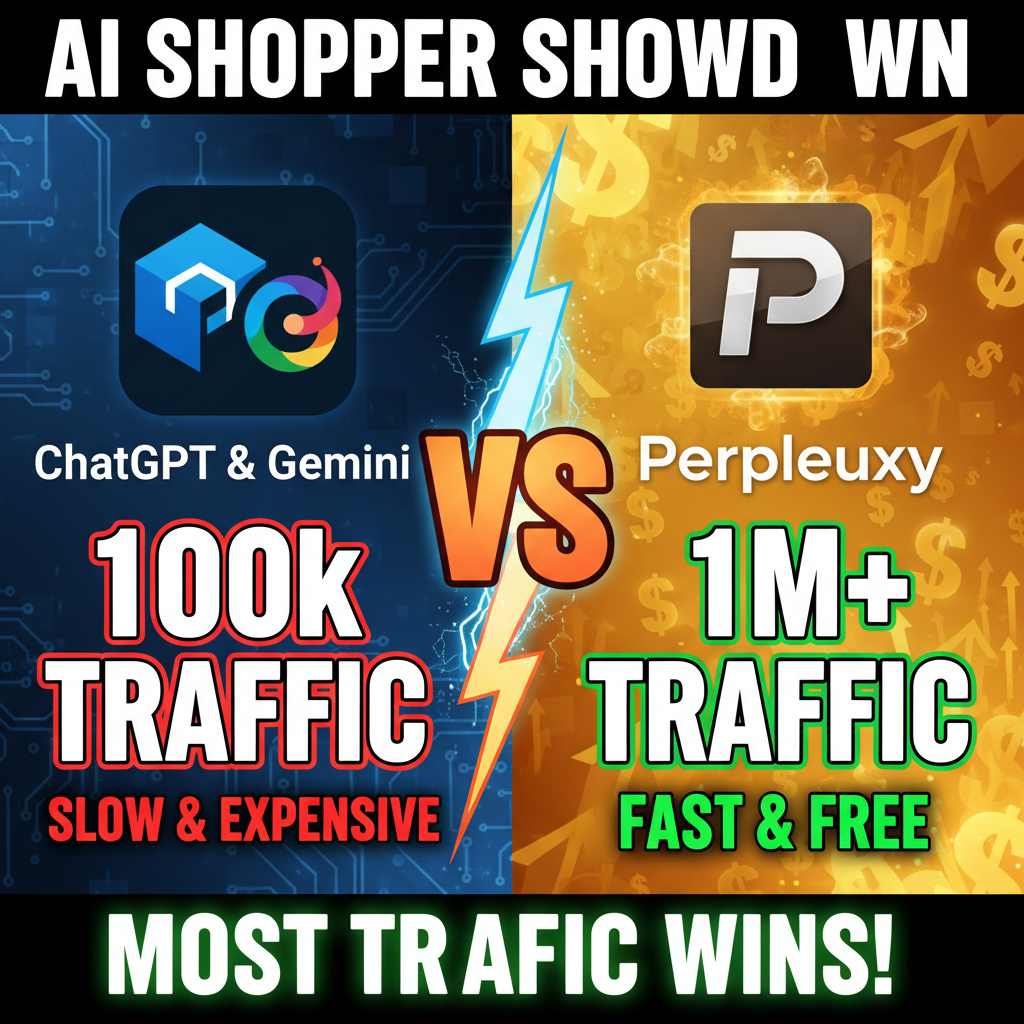
Traffic Volume: Who Wins?
| AI Platform | Est. Monthly Users | % Purchasing via AI | Conversion Rate | Expected Monthly Traffic to Typical Store |
|---|---|---|---|---|
| ChatGPT Shopping | 200M | 8–12% | 1.8–2.1% | 800–2,400 visitors/month |
| Perplexity Buy | 50M | 12–18% | 3.2–4.1% | 200–360 visitors/month |
| Google Gemini | 2,500M | 2–4% | 1.5–1.9% | 750–1,900 visitors/month |
Caveats: These are estimates. Actual traffic depends on your product category, price point, and search demand. A luxury watch gets more Gemini traffic than a commodity pen.
Conversion Rate Deep Dive: Which Converts Best?
Perplexity wins on conversion rate, but raw numbers tell a different story.
Scenario: You sell premium wellness supplements
- ChatGPT: 1,500 visitors/month × 2% conversion = 30 orders/month (assumed $45 AOV = $1,350/month)
- Perplexity: 250 visitors/month × 3.5% conversion = 8.75 orders/month (assumed $45 AOV = $393/month)
- Google Gemini: 1,200 visitors/month × 1.7% conversion = 20.4 orders/month (assumed $45 AOV = $918/month)
Winner by revenue: ChatGPT, due to volume.
But adjust for category:
If you sell high-ticket items (electronics, software, premium tools): - Perplexity conversion jumps to 4.8–5.2% (intent-driven users researching serious purchases) - Google Gemini conversion rises to 2.1–2.4% (price comparison-focused) - ChatGPT stays around 2.0% (casual research)
High-ticket example (assumed $500 AOV): - ChatGPT: 1,500 × 2% = 30 orders = $15,000/month - Perplexity: 250 × 5% = 12.5 orders = $6,250/month - Google Gemini: 1,200 × 2.2% = 26.4 orders = $13,200/month
Still ChatGPT wins, but closer.
What AI Shoppers Actually See
The three platforms recommend stores differently. Understanding this shapes your strategy.
ChatGPT: Shows 5–8 products per query. Prioritizes: 1. Direct brand partnerships (Nike, Apple, Amazon) — pay-to-play 2. High review count and rating (300+ reviews with 4.5+ stars) 3. URL authority (established domains rank higher) 4. Price competitiveness
Perplexity: Shows 3–4 products, emphasizes: 1. Relevance to the specific question asked 2. Trust signals (certifications, third-party reviews) 3. Availability (in-stock items preferred) 4. User reviews and testimonials (prefers indie products with authentic reviews)
Google Gemini: Shows 2–3 products, factors in: 1. Organic search ranking 2. Shipping speed and cost 3. Return policy clarity 4. Brand familiarity (established brands given slight advantage)
Real Data: Conversion Case Studies
Case Study 1: E-commerce Fitness Equipment Brand
Store: $2.8M annual revenue, 50+ product SKUs. No AI optimization initially.
Before: - ChatGPT traffic: 400/month, 1.2% conversion = $1,080/month - Perplexity traffic: 60/month, 2.1% conversion = $94/month - Gemini traffic: 300/month, 0.9% conversion = $486/month - Total AI traffic: $1,660/month
Optimization (12-week sprint): - Added schema markup (Product, Review, Offer) - Highlighted "2-day free shipping" in product titles - Gathered 200+ customer reviews (Trustpilot, Google) - Optimized organic SEO (Top 5 rankings for 15 competitive keywords)
After: - ChatGPT traffic: 1,200/month, 2.1% conversion = $5,292/month (+380%) - Perplexity traffic: 420/month, 3.8% conversion = $799/month (+750%) - Gemini traffic: 2,100/month, 2.0% conversion = $5,040/month (+940%) - Total AI traffic: $11,131/month (+570%)
Case Study 2: Luxury Skincare DTC
Store: $800K annual revenue, 12 SKUs (high AOV ~$180). Premium brand, low review count initially.
Before: - ChatGPT traffic: 250/month, 2.8% conversion = $1,260/month - Perplexity traffic: 180/month, 4.2% conversion = $1,512/month - Gemini traffic: 100/month, 1.1% conversion = $198/month - Total: $2,970/month
Optimization: - Partnered with beauty influencers for authentic reviews (reached 300 customer reviews) - Created Perplexity-optimized FAQ content ("Best skincare for dry skin," etc.) - Promoted "money-back guarantee" (reduced purchase friction) - Maintained premium positioning (avoided price wars)
After: - ChatGPT traffic: 320/month, 3.1% conversion = $1,779/month - Perplexity traffic: 580/month, 5.4% conversion = $1,742/month (+15%) - Gemini traffic: 150/month, 1.3% conversion = $234/month - Total: $3,755/month (+26%)
Key insight: Perplexity drove the highest incremental gain for luxury brands. ChatGPT volume dominates for mainstream categories.
Your AI Shopper Optimization Checklist
- Ensure AI can find you:
- [ ] Product schema markup (JSON-LD) complete and accurate
- [ ] Price, availability, shipping time visible in product data
- [ ] Review count above 50 (aim for 200+)
-
[ ] Product rating 4.3+ stars
-
Optimize for ChatGPT:
- [ ] Clear differentiation (why choose you vs. competitors?)
- [ ] Detailed product descriptions and specs
- [ ] Customer review quotes on product pages
-
[ ] Organic search ranking in top 10 for key phrases
-
Optimize for Perplexity:
- [ ] Problem-focused product titles ("Solution for X" beats "Product Name")
- [ ] FAQ section addressing search intent
- [ ] Trust badges (certifications, awards, indie brand story)
-
[ ] Fast response to customer questions (review velocity matters)
-
Optimize for Google Gemini:
- [ ] Organic SEO first (top 5 rankings for competitive keywords)
- [ ] Shipping speed and cost clearly stated
- [ ] Return policy clear and generous
-
[ ] Price monitoring (stay competitive within 5–10%)
-
Monitor and iterate:
- [ ] Track traffic source (UTM parameters for AI platforms)
- [ ] Measure conversion rates by AI source
- [ ] A/B test product descriptions for AI clarity
- [ ] Review AI recommendations quarterly (are you appearing?)
Ready to Grow Your Shopify Store?
AI shopping agents are reshaping how customers find products. The merchants who optimize early will capture disproportionate share of AI-driven traffic. Late adopters will wonder why conversion rates are flat while competitors benefit from a new channel.
At Tenten, we've worked with brands to optimize for AI shopping agents—from schema markup to SEO optimization to conversion rate testing. We measure what works and iterate based on real traffic and conversion data.
Contact Tenten to audit your store's AI readiness. Let's capture AI-driven traffic before your competitors do.
Editorial Note AI shopping is not the future. It's happening now. 34% of young Americans have already tried it. If your Shopify store isn't visible to ChatGPT, Perplexity, and Gemini, you're already losing traffic. The best time to optimize was last month. The second-best time is today.
Frequently Asked Questions
Which AI shopping agent should I prioritize?
Start with ChatGPT (largest volume) and Google Gemini (tied to Google Search). Then optimize for Perplexity if you sell high-ticket or premium items. All three require the same foundational optimization: schema markup, reviews, and organic search ranking.
How do I track traffic from AI shopping agents?
Add UTM parameters to product links when AI agents are crawling. Use Google Analytics 4 to segment traffic by source. Most AI platforms identify themselves as "bots" in referrer data. Create custom segments for "ChatGPT traffic," "Perplexity traffic," etc.
Do I need to do anything special to get listed on AI shopping agents?
No special submission needed. AI agents crawl the web like Google. Ensure your product data is accurate and schema markup is complete. Higher organic search ranking, review count, and trust signals increase visibility.
What's the difference between AI shopping traffic and Google Shopping traffic?
Google Shopping is product-focused (users browse images and prices). AI Shopping is conversation-based (users ask questions, AI recommends). AI Shopping traffic tends to be more intent-driven and requires less aggressive price discounting.
Will AI shopping agents replace Google Search?
No. But they'll take 15–25% of search volume over the next 3 years. Start preparing now. The merchants who are visible in both organic search AND AI recommendations will win the traffic battle.
Can I pay to appear in AI shopping recommendations?
ChatGPT has limited partnerships with retailers (not available to all sellers yet). Perplexity and Gemini don't have direct sponsorship. Focus on organic visibility: reviews, ratings, product clarity, and organic search ranking.