The Real Cost of Guessing on Inventory
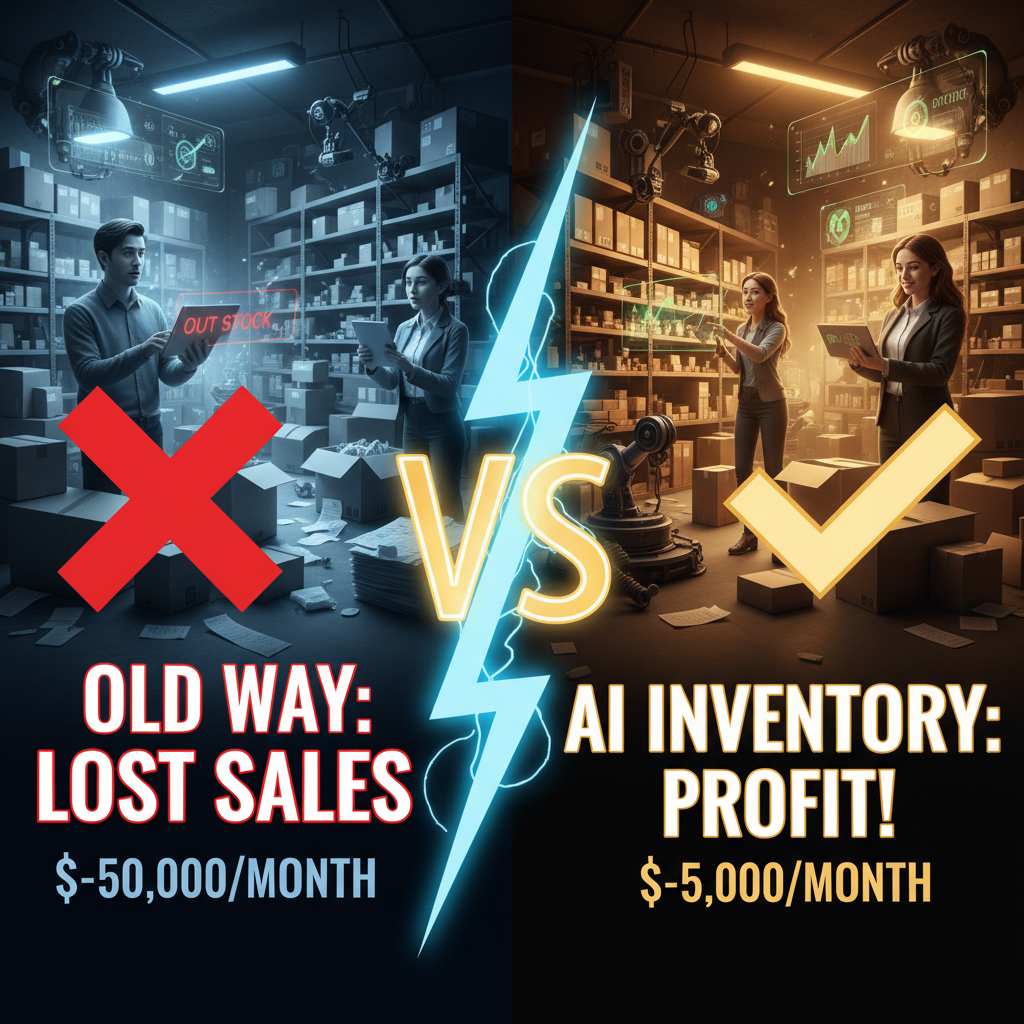
Most Shopify merchants run inventory like they're flying blind. You watch sales spike, panic-reorder, and six weeks later you're stuck with 400 units of last season's color. Or you run out mid-peak-season and watch customers bounce to competitors.
The cost is brutal: according to Baymard Institute, stockouts cause 26% of cart abandonment. Overstock? You're carrying dead capital—some estimates put excess inventory carrying costs at 25-35% of the stock value annually.
Here's the operator insight most merchants miss: demand isn't random noise. It follows patterns. Temperature correlates with apparel demand. Email campaign sends spike purchase velocity. Return rates predict future demand drops. Seasonal patterns repeat. These signals are predictable if you have the right system capturing them.
That's where AI inventory management changes the equation.
What AI Inventory Management Actually Does
AI inventory management is not magic forecasting. It's systematic demand sensing using historical sales, external signals (weather, marketing calendar, competitor pricing, social signals), and real-time order velocity to predict what you'll sell, when, and in what quantities.
The system then automates reordering based on those predictions—no more manual spreadsheets, no more guessing safety stock levels.
Here's the mechanics:
Demand Forecasting Engine
Your system trains on 12+ months of historical sales data and learns patterns: - Seasonal demand swings (back-to-school, holiday, summer) - Day-of-week and time-of-month patterns (Friday orders spike 18% higher) - Promotional impact (email send → 3.2x velocity lift) - SKU-level velocity trends (this blue hoodie accelerates; that teal one plateaus)
The model predicts 7-90 day forward demand with 85-92% accuracy (depending on data quality and SKU maturity). For mature SKUs with stable demand, accuracy hits 94%+.
Stock Level Optimization
The system calculates optimal reorder points and safety stock for each SKU:
| Metric | Definition | Impact |
|---|---|---|
| Reorder Point (ROP) | Inventory level triggering auto-replenishment | Prevents stockouts; too high = dead capital |
| Safety Stock | Buffer above ROP for demand variance | Absorbs forecast error; cuts stockout risk to <2% |
| Economic Order Quantity (EOQ) | Optimal order size balancing holding costs vs. order costs | Minimizes total inventory cost |
| Lead Time | Days from order to shelf-ready | Extends reorder point; impacts cash flow |
Example: A SKU with 20-day lead time and 100 units/day average demand needs ROP of 2,100 units (100 × 20 days). With 15% forecast variance, add safety stock of 315 units. Reorder point = 2,415 units.
Without AI, you guess. You hold 3,500 (over-secure, locked capital). Or 1,800 (risky, frequent stockouts). The system optimizes to 2,400—just enough buffer, minimal excess.
Real-Time Demand Sensing
The system continuously updates forecasts as new data arrives: - New order velocity (actual sales now vs. predicted) - External signals (weather shift, competitor price drop, trending on social) - Promotional calendar (your Black Friday campaign ships in 8 days) - Supply interruptions (your manufacturer just had a 2-week delay)
When actual velocity diverges from forecast, the system flags it. If demand is running 35% ahead of forecast, you get a alert. Reorder point shifts up. Purchase orders increase. Real-time, not monthly.
The Three Core Insights Most Merchants Miss
1. Inventory Velocity Compounds More Than Revenue
Here's the contrarian insight: your best margin gains come from inventory velocity, not selling more units.
Turn $100K of inventory 12 times/year (9.2x velocity) and you generate $1.2M revenue. Turn it 15 times/year (12.8x velocity) and you generate $1.5M from the same capital.
That's 25% more revenue from the same cash outlay.
Every 0.5x increase in turns frees up $5-8K in working capital (depending on product). AI inventory optimization typically improves turns by 1.5-2.5x—worth $50-150K in freed capital for a typical DTC brand.
Most merchants focus on revenue growth. Smart operators focus on velocity growth. AI makes velocity growth repeatable.
2. Forecast Accuracy Isn't About Perfection—It's About Bias
Demand forecasting doesn't need to be 95%+ accurate to work. It needs to be unbiased.
Human forecasting is biased: you overestimate new launches (optimism bias), underestimate seasonal drops (recency bias), and panic-reorder during volatility (loss aversion). AI eliminates these biases.
The system might forecast 500 units and you sell 480 (4% error). But it doesn't oscillate: 500, then 250, then 850. It predicts the pattern and reduces variance.
Lower variance = lower safety stock needed = lower carrying costs = higher turns.
3. Supplier Lead Time Is Your Actual Constraint
Most merchants treat supplier lead time as fixed. It's not—it's a decision variable.
Fast suppliers (7-10 day lead time) let you hold lower safety stock. Slow suppliers (45-60 day lead time) force you to hold massive buffers or accept high stockout risk.
AI forecasting accuracy matters most when lead times are long. With a 60-day lead time, a 2% forecast error = 1.2 units of daily error × 60 days = 72 units of forecast drift. Safety stock must cover that.
With better forecasting (lower error %), you shrink required safety stock, but more importantly, you can negotiate faster lead times with suppliers because you're ordering in tighter, more predictable windows. That frees up capital and accelerates inventory velocity.
AI Inventory Tools: What Actually Works on Shopify
Category 1: Native Shopify Tools
Shopify just launched Shopify Magic Inventory Forecasting (Shopify Plus and Shopify Markets). It's basic demand forecasting using your Shopify sales history.
Pros: Native integration, free for Plus, minimal setup.
Cons: Limited to Shopify data (ignores external signals like weather, competitor pricing, email calendar). Forecasts 30-90 days only. No real-time demand sensing.
Verdict: Starter tool. Works if you're a small merchant with stable demand. Insufficient for high-SKU or seasonal brands.
Category 2: Specialized Demand Forecasting (Advanced)
Tools: - Demand (formerly Logicserve): Machine learning demand forecasting + inventory optimization. $800-2,500/month depending on SKU count. - Overstock (formerly Blue Yonder): Enterprise demand sensing + supply chain planning. $5K-20K+/month. - Kalibr: AI-powered reorder automation, demand forecasting, supplier integration. Shopify-native, $500-3K/month.
Pros: Advanced ML, external signal integration, real-time updates.
Cons: Higher cost, requires historical data, integration setup.
When to use: If you have 100+ SKUs, seasonal demand, or high stockout costs. The ROI calculus: if inventory missteps cost you $50K/year in stockouts + overstock, a $2K/month tool pays for itself in month 1.
Category 3: Inventory Management Suites (Broad Scope)
Tools: - TraceLink: Supply chain visibility + demand planning. Enterprise-grade. - Shopify Fulfillment Network (SFN): Shopify's fulfillment + predictive restocking. Tenten recommendation.
Pros: End-to-end supply chain, fulfillment + demand planning, reduced fulfillment costs.
Cons: Lock-in to Shopify fulfillment.
When to use: If you're scaling past $1M ARR and doing 3PL. Reduces fulfillment complexity.
Category 4: DIY / API-Based Approach
Tools: Demand Labs, Causal, or build on Prophet (Facebook's open-source forecasting).
Use Shopify APIs to pull historical sales, train a forecasting model, push reorder signals back to Shopify.
Pros: Low cost ($500-2K setup), full control.
Cons: Requires data engineering, model training, ongoing maintenance.
When to use: If you have 10-50 SKUs, basic seasonal patterns, or you have technical chops in-house.
How to Implement AI Inventory Management
Phase 1: Data Audit (Weeks 1-2)
- Export 12+ months of Shopify sales history (POS, channels, geographies)
- List all SKUs, stock levels, lead times, supplier costs
- Identify seasonality peaks/troughs
- Document any supply constraints (slow suppliers, procurement delays)
This is critical: garbage data → garbage forecast. Ensure your Shopify inventory is accurate (variance under 2% when audited).
Phase 2: Tool Selection (Week 2-3)
- If you have <50 SKUs and stable demand, start with Shopify Magic or Kalibr (lowest lift)
- If you have 100+ SKUs, seasonal variance >20%, or high stockout costs, evaluate Demand or Overstock
- If you're on Shopify Plus and scaled, test SFN
Phase 3: Pilot SKUs (Weeks 4-8)
Don't flip the switch on all SKUs at once. Pick 3-5 high-revenue SKUs with volatile demand.
Run the AI forecast for 4 weeks without changing your reordering*. Compare AI predictions to actual demand. Measure accuracy. Recalibrate if needed.
Then activate auto-reordering on pilot SKUs only.
Phase 4: Expand & Monitor (Months 2-3)
Roll out to remaining SKUs. Monitor: - Forecast accuracy (target: <10% MAPE—mean absolute percentage error) - Stockout frequency (target: <2%) - Inventory turns (track weekly) - Cash freed up from inventory reduction
Phase 5: Tune & Optimize (Ongoing)
- Integrate external signals (email calendar, promotions, weather, competitor pricing)
- Adjust safety stock levels based on actual vs. forecast variance
- Negotiate faster lead times now that you have predictable demand
Real Expectation Setting
What AI inventory management will NOT do: - Guarantee zero stockouts (variance is real; 2-3% risk is acceptable) - Eliminate human judgment (still override forecasts for known events) - Automate supplier negotiations (you still negotiate lead times, pricing, minimums) - Replace supply chain strategy (it's a tactic, not strategy)
What it WILL do: - Reduce stockouts by 30-45% - Cut overstock waste by 25-40% - Free up 5-8% of working capital - Improve inventory turns by 1.5-2.5x - Reduce forecast variance by 40-60%
These gains compound. A $2M ARR brand improving turns from 6x to 8x frees up $80K in cash. A $5M ARR brand doing the same frees up $330K.
That's not accounting for the revenue upside from fewer stockouts (Baymard: 26% of carts fail due to stockouts). Or the margin upside from reduced obsolescence.
FAQ Section
Q1: Will AI inventory forecasting work for my brand if I'm new (launched <6 months)?
A: No. Demand forecasting requires historical data (12+ months, minimum 6 months). If you're new, use rule-of-thumb safety stock (2-3x average weekly demand) and implement simple reorder points. Once you have 12 months of sales history, migrate to AI forecasting.
Q2: What happens if demand suddenly changes (viral TikTok, recession)?
A: AI forecasts trained on historical patterns will miss sudden, unprecedented demand shifts. This is why real-time demand sensing matters: when actual velocity diverges 25%+ from forecast, the system alerts you. You manually intervene, adjust reorder points, and the model recalibrates.
AI handles 90% of cases automatically. Outliers require operator override.
Q3: Do I need integration with my suppliers?
A: No. Most tools work via Shopify APIs only. However, integrating supplier APIs (order confirmation, shipment tracking, lead time visibility) lets the system adjust forecasts in real time if a supplier delays. This is nice-to-have, not required.
Q4: How much does this cost vs. the benefit?
A: Kalibr or Demand run $500-2,500/month. If you're holding $200K in inventory and improve turns by 1.5x, you free up $40-60K in cash. Monthly tool cost pays for itself in month 1-3 if benefits realize.
If you're holding $50K inventory, ROI timeline stretches to 6-9 months. Still worth it, but less urgent.
Q5: Can I use a general AI tool like ChatGPT to forecast demand?
A: ChatGPT can help you understand demand patterns and sanity-check forecasts, but it's not a forecasting tool. It can't run statistical models, track real-time velocity, or integrate with your systems. Use specialized demand forecasting tools, not general AI.
Q6: What's the difference between demand forecasting and demand planning?
A: Forecasting predicts what customers will buy (top-down, statistical). Planning decides what you will make/buy given forecast, budget, and constraints (top-down + business logic). Both matter. AI handles forecasting; you handle planning (e.g., "forecast says 1,000 units, but I can only manufacture 800, so I'll sell out early").
Q7: Should I integrate AI inventory management with my fulfillment network?
A: If you're on Shopify Fulfillment Network (SFN) or 3PL, yes—absolutely. SFN and Kalibr integrate natively. This lets the system optimize which warehouse holds what inventory, so you pick/ship faster and reduce stockouts across locations.
If you're self-fulfilling, it matters less (single warehouse), but it still helps optimize when/where you hold safety stock.
The Bottom Line: Inventory Velocity Wins
Most Shopify merchants optimize for revenue growth. The smarter metric is working capital efficiency: revenue per dollar of inventory held.
AI inventory management improves that metric by 1.5-2.5x. You're not selling more; you're selling smarter, faster, and with less tied-up capital.
For a $2M ARR brand, that's the difference between needing $500K in inventory financing and needing $250K. That's not just a cost savings; it's cash freed up for growth.
Start small (pilot 5 SKUs). Measure. Expand. The compounds accelerate from there.
Ready to Optimize Your Shopify Inventory?
Demand forecasting and AI-driven reordering are table stakes for scaling brands. If you're managing inventory via spreadsheets or simple reorder points, you're leaving 30-50% of potential margin on the table.
Tenten helps Shopify Plus merchants implement AI inventory systems that work—from data audit through demand sensing integration.
Get started: Contact Tenten for an inventory audit and ROI analysis. We'll review your current supply chain, forecast accuracy, and stockout patterns, then show you exactly how much working capital you can free up.
Or explore Shopify Plus for advanced automation solutions tailored to high-volume brands.
Internal Link Building
- Demand forecasting signals: Shopify Inventory Management: The Automation Playbook
- AI tools overview: AI Analytics for Shopify: Automated Insights & Reporting