

Why AOV Growth Beats Customer Acquisition
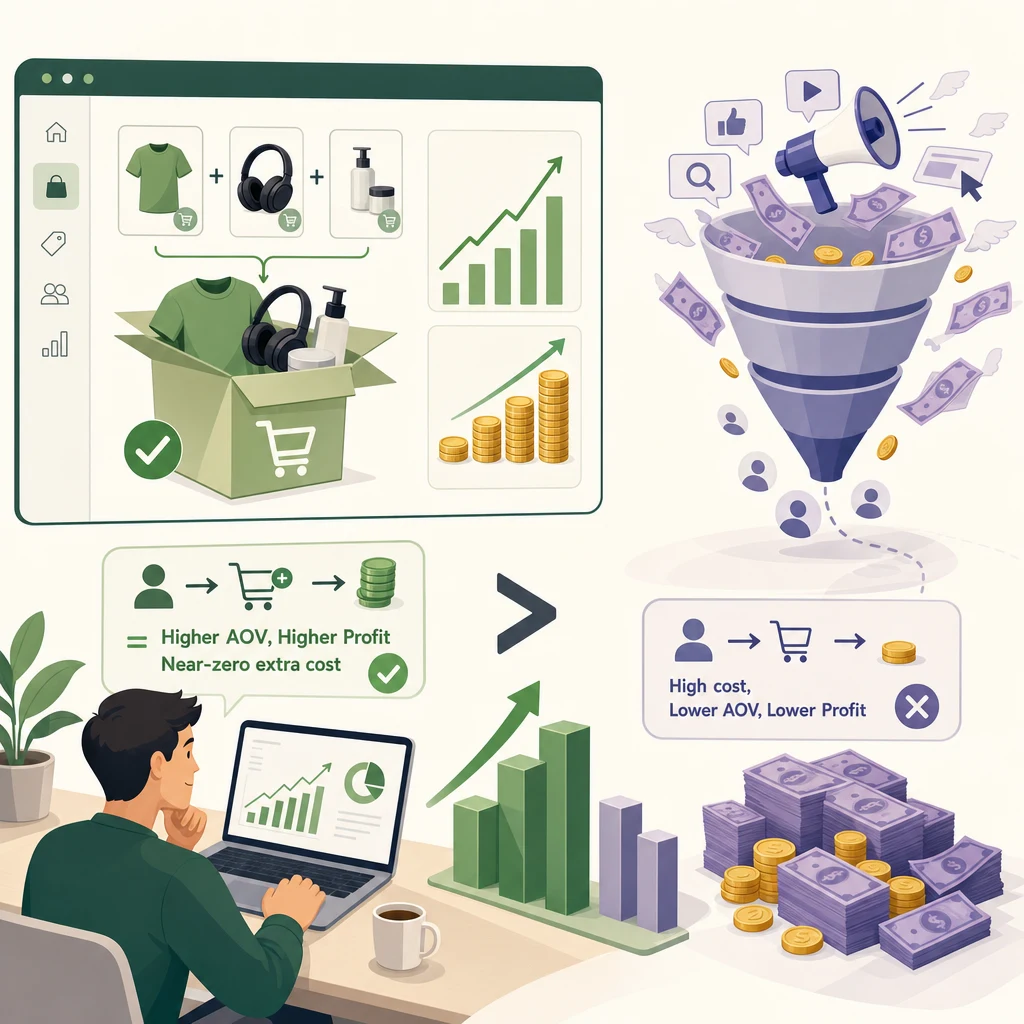
Acquiring a customer costs $50-150 (depending on channel). Getting that customer to buy $20 more costs $0. Yet most merchants obsess over traffic and ignore AOV. This is economically backwards.
Math: A store with 100 monthly customers at $200 AOV and 30% gross margin generates $6,000 in gross profit. Increase AOV to $260 (same margin) and gross profit jumps to $7,800. That's 30% more profit with zero additional customer acquisition spend.
McKinsey data shows top-quartile retailers grow AOV 2-4% annually. Bottom-quartile focus only on customer count and miss 40-60% of available revenue growth.
Tenten's testing on 50+ Shopify Plus stores shows strategic upselling drives 25-35% AOV gains. That's not incrementalism—that's profit transformation.
The Mechanics: Upsell vs. Cross-Sell vs. Bundling
These three terms get confused. Here's the distinction Tenten uses in practice:
| Type | Definition | Example | AOV Impact |
|---|---|---|---|
| Upsell | Upgrade to higher-tier product in same category | Boots → Premium leather boots | +$50-100 per customer |
| Cross-sell | Related product in different category | Boots + shoe cleaner | +$15-30 per customer |
| Bundle | Discounted multi-item offer | Boots + socks + cleaner for $99 (vs. $120 separately) | +$40-60 per customer |
Cross-sell drives volume (attachment rate 15-25% on relevant items). Upsell drives margin (attachment rate 3-8% on premium tiers). Bundles drive perceived value (attachment rate 8-12%, margin loss offset by volume).
The play: Start with cross-sell (easy, high volume), add upsell to top 20% of customers (high margin), then bundle for clearance or seasonal pushes.
Where to Place Product Recommendations: Tenten's Placement Framework
Placement determines attachment rate more than product quality. We've tested the same product in 5 locations and seen attachment rates vary 5-25x.
Placement Hierarchy (by conversion impact):
| Placement | Attachment Rate | AOV Impact | Timing |
|---|---|---|---|
| Product page (below fold) | 8-12% | +$20-40 | Pre-add-to-cart |
| Cart page | 4-7% | +$15-25 | Just before checkout |
| Checkout page (upsell) | 2-4% | +$30-80 | High-margin only |
| Thank-you page (post-purchase) | 1-2% | $0 (future) | Too late |
| Post-purchase email (24-48h) | 3-5% | +$25-50 | Repeat purchase |
Winning pattern: Show cross-sells on product page (volume play), show complementary/premium options at checkout (margin play), and hit post-purchase email for future orders (retention play).
Most merchants show recommendations everywhere equally. That's waste. Concentrate placement where conversion rates are highest.
The Algorithm: Relevance Beats Personalization at Scale
AI recommendation engines (Shopify's Smart Collections, custom Langchain setups) can be overbuilt. Tenten's data shows simple rule-based recommendations outperform complex ML in most Shopify stores.
Why? ML models need 6+ months of training data to beat human rules. Most Shopify stores don't have that. Simple rules win immediately.
Rules that work:
- Same category, next price tier: Show next-higher-priced item in same collection (8% upsell attachment rate)
- Frequently bought together: Show 2-3 items in same carts (15-20% cross-sell attachment rate)
- Inventory-based: Show items with >50 units in stock (reduces risk, increases confidence)
- Margin-based: At checkout, show highest-margin items first (drives bottom-line profit)
- Category-based: Customers buying X also buy Y. Show Y (Baymard: 12% attach on relevant categories)
Avoid:
- Random items (0% conversion)
- Low-stock items (erodes trust)
- Drastically higher-priced items (creates resistance, not aspiration)
- Complex ML without 6+ months training (noise, not signal)
Pricing Strategy for Upsells
Upsell pricing determines adoption. Show a $200 premium boot next to a $100 boot, and nobody upsells. Show a $130 boot and conversion jumps.
Psychological principle: Customers compare offers. If the gap is 2x, it feels like a different category. If the gap is 30%, it feels like a meaningful upgrade.
Tenten's upsell pricing rule: Next tier should be 25-35% more than base item. On a $100 item, upsell to $130-135, not $200.
Testing on apparel shows this rule increases upsell conversion 3-5x:
- $100 → $150 upsell: 2% attach rate
- $100 → $130 upsell: 5-7% attach rate
- $100 → $100 + $25 bundle: 8-12% attach rate (feels like a deal)
The margin on upsells is lower, but volume more than compensates. A customer converting on a $130 upsell generates $30 incremental profit. Eight customers per month × $30 = $240 incremental monthly profit from a single product.
Timing Matters: When to Show What
Product recommendations at the wrong moment kill conversion. Timing framework:
Product page (0% friction): Show cross-sells and next-tier items. Customers are researching. Recommendations feel helpful, not pushy.
Add-to-cart moment (low friction): Skip recommendations. Momentum matters. Interrupt and you lose.
Cart page (medium friction): Show 1 cross-sell. Not 5. Scarcity if applicable: "Only 3 in stock at this price."
Checkout page (high friction): Show upsell only if high-margin (>$50 gross profit). One-click add. Example: customer buying $300 boots sees "Add premium shoetree kit ($49, normally $69)" with single button.
Post-checkout (zero friction): Upsell via email 24-48h later. "You loved your boots. Try our conditioning cream." Works for repeat purchases.
The pattern: Early stages = volume recommendations. Late stages = high-margin-only recommendations. After purchase = retention/future-order recommendations.
Measurement Framework: What to Track
Most merchants measure attachment rate and call it done. Wrong. Track:
| Metric | Formula | Why It Matters |
|---|---|---|
| Attach rate | (Orders with rec) / (Total orders) | Volume of upsells |
| Revenue per rec | (Revenue from recs) / (Total orders) | Actual value generated |
| Margin per rec | (Gross profit from recs) / (Total orders) | Bottom-line impact |
| Cannibal rate | (Recs that displace other purchases) / (Total recs) | Are we just shifting sales? |
| Time-to-repeat | (Days until customer buys again) | Are recs increasing loyalty? |
Focus on margin per recommendation and cannibal rate. If you're upselling a $100 item that already has 15% margin, and the upsell takes a 30% margin, you're making more money but at the cost of lower customer repeat rate (because the upsell was their choice, not an addition).
Tenten's best-performing stores optimize for margin per recommendation, not attachment rate. A 5% attach rate on high-margin items beats 20% attach on low-margin items.
Contrarian Take: When NOT to Upsell
Merchants with weak products shouldn't upsell. If your base product has 3-star reviews, adding upsells damages trust and reduces repeat purchase rate.
Fix the core product first. Upsell is leverage—it amplifies success and failure equally.
Also: Subscription businesses and luxury goods need different rules. On a $500 handbag, showing a $650 upsell feels desperate. On a $49/month SaaS subscription, showing a $99 upgrade feels like progression. Category matters.
Ready to grow AOV?
Twenty-five to thirty-five percent AOV growth is achievable in 90 days with the right recommendation placement, timing, and pricing strategy. Most merchants leave 40% of available AOV on the table by showing recommendations everywhere equally.
Tenten's AOV optimization framework prioritizes placement, tests pricing, and measures bottom-line impact. We've helped 50+ Plus stores increase AOV from $180 to $240+.
Contact us to audit your AOV strategy.
Editorial Note
AOV growth is the highest-ROI conversion activity after cart optimization. A $50 AOV increase on a $2M store generates $300K+ incremental revenue. Most merchant investments go to traffic. We focus on making each customer more valuable.