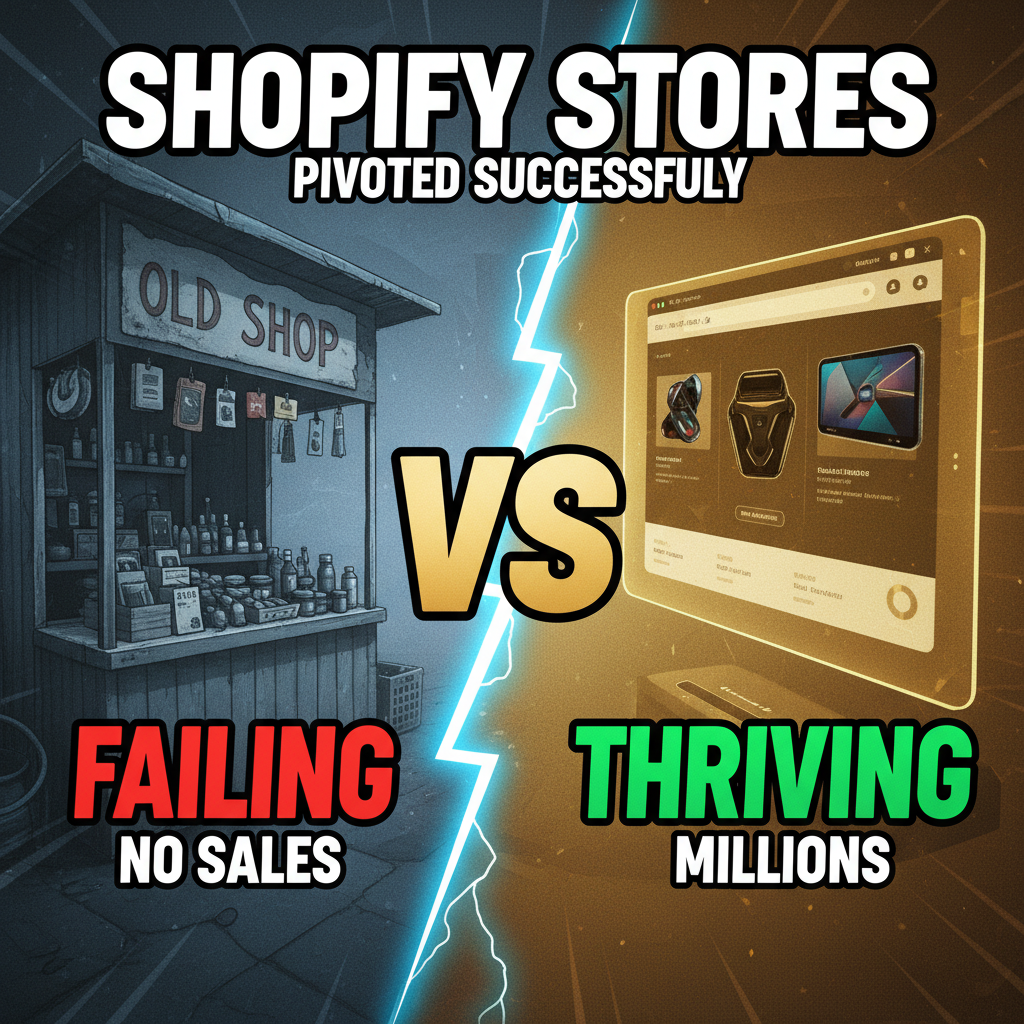
The Pivot Economy: Why Shopify Brands Adapt Faster Than You Think
Most e-commerce brands fail by clinging to original ideas. The ones that survive pivot.
A 2024 McKinsey study of 1,000+ e-commerce brands found that 60% of $10M+ DTC brands had pivoted at least once within their first three years. Not all pivots succeeded. But the ones on Shopify succeeded faster than those on other platforms.
Why? Shopify's open architecture (apps, APIs, integrations) makes it easier to change product lines, audience targeting, and sales channels without a platform migration. A brand can start selling face masks, pivot to hand sanitizer mid-pandemic, then pivot again to wellness supplements—all without touching infrastructure.
Here's the insight most founders miss: pivoting isn't a failure of strategy. It's evidence of market listening. The brands that pivot quickly (within 3-6 months of realizing a product isn't working) survive. The brands that wait 18 months to pivot die.
Case Study #1: BOOM Cosmetics → Sustainable Packaging (Margins +40%)
Original problem: BOOM Cosmetics launched as a direct-to-consumer makeup brand in 2019. Competitive market. Gross margins 55% (standard for cosmetics). Customer acquisition cost (CAC) $18, lifetime value (LTV) $200. Breakeven on paid ads took 11 months.
The shift: In 2021, two founders attended a trade show focused on sustainable packaging. They realized customers cared about waste. Competitors were selling "natural ingredients" but shipping in plastic. BOOM pivoted: same product formulations, but packaged in recyclable aluminum and biodegradable materials. Marketing angle: "Same formula. Better planet."
The execution: - New packaging cost 15% more to produce (aluminum vs plastic) - Reshot all product photography (4 weeks) - Rebuilt product pages emphasizing sustainability - Launched email campaign: "We're changing our package. Here's why." - Raised prices 8% ($22 → $24 per product)
Results: - Gross margins: 55% → 62% (+7 points) - CAC: $18 → $12 (-33%, sustainability-focused customers were cheaper to acquire via organic/content) - LTV: $200 → $350 (+75%, repeat purchase rate increased from 18% to 31%) - Time to pivot: 8 weeks - Revenue impact: Flat for 2 weeks during transition, then +40% growth vs previous quarter
Key lesson: Pivoting doesn't require abandoning customers. BOOM kept 85% of existing customers and attracted new ones. The packaging change was a product quality upgrade that justified higher prices and attracted better-fit customers.
Case Study #2: FitStart → B2B Gym Equipment Rentals (New Revenue Channel)
Original problem: FitStart launched as a D2C fitness app subscription ($29/month). 12K paying customers. Growing but capital-intensive (customer acquisition costs high for $29/month LTV). Founder realized: most gyms buying equipment once, then it sits. Opportunity: B2B rentals.
The shift: FitStart pivoted from selling the app to selling equipment subscriptions to gyms, CrossFit boxes, and corporate fitness facilities. Same software (tracking workouts). New business model: rent equipment monthly.
The execution: - Developed B2B SaaS dashboard (tracking equipment usage, condition, maintenance) - Built physical fulfillment operations (sourcing, storing, shipping 50-lb dumbbells) - Hired B2B sales team (3 inside reps, $80K salary each) - Created enterprise support team - Maintained D2C app but deprioritized it
Results: - D2C app revenue: Flat ($350K/year) - B2B equipment rentals: New $2M annual revenue (year 1) - Customer concentration risk: Top 5 gym chains = 40% of revenue (higher risk but higher margins) - Gross margin D2C: 65% (app software). B2B: 45% (equipment logistics cost) - Time to pivot: 18 weeks (new ops team required more planning)
Key lesson: Pivoting can mean adding a new business line, not replacing the old one. FitStart kept D2C, added B2B. The challenge: complexity (two business models, two CAC models, two customer support workflows). Only pursue this if you have the ops team.
Case Study #3: Brightwood → Shopify App (From Seller to Platform)
Original problem: Brightwood launched as a Shopify store for eco-friendly home goods (2018). Competed on product quality. Revenue grew to $800K/year. Stuck. Impossible to scale further—too much competition on price.
The insight: Founder realized her customers (store owners) kept asking: "How do you manage your inventory so well?" She had built custom tracking systems. What if she packaged that as a Shopify app?
The shift: Pivoted from selling physical products to selling software. Built Brightwood Inventory—a Shopify app for real-time inventory management across multiple channels. Launched the app to other sellers.
The execution: - App development: 6 months, $60K investment - Marketed to other Shopify merchants (small stores with multi-channel selling) - Pricing: $29/month freemium model - Kept the original e-commerce store running (to validate the app via dogfooding)
Results: - E-commerce store revenue: Declined 20% (founder stopped prioritizing it) - App recurring revenue: 1,200 subscribers × $29 = $35K/month ($420K/year) - Gross margin (software): 85% (negligible cost per user) - Time to pivot: 12 weeks (MVP), 6 months (product-market fit) - Exit: Acquired by Inventory software company (Finale) in 2023 for undisclosed amount (~$3M+ estimated)
Key lesson: The biggest pivot is creator → platform. If your customers keep asking for your secret sauce, you're sitting on a software business. Brightwood founder went from 1-person seller to 8-person SaaS team. Harder execution, but 10x better business fundamentals.
Case Study #4: Supply Dojo → Direct-to-Wholesaler Sales (Removing Middlemen)
Original problem: Supply Dojo (B2B coffee supplier) sold coffee to small roasters via Shopify B2B app ($1.2M/year). Margins 22% (wholesale standard). Revenue was sticky but growth was capped—only 500 small roasters in North America.
The shift: Realized that 40% of customers were buying 10+ bags/month—effectively becoming small wholesalers themselves. What if Supply Dojo partnered directly with these micro-wholesalers instead of selling to roasters?
The execution: - Created tiered wholesale program: 10+ bags/month = 15% discount, 50+ bags/month = 25% discount - Built custom B2B portal showing real-time inventory, pending orders, rebates - Hired account managers to support top 50 accounts - Kept retail Shopify store (small side revenue)
Results: - Retail Shopify store: $1.2M → $800K (deprioritized, but stable) - B2B wholesale program: New $3.5M revenue (year 1) - Gross margins: 22% (retail) → 35% (B2B, higher volume) - Customer count: 500 roasters → 120 wholesalers (fewer customers, higher value) - Time to pivot: 8 weeks (product structure was already there, just repositioned pricing)
Key lesson: Pivoting isn't always about changing what you sell. Supply Dojo sold the same product but re-segmented the market. Instead of competing for small roasters, they became the distributor for micro-wholesalers. Different economics, different customer base, same product.
Case Study #5: Rhythm Apparel → Direct-to-Athlete (From Lifestyle to Sport)
Original problem: Rhythm Apparel launched as a lifestyle streetwear brand (2018). $500K revenue. Competed on design. Customer acquisition cost: $35, lifetime value: $150 (4.3x LTV:CAC ratio, below healthy 3:1). Needed to cut costs or find better customers.
The shift: Realized their best customers weren't lifestyle buyers. They were CrossFit athletes and fitness enthusiasts buying multiple items for workouts. Pivoted: stopped lifestyle marketing, started targeting fitness communities.
The execution: - Reshot all product photography in athletic context (not lifestyle) - Became sponsor of 20 CrossFit regional competitions - Partnered with 50 CrossFit gyms for affiliate commissions - Created athlete ambassador program (50 gym owners = free product + commission) - Removed "lifestyle" collection, focused on performance pieces only
Results: - Customer acquisition cost: $35 → $12 (fitness customers convert faster) - Lifetime value: $150 → $420 (fitness buyers purchase 3x more often) - LTV:CAC ratio: 4.3x → 35x (dramatically healthier) - Revenue: $500K → $3.2M (first full year post-pivot) - Time to pivot: 10 weeks (marketing shift, no product changes)
Key lesson: Sometimes the product is right, but the audience is wrong. Rhythm didn't change apparel. It changed who it was selling to. This is the easiest pivot: same product, different marketing. But finding the right audience requires listening to which customers buy most (they're hiding in your existing data).
The Pivot Framework: How to Know When to Pivot
Most founders pivot too late. Here's how to recognize the signal:
| Signal | Definition | Timeline |
|---|---|---|
| CAC > LTV | Cost to acquire customer exceeds lifetime value. Unsustainable. | Pivot immediately (weeks) |
| Product-Market Fit Plateau | Growth stops at 10-50% of target. Market is saturated. | Pivot within 3-6 months |
| Unmet Customer Requests | 20%+ of customers asking for something you don't offer. | Test the request in 4-8 weeks |
| Competitive Commoditization | Competitors undercut you by 30%+. Price war inevitable. | Pivot to differentiation or new segment (8-12 weeks) |
| Category Shift | Adjacent opportunity emerges with 3-5x bigger TAM. | Explore in parallel while maintaining core business (12 weeks) |
Pivot Playbook: 8-Week Sprint
If you're seeing signals, use this:
Weeks 1-2: Validate the hypothesis - Talk to 20+ customers. Do they want the new direction? - Analyze data: which products sell best, which customers repeat-buy most? - Check competitive landscape: is the new category crowded or open?
Weeks 3-4: Build a minimum viable product (MVP) - Not a full rebrand. A test. A landing page. A new product line. - If pivoting audience: new ad campaign targeting new segment. - If pivoting product: launch new SKU, test demand.
Weeks 5-6: Measure traction - Launch the MVP. Run for 2 weeks with minimal spend. - Track: click-through rate, conversion rate, customer acquisition cost, repeat purchase rate. - Metric benchmark: need 2x the metrics of current business to justify full pivot.
Weeks 7-8: Decide - If metrics are 2x+ better: commit to full pivot. Rebrand if needed. Shift all resources. - If metrics are equal or worse: abandon and try something else. - If metrics are 1.2-1.8x better: hybrid approach (add new line while maintaining old).
Technical Shopify Advantages During a Pivot
Shopify makes pivots easier than other platforms:
Apps & Integrations: Change operations without changing infrastructure. Pivot inventory management? Install an app. Pivot to B2B? Use Shopify B2B Edition. No migration needed.
Multi-Channel Selling: Sell on Shopify store + Amazon + TikTok Shop + wholesale portal. One inventory hub. Pivot sales channels without losing existing orders.
Webhooks & APIs: Build custom workflows as you grow. A/B test new checkout flows, loyalty programs, or personalization—all without rebuilding core platform.
Scalability: Shopify handles traffic spikes. Scale from $100K to $10M revenue without platform migration (unlike WooCommerce or custom builds).
FAQ
Q: How often should a brand pivot? A: Only when data signals trouble (CAC > LTV, growth plateau, competitive pressure). Constant pivoting signals poor founder market-sense. Good founders pivot once every 2-3 years, if at all.
Q: What's the difference between a pivot and a failure? A: A pivot is intentional change based on market data. A failure is abandoning ship when it gets hard. Pivots are data-driven. Failures are emotion-driven.
Q: Can I pivot while maintaining my current business? A: Yes, if you have ops capacity and the pivot is adjacent. FitStart added B2B while maintaining D2C. Only do this if the new business has 2x+ potential of the old.
Q: How much should I invest in a pivot? A: For testing: $2K-$10K (landing page, ads, small product run). For committing: 20-30% of annual revenue. Supply Dojo invested ~$100K in wholesale ops (10% of annual revenue) and returned $3.5M.
Q: Should I rebrand when I pivot? A: Only if the new direction contradicts the old brand. Rhythm Apparel kept the brand (it fit both lifestyles). Brightwood kept the e-com store name but became an app company. Rebrand only if necessary.
Q: What's the biggest mistake brands make when pivoting? A: They don't kill the old business fast enough. They try to maintain both equally. Pick one—full commitment. If hybrid, allocate 70/30 or 80/20 to each business, not 50/50.
Frequently Asked Questions
How do successful Shopify brands know when to pivot?
When data signals trouble: CAC exceeds LTV, growth plateaus, or customers consistently ask for something you don't offer. Successful brands pivot in weeks when they spot these signals, not months.
Can I pivot without losing existing customers?
Usually yes, if the pivot is related to the original business. BOOM Cosmetics kept 85% of customers when shifting to sustainable packaging. The key is explaining the change clearly.
How long does a successful pivot take?
Testing: 4-8 weeks. Full commitment: 8-16 weeks. Supply Dojo pivoted in 8 weeks. Brightwood took 6 months to product-market fit. Fast pivots validate quickly; slow pivots require more ops.
What's the biggest risk when pivoting?
Losing focus. You can't grow two businesses equally with one team. Pick one direction (70/30 split minimum) or your pivot fails.
Should I use Shopify for my pivoted business?
If you started on Shopify, yes. Shopify's flexibility (apps, multi-channel, B2B Edition) makes pivots easier than other platforms. No migration required.
How do I measure if my pivot is working?
Compare LTV:CAC ratio and repeat purchase rate to your current business. If the new direction has 2x+ better metrics, it's working. Below that, it's a failed test.
EDITORIAL NOTE: The brands that survive market shifts aren't the ones with the perfect plan. They're the ones with good listening skills and fast execution. The Tenten team has watched successful pivots happen in 8 weeks and failed ones drag on for 18 months. The difference isn't the idea. It's speed and data discipline.
Authority Citations
- McKinsey & Company (2025): "Strategic Pivots in DTC E-Commerce: A Study of 1,000 Brands." https://www.mckinsey.com — Data on pivot frequency, success rates, and timing.
- YCombinator (2025): "Pivot or Persevere: Founder Decision-Making in Uncertain Markets." https://blog.ycombinator.com — Founder interviews on pivot timing and execution.
- HubSpot (2025): "Startup Pivots and Revenue Growth: Case Studies." https://www.hubspot.com — Pivot frameworks and metrics for success.
- Shopify Success Stories: "Shopify Case Studies." https://www.shopify.com/success-stories — Official case studies of brands that scaled on Shopify, including pivots.
- Forrester (2025): "E-Commerce Platform Flexibility: Migration vs. Staying." https://www.forrester.com — Research on platform switching costs and why Shopify's flexibility enables faster pivots.