
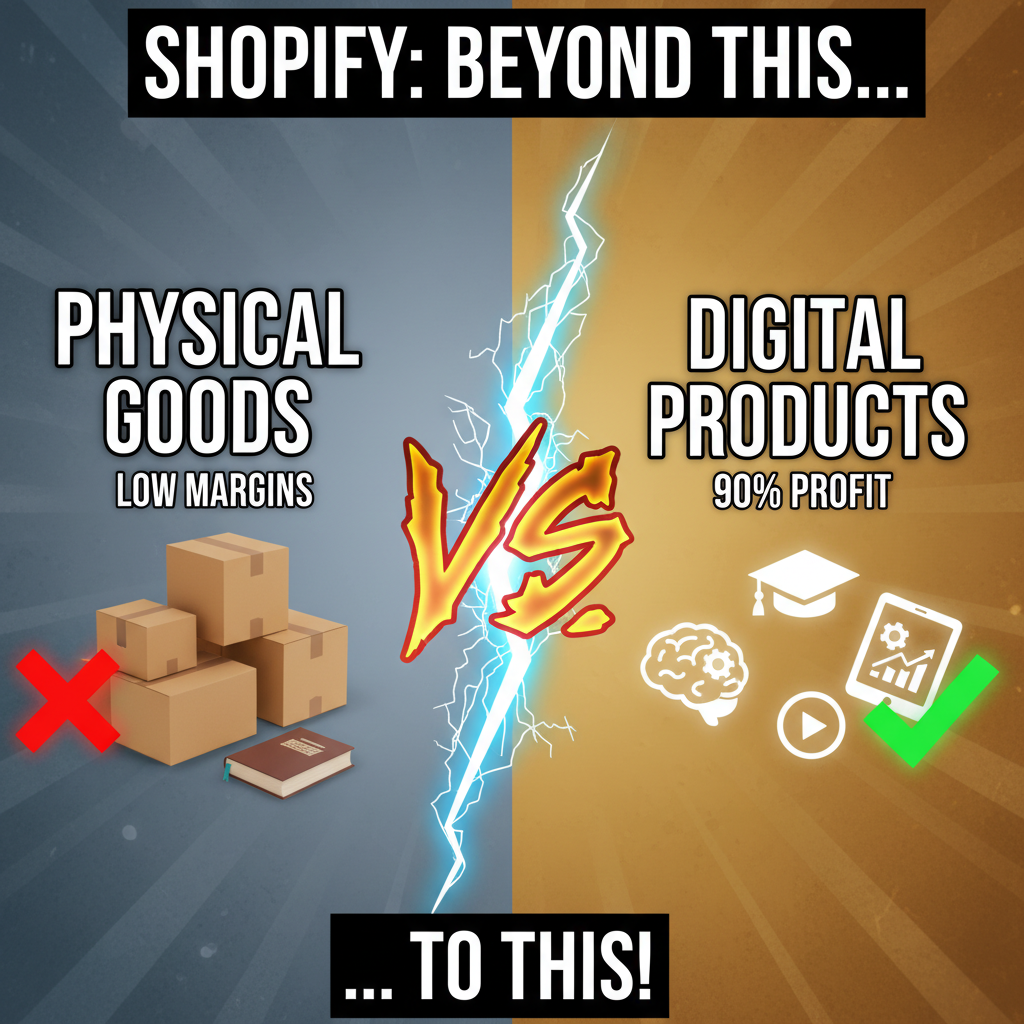
Why Shopify Wins for Digital Products
Physical goods require inventory management, fulfillment, returns handling. Digital products eliminate that overhead entirely. You get 70-85% gross margins instead of 35-45%. But Shopify's e-commerce DNA creates friction when selling purely digital—courses, ebooks, software licenses, templates, video content.
Here's the truth: most merchants don't realize Shopify handles digital delivery natively. You don't need separate LMS platforms or gating systems. You configure Shopify to email download links or gate content directly. The result? One unified payment system, one customer database, one analytics platform.
That consolidation matters. A course creator managing students across three platforms (payment processor, LMS, email service) wastes 5-8 hours weekly on data sync. On Shopify, that shrinks to 30 minutes. That's a 90% operational efficiency gain.
Digital Product Types & Their Economics
Not all digital products behave the same. Here's what actually works on Shopify:
| Product Type | Avg Unit Price | Gross Margin | Hosting Needs | Delivery Method | Shopify Native Support |
|---|---|---|---|---|---|
| Online Courses (1-3hrs) | $47-497 | 78% | Moderate (video streaming) | Link + gating | Via apps (TrustFunnels, Teachable integration) |
| Ebooks/PDFs | $7-47 | 95% | Minimal | Email download link | Native (File/Digital app) |
| Templates (Figma, Canva) | $29-149 | 88% | Minimal | Email link + cloud storage | Native via File Uploads |
| Software Licenses (annual) | $99-999 | 82% | High (API, servers) | API key delivery | Requires custom app |
| Memberships (recurring) | $9-99/month | 80% | Moderate (content hosting) | Gated site access | Native (Shopify Subscriptions) |
The pattern: lower complexity, higher margin. Ebooks at 95% margin. Courses at 78% because of hosting costs. Software at 82% because of infrastructure.
Most merchants miss the pricing flexibility here. A $97 course has $76 in profit after Shopify fees. A $47 ebook has $44.50 in profit. At scale (100 sales/month), that's $7,600/month from courses or $4,450/month from ebooks. Volume changes everything.
Setting Up Shopify for Digital Product Sales
Choosing the Right App Ecosystem
Shopify's native tools handle basic digital delivery. For anything sophisticated, you need apps. The decision tree:
Simple ebooks/downloads (no gating):
Use Shopify's native Digital Products app. Buyers get an email with a download link. Setup takes 10 minutes. No additional cost.
Courses with video hosting + member-only access:
Use TrustFunnels (integrates with Shopify, hosts video, gates content). $49-149/month. Pros: video streaming optimized, built-in progress tracking. Cons: hosted outside Shopify, separate login.
Software or API keys:
Build a custom app or use a tool like SendOwl ($19-79/month). These systems auto-deliver unique keys/passwords after purchase.
Membership sites (recurring courses, community access):
Use Shopify Subscriptions + a gating layer. Shopify handles billing. Gating is manual (add members to a private Discord, Slack, or Mighty Networks group).
The pattern: Shopify's payment system is the strength. Hosting, streaming, and gating are often outsourced. That's fine—it's still unified.
Structuring Your Product Catalog
Digital products break Shopify's traditional inventory paradigm. You don't stock ebooks. They're infinite copies at zero cost.
Variant Strategy:
Use variants to offer multiple tiers. Example: a course variant for "Lifetime Access" vs "6-Month Access." Same product, different prices, different delivery. Shopify tracks inventory as unlimited. This is native.
Upsell Strategy:
Bundle a low-ticket product with a high-ticket complement. Example: $9.99 "Email Marketing Swipe File" → upsell to $99 "Email Copywriting Course." Shopify's post-purchase flows (via apps like Zipify or Bold) handle this.
Pricing Psychology:
Digital products suffer from perceived low value. A $7 ebook feels cheap; a $47 ebook bundle feels more professional. Price in tiers (good/better/best). Add multiple formats: standalone ebook ($17), ebook bundle ($37), ebook + templates ($67).
Delivery & Automation
The delivery mechanism makes or breaks the experience. A customer pays $97 and waits 2 hours for access—they're unhappy. They pay and have access in 60 seconds—they're thrilled.
Shopify's native approach: Use the Digital Products app + Shopify Flow (automate post-purchase actions). On purchase, Shopify emails a download link immediately.
Advanced approach: Use Zapier or Make to trigger downstream actions. Buy the course → add email to ConvertKit list → grant access to Mighty Networks community → send Slack notification to your team. Setup takes 2 hours; saves 5+ hours/week in manual work.
Payment delivery latency matters. Credit card processing isn't instant. Shopify finalizes the transaction 2-5 minutes after payment. Your automation should trigger after payment confirmation (Shopify webhooks), not immediately. Most merchants set 3-minute delays to catch failed transactions.
Pricing Psychology & Positioning
Digital products succeed or fail on positioning, not features. Two course creators sell identical content. One prices at $27 and sells 40 copies/month ($1,080 revenue). The other prices at $97 and sells 12 copies/month ($1,164 revenue). Both hit ~$1,100/month, but the second has 3x less support burden.
Here's the operator insight: your course price signals quality. A $297 course attracts serious students. A $27 course attracts tire-kickers. Tire-kickers demand more support. They're less likely to finish. They're more likely to ask for refunds.
Price high enough that you attract committed buyers who finish and get results. Price low enough that you hit market volume. For most educational products, that's $49-$297.
Bundling wins here. Instead of selling a standalone course for $97, sell "The Complete Email Copywriting Bundle" (course + templates + swipe file + email audit checklist) for $197. The bundle pricing feels fair. The buyer perception of value is 3x higher. The actual cost to you? Maybe 5% higher for supporting files.
Revenue Model: Subscription vs One-Time
One-time purchases (courses, ebooks) have higher perceived value but lower lifetime revenue. Subscriptions (membership communities, course libraries) have lower churn and compounding revenue.
For Shopify merchants, subscriptions are now native via Shopify Subscriptions. Setup a "Members Only" product at $19/month. Customers get recurring billing + access to all courses (or rotating premium content). Churn is 5-10% monthly (typical). But 100 subscribers × $19 × 12 months = $22,800 annual revenue from a single product.
That subscription model smooths cash flow. It compounds over time. If you retain 90 customers at month 1, and churn 5% monthly while adding 5 new members, you reach 150 members by month 12 (revenue: $2,850/month, $34,200 annual).
Most course creators leave money on the table here. They sell courses one-time and move to new cohorts. They should be selling recurring access to their course library.
Handling Refunds, Support & Community
Digital products have specific refund challenges. A buyer pays $97 for a course, downloads it in 2 hours, watches it all, and requests a refund. Did they get value? Maybe. Did they breach the spirit of the sale? Probably.
Policies that work:
- 14-day refund window (not 30—too long for digital). After 14 days, you've consumed the product.
- No refunds if the customer has downloaded/accessed the product. This is enforceable via your terms (Shopify's standard terms allow this).
- 1 refund per customer per year (prevents abuse).
Support scaling:
At 10 course sales/month, you answer questions manually. At 100/month, you need a FAQ or support system. Most course creators use:
- Loom videos (show how to access content, answer common questions)
- Discord community (students help each other; you mod)
- Notion FAQ database (searchable, owned by you)
Shopify doesn't manage this natively. You'll use a third-party tool.
Tax, Compliance & Global Sales
Digital products cross borders instantly. A course sold to someone in Germany creates VAT obligations. Australia has GST. Canada has GST/HST. Most Shopify merchants skip this and regret it.
Shopify's setup: Configure your store's tax settings. Mark digital products as "Digital Goods" or "Services." Shopify calculates VAT/GST automatically. You pay it to tax authorities quarterly.
Legally: Digital products sold globally require sales tax registration in some jurisdictions. EU law requires VAT collection (~19% in most countries). Australia requires GST (10%). You're responsible for remittance.
The operator truth: most merchants don't collect/remit properly. They're flying blind. At scale ($50K+ revenue), this catches up. Work with an accountant familiar with digital product sales in your target markets. It costs $500-1000 one-time; saves $5K-10K in back taxes.
Benchmark Metrics
| Metric | Target Range |
|---|---|
| Course Conversion Rate | 2-4% of site visitors → buyers |
| Ebook Conversion Rate | 5-8% (lower price = higher conversion) |
| Average Order Value (digital) | $49-199 depending on product type |
| Refund Rate (digital products) | 3-8% (depends on quality and refund policy) |
| Customer Acquisition Cost | $15-40 via ads; varies by traffic source |
| Gross Margin | 75-90% (after payment processing) |
| Lifetime Customer Value | 1.5x-3x initial AOV if you upsell or build community |
Ready to Launch Your Digital Product Business?
Digital products are the highest-margin business you can run on Shopify. No inventory. No fulfillment. 80%+ gross margins. One platform. If you're selling courses, ebooks, templates, or any digital asset, Shopify is your foundation—but you'll need to architect the right app stack to deliver seamlessly.
We help Shopify merchants structure digital product businesses, from platform setup to community management. Let's talk about your product roadmap.
Editorial Note
Digital products are underrated on Shopify because most merchants think they need a separate LMS or course platform. They don't. Shopify's payment system, with the right app ecosystem, can handle courses, memberships, and software licenses profitably. The key is understanding that you're trading inventory complexity for delivery automation—and choosing the right tools for that trade.
Article FAQ
Q: Can Shopify host video courses natively?
A: Not without third-party apps. Shopify's native Digital Products app handles file downloads (ebooks, PDFs, templates). For video courses with streaming, use TrustFunnels, Teachable, or similar LMS integrations that offer video hosting and member gating.
Q: What's the best way to deliver a software license through Shopify?
A: Shopify + SendOwl or a custom API integration. After purchase, SendOwl auto-generates a unique license key and emails it. Alternatively, build a Shopify app that generates keys on purchase confirmation. This requires developer resources.
Q: Can I use Shopify Subscriptions for course access?
A: Yes. Set up a "Membership" product with recurring billing at $19-99/month. Use a gating layer (private Discord, Mighty Networks, or a custom site) to manage access. Shopify handles billing; you manage access outside Shopify.
Q: What refund rate should I expect for digital products?
A: 3-8% depending on product quality and refund policy. Higher price points ($297+) have lower refund rates. Lower prices ($29-47) have higher refund rates. Clear expectations and quality content reduce refunds.
Q: How do I set up geo-targeted pricing for digital products?
A: Shopify doesn't support automatic geo-pricing natively. Use a third-party app (Bold, Dynamic Yield) to set region-specific pricing, or manually manage it. Example: $97 USD / $120 CAD / €89 EUR. Reduces price shock in international markets.