The Content Team Problem
Most Shopify merchants publish zero content. Some publish randomly. A few publish consistently but with low quality.
Why? They tried to run content in-house, it fell apart, and now nobody owns it. Or they hired an agency, paid $50K for a blog that nobody reads, and decided content wasn't worth it.
The real issue isn't whether to publish content. It's how to build a sustainable in-house operation that actually drives revenue.
This guide walks you through the structure, hiring decisions, and workflows we've seen work for $5M-$100M+ Shopify stores.
The Content Team Minimum Viable Product (MVP)
If you're doing <$5M in revenue, you probably don't need a full content team. You need one person wearing three hats: strategist, writer, operator.
The Minimum: 1 Content Lead (Full-Time)
This person:
- Owns content strategy (what to write, what keywords matter, what drives revenue)
- Writes 2-3 articles per month (1,500-2,500 words each)
- Manages publishing (Ghost CMS, scheduling, distribution)
- Tracks metrics (organic traffic, conversion, ROI)
Hiring profile: Look for someone with either:
- 3+ years of content marketing experience at an e-commerce brand (preferred), or
- 5+ years of journalism/writing with self-taught SEO/analytics skills (acceptable)
Compensation: $60K-$90K USD depending on location. Shopify-specific experience commands premium.
The Realistic Add-On: 0.5 Designer (Part-Time)
Content without images is just text. If your content lead isn't a designer, allocate 10-15 hours/week to a freelance designer who can:
- Create infographics for articles
- Design templates for email + social repurposing
- Build cover images
Cost: $2K-$3K/month (roughly $25-35/hour, 10-15 hours/week).
Total for MVP: 1 FTE content lead + 0.5 designer = $90K-$120K annually
This is bare minimum for consistent monthly publishing.
The Full Content Team (Shopify Plus & $20M+)
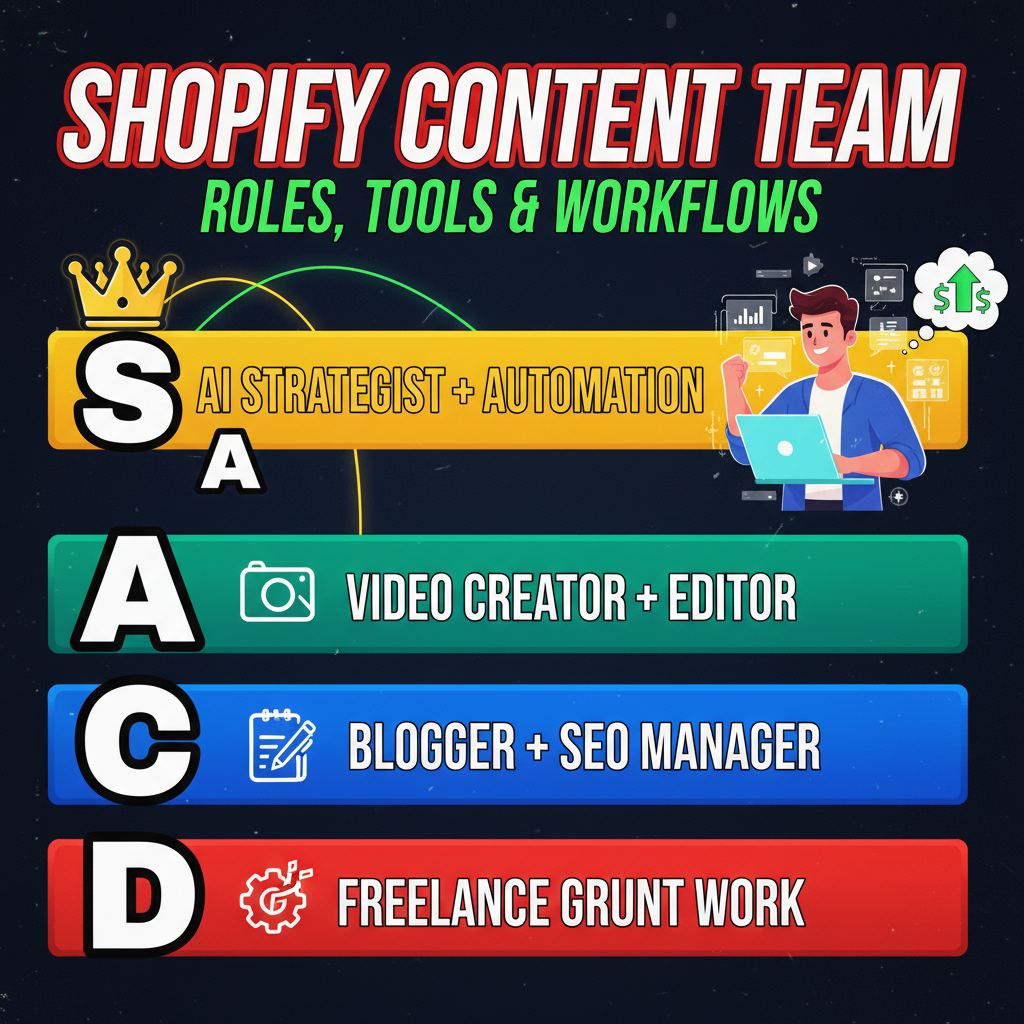
Once you're scaling hard—$20M+ revenue, aggressive growth targets—you need a structured team:
| Role | FTE | Responsibility |
|---|---|---|
| Content Strategist/Manager | 1.0 | Strategy, keyword research, topic planning, hiring |
| Senior Writer | 1.0 | 3-4 flagship articles/month, depth, authority |
| Junior Writer | 1.0 | 4-6 supporting articles/month, optimization |
| Data/SEO Analyst | 0.5 | Keyword research, SEO audits, traffic analysis |
| Designer (Graphics + Video) | 1.0 | Infographics, cover images, video thumbnails |
| Video Editor | 0.5 | Turning long-form articles into YouTube shorts |
| Community Manager | 0.5 | Email, Discord, comment moderation |
Total for full team: 5 FTE = $600K-$800K annually
This team produces:
- 50+ long-form articles per year (3,000-5,000 words each)
- 100+ short-form pieces (email, guides, case studies)
- 20+ video assets per month
- Consistent email nurture (2-3x per week)
- Community moderation and engagement
Hiring Patterns That Work
For the Content Lead:
Look for people with this profile:
Ideal:
- 3-5 years at a high-growth DTC or e-commerce brand (Glossier, Allbirds, Dollar Shave Club level)
- Has shipped 50+ articles that moved the needle on organic traffic
- Understands unit economics, CAC, LTV
- Can write AND analyze data
Acceptable:
- Journalist or agency writer with strong self-taught SEO chops
- Has shipped content that ranked and converted (show portfolio with traffic metrics)
Red flags:
- "I wrote 200 articles for a content mill"
- No portfolio with traffic/conversion data
- Can't explain why they'd write for e-commerce vs corporate comms
- No opinion on what makes good content
Compensation structure:
- Base: $75K-$95K
- Bonus: 10-20% tied to organic traffic growth targets or conversion metrics
- Tools budget: $2K/year (SEO tools, AI writing, design)
For Writers:
Senior writers ($90K-$120K):
- 5+ years content or journalism experience
- Can write independently, minimal editing
- Understands Shopify/e-commerce space
- Portfolio of articles that ranked and moved metrics
Junior writers ($60K-$75K):
- 2-3 years content experience
- Learns fast, takes feedback well
- Can research deeply and synthesize information
- No domain expertise required (can be trained)
For Designers:
- Portfolio showing infographics, cover designs, and marketing assets
- Ability to own design systems (templates for consistency)
- Comfortable with AI image tools (not defensive)
- Shopify store design experience is a plus
The Tech Stack: What You Actually Need
Most content teams over-engineer their stack. You don't need 10 tools.
The essentials:
| Tool | Purpose | Cost |
|---|---|---|
| Ghost CMS | Blog platform, publishing, email | $50-200/month |
| Ahrefs or SEMrush | Keyword research, SEO tracking | $120-200/month |
| Figma | Design, templates, collaboration | $12-80/month |
| Notion or Monday | Workflow management, editorial calendar | $10-80/month |
| Google Analytics 4 | Traffic analysis, conversion tracking | Free |
| Gemini or Claude (API) | Content drafting, research synthesis | $20-100/month |
Total: $260-660/month ($3,120-7,920 annually)
Nice-to-have (but not critical):
- Midjourney/Runway (AI image generation) - $30/month
- Grammarly Premium - $12/month
- Zapier (automation) - $25/month
Avoid:
- Content management platforms that try to do everything (Contentflow, etc). Ghost is simpler and cheaper.
- Expensive SEO tools if you're bootstrapped. Start with free SEMrush trial, then upgrade.
The Publishing Workflow
Here's the workflow that works:
Week 1: Planning & Research
- Monday: Strategist selects topic, brief writer
- Tuesday-Wednesday: Writer researches, identifies data points
- Thursday: Writer drafts outline, shares with strategist for feedback
- Friday: Writer begins full draft
Week 2: Writing & Design
- Monday-Wednesday: Writer completes draft, sends to strategist for edit
- Thursday: Strategist reviews, provides feedback
- Friday: Writer revises, submits final
Week 3: Design & Final Review
- Monday: Designer creates cover image + infographics
- Tuesday: Writer reviews images, makes final tweaks
- Wednesday: Final proofread, SEO check
- Thursday: Schedule on Ghost for publication
Week 4: Publishing & Promotion
- Friday: Publish on Ghost
- Friday-Monday: Repurpose for email, Twitter, LinkedIn
Cadence:
- 1 writer = 1 article every 3 weeks (4/month)
- 2 writers = 1.5 articles per week (6+ per month)
- Content lead = 1 flagship article per month + strategic editing
The Metrics That Matter
Track these or don't bother with content:
Monthly:
- New organic visitors from blog
- Pages indexed by Google
- Average organic session duration
- CTR from SERP (via Google Search Console)
Quarterly:
- Organic-to-revenue attribution (sessions → email signup → purchase)
- CAC reduction via organic traffic vs paid
- Repeat purchase rate for customers acquired via blog
Annually:
- Organic revenue (attributed conversions × AOV)
- Organic CAC (cost of blog operation / customers acquired)
- Content ROI (annual revenue - annual operation cost / annual operation cost)
Healthy benchmark: Mature content programs generate 15-25% of store traffic and 20-30% of customer acquisition.
Common Mistakes to Avoid
1. Hiring content writers who don't understand e-commerce
Writers trained on consumer brands or B2B SaaS often misunderstand the merchant perspective. They write "tips" instead of "this will increase your AOV by 12%."
Test: Ask candidates why [your store's] content would rank. If they say "high-quality content," they don't get it.
2. Publishing without an email list strategy
Blog traffic alone is weak. Every article should drive email signups. Every email should offer value that leads to conversion.
Content without email capture is awareness only. You're building competitor customer base.
3. Treating content like a cost center
Most merchants view content spend as pure cost. "We spent $60K on the blog." No. You invested $60K in a customer acquisition channel.
Track ROI like you do with paid ads. If ROI is negative, fix it or kill it.
4. Inconsistency
Publishing 1 article every 6 months doesn't work. Google rewards consistency. SEO needs 6-12 months of regular publishing before significant traffic returns.
Commit to 2-4 articles per month minimum, or don't do it.
5. Hiring generalist agencies for specialist work
Agencies say they do "content marketing." Then they produce blog posts that rank for keywords but don't move needle on revenue.
Hire specialists (Shopify content expert) or build in-house. Generalists are a middle ground that works for nobody.
Build It In-House or Outsource?
Build in-house if:
- You can commit to 1-2 FTE for 18+ months
- You want proprietary, defensible brand voice
- You're building a company with >5-year time horizon
- You can tolerate 6-12 month ramp before ROI
Outsource if:
- You're early-stage (<$5M revenue) and want to test content
- You need immediate results and can pay premium agencies
- Your core business requires 100% of leadership attention
- You're OK with commoditized content
Hybrid (recommended for $5M-$20M):
- Hire 1 in-house strategist/lead
- Outsource writing to freelance contractors ($0.15-0.30/word)
- Hire freelance designer for infographics
- Use in-house for strategy, publishing, analytics
This keeps cost ~$120K-$180K annually while maintaining quality.
Ready to Build Your Content Program?
The first step is hiring the right content lead. Everything flows from that person. If you want help structuring your content operation or identifying hiring targets, we can help.
Let's discuss your content strategy
Editorial Note
We've built content operations for 40+ Shopify merchants. The pattern is always the same: one great strategist/writer can carry a program for 2-3 years, producing 30+ articles per year that actually drive revenue. Start there.
Frequently Asked Questions
How much does a content team cost?
MVP is $90K-$120K annually (1 writer + 0.5 designer). Full team for $50M+ store is $600K-$800K. Hybrid (in-house lead + outsourced writers) is $120K-$180K.
How long before content ROI shows?
6-12 months for meaningful organic traffic. 12-18 months for attribution to revenue. Content is not a 90-day channel.
Should we hire writers who know Shopify or train them?
Hire strategists who know e-commerce. Train writers in Shopify specifics. Shopify expertise is teachable; e-commerce thinking is harder to learn.
Can we use AI to write content?
AI is a research and drafting tool, not a writer. You still need humans to ensure accuracy, add perspective, and drive revenue. 100% AI content ranks poorly and converts worse.
What content generates the most revenue for Shopify stores?
Educational (how-to guides), comparison pieces, and case studies. These capture high-intent searches and drive repeat visits. Trend pieces and news rank poorly.