The Content Team Problem: Most Stores Have One
The typical Shopify store content workflow:
Marketing manager (full-time, many hats) writes blog posts in Notion. Posts go live on the store without SEO optimization. No internal linking strategy. Infographics are either non-existent or Canva templates. Email sequences are copy-pasted. Nobody's tracking what moves revenue.
This isn't wrong—it's just undersourced. And the impact compounds. A $2M store with weak content underperforms by $300K–$600K annually in repeat purchase revenue, organic traffic, and email conversion.
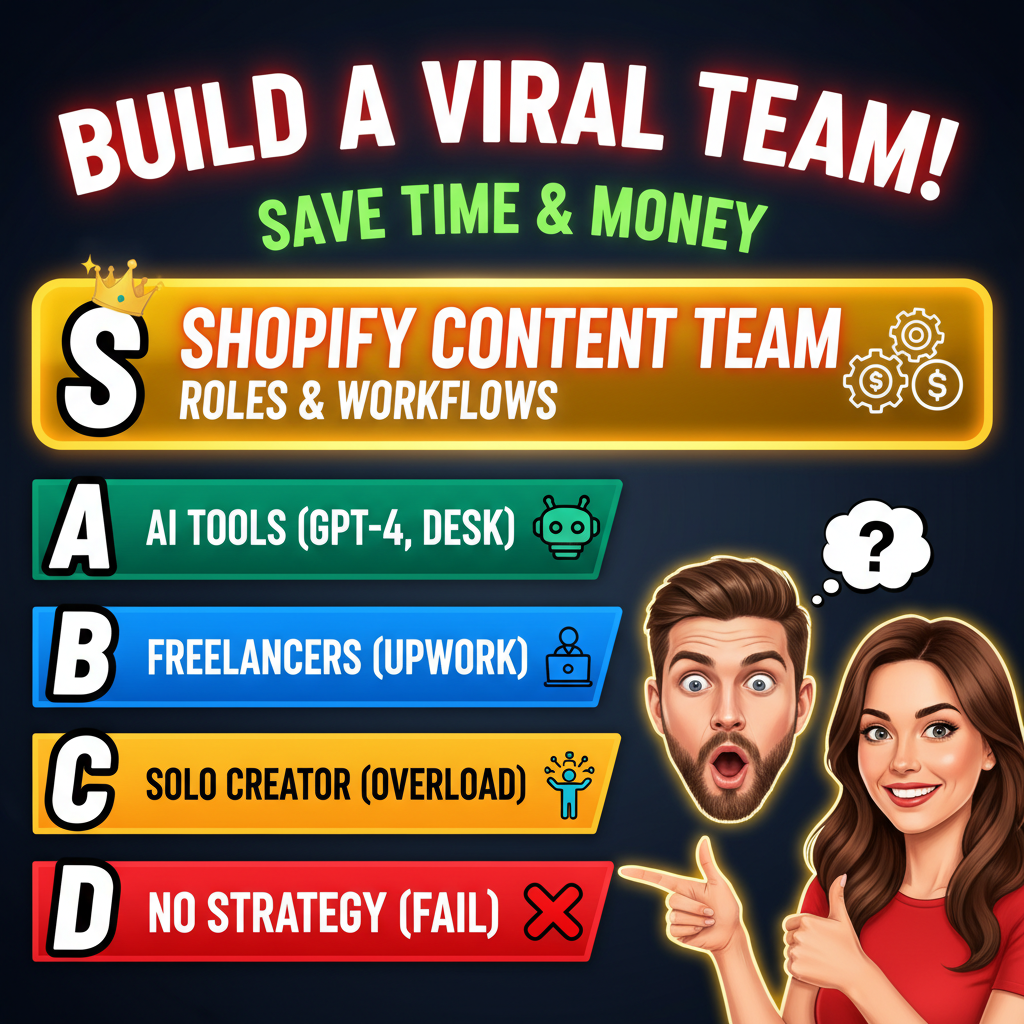
Building a real content team doesn't mean hiring five people. It means structuring one person's time differently, or, at scale, dividing responsibilities so expertise and velocity both improve.
Content Team Structure by Revenue Stage
| Revenue Stage | Team Size | Roles | Monthly Budget | Focus |
|---|---|---|---|---|
| $500K–$2M | 1 person | Content Manager | $4K–$8K | Blog, email, product content |
| $2M–$10M | 2–3 people | Manager + Writer + Designer | $12K–$25K | Blog, email, SEO, product pages |
| $10M–$50M | 4–6 people | Manager + 2 Writers + Designer + Strategist | $35K–$70K | Blog, email, SEO, UGC, community |
| $50M+ | 6+ people | Manager + 4+ writers + Design lead + SEO specialist + Video | $80K–$150K | All channels + owned media |
Translation: You don't need five people at $2M. But you do need to stop treating content as a side project.
The Roles (And What Each Actually Does)
Content Manager (1 FTE at all stages)
Responsibilities:
- Editorial calendar (3–6 months ahead)
- Blog assignment and review
- Product description copywriting
- Email sequence strategy
- Internal metrics dashboard (traffic, conversion, ROI)
This person owns the machine. They don't write everything, but they decide what gets written, by whom, and when.
Content Writer(s) (0.5–4 FTE, scale with revenue)
At $2M: Hire a freelancer (10 hrs/week) for 4–6 blog posts/month.
At $10M: Hire 1–2 full-time writers. Split: one focused on SEO/blog, one on product/email.
At $50M+: Hire 2–4 writers + 1 content strategist. Split by topic pillar (product, growth, thought leadership).
Designer (0–1 FTE)
Optional at $2M. Essential at $10M+. Responsibilities:
- Infographics (product pages, blog posts, email headers)
- Email template design
- Social assets
- Brand consistency across content
SEO Specialist (0–0.5 FTE at $10M+)
Keyword research, content audits, internal linking strategy. Often a freelancer or consultant rather than full-time until $20M+.
Video Lead (0–0.5 FTE at $50M+)
Product demos, founder content, educational videos for YouTube or TikTok.
The Tools Stack (What Actually Gets Used)
| Category | Tool | Cost | Why It Matters |
|---|---|---|---|
| Writing | Notion + Google Docs | $10–$15/mo | Central source of truth, edit tracking, collaboration |
| SEO | SEMrush or Ahrefs | $120–$200/mo | Keyword research, competitor analysis, backlink tracking |
| Design | Figma + Canva Pro | $25–$30/mo | Infographics, email headers, social |
| Analytics | Google Analytics 4 + Shopify | Free | Track content traffic, conversion, revenue attribution |
| Klaviyo or Omnisend | $80–$300/mo | Segment campaigns, A/B test, track conversion | |
| Blog/CMS | Ghost or Shopify Blog | $0–$100/mo | Content publishing, SEO metadata, automation |
| Project management | Linear or Monday | $10–$50/mo | Editorial calendar, assignment tracking, workflow |
Don't overthink this. Most DTC brands overdo tools. Start with Notion for editorial calendar, Google Analytics for reporting, and Figma for design. Add specialized tools when you hire specialists.
The Workflow That Actually Works
Week 1–2: Plan
- Content manager + strategist (or founder) define next month's topics
- Assign 4–6 blog post ideas based on keyword research and product roadmap
- Identify which posts need infographics
- Schedule email themes (product launch, educational, retention)
Week 3: Create
- Writers draft blog posts (48-hour turnaround for 1,500-word piece)
- Designers create infographics (1–2 per blog post)
- Copy editor (manager or freelancer) reviews for brand voice and clarity
- SEO specialist audits draft (keywords, internal links, meta)
Week 4: Publish + Distribute
- Blog posts go live on Ghost or Shopify (Monday–Wednesday to catch search)
- Infographics embedded in post
- Email sequences drafted based on blog topic (announcement, 3-day follow-up, 1-week nurture)
- Social ads seeded (if budget exists)
- Internal links added to related posts
Ongoing: Measure
- Weekly metrics review (traffic, conversion, email open rates)
- Monthly ROI calculation (content spend → customer acquisition, repeat purchase)
- Quarterly content audit (what performed, what flopped, what to keep)
Revenue Impact: What Content Actually Moves
Real benchmarks from Shopify merchants we work with:
| Content Type | Traffic Driver | Conversion Lift | Repeat Purchase Lift |
|---|---|---|---|
| SEO blog posts (3–6 months to impact) | +20–40% organic traffic | 2–4% | 8–15% |
| Email sequences (personalized) | Engaged segment | 5–8% | 12–20% |
| Product descriptions (optimized) | On-page conversion | 1–2% CAC reduction | 5–8% |
| Educational content (YouTube/blog) | Brand awareness, organic | Long tail keywords | 15–25% (brand lift) |
Dollar math: A $5M revenue store with 25% repeat purchase rate generates $1.25M from repeat customers. A 10% improvement in repeat purchase (through better email content + product storytelling) is $125K incremental revenue. The content team budget? $25K–$35K/month. ROI: 3–5x within 6 months.
Common Mistakes in Content Team Structure
Mistake 1: Writer without strategist. Hire a freelancer to pump out 10 blog posts/month. Nobody decides which 10. You get decent writing, zero ROI. Fix: Always pair writing with strategy.
Mistake 2: Content team in isolation. Content person reports to marketing alone. Product, ops, and customer success have no voice. Result: content doesn't reflect real customer questions. Fix: Monthly meetings between content + product + CS.
Mistake 3: No measurement. Blog post goes live. Traffic rises 30%. Nobody tracks if that traffic converts or improves LTV. Fix: Build a dashboard. Track content → customer → revenue.
Mistake 4: Designer does blog images only. Designer underutilized. Could be optimizing email, social, product pages. Fix: Define design scope clearly. Infographics + email + product pages + social = 40% content team impact.
Mistake 5: No editorial guidelines. Different writers have different voices. Blog post reads like six people wrote it. Fix: Write a 2-page brand voice guide. Review every piece for consistency.
Building a Remote Content Team
Most DTC brands hire remote content teams now. The advantage: access to global talent. The challenge: asynchronous workflows.
Best practices:
- Editorial calendar + assignments live in Notion. Everyone sees what's coming 6 weeks ahead.
- Drafts reviewed 48 hours. Feedback specific and actionable, not "I don't like this."
- Weekly 30-minute sync on key projects. Async on execution.
- Infographics + graphics require a shared Figma file with comments, not email threads.
- Monthly metrics review (all team members), quarterly strategy review (manager + key writers).
The Founder's Role in Content
Most founders worry: "I don't have time to write."
You don't need to write a lot. But you need to:
- Define content strategy (what stories matter to your brand)
- Review 10% of pieces for voice alignment
- Contribute 1 founder piece/quarter (authentic authority builder)
- Connect content team with customer data (what do customers actually ask?)
This is 4–6 hours/month. It's non-negotiable for brand authority.
Ready to Build a Content Machine That Moves Revenue?
A structured content team is one of the highest-ROI investments you can make at $2M+. It takes time to hire well and workflows to click, but the payback is substantial: lower CAC, higher LTV, defensible brand advantage.
At Tenten, we help Shopify merchants architect their content operations and hire remote teams that deliver. Whether you're starting from scratch or restructuring an existing team, let's talk about what's next. Contact us here.
Editorial Note
The biggest mistake we see: founders treating content as a cost center instead of a revenue engine. A $1 spend on content strategy compounds over quarters. Most merchants are 6–12 months away from a breakthrough if they structure the team right.
Frequently Asked Questions
Should we hire in-house or use freelancers?
At $2M–$10M, hybrid works best: one in-house content manager + freelance writers + contractor designer. At $10M+, shift to full-time writers and in-house strategy. Consistency matters more at scale.
How long before we see ROI from a content team?
SEO blog content takes 3–6 months to move metrics. Email and product content show ROI in weeks. Budget 6–12 months for the full impact of a content team to compound.
What should content spend be as a % of revenue?
2–4% of revenue at $2M–$10M. At higher revenue (>$50M), 3–5%. This includes salary, tools, and freelance.
Can one person manage content at $10M revenue?
Not well. One person can manage the calendar, but writing + design + analytics requires multiple people (or part-time specialists). You'll hit a ceiling at $3M–$5M with one person.
How do we measure content ROI?
Track content source in Google Analytics and Shopify. Segment by customer: first purchase source (organic, email, social) + repeat purchase source. Calculate LTV by source. Use Shopify's customer analytics or a BI tool.
Should our content team report to marketing or product?
Both. Content manager reports to marketing (budget, strategy). But they take feedback from product, ops, and CS. Monthly cross-functional meetings prevent silos.