
The Search Engine Duopoly is Cracking
Google owned search for 20 years. You optimized for Google's algorithm, got backlinks, ranked, captured traffic.
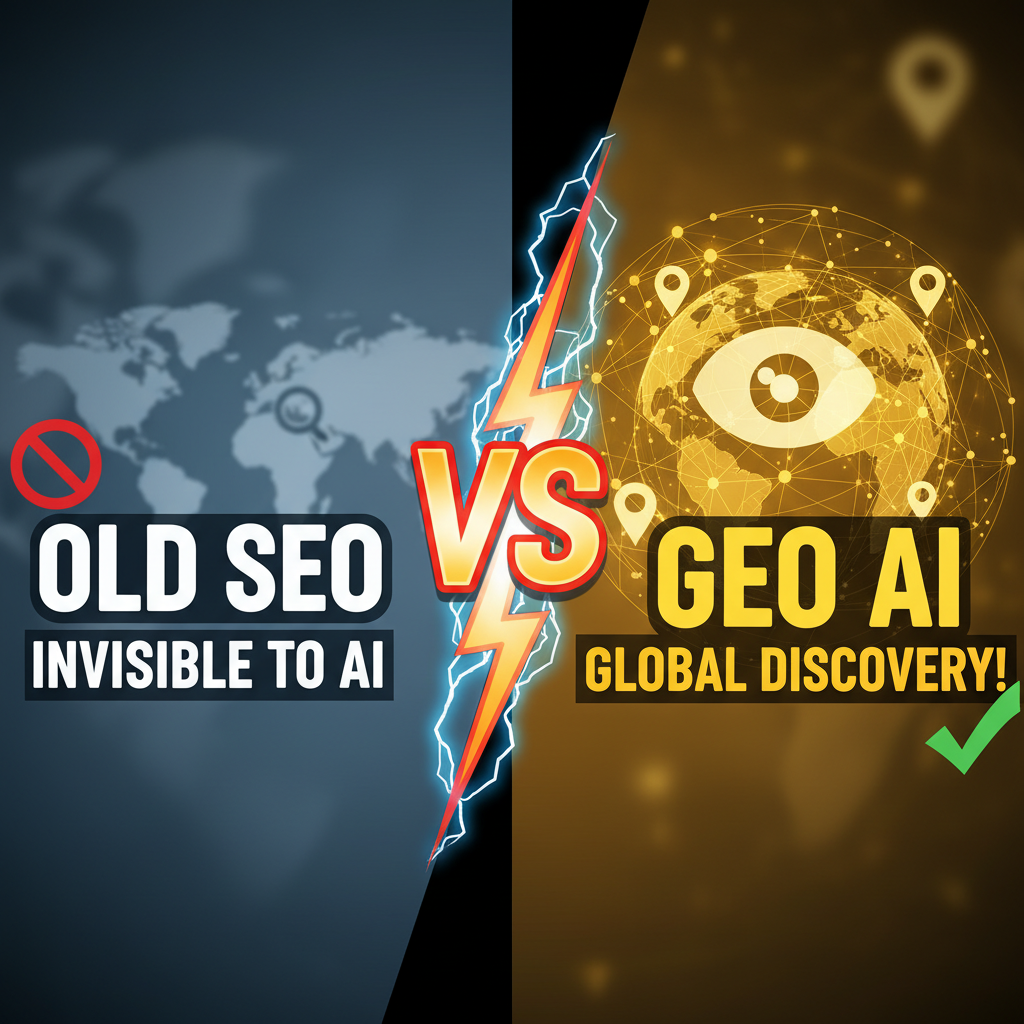
That's changing now. Three competing search paradigms:
-
Traditional SEO (Google). Links + content authority. Ranks best site, sends traffic to domain.
-
GEO (Generative Engine Optimization). AI search engines (ChatGPT Search, Perplexity, Claude) synthesize answers from multiple sources in real time. They cite sources but don't necessarily send 90% traffic to the top result.
-
Discoverability platforms (YouTube, TikTok, Amazon search). Non-Google search but still huge traffic sources.
The seismic shift—AI search engines grew from 0% to 15% of search volume in 18 months. By 2027, they could be 30%. That's enough to matter.
Here's what nobody's talking about yet: you can't win at GEO with a traditional SEO strategy. They have different rules.
How AI Search Engines Actually Work
A user asks ChatGPT Search: "What's the best Shopify app for inventory management?"
ChatGPT doesn't rank one result and send them there. Instead, it:
-
Scans sources in real time. Searches current web for relevant pages (timing matters more than links).
-
Synthesizes an answer. Combines data from 3-7 sources, writes a natural answer in plain English.
-
Cites sources. Lists 2-4 links at the bottom. "According to [Site A], [Site B] recommends..."
-
Sends some traffic. But not all of it. Some users read the AI answer and move on. Some click through to the sources.
The revenue implication—even if you're cited as a source, you get 20-40% of the traffic that a Google ranking would send. You're the cited expert, not the destination.
Traditional SEO players hate this. They optimized for destination traffic. GEO optimizes for authority and citations.
The GEO Playbook (Not SEO)
If you want to win in AI search engines, the moves are different:
Rule 1: Be the synthesizable expert. AI engines look for specific, factual information. Not essays. Not brand narratives. Structured data points that can be extracted and used in an AI answer.
Example—bad for GEO: "Our app is the best because we care about our customers and innovation is in our DNA."
Better for GEO: "Our app reduces inventory reconciliation time by 3-4 hours per week. Users report 14% faster reorder cycles because they see stock levels in real time."
One is quotable. One is a marketing fluff.
Rule 2: Use data and expert frameworks. AI models reward specific data points, methodologies, and primary research. They cite sources that have data.
If you published: "We surveyed 500 e-commerce managers and found 67% manually reconcile inventory weekly. Automation reduced this to monthly, saving 8 hours/month per person," you'd be cited in every AI answer about inventory management. That's the play.
Rule 3: Structured data matters. Google's Knowledge Graph used schema markup. AI engines care less about metadata and more about content structure.
Tables, lists, step-by-step procedures, and clear definitions are highly extractable. AI models find these, extract the info, and cite the source.
If your answer is a table (feature comparison, step-by-step guide, methodology), you're 3x more likely to be cited than if it's prose paragraphs.
Rule 4: Real-time updates are gold. Perplexity prioritizes fresh content. An article published yesterday ranks higher than one published 2 years ago for the same query. This flips traditional SEO—old authoritative pages used to rank forever. In GEO, freshness wins.
If your space is moving fast (AI tools, e-commerce, fintech), publishing monthly or weekly (not quarterly) helps GEO. The trade—more frequent publication requires content operations, not just freelance writers.
Rule 5: Primary research beats synthesis. AI engines trust original research more than content that rehashes other articles.
If you're an e-commerce platform, survey your own users. Publish findings. AI models will cite you as a primary source rather than a secondary aggregator.
GEO vs SEO: The Structural Differences
| Factor | SEO | GEO |
|---|---|---|
| Traffic Model | Send traffic to one winning URL | Cite multiple sources, share traffic |
| Link Building | Backlinks create authority | Citation (mentions) matters more |
| Content Format | Long-form essays (2000+ words) | Structured data, tables, lists, facts |
| Update Frequency | Old authoritative pages rank forever | Fresh pages rank higher |
| Source Preference | High domain authority | Primary research, original data |
| Keyword Strategy | Exact keyword + variations | Intent matching + related concepts |
| Competition | Winner-take-most (rank 1) | Distributed (multiple sources cited) |
| Time to Visibility | 2-6 months | 1-2 weeks |
The competitive implication—if you're a new brand, GEO is your friend. You don't have the domain authority to rank #1 in Google (takes 12-18 months). But you can be cited as a source in AI answers in 2-4 weeks if you publish the right content.
The Hybrid Strategy: Not Either/Or
The mistake is thinking you pick one. You don't.
Traditional SEO still drives 70% of search volume. You need to rank on Google. But as AI search grows, you need GEO too.
Here's the overlap—good GEO content often helps SEO:
- Tables and structured data help both.
- Primary research helps both (unique, citable, authoritative).
- Fresh updates help SEO (freshness boost) and GEO (recency preference).
- Clear writing helps both (readability, clarity, scannability).
But SEO-optimized content doesn't automatically become GEO-optimized. Long-form articles (3000+ words) with keyword density are SEO plays. They often don't have the structured data that AI engines prefer.
The hybrid approach:
-
Publish long-form SEO content (2000-3000 words) for Google rankings. Build authority. Get backlinks.
-
Extract a structured summary (table, checklist, step-by-step procedure) from the long-form content and publish it separately. This is GEO bait.
-
Cite the long-form article in the structured summary. "For the full methodology, see [link]." Traffic flows: AI engine cites the summary, readers click through to the full article.
Example:
-
Blog post (SEO): "Complete Guide to Shopify Inventory Management" (3500 words, full system, best practices, case studies). Ranks for "Shopify inventory management" on Google.
-
Extraction (GEO): Publish a separate page—just a table with "5 Best Shopify Inventory Apps" (name, price, reconciliation time saved, rating). This is highly extractable. AI engines cite this. Readers who want more details click through to the full guide.
Both articles exist. Both serve different search engines. Both send traffic.
Measuring GEO Impact (It's Hard)
Google Analytics doesn't show AI search traffic separately (yet). So how do you know if GEO is working?
Proxy metrics:
-
Direct traffic spikes. When an AI engine cites you, you see sudden direct visits (users reading the AI answer and clicking your link, arriving without a referrer).
-
Branded search spikes. After being cited, users often search for your brand to verify. You'll see "your brand name" queries go up in Google Search Console.
-
Publication date correlation. Compare traffic to publication date. GEO-optimized content (fresh, structured) sees traffic spike within 1-2 weeks. SEO content takes 2-3 months.
-
Reverse-engineer mentions. Search Perplexity, ChatGPT Search, Claude for queries in your niche. See if you're cited. If you're cited 5+ times per month, you have GEO traction.
If you're getting 200 visitors monthly from a Google ranking but you're being cited 10 times in AI search answers, GEO is working even though it looks quiet in Analytics.
Content Themes That Win in GEO
AI engines prefer factual, extracted content over opinions. This shifts what wins:
Themes that crush in GEO:
-
Methodologies and frameworks. "5-Step inventory audit process." "6-stage customer retention funnel." AI loves procedures.
-
Comparisons with data. "Shopify vs BigCommerce: 8 factors compared." Tables. Numbers. Factual. Easy to cite.
-
Primary research. "We surveyed 1000 e-commerce managers and found X." Specific percentages. Credible sources.
-
Listicles with metrics. "7 Best Shopify Apps for Inventory: Speed, Cost, Rating Compared." Each item has data. Highly extractable.
-
FAQs with concise answers. "What's the average cart abandonment rate in 2026?" "Answer: 71%, down from 75% in 2024." AI loves structured Q&A.
Themes that underperform in GEO:
-
Brand narratives. "How we built our agency" (not extractable).
-
Long opinion essays. "Why Shopify Plus is the future" (can't synthesize into AI answers easily).
-
Vague best practices. "7 ways to improve your store" (no metrics, no specificity).
-
Motivational content. "You can do it! Follow your dreams!" (irrelevant to factual search).
The 2026 Content Calendar Shift
Most brands publish a blog calendar that's SEO-optimized. One post per week. Long form. Topically varied.
For GEO, you'd shift to:
| Format | Frequency | Purpose |
|---|---|---|
| Long-form guide (2000-3000 words) | Monthly | SEO authority, backlinks, in-depth learning |
| Structured extraction (table/list/FAQ) | Weekly | GEO citations, AI search visibility |
| Primary research/survey | Quarterly | Original data, high GEO authority |
| Case study with metrics | Monthly | Credibility, extractable results |
| Quick answer (100-200 words) | Weekly | Fast GEO pickups, AI summary bait |
More frequent publication, more structured formats, less essays. This is a operations shift, not a strategy shift.
Why Both Matter
In 2024, 70% of search was Google. 15% was AI search engines. By 2026, that could flip to 60% Google, 25% AI, 15% other (YouTube, Amazon, TikTok, etc.).
You're leaving 25% of search on the table if you ignore GEO.
The cost to optimize for both—not much. Better structured data and more frequent publishing. The upside—access to a new search channel before everyone figures it out.
Ready to Future-Proof Your Content Strategy?
GEO is the emerging moat. Brands that master both SEO and GEO in 2026 will own search in 2027. Tenten's Content Architecture Program includes keyword research for both Google and AI search engines, content format strategy, publishing roadmap, and GEO measurement setup.
Editorial Note
SEO professionals will claim GEO is hype. They're protecting their expertise. The reality—AI search went from zero to 15% of queries in 18 months. Trajectory matters. Early movers building both SEO and GEO infrastructure now will have a 12-18 month advantage by 2027. This is the time to move.
Article FAQ
Q: Is GEO replacing SEO?
A: No. Google still drives 60-70% of search volume. SEO is foundational. But as AI search grows (projected 25-30% by 2027), GEO becomes essential. You need both.
Q: How do I know if AI search engines are citing my content?
A: Search Perplexity, ChatGPT Search, or Claude for queries in your niche. If you're cited in multiple answers, GEO is working. You can also set up Google Alerts for your brand + key phrases to monitor mentions.
Q: Should I publish less longer content or more shorter content for GEO?
A: Different format for different engines. Long-form (2000+ words) for SEO authority. Structured summaries (tables, lists, FAQs) for GEO. Not either/or—both, served separately.
Q: Does my website architecture need to change?
A: Not necessarily. Use categories, tags, and clear header hierarchy. Structured data (schema markup) helps. But you don't need to rebuild your site. Publishing better-structured content is enough.
Q: How soon will AI search traffic show up?
A: Typically 1-4 weeks if content is GEO-optimized (structured, data-rich, well-sourced). Traditional SEO takes 2-6 months. The speed difference is why GEO is valuable for new brands.
Q: Can I optimize one piece of content for both SEO and GEO?
A: Partially. Some overlap (clarity, primary research, freshness). But GEO favors structured data and tables while SEO favors keyword density and link-friendly prose. Best practice—publish SEO content, then extract a structured summary for GEO.