
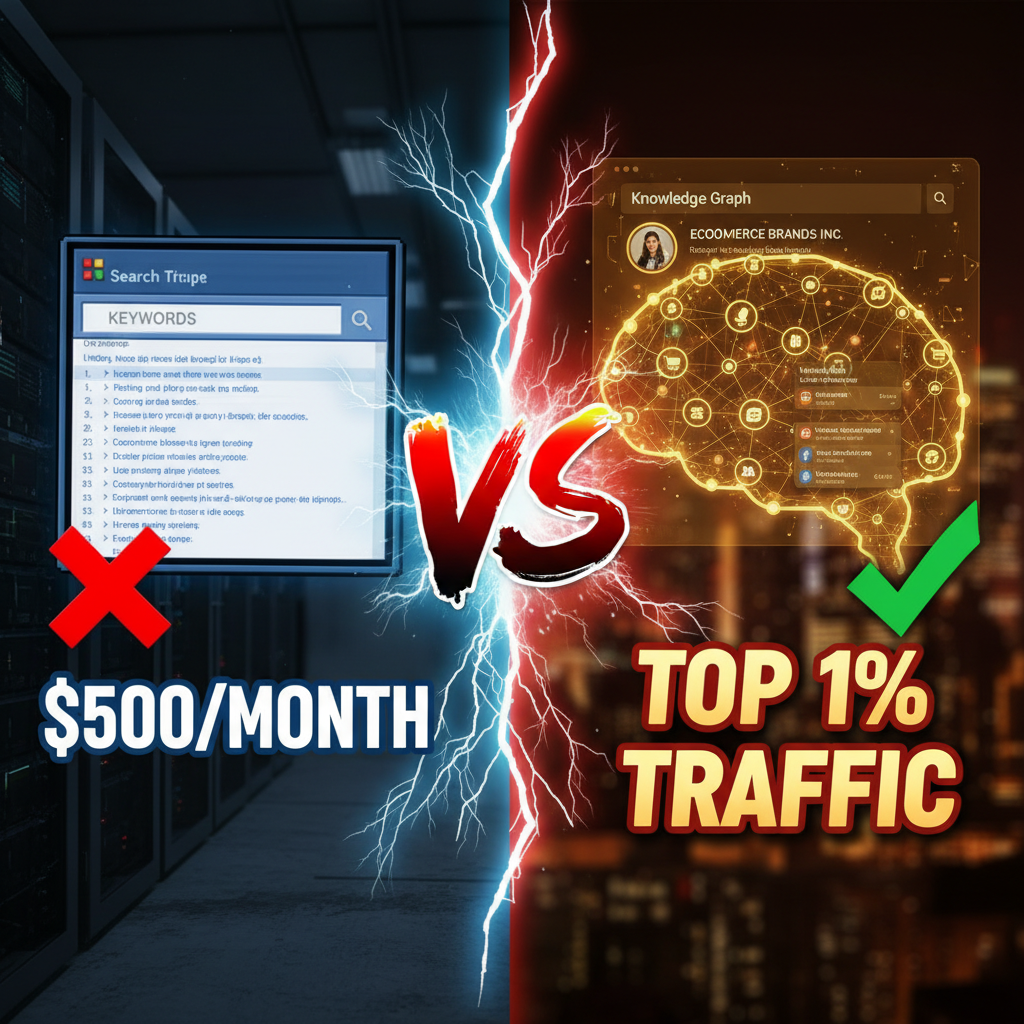
The Shift from Keywords to Entities
For 20 years, SEO was about keywords. Stuff the right phrase in your title and meta description, and Google would rank you.
That's over.
Google now understands entities—people, places, brands, products, concepts. A search for "best coffee grinder" returns results based on entity relationships, not keyword matches. Google knows these brands make grinders, these reviewers cover the category, and these retailers sell them.
This shift is seismic. The old playbook (keyword research, thin content, link velocity) still works for 40% of searches. For the other 60%, you need entity optimization.
The operator insight: entity optimization is compounding. Your brand builds authority over 6-12 months, but once you own your entity, competitors can't dislodge you easily. You become the canonical source for your category.
This is how Shopify brands beat larger competitors. Not with SEO tricks, but with authoritative entity building.
What Is an Entity in SEO?
An entity is a distinct concept Google recognizes and indexes separately from all other concepts.
Examples:
- Brand entity: "Allbirds" (the brand, products, company, founders, funding)
- Product entity: "Allbirds Wool Runners" (specific product, reviews, comparisons, pricing)
- Person entity: "Tim Brown" (founder of Allbirds, biography, social profiles)
- Category entity: "Sustainable sneakers" (broader concept, competing brands, retailers)
Google represents these as nodes in its Knowledge Graph—a massive database of interconnected entities and relationships.
When you search "Allbirds sustainable sneakers," Google understands:
- Allbirds (brand entity) makes sustainable sneakers (category entity)
- They're founded by Tim Brown (person entity)
- They use Merino wool (material entity)
- They're similar to Patagonia, Reformation (competitor entities)
Your goal: become the authoritative entity for your category.
Entity Signals Google Uses to Verify Your Brand
Google doesn't just trust your website. It verifies your entity through external signals:
Signal 1: Wikipedia or Wikidata
If your brand has a Wikipedia page, Google treats it as canonical. Don't have one? Create a Wikidata entry (open-source equivalent).
What to include:
- Brand name (English + any variations)
- Founded date
- Founder(s) name
- Headquarters location
- Business category
- Official website URL
This is high-authority verification.
Signal 2: Structured Data (Schema Markup)
Schema markup tells Google "Here's my entity data in a standard format."
Critical schemas for e-commerce:
Organization(brand info, contact, founding date)Brand(name, logo, official website)Product(name, description, price, availability, review rating)LocalBusiness(for stores with physical locations)BreadcrumbList(hierarchy structure)
{
  "@context": "https://schema.org",
  "@type": "Organization",
  "name": "Acme Sustainable Fashion",
  "url": "https://acmefashion.com",
  "logo": "https://acmefashion.com/logo.png",
  "foundingDate": "2018",
  "founder": {
    "@type": "Person",
    "name": "Jane Doe"
  },
  "address": {
    "@type": "PostalAddress",
    "streetAddress": "123 Main St",
    "addressLocality": "Portland",
    "addressRegion": "OR",
    "postalCode": "97201",
    "addressCountry": "US"
  },
  "sameAs": [
    "https://www.linkedin.com/company/acme-sustainable-fashion",
    "https://www.twitter.com/acmefashion",
    "https://www.instagram.com/acmefashion"
  ]
}
This goes in the <head> of your site. Ghost CMS lets you add it via code injection.
Signal 3: Cross-Domain Links & Citations
When other authority sites link to you or mention your brand, Google strengthens your entity.
High-value mentions:
- Press coverage (TechCrunch, Forbes, Wall Street Journal)
- Industry awards (Shopify App Store featured, Fast Company MVP, etc.)
- Podcast interviews where you're named
- Industry directories where you're listed
Each mention reinforces your entity in Google's graph.
Signal 4: Knowledge Panel Optimization
Your Knowledge Panel is Google's entity summary (appears on the right side of branded searches).
To influence it:
- Create a Google Business Profile (if you have a physical location)
- Verify your social profiles (link from your website to verified Twitter, LinkedIn, Instagram)
- Keep your About page updated with key entity details
- Use consistent branding across your site (logo, name, color, messaging)
Google uses these signals to auto-populate your Knowledge Panel.
Signal 5: Consistency Across the Web
Use the exact same brand name, logo, and contact info everywhere:
- Your website
- Social profiles (Twitter, LinkedIn, Instagram, Facebook)
- Google Business Profile
- Industry directories
- Press releases
- Wikipedia
Inconsistency weakens your entity (Google thinks you're multiple brands).
Building Your Brand Entity: The Playbook
Step 1: Define Your Entity (Brand Architecture)
Write out your entity attributes:
| Attribute | Value |
|---|---|
| Official Brand Name | Acme Sustainable Fashion (Inc) |
| Tagline/Descriptor | "Ethical fashion for conscious consumers" |
| Founded Date | 2018 |
| Founders | Jane Doe, John Smith |
| Headquarters | Portland, OR, USA |
| Business Category | E-commerce, Fashion, Sustainable/Ethical |
| Official Website | https://acmefashion.com |
| Industry | Apparel & Fashion |
| Key Products | Organic cotton dresses, ethically-sourced jackets, vegan leather bags |
| Related Entities | (Competitors) Patagonia, Reformation, Everlane |
| Investor/Partner Entities | (If applicable) Y Combinator, Shopify Plus, etc. |
This is your entity blueprint.
Step 2: Implement Structured Data (Schema)
Add Organization schema to your homepage and Product schema to all product pages.
For Shopify:
Go to Settings → Checkout & Payments → Additional Scripts and add your schema in the header scripts.
Or use a Shopify app like Schema Editor or JSON-LD for SEO to automate this.
Essential schemas:
- Organization (homepage)
- BreadcrumbList (all pages—helps with hierarchy)
- Product (every product page)
- LocalBusiness (if you have a store)
Step 3: Build Your About Page as an Entity Hub
Your About page is where Google learns your entity. Make it authority-rich:
Include:
- Company origin story (credibility)
- Founder(s) full name + brief bio (person entities)
- Headquarters location + contact info (location entity)
- Mission statement (entity differentiator)
- Key milestones and funding (verification signals)
- Team photos and names (person entities)
- Links to social profiles (cross-domain verification)
Example structure:
# About Acme Sustainable Fashion

Acme was founded in 2018 by Jane Doe (formerly VP of Sustainability at [Major Brand])
and John Smith (former designer at [Luxury Brand]). We're based in Portland, Oregon.

Our mission: Make ethical fashion accessible to 1M conscious consumers by 2030.

## Founders
[Photo + name + background]

## Team
[Photos + names + roles]

## Milestones
- 2018: Founded with $500K seed funding
- 2019: Hit $1M ARR
- 2021: Featured on Fast Company "Most Innovative Brands"
- 2023: Raised Series A ($3M)

## Our Values
[Substantive section on values]

## Press
[Links to coverage]

## Awards
[Links to award pages]
Step 4: Claim Your Presence on Authority Platforms
Register your brand on platforms Google trusts:
Priority (do first):
- Google Business Profile
- LinkedIn Company Page (verify as founder)
- Wikipedia (if you qualify—$1M+ revenue, press coverage)
- Wikidata (open-source, easier than Wikipedia)
Secondary:
- Industry directories (Crunchbase, PitchBook for VC-backed brands; retail directories for merchants)
- Award sites (Best Products, Wirecutter, Fast Company)
- Sustainable fashion directories (if relevant to your brand)
Use the exact name, logo, and description across all.
Step 5: Earn Press and Authority Mentions
Press coverage is high-signal for entity verification.
Strategies:
- Pitch your origin story to lifestyle media
- Offer exclusive data or research to business media (e.g., "State of Sustainable Fashion Survey")
- Issue press releases on milestones (funding, awards, partnerships)
- Sponsor or speak at industry conferences (generates mentions)
Each mention adds an incoming edge to your entity graph. Accumulate 20-30 quality mentions, and your entity authority grows significantly.
Step 6: Link from Your Site to Entity Expressions
Internally link to category pages, related products, and founder pages. This creates entity relationships.
Example internal link structure:
Homepage
  → About Page (brand entity)
    → Founder Bio (person entity)
    → Sustainability Page (value entity)
  → All Products (product category entity)
    → Specific Product (product entity)
      → Material (material entity)
      → Sustainability (related concept entity)
  → Customer Reviews (social proof for entity)
This hierarchy teaches Google your entity structure.
Featured Snippets & AI Overviews: Entity-Driven SERP Features
Once your entity is strong, you become eligible for premium SERP features.
Featured Snippets
Featured snippets (the "Position Zero" box above organic results) are triggered by entity authority.
For "best sustainable sneakers," Google shows:
- Definitions (what are sustainable sneakers?)
- Comparisons (Allbirds vs. Patagonia vs. Reformation)
- How-to (how to choose sustainable sneakers)
- Lists (top 5 sustainable sneaker brands)
Strong entity authority makes you a candidate for snippets in your category.
To win snippets:
- Answer common questions on your category page
- Structure answers in short paragraphs (40-60 words each)
- Use lists and tables for comparisons
- Emphasize your brand's unique angle
- Include schema markup
Google AI Overviews (SGE)
Google's AI-driven search summaries pull from authoritative entities. If you own your entity, you're likely cited in the AI Overview.
The current Google AI Overview structure is:
"[Definition of category] Here's what's available: [list of top 3-5 brands/products, with links]. [Details on comparison/selection criteria]."
Entity optimization ensures you're in that list.
Competitor Entity Mapping
What entities compete with yours?
Exercise:
- Search "[Your Category] + [Key Attribute]" (e.g., "sustainable sneakers ethical")
- Note which brands appear in the Knowledge Panel, featured snippet, and top 10
- Map their entity strength (do they have Wikipedia? Schema? Press coverage?)
- Identify gaps (What entities are missing? What's underserved?)
Example map:
| Entity | Wikipedia | Schema | Press | Funding | Strength |
|---|---|---|---|---|---|
| Allbirds | Yes | Excellent | 50+ mentions | Public | 9/10 |
| Patagonia | Yes | Good | 100+ mentions | Private | 9/10 |
| Reformation | Yes | Excellent | 80+ mentions | Funded | 8/10 |
| Your Brand | No | Basic | 5 mentions | Seed | 3/10 |
This shows you where to invest. Aiming for Wikipedia entry is valuable. Getting into Crunchbase/PitchBook is achievable. Press coverage is the fastest lever.
Measuring Entity Authority
Google Search Console shows how often your brand appears in searches. High brand search volume + growing impressions = strong entity.
KPIs:
- Brand searches (month-over-month): Growing month 5-10%? You're building entity authority.
- Knowledge Panel impressions: "Impressions" where you appear in Knowledge Panels.
- Branded keywords ranking: Track how you rank for "[Your Brand] + [Category]".
- Featured snippet wins: Track how many category queries show your snippet.
- External mentions: Use a tool like Brandwatch or Meltwater to track online mentions of your brand name.
Monitor these monthly. Entity authority is a lagging indicator—changes take 3-6 months to show up.
Common Entity Optimization Mistakes
Mistake 1: Inconsistent Brand Names
Using "Acme Fashion" on your site, "ACME" on social, and "Acme Inc." on your legal docs confuses Google.
Use one official name everywhere. Variations (hyphens, capitalization) are OK, but keep primary name identical.
Mistake 2: Missing or Poor Schema
Schema markup isn't optional—it's how you tell Google who you are.
Don't miss:
- Organization schema on homepage
- Product schema on every product page
- BreadcrumbList on all pages
Mistake 3: Ignoring Wikipedia/Wikidata
If you have $1M+ revenue or press coverage, create a Wikipedia entry. If you don't qualify, create a Wikidata entry (takes 10 minutes).
This is one of the highest-signal entity verifications.
Mistake 4: No Press Coverage Strategy
You don't need to be TechCrunch-level famous. 10-15 mentions in relevant industry media significantly boost your entity.
Make press outreach systematic (once per quarter minimum).
Mistake 5: Thin About Page
Your About page is where Google learns your entity. A 100-word About page isn't enough.
Go long (1,000+ words). Include founder bios, company milestones, team photos, social proof, and entity attributes.
FAQ
How long does entity optimization take to show results?
Entity authority is a 6-12 month play. You'll see small improvements in brand search volume within 3 months, but meaningful SERP feature improvements (Knowledge Panel, featured snippets) take 6+ months. Consistency matters more than speed.
Can I manipulate Google's Knowledge Graph?
Not really. Google verifies entities through external signals (Wikipedia, press coverage, schema markup, consistency across the web). You can't force a ranking. You can only provide accurate, consistent signals and let Google connect the dots.
Does schema markup actually improve my rankings?
Schema doesn't directly improve rankings. It improves visibility for featured snippets, Knowledge Panels, and special SERP features. In one study, sites with product schema saw 35% more visibility in product-related searches. Indirect but significant.
Should I create multiple brand entities if I have multiple product lines?
Probably not. A single brand entity with multiple product entities is stronger than multiple brand entities. Google rewards vertical integration. Use sub-brand pages/schema to organize product lines within a single brand entity.
How do I know if my entity is strong?
Search your brand name. If you have a Knowledge Panel on the right, you're decently authoritative. If you appear in featured snippets for your category keywords, you're very strong. Use Google Search Console to track branded query impressions and clicks month-over-month.
Key Takeaways
Entity SEO is the future. Google's shift from keywords to entities has opened a gap: brands that optimize for entities own their category; brands that don't get drowned in commodity competition.
The playbook is straightforward: define your entity attributes, build them into your site structure (schema markup), verify them across the web (Wikipedia, Wikidata, social profiles, press), and accumulate mentions and citations.
Once your entity is strong, you become a natural candidate for featured snippets, Knowledge Panels, and AI Overviews. You also become much harder to displace in organic search.
The brands winning at entity SEO aren't bigger or better-funded. They're just more intentional about building their brand as a distinct entity Google recognizes and trusts.
Ready to build a category-owning brand entity? Tenten specializes in e-commerce positioning and SEO strategy. Let's talk about your entity strategy.
Frequently Asked Questions
What is an entity in SEO?
An entity is a distinct concept Google recognizes and indexes separately—a brand, product, person, or category. Google represents entities as nodes in its Knowledge Graph and understands relationships between them. For example, "Allbirds" (brand entity) makes "sustainable sneakers" (category entity). Strong entity optimization makes your brand authoritative and hard to displace.
How does entity SEO differ from keyword SEO?
Keyword SEO focuses on ranking for specific search phrases (e.g., "sustainable sneakers"). Entity SEO focuses on becoming the authoritative source for a category or concept. Keyword SEO is table-stakes; entity SEO wins featured snippets, Knowledge Panels, and AI Overviews. Both matter, but entity authority increasingly determines visibility in Google's newer ranking systems.
What are the most important entity signals Google uses?
Google verifies entities through: Wikipedia/Wikidata entries (highest signal), structured data/schema markup (how you declare your entity), consistent branding across the web (same name, logo, description everywhere), external mentions and press coverage (third-party verification), and knowledge panel optimization. More signals = stronger entity authority.
How do I implement entity optimization for my Shopify store?
Start with: (1) Add Organization schema to your homepage and Product schema to all product pages, (2) Create/verify your Google Business Profile, (3) Strengthen your About page with founder bios and company details, (4) Register on LinkedIn Company Page and Wikidata, (5) Pursue press coverage and industry mentions, (6) Keep branding consistent across all online properties.
How long does entity optimization take to show results?
Entity authority is a 6-12 month compound play. You'll see small improvements in branded search volume within 3 months, but significant SERP feature improvements (Knowledge Panel, featured snippets, AI Overviews) take 6+ months. Consistency and external signals matter more than speed.
FAQ JSON-LD Schema
{
"@context": "https://schema.org",
"@type": "FAQPage",
"mainEntity": [
{
"@type": "Question",
"@id": "faq-1",
"name": "What is an entity in SEO?",
"acceptedAnswer": {
"@type": "Answer",
"text": "An entity is a distinct concept Google recognizes and indexes separately—a brand, product, person, or category. Google represents entities as nodes in its Knowledge Graph and understands relationships between them. For example, \"Allbirds\" (brand entity) makes \"sustainable sneakers\" (category entity). Strong entity optimization makes your brand authoritative and hard to displace."
}
},
{
"@type": "Question",
"@id": "faq-2",
"name": "How does entity SEO differ from keyword SEO?",
"acceptedAnswer": {
"@type": "Answer",
"text": "Keyword SEO focuses on ranking for specific search phrases (e.g., \"sustainable sneakers\"). Entity SEO focuses on becoming the authoritative source for a category or concept. Keyword SEO is table-stakes; entity SEO wins featured snippets, Knowledge Panels, and AI Overviews. Both matter, but entity authority increasingly determines visibility in Google's newer ranking systems."
}
},
{
"@type": "Question",
"@id": "faq-3",
"name": "What are the most important entity signals Google uses?",
"acceptedAnswer": {
"@type": "Answer",
"text": "Google verifies entities through: Wikipedia/Wikidata entries (highest signal), structured data/schema markup (how you declare your entity), consistent branding across the web (same name, logo, description everywhere), external mentions and press coverage (third-party verification), and knowledge panel optimization. More signals = stronger entity authority."
}
},
{
"@type": "Question",
"@id": "faq-4",
"name": "How do I implement entity optimization for my Shopify store?",
"acceptedAnswer": {
"@type": "Answer",
"text": "Start with: (1) Add Organization schema to your homepage and Product schema to all product pages, (2) Create/verify your Google Business Profile, (3) Strengthen your About page with founder bios and company details, (4) Register on LinkedIn Company Page and Wikidata, (5) Pursue press coverage and industry mentions, (6) Keep branding consistent across all online properties."
}
},
{
"@type": "Question",
"@id": "faq-5",
"name": "How long does entity optimization take to show results?",
"acceptedAnswer": {
"@type": "Answer",
"text": "Entity authority is a 6-12 month compound play. You'll see small improvements in branded search volume within 3 months, but significant SERP feature improvements (Knowledge Panel, featured snippets, AI Overviews) take 6+ months. Consistency and external signals matter more than speed."
}
}
]
}