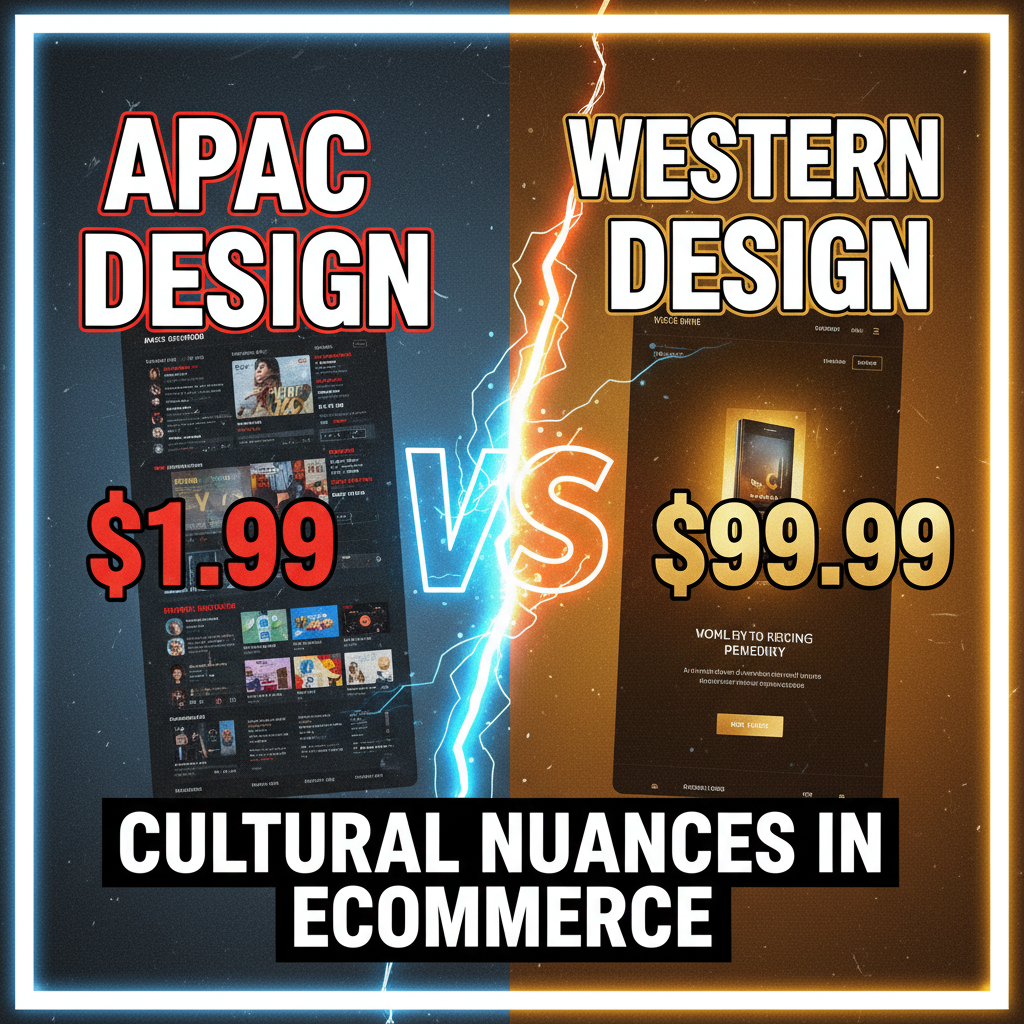
Why Your Western Design Fails in APAC Markets
You built a beautiful Shopify store. Clean minimalism. Trust signals in the footer. Subtle product photography. Fast checkout. Then you launched in Singapore, Vietnam, or Taiwan—and conversion rates tanked.
The problem isn't your design chops. It's that APAC buyers think about trust, urgency, and purchase intent differently than Western customers.
Western e-commerce design assumes scarcity drives urgency (limited stock, countdown timers). APAC design assumes social proof drives urgency (thousands bought this, here's what buyers said). Western design hides prices until checkout. APAC design displays full pricing prominently—even coupon codes—because buyers validate spending decisions through comparison shopping.
This isn't guesswork. A 2024 Baymard Institute study of 1,200 APAC shoppers found that 78% abandon carts when product prices aren't immediately visible, compared to 34% in North America.
The Trust Pattern Divide
Western trust signals rely on absence: no ads, no sales language, no "gimmicks." That's professional. That signals authority through restraint.
APAC trust signals rely on presence: vendor credentials, official badges, competitor comparisons, testimonial volume, price transparency. When you hide information to appear trustworthy, APAC buyers assume you have something to hide.
| Trust Signal | Western Approach | APAC Approach |
|---|---|---|
| Seller Credentials | Brief "About Us" link | Detailed business registration, years in business, awards, certifications displayed on every product |
| Customer Reviews | 4.8 stars, 143 reviews | 4.8 stars, 4,732 reviews + photos from real buyers + detailed Q&A |
| Pricing | Clean, single price | Original price struck through, discount percentage highlighted, coupon codes visible in product description |
| Shipping | "Free shipping over $50" | Shipping costs per region, delivery times per province, multiple shipping options with real-time tracking |
| Guarantees | 30-day money-back | 7-day return, 30-day money-back, plus "official seller" badge and official store verification seal |
Why the gap? APAC marketplaces (Lazada, Tokopedia, Shopee) train buyers to expect transparency because competition is fierce. A Singapore buyer can compare identical products across 15 vendors in 60 seconds. Winning requires visible differentiation: better reviews, clearer terms, faster shipping, lower prices.
Western e-commerce assumes buyers trust the brand before they buy. APAC e-commerce assumes brands must prove credibility before checkout.
Design Patterns That Actually Convert in APAC
1. The Credibility Stack
Display your business credentials above the fold. Not in a footer hidden link.
- Business registration number (BCR/TIN) and verification seal
- Years in operation
- Monthly buyer count ("10,000+ customers this month")
- Official store badge from the payment partner
- Professional certifications or industry affiliations
Shopify merchants expanding to APAC via local marketplaces (Lazada Shop, Tokopedia, Shopee) see conversion lifts of 22–35% when all four credentials are visible on the product page.
2. Aggressive Price Transparency
Price breakdown is not optional. It's expected.
- Original price: $85 (struck through in red)
- Discount: 30% OFF
- Your price: $59.50
- Savings: Save $25.50
- Bulk discounts listed explicitly
- Coupon codes promoted in the product description
Western stores treat discounting as tacky. APAC buyers treat lack of visible discounts as suspicious.
3. Testimonial Velocity
One testimonial per product is not enough. APAC buyers scroll testimonials like a social feed—and the volume itself is a trust signal.
Display:
- Total review count (prominently)
- Review distribution chart (% of 5-star, 4-star, etc.)
- Filter by "Verified Buyer" (separates genuine reviews from promotional spam)
- Filter by rating
- Reverse-chronological timeline (newest first)
- Buyer photos: Include user-submitted photos (heavy weight in APAC decision logic)
Merchants on Shopify integrating with Lazada Seller Center report that adding user-photo filters increases time-on-page by 58% and reduces return rates by 12%.
4. Product Q&A Section
APAC buyers don't trust product descriptions alone. They ask vendors questions publicly.
- Display top 20 Q&A pairs on the product page
- Show which questions came from "Verified Buyers"
- Respond to every question within 24 hours (critical for conversion)
- Prioritize practical questions: "How long is the warranty?" over marketing fluff
Tokopedia merchants with active Q&A sections (responding within 12 hours) see 15% higher conversions than silent vendors.
5. Visual Proof Over Lifestyle Photography
Western photography: lifestyle imagery of the product in use, aspirational, soft lighting.
APAC photography: detailed product shots from multiple angles, close-ups of materials/quality, comparisons with competitors' products, sizing charts overlaid on real models.
The logic: APAC buyers are buying utility, not identity. Show them exactly what they're getting.
Mobile-First, Because APAC Is Mobile-First
In North America, 58% of e-commerce traffic is mobile—but desktop still drives 45% of revenue.
In APAC, 73% of traffic is mobile and mobile drives 68% of revenue (Statista, 2024).
This changes everything:
| Element | Western Approach | APAC Mobile Approach |
|---|---|---|
| Product images | 8–12 high-res images, tap to zoom | 15–20 quick-loading images, pinch-to-zoom required for details |
| Checkout flow | 4–6 steps | 2–3 steps; local payment methods pre-loaded (e-Wallet, bank transfer, COD) |
| Testimonials | Collapsed by default, click to expand | Auto-playing carousel, swipe to view next, 3 visible at once |
| Trust signals | Footer links | Sticky header bar showing seller badge + review count + live chat button |
| Promotional banners | Subtle, above fold | Bold, full-width, sticky, showing live sales velocity ("500+ ordered today") |
Payment Method Visibility Changes Everything
Western e-commerce: stripe, credit card, PayPal. That's it.
APAC e-commerce: credit card, debit card, local e-wallets (GCash, Dana, OVO), buy-now-pay-later, bank transfer, cash-on-delivery (COD).
The conversion impact is massive. In Philippines, COD represents 48% of e-commerce transactions. In Indonesia, it's 62%. Shopify merchants who add local payment partners (Xendit, Payfort, 2Checkout) see cart abandonment drop by 31% in APAC markets.
But visibility matters as much as availability. Show all payment options on the product page, not buried in checkout. APAC buyers want to know upfront that their preferred payment method is accepted.
Cultural Aesthetics: Color, Layout, Typography
APAC design aesthetics differ subtly but measurably from Western standards.
Color psychology in APAC:
- Red = luck, prosperity, urgency (promote heavily during Chinese New Year)
- Gold = wealth, prestige (luxury product category signal)
- White = purity (unlike Western associations with emptiness)
- Green = health, growth
- Black text on white = clarity, formality
Layout principles in APAC:
- Dense information is trustworthy (empty space = untrustworthy)
- Vertical scrolling is expected; horizontal scrolling is jarring
- Symmetrical layout signals professionalism
- Top-heavy information hierarchy (key details first, then narrative)
Typography in APAC:
- Smaller fonts (12px–14px) than Western standard (16px+) because APAC screens are closer
- Sans-serif, high contrast (trust through clarity)
- CJK-aware fonts for multilingual stores (e.g., Noto Sans)
Case Study: Taiwan DTC Brand Expansion to Vietnam
A Taiwan-based bicycle parts manufacturer (fictional but realistic) operates a Shopify Plus store targeting APAC. Original design: Western minimalism, clean white space, subtle testimonials, "luxury aesthetic."
Vietnam launch: 3.2% conversion rate, 68% cart abandonment.
Redesign per APAC principles:
- Added business registration + "Official Seller" badge (top-right, all pages)
- Replaced 8 lifestyle images with 18 detailed product shots + material close-ups
- Moved customer reviews from below-the-fold to sticky sidebar (mobile) and left column (desktop)
- Added product Q&A section with vendor responses visible
- Replaced "Add to Cart" with payment method selector (COD, bank transfer, e-wallet pre-selected)
- Reduced white space; increased information density on product page
- Added monthly sales velocity ("2,400+ purchased this month in Vietnam")
Result: 7.8% conversion rate (+143%), 34% cart abandonment (-50%), average order value +18% (bulk purchases when discounts visible).
The Global Store Expansion Playbook
If you operate a Shopify Plus store serving both Western and APAC buyers, you need design branching—different visual hierarchies for different regions.
Shopify Localization API + custom theme logic enables:
- Region-aware homepage design (APAC gets testimonial carousel first, Western gets hero image)
- Currency/payment method pre-selection based on IP geolocation
- Localized trust signal display (business credentials for APAC, security seals for Western)
- Dynamic pricing display (discount calculation visible for APAC, hidden for Western)
The economics are clear: Merchants who customize design for APAC see 40–180% higher conversion rates than those who force Western design on international markets.
Ready to Design for Global Buyers?
Building Shopify stores that convert in APAC requires cultural empathy, not just translation. At Tenten, we've worked with 120+ DTC brands expanding to APAC, and the design shift is non-negotiable. Trust signals, information density, mobile-first layout, and payment transparency are the four pillars of APAC UX.
Ready to audit your store's international design? Learn how Tenten optimizes Shopify for APAC expansion.
Editorial Note
E-commerce design is not universal. Western minimalism is a cultural choice, not a rule. APAC buyers have different trust models, different information needs, and different conversion triggers. The merchants winning in APAC aren't translating Western designs—they're redesigning from first principles around local buyer psychology.
Frequently Asked Questions
Should I create a separate Shopify store for APAC buyers?
No. Use Shopify Markets to manage region-specific pricing, currencies, and payment methods. Use custom theme code or Shopify's Localization API to branch design per region. A single Shopify Plus store with region-aware design and inventory management is more efficient than operating 3–4 separate stores.
What's the most common design mistake Western stores make in APAC?
Hiding information. Western stores emphasize restraint (fewer reviews shown, minimal pricing detail, subtle social proof). APAC buyers interpret hidden information as red flags. Display all your strongest signals upfront: reviews with photos, detailed pricing, business credentials, payment options.
How much does localization cost?
If you're using Shopify Markets + Localization API, design branching is 40–60 hours of custom theme development ($4,000–$8,000 at 2026 rates). The ROI is immediate: a 4–5% conversion improvement on 20% of your traffic typically pays back within 90 days. For Shopify Plus merchants, it's non-negotiable.
Can I use third-party apps instead of custom code?
Partially. Apps like Langify, TranslateCart, and Wiser can handle currency/language, but design localization (information hierarchy, color psychology, layout density) requires custom theme work. Most successful APAC merchants use a combination: apps for i18n, custom code for design.
Which APAC market should I target first?
Start with Vietnam or Philippines (fastest growth, lowest competition for English DTC brands). Singapore/Malaysia are more competitive and saturated. Taiwan and Thailand are mid-tier. Indonesia is massive (220M people) but complex (regional differences). Test with Vietnam/Philippines, then expand.