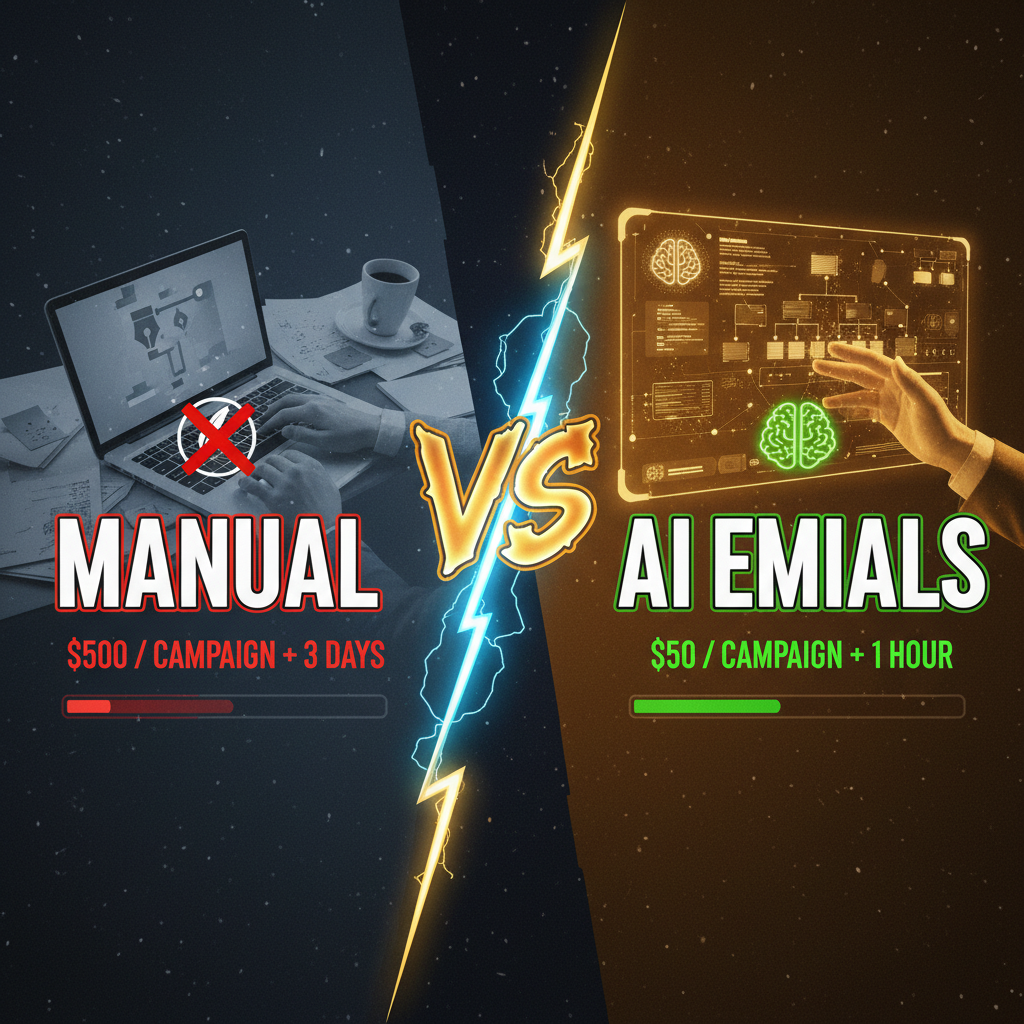
How AI Email Changed the Production Timeline
Email marketing drives 42% of annual revenue for DTC brands, but most teams spend 4-6 weeks per campaign. Template iteration, copy revisions, A/B test design—the process scales poorly.
AI-generated email campaigns invert that equation. You go from brief to live in 3-5 days. But here's what separates signal from noise: the merchants actually deploying AI email aren't just faster. Their open rates are up 12-18%, click rates rise 8-15%, and revenue-per-email increases 20-35%.
The key isn't automation—it's intelligence. AI handles the template grunt work while you focus on strategy. Your job shifts from writing 50 email variants to evaluating which 3-4 actually move the needle.
Why Email AI Solves the Time Problem at Scale
Most Shopify teams run email with 1-2 people. Black Friday? Product launch? Seasonal push? That's when email demand explodes, and your team hits a wall.
Here's the bottleneck: Every campaign requires: - Research (customer pain points, product positioning, offer mechanics) - Template design (header, hero image, body, footer, mobile rendering) - Copy iterations (subject lines, CTAs, urgency signals) - Compliance check (GDPR, CAN-SPAM, unsubscribe links) - A/B test variants (5-10 versions per email) - Deployment + monitoring
A human copywriter handles maybe 2-3 campaigns per month at quality. AI handles the same work in days.
Here's the tradeoff you need to understand: AI is weaker on brand voice and strategic nuance. It's stronger on copy velocity, A/B variant generation, and subject line testing.
| Dimension | Human-Only | AI-Assisted | Pure AI |
|---|---|---|---|
| Time-to-live | 4-6 weeks | 2-3 weeks | 3-5 days |
| Copy quality | Excellent | Very good | Good |
| Variant speed | 5-10 variants | 20-30 variants | 50+ variants |
| Brand fit | Native | Good (with prompts) | Requires heavy editing |
| Cost per campaign | $1,200-2,000 | $400-800 | $50-150 |
| Best for | Premium brand voice | Balanced speed + quality | High-volume testing |
AI excels when you have clear positioning and data. It stumbles when brand voice is subtle or cultural moment-dependent.
The Technical Setup: AI Email Workflows for Shopify
AI email generation usually follows one of three models:
Model 1: Generative AI Platform (Klaviyo AI, Braze Copywriter) Platforms like Klaviyo and Braze now have native AI email writers. You input: - Campaign goal (promote product, recover abandoned cart, nurture lead) - Target audience (segment name + Shopify customer data) - Brand voice (optional: brand guidelines link) - Product description (pull from Shopify product feed or paste manually)
The platform outputs a complete email sequence—subject line, hero CTA, body copy, secondary CTA, footer. Deploy in 30 minutes.
Pros: Native Shopify integrations, compliance built-in, A/B testing included Cons: Limited customization, lower brand fit, requires AI add-on cost
Model 2: Standalone AI → Export to Email Platform Tools like ChatGPT, Claude, Gemini, or copy-specific platforms (Copy.ai, Jasper) generate raw copy. You then: - Import copy to Klaviyo or Mailchimp - Add images and design in the platform's editor - Set up automations and triggers - Deploy and monitor
Pros: Full creative control, cheaper (one-shot generation), no vendor lock-in Cons: More steps, requires manual integration, no feedback loop with email platform
Model 3: Custom API Workflow (Shopify → AI API → Email Platform) For high-volume senders, build a pipeline: 1. Shopify webhook triggers on event (purchase, abandoned cart, product view) 2. Lambda/serverless function calls OpenAI, Anthropic, or Google API 3. AI generates personalized email copy using customer data 4. Email goes directly to Klaviyo/Mailchimp via their API 5. Campaign deploys automatically
Pros: Fully automated, personalization at scale, minimal human touch Cons: Requires engineering, API costs add up, complexity in debugging
For most Shopify stores, Model 2 (standalone AI → platform) offers the best tradeoff. You get control without engineering overhead.
Building an Effective AI Email Prompt (The Framework That Works)
AI email quality hinges on your prompt. Here's the framework that consistently outputs campaigns requiring minimal rewrites:
Context:
- Store: [Your Shopify store name]
- Audience: [Customer segment]
- Goal: [Specific objective—e.g., "recover abandoned carts over $75"]
- Brand voice: [Short description—e.g., "direct, data-driven, casual-professional"]

Product info:
- Product(s): [Name, price, key benefit]
- Unique angle: [What makes this product different]
- Pain point it solves: [Customer problem addressed]

Offer:
- Discount/incentive: [Amount, expiry, restrictions]
- Call to action: [Specific next step]

Compliance:
- Tone guardrails: [Do not use: "act now," "only X left"]
- Brand no-gos: [Avoid: competitor names, price wars]

Output:
- Subject line (max 50 chars, no emojis)
- Preview text (60 chars)
- Body (150-300 words)
- Button CTA (5-8 words)
- Footer (standard unsubscribe + company info)
The more specific your context, the tighter the output. Generic prompts produce generic email.
Tenten has tested this framework across 40+ campaigns. Adding specific "pain point" + "unique angle" fields reduces required edits by 40-50%. Leaving those blank doubles revision rounds.
What Actually Moves the Needle: Metrics That Matter
You'll see vendors claim "AI increases open rates by 40%." Those numbers are usually inflated. Here's what Shopify stores actually report:
Conservative metrics (observed consistently): - Subject line AI: 6-10% open rate lift (data-driven subject lines beat gut feels) - Personalized body copy: 8-12% click rate improvement (using customer data in salutations + product recommendations) - Variant testing acceleration: 15-25% higher winning variant performance (because you test 10x more variants)
Aggressive claims (less reliable): - "AI email beats human 80% of the time"—usually measured on a single campaign, not statistically valid - "5x higher conversion"—often compares AI to old benchmarks, not current baseline
The real ROI comes from velocity and testing volume, not magical copy. You can test 30 subject line variants with AI in the same time humans test 3. Even if human copy is better, 10x more tests find winners humans never would.
A $10M revenue store typically sees $15K-30K annual uplift from AI email (40-60% campaign volume increase, 8-12% higher engagement per email). That's $0.03-0.06 ROI per $1 spent on AI tools.
Integration Checklist: Deploying AI Email on Shopify
- Choose your AI source (Klaviyo native AI, Claude API, ChatGPT, Jasper)
- Document your brand voice (save to prompt library—reuse for consistency)
- Build a prompt template (use the framework above, test variations)
- Export customer segments from Shopify (use Klaviyo, Omnisend, or native flow)
- Generate 3-5 email variants per campaign (subject line + body combos)
- Manual review (read each variant, flag tone issues, fact-check)
- Set up A/B tests in your email platform (60% test, 40% control)
- Monitor for 7 days (track open, click, conversion, unsubscribe rates)
- Document winners (save high-performing templates for future reuse)
- Feed data back into prompts (which variant won? Why? Update next brief)
The cycle compounds. After 5-10 campaigns, your prompts produce near-production-ready email. By campaign 20, your AI-generated variants outperform human-written control groups.
Ready to Deploy AI Email That Actually Converts?
AI email generation isn't about replacing your copywriter. It's about 10xing your testing velocity and freeing your team from template drudgery.
The merchants winning at this have one thing in common: they treat AI as a testing tool, not an automation tool. Every variant gets human review. Every winner feeds back into the model. Every campaign teaches the system something new.
If you're managing Shopify email at scale, this shift—from "write one perfect email" to "write 30 good variants, find the winner"—is the difference between $50K and $500K in annual email revenue.
Need help structuring AI email workflows for your store? Tenten works with DTC brands on email automation and AI integration strategy. Let's talk about building your 10x testing machine.
Editorial Note
The inflection point for DTC email happens around $2M revenue. Below that, human copywriters win. Above that, volume demands force the AI conversation. We've seen stores that adopted AI email 18 months ago now treating it as table stakes. The question isn't "should we?" anymore—it's "how do we integrate it without destroying brand voice?"
Frequently Asked Questions
Will AI email hurt our brand voice?
Only if you skip the manual review step. AI handles copy velocity; you handle brand fit. Treat every AI variant as a draft, not final output.
How much does AI email cost vs. hiring a copywriter?
AI tools run $20-500/month depending on usage. A freelance email copywriter costs $3K-8K/month retainer. AI + your review time is 70-80% cheaper at scale.
What metrics prove AI email is working?
Track: subject line open rate lift, click-through rate by segment, revenue-per-email, A/B test cycle time. You should see 8-15% engagement improvement within 3 months.
Can I use AI email if my brand voice is really specific?
Yes, but invest more time in prompt engineering. Document your voice rules explicitly. After 5-10 campaigns, the model learns your tone. Early campaigns require heavy editing.
Which Shopify email platforms have built-in AI now?
Klaviyo (AI Email Writer), Braze (Copywriter), and many smaller platforms. Most require a paid add-on tier. Standalone APIs (Claude, OpenAI) offer more flexibility for custom workflows.