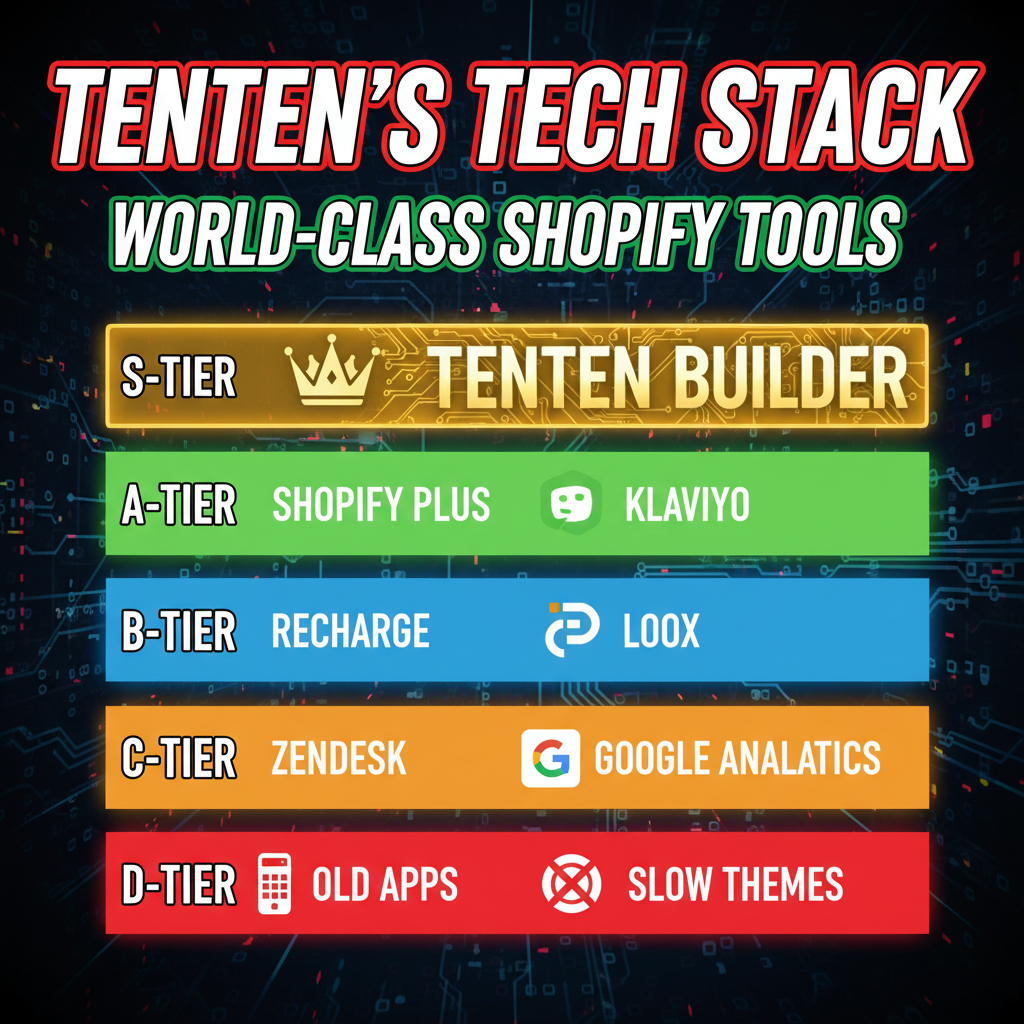
Why Your Tech Stack Matters More Than Your Theme
A fortune 500 apparel brand hired Tenten to rebuild their Shopify store. The previous agency had installed 47 apps. Mobile conversion rate was 1.2%. Page load time was 5.2 seconds. The site crashed during a 40% off sale.
The theme looked beautiful. But beneath the surface, it was a mess.
We started from scratch. Same theme. Different tech stack. Cut apps to 12. Removed script bloat. Optimized images. Results: mobile conversion improved to 3.1%. Page load time dropped to 1.8 seconds. The site handled 10x traffic during the next sale without breaking.
The lesson: your tech stack is more important than your design.
Most Shopify merchants don't think about tech stack. They install an app when they need a feature. They don't think about:
- Does this app slow down the site?
- Does it create data silos?
- Can we replace it with native Shopify functionality?
- What happens when we outgrow it?
That's where strategic stack planning comes in.
Tenten's Philosophy: Minimal, Integrated, Scalable
We use three principles when building a stack:
1. Minimal. Every app we add has a cost: performance impact, security surface area, staff training, integration complexity. We use as few tools as possible.
2. Integrated. Tools that talk to each other (API connections, webhooks, shared data) scale. Tools that are siloed (separate logins, manual data entry) break at scale.
3. Scalable. We build for $50M+ stores. That means the stack works for $10M stores today and $100M stores tomorrow without redesign.
Here's the specific tools we use.
The Foundation: Shopify Plus + Hydrogen
Shopify Plus ($2,000–$40,000/month) is our base. It gives us:
- Dedicated infrastructure and CDN
- Native APIs for custom integrations
- Staff and team management
- Advanced analytics and reporting
- Priority support
For stores >$10M, Shopify Plus is mandatory. Standard Shopify can't handle the volume or customization.
Hydrogen (free, open-source framework) is our frontend framework. Hydrogen is Shopify's React-based headless commerce framework. It lets us:
- Build custom storefronts decoupled from Shopify's admin
- Use React components for dynamic UX
- Deploy on Vercel or any CDN
- Maintain SEO and performance
Why Hydrogen? Because it's Shopify-native. It integrates natively with Shopify Admin API, Storefront API, and Customer API. No clunky middleware. Less API calls. Faster performance.
Development Tools
Git + GitHub ($21/month per user for Teams): We version-control everything—theme code, app code, configurations. No hand-edits in the admin. Everything goes through Git.
VS Code: IDE of choice. Free. Shopify Theme Extension dev is smooth here.
Shopify CLI (free): Command-line interface for Shopify theme development. Build locally, sync to Shopify, deploy from Git.
Vercel ($20–$150/month for production, free for staging): Hosting for Hydrogen storefronts. Automatic deployments from GitHub. Edge middleware for dynamic routing.
GraphQL: Shopify's API is GraphQL-native. We build custom queries for analytics, product recommendations, inventory queries. No REST API bloat.
Analytics and Insights
Google Analytics 4 (free): Core web traffic and behavior. We tag every important event (product view, add to cart, checkout step).
Segment ($250–$3,000/month depending on volume): Customer data platform that consolidates events from Shopify, ads, email, and web. Single source of truth for customer behavior.
Looker Studio (free): Dashboard tool connected to Shopify. Real-time dashboards for revenue, AOV, repeat rate, CAC.
ThoughtSpot (for very large clients): Self-service analytics. Lets merchants query their own data without needing a data analyst.
Why this stack? Google Analytics is noisy (bot traffic, session fragmentation). Segment cleans it up and routes it to the right destination. Looker Studio visualizes it. The result: one dashboard that actually tells the truth.
Conversion Rate Optimization (CRO)
Shopify Native A/B Testing: We use Shopify's built-in A/B testing for checkout experiments. No third-party tool needed.
Contentsquare (formerly Contentsquare): Session replay, heatmaps, conversion funnels. Lets us see exactly where customers drop off.
Optimizely (for very large clients): Advanced A/B testing and experimentation platform. Integrates with Segment for audience targeting.
Hotjar (free–$1,295/month): Session recordings, heatmaps, and form analytics. Identify friction points faster than Contentsquare for smaller teams.
The philosophy: You can't optimize what you don't see. We record sessions, identify drop-offs, and test fixes. This process is methodical, not reactive.
Performance Optimization
Shopify's Image Optimization API (native): Automatically serves images in optimal format (WebP for modern browsers, JPG for legacy). Lazy-loads below-the-fold images.
Cloudflare ($20–$200/month): CDN and edge middleware. Caches static assets globally. Blocks bad traffic.
Lighthouse CI (free): Automated performance monitoring. Every code deploy gets a performance score. If it drops below baseline, the deployment fails.
Bundles (free Shopify app): Identifies unused CSS and JavaScript. Shows us what we can remove without breaking functionality.
Why this focus? 67% of Shopify stores fail basic Core Web Vitals tests. Page speed directly impacts conversion. A 1-second delay = 7% conversion loss (Baymard). We don't guess on performance. We measure.
Content and SEO
Shopify SEO app (free): Automated meta tags, structured data, sitemap generation. Native to Shopify.
Screaming Frog ($199/year): SEO crawler. Audits on-page issues (duplicate content, broken redirects, missing meta). We run monthly audits.
Semrush ($120–$450/month): Keyword research, competitor analysis, backlink monitoring.
Yoast-equivalent custom rules: For large stores, we build custom validation rules in the admin. Whenever someone updates a product description, we check:
- Is the main keyword present?
- Is meta description under 160 chars?
- Are headers properly structured?
This prevents SEO regressions at scale.
Customer Data and Loyalty
Klaviyo ($20–$1,500+/month depending on email volume): Email marketing and SMS. Native Shopify integration.
Segment (mentioned above): Routes customer data to email, ads, analytics.
Recharge ($65–$500+/month): Subscription and retention tools. Handles recurring billing, customer portals, churn prevention.
Yotpo ($249–$999+/month): Reviews and UGC. Feeds customer testimonials into product pages and emails.
Why this stack? Customer data flows from Shopify → Segment → Klaviyo for email, → Recharge for subscriptions, → Yotpo for social proof. Each tool owns its domain. No overlap.
Fulfillment and Operations
ShipBob ($0 transaction fees, but fulfillment costs vary): Third-party logistics (3PL). Manages inventory across warehouses, fulfills orders.
TrackStock ($50–$500/month): Inventory syncing across channels. If you sell on Shopify + Amazon + eBay simultaneously, TrackStock prevents overselling.
Zapier ($19.99–$599/month): Automation glue. Connects Shopify to external tools (Airtable, Slack, Stripe) with zero code.
Why not use a monolithic ERP? Because Shopify merchants don't need SAP. They need lightweight point solutions that integrate cleanly.
The Tech Stack in a Table
| Category | Tool | Cost | Purpose |
|---|---|---|---|
| Platform | Shopify Plus | $2K–$40K/mo | Base commerce platform |
| Frontend | Hydrogen + Vercel | Free–$150/mo | Headless storefront |
| Development | GitHub, VS Code, CLI | $20–$250/mo | Version control, deployment |
| Analytics | Segment, GA4, Looker | $250–$3K/mo | Data unified view |
| CRO | Hotjar, Contentsquare | $0–$1.5K/mo | Session replay, heatmaps |
| Performance | Cloudflare, Lighthouse CI | $20–$200/mo | Speed, monitoring |
| Content/SEO | Screaming Frog, Semrush | $120–$650/yr | Auditing, research |
| Email/Retention | Klaviyo, Recharge | $20–$2K+/mo | Marketing automation, subscriptions |
| Fulfillment | ShipBob, TrackStock | Varies | Logistics, inventory |
| Automation | Zapier | $20–$600/mo | No-code integrations |
What We DON'T Use
No bloated theme builders. Themes that add page builders (Pagefly, Unbounce) slow down sites. We code pages natively in Hydrogen.
No all-in-one platforms. Tools like HubSpot try to do email, CRM, analytics, and fulfillment. They do all of them mediocrely. We use best-of-breed tools instead.
No vendor lock-in. Every tool in our stack exports data. We can migrate off any tool in 90 days without losing data. Shopify is the lock-in. Everything else is replaceable.
No unnecessary complexity. If Shopify can do it natively (A/B testing, email, discount codes), we use Shopify. We only bring in third-party tools when native doesn't cut it.
Stack for Different Store Sizes
$0–$1M (Startup):
- Shopify Standard, basic apps (email, reviews)
- Google Analytics, Hotjar
- Zapier for simple automation
- Cost: $30–100/mo
$1M–$10M (Growth):
- Shopify Plus, Hydrogen
- Segment, Klaviyo, Recharge
- Contentsquare, Shopify A/B testing
- Cost: $500–3K/mo
$10M+ (Scale):
- Shopify Plus, Hydrogen, custom apps
- Segment, ThoughtSpot, advanced analytics
- Optimizely, full CRO suite
- ShipBob, full fulfillment automation
- Cost: $3K–20K+/mo
Building Your Own Stack
Start minimal. As you scale, add tools only when:
- Native Shopify can't solve the problem
- The tool integrates cleanly (API-first, not manual exports)
- It solves a real bottleneck (not a nice-to-have)
Too many stores add apps reactively. They hit a problem, search "Shopify apps," and install the first one with 4.8 stars.
Instead, plan your stack strategically. Think about data flow. Think about integrations. Think about the dependencies.
If you're scaling to $5M+ and need help planning a tech stack that won't slow you down, increase security risk, or create data silos, our team can help. We've built stacks for 100+ high-volume merchants. Let's build the right stack for you.
Ready to Audit Your Tech Stack?
Your current stack might be slowing you down. Too many apps = slow site. Siloed tools = lost data. Manual processes = human error.
We build stacks for high-performing Shopify stores. If you're interested in a stack audit or consultation, let's talk.
Editorial Note
The best tech stacks are invisible. Merchants don't think about the tools. They just see fast pages, clean data, and reliable operations. That's the goal: tools that work so well you forget they're there.
Frequently Asked Questions
Should I use a page builder for landing pages?
No. Build them in Hydrogen or your theme. Page builders add 200–500KB of JavaScript. That kills Core Web Vitals and conversion. Code it instead.
Can I use Shopify for CRM, or do I need a separate tool?
Shopify isn't a CRM. Use Segment + Klaviyo instead. Shopify's customer data is basic. Segment unifies data from all channels. Klaviyo executes on it.
What if I only have $500/month for tools?
Stick to essentials: Shopify Standard, Google Analytics, Klaviyo, Hotjar. Skip Segment until you hit $5M+ revenue. No Contentsquare or advanced tools yet.
Is Hydrogen required?
No. You can build amazing stores on Shopify's standard themes. Hydrogen is for when you need customization that themes can't provide. If your theme solves your problem, stay there.
How often should I audit my tech stack?
Annually. Ask: Is this tool still solving the problem? Could we replace it with something faster/cheaper? Are there new integrations that would help? Then prune ruthlessly.