
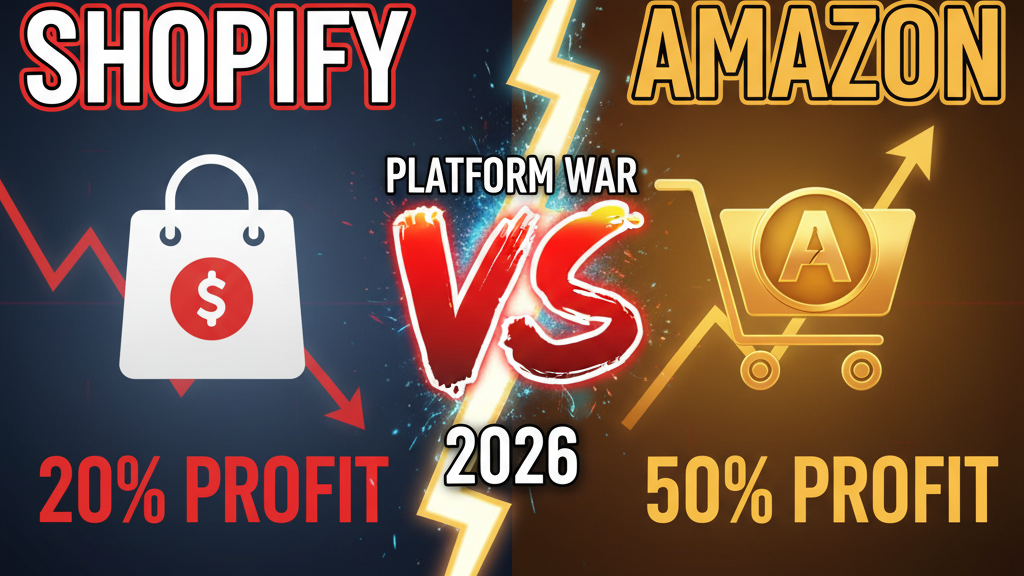
Shopify vs Amazon: The Platform War in 2026
shopify-vs-amazon-2026
Shopify vs Amazon: Why Independent Brands Choose Shopify Over Amazon's Marketplace
In 2026, selling online means choosing between two fundamentally different business models. Amazon marketplace offers immediate traffic and 100M+ customer base. Shopify offers brand ownership, data control, and margin preservation. This isn't a feature comparison—it's a choice about who owns your customer relationship.
The Stakes Are Higher Than They Look
Amazon takes 15-45% of gross revenue depending on category and fees. Shopify's take is 2.9% + $0.30 per transaction on the base plan. That math compounds fast. A $1M annual revenue store pays Amazon $150K-$450K. The same store pays Shopify roughly $29K. The $120K+ difference isn't just operational savings—it's margin recapture that funds growth.
Amazon wins on reach. 69% of product searches start on Amazon (eMarketer 2025 data). But reach without control is leverage you don't own. Amazon owns your customer data, your pricing power, and your brand voice. One algorithm change, policy update, or competitor undercutting you and your business migrates overnight.
Tenten has worked with brands doing $5M-$50M+ revenue on Shopify, and the pattern is consistent: merchants who build independent brands achieve 2-3x higher lifetime value per customer than their Amazon equivalents, even with lower absolute traffic volume. The reason isn't better marketing—it's margin and retention.
The Amazon Trap: Subsidized Growth, Trapped Margin
Amazon doesn't want you owning your customer relationship. The platform is architected to keep you dependent on Amazon's traffic and algorithms. Here's what that looks like operationally:
Advertising Requirements: Amazon advertising isn't optional anymore. Sponsored product ads now consume 25-35% of net margin for competitive categories. In 2024, top sellers reported spending $0.75-$1.50 per dollar of revenue on Amazon ads.
Algorithm Volatility: A single algorithm change—or a new competitor offering a similar product at slightly lower price—tanks your rankings. Your revenue became a function of Amazon's priorities, not your product quality or customer satisfaction.
Data Opacity: Amazon doesn't tell you who your customers are. You can't email them, segment them, or build a retention program. Each sale is atomic. Each customer is a one-time transaction in Amazon's walled garden.
Category Saturation: Product categories that worked in 2020 are now owned by Amazon itself or by established sellers with 50K+ reviews. Entry cost and marketing spend for new categories on Amazon has tripled since 2022.
Amazon is a channel. Shopify is a business. If you're selling the same product on both platforms, Shopify margins will be 2-3x higher despite lower volume. That margin difference is where you build competitive advantage.
Shopify's Asymmetric Advantage: Margin, Data, and Scale
Shopify's architecture solves the three problems Amazon creates: margin compression, customer data loss, and growth ceiling.
You Keep the Margin: At 2.9% + transaction fee, a $1M store generates $29K in Shopify revenue. That leaves you $140K-$420K in margin depending on product mix. That margin is real money you control. You can spend it on acquisition, product development, retention, or operations. On Amazon, half that margin disappears to fees and advertising.
You Own the Customer: Every customer who lands on your Shopify store becomes data you control. Email, purchase history, product preferences, repeat purchase interval—all of it belongs to you. That customer data is the seed for retention, upselling, and long-term brand value. One customer on Shopify worth $500 LTV becomes a $5K asset when you segment and retain them. On Amazon, that same customer is invisible after checkout.
You Scale Profitably: Shopify brands typically reach $5M-$100M+ revenue before hitting platform limitations. At that scale, you have margins to invest in content marketing, community, and brand building. Amazon brands often hit a growth ceiling around $3M-$5M because advertising costs rise faster than revenue. Profit margins compress below breakeven on increased volume.
You Control the Experience: Your store design, checkout flow, product positioning, messaging—all controlled by you. That control means you can optimize for your specific customer archetype, not Amazon's generic template. A DTC cosmetics brand on Shopify can create an experience optimized for sustainability-minded customers. The same brand on Amazon is buried beneath 500 competitors with identical product photography and generic descriptions.
Direct Comparison: Metrics That Actually Matter
| Metric | Amazon Marketplace | Shopify Standard | Winner | Why |
|---|---|---|---|---|
| Monthly Fees | $0 (but 15-45% revenue cut) | $29 + 2.9% + $0.30/trans | Shopify | On $100K/mo revenue: Shopify costs $3,200; Amazon costs $15,000+ |
| Customer Data Access | Restricted (no email, no behavior) | Complete (email, purchase history, LTV) | Shopify | Data ownership = retention = margin |
| Advertising Cost | 25-35% of net margin | Flexible (you decide spend) | Shopify | Amazon advertising is mandatory tax |
| Customization | Minimal (Amazon template) | Unlimited (Liquid/API) | Shopify | Brand differentiation requires control |
| Payment Processing | Amazon Pay 2.5% + conditions | Shopify Payments 2.9% + $0.30 | Amazon | Marginal advantage on fees only |
| Inventory Control | Amazon managed (slow, restricted) | Your integration (fast, flexible) | Shopify | Direct control = faster fulfillment |
| Repeat Purchase Rate | 5-10% (channel fatigue) | 30-50% (brand loyalty possible) | Shopify | With retention mechanics, Shopify achieves 5x higher repeat rate |
| Brand Building | Commodity visibility (hard) | Direct brand building (easy) | Shopify | Reviews, brand voice, messaging—all yours |
The table hides a crucial dynamic: as you scale, Amazon becomes increasingly expensive and Shopify becomes increasingly valuable. A $500K store might break even on Amazon fees. A $5M store is getting strangled.
The Hybrid Approach: Amazon as Channel, Shopify as Business
The smartest brands don't choose. They use Amazon as a performance channel (like Google or Facebook ads) and build their business on Shopify.
This approach flips the relationship: Instead of Amazon as your primary sales channel, it becomes one traffic source. You ship to Amazon's fulfillment network, push inventory, and treat Amazon advertising like paid acquisition. Margin gets compressed on Amazon, but volume amortizes fixed costs and feeds brand awareness.
The margin you lose on Amazon volume gets reinvested into Shopify acquisition and retention. A brand doing $500K on Amazon and $500K on Shopify pays only $29K monthly to Shopify (plus transaction fees) and loses margin on Amazon volume—but controls the customer relationship and data for half the revenue.
Tenten's clients typically run a 60/40 (Shopify/Amazon) or 70/30 split. The Shopify side generates 60-70% of revenue but drives 85-90% of profit.
Why Merchants Leave Amazon for Shopify
The common conversion pattern goes like this:
- Phase 1 (Year 1-2): Launch on Amazon, generate quick revenue, rely entirely on Amazon traffic
- Phase 2 (Year 2-3): Margins compress, advertising gets expensive, product category gets crowded
- Phase 3 (Year 3+): Launch Shopify store as side channel, experiment with email, SEO, brand storytelling
- Phase 4: Realize Shopify is more profitable despite lower volume. Shift focus. Amazon becomes fulfillment only.
This happens because Amazon is optimized for discovery. Shopify is optimized for loyalty. At small scale, discovery wins. At scale, loyalty becomes more valuable than discovery.
The Tenten Approach: Building Your Own Platform
We position Shopify not as a platform, but as the foundation for brand independence. The goal isn't to hit a revenue number on Shopify—it's to own your customer relationship so you can scale profitably and survive platform changes.
That means:
- Store design optimized for repeat purchase signals and brand storytelling (not conversion theater)
- Email integration that captures every customer and builds retention loops
- SEO strategy that drives organic traffic that compounds over time
- Analytics configured to surface customer cohort behavior, not just revenue
Amazon merchants optimize for "get discovered." Shopify merchants optimize for "own your customer." The math favors the second approach above $1M revenue.
FAQ
Q: Is Shopify better for all business types?
A: No. Physical goods with high search volume (electronics, commodities) still benefit from Amazon discovery. High-margin, branded products (cosmetics, apparel, supplements) see 2-3x higher LTV on Shopify. Services and digital goods belong on Shopify entirely.
Q: Can I use both platforms simultaneously?
A: Yes. Sync inventory, run Shopify as primary business (customer data, brand), and use Amazon as fulfillment channel. This is the 60/40 split most DTC brands use at $2M+ revenue.
Q: How long does it take to build meaningful Shopify traffic from zero?
A: SEO takes 6-12 months to show results. Email captures customers faster (weeks). Paid ads show results immediately but require budget. Most brands see profitability within 12-18 months with proper retention mechanics.
Q: What's the real all-in cost to run Shopify vs Amazon?
A: Shopify: Platform ($29-300), payment processing (2.9% + $0.30), and apps ($50-500/mo). Total: $100-1,000/mo fixed + 3.2% of revenue. Amazon: 15-45% of revenue cut + mandatory advertising (25-35% of margin). At $1M revenue: Shopify = $32K-40K/year; Amazon = $200K-500K/year.
Q: Will Amazon ever lower fees to compete with Shopify?
A: No. Amazon's FBA model and advertising business require those fees. Amazon margins matter more than seller retention now. Merchants will continue shifting to Shopify as awareness grows.
Q: What about Amazon Ads vs Shopify + Google Ads?
A: Amazon Ads reach customers actively searching for products. Google Ads (through Shopping) reach customers at earlier decision stages. Together they perform 1.5-2x better than Amazon alone, with better data control.
Q: How do I migrate from Amazon FBA to Shopify?
A: Sync inventory to a 3PL, set up Shopify fulfillment app, redirect customer traffic gradually. Phase out Amazon over 3-6 months once Shopify handles 50%+ volume. Don't cold-turkey switch.
Q: Is Amazon ever worth it at small scale?
A: At <$100K revenue, Amazon is free discovery. Perfect for validating product-market fit. At >$500K, margins become painful. Plan your Shopify migration before $1M revenue.
Want to evaluate your platform strategy? Talk to us about building your DTC brand on Shopify. We work with merchants doing $1M-$50M+ revenue building independent brands that survive platform changes.
For deeper analysis on Shopify's platform architecture, check out our Shopify Plus vs Salesforce Commerce Cloud comparison.