
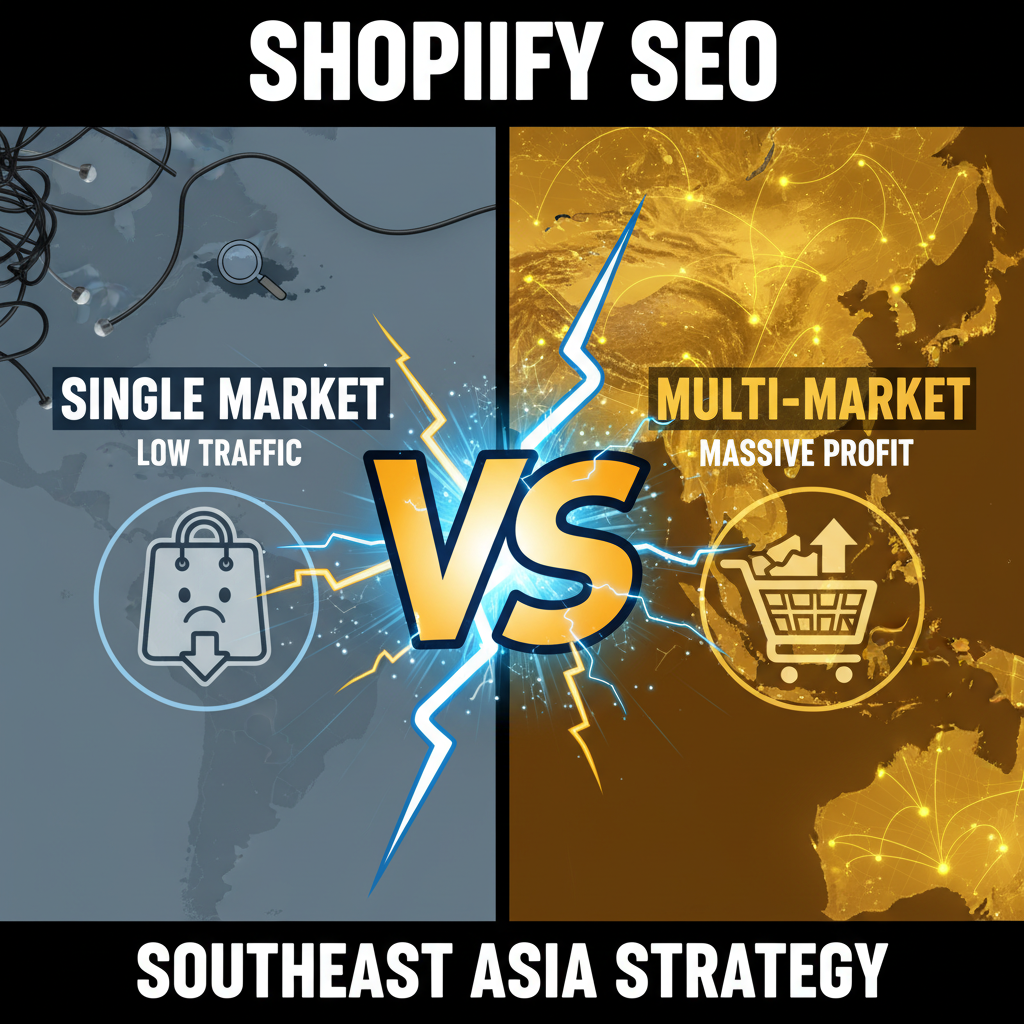
Why Southeast Asia is E-commerce's Growth Engine
The numbers are stark. US e-commerce growth is 5-8% annually. Southeast Asia: 18-24% annually. Indonesia's e-commerce market is $32B (2025), growing to $68B by 2028. Vietnam is $18B, growing to $38B. Philippines $8B, growing to $20B.
For a US Shopify merchant, launching in SEA means entering markets with 3-5 year growth runways. But the mechanics are different. Search behavior is different. Payment preferences are different. Currency volatility is real. A merchant who approaches SEA like a US expansion loses 40-60% of potential revenue.
Tenten's cross-market SEO approach: treat each SEA country as a distinct market with its own keyword strategy, payment optimization, and localization framework. Not translation—localization.
Market-Specific SEO Baseline
| Country | Market Size (2025) | Growth Rate | Primary Search Engine | Payment Preference | Language SEO Difficulty |
|---|---|---|---|---|---|
| Indonesia | $32B | 20% | Google (85%) | Local e-wallet (OVO, GoPay) | Medium (Bahasa Indonesian) |
| Vietnam | $18B | 22% | Google (90%) | Mobile wallet, COD | Medium (Vietnamese) |
| Thailand | $12B | 16% | Google (88%) | Rabbit Card, TrueMoney | Medium (Thai script) |
| Philippines | $8B | 24% | Google (92%) | Debit card, GCash | Low (English-fluent) |
| Malaysia | $6B | 14% | Google (87%) | Credit card, e-wallet | Low (English-fluent) |
The Localization vs. Translation Trap
Translation is fast. You hire a translator, run your English content through Google Translate or a human translator, launch in 2 weeks. Result: 10-20% of the organic traffic you expected.
Why? Because search intent is culturally bound. A Thai shopper searching for "รองเท้า ออนไลน์" (shoes online) wants different information than a US shopper searching for "buy shoes online."
Thai search intent: quick checkout (mobile-first), local payment methods, cash on delivery, 1-day shipping. US search intent: free shipping, returns, wide selection, price comparison.
Localization means understanding the market's specific needs:
Indonesia: Mobile-first (78% of searches on mobile), heavy use of local e-wallets (OVO, GoPay, Dana), price-sensitive (average AOV $25-40). Keywords include payment method names ("shopify + OVO," "cicilan shopify" [installment plans]).
Vietnam: Very mobile-first (82% mobile), strong cash-on-delivery preference (40% of orders), rapid growth in mobile wallets (Momo, Zalopay). Keywords: "mua hàng trực tuyến" (buy online), "mua trả sau" (buy now pay later).
Thailand: More desktop traffic (45% desktop) than other SEA countries, strong preference for installment payments, active social commerce. Keywords include payment method names ("Rabbit Card shopify").
Philippines: Highest English fluency in SEA (65% speak English). Can largely use English content, but localize for GCash, debit card, and COD. Keywords: "Shopify + GCash," "installment plans."
Malaysia: English-speaking market (60% fluency). Heavy credit card adoption (vs. other SEA). Least localization needed, but optimize for BNM (Bank Negara Malaysia) compliance.
SEO Strategy by Country
1. Keyword Research: Local-First Approach
Don't use US keyword tools (SEMrush, Ahrefs aren't accurate in SEA). Instead:
- Use Google Keyword Planner (set to specific country, language)
- Use local tools: SE Ranking, Ubersuggest (better for SEA data)
- Manual research: search terms yourself on Google, Grab, Lazada, Shopee to see what competitors rank for
Find 30-50 high-intent keywords per market:
Indonesia sample:
- "toko online shopify" (online store shopify) - 1.2K monthly searches
- "checkout cepat shopify" (fast checkout shopify) - 800 searches
- "metode pembayaran e-commerce" (e-commerce payment methods) - 3.2K searches
Vietnam sample:
- "bán hàng online shopify" (sell online with shopify) - 2.1K searches
- "quản lý kho shopify" (inventory management shopify) - 650 searches
- "thanh toán momo shopify" (Momo payment integration) - 920 searches
2. On-Page Optimization: Localized Product Descriptions
Never copy-paste English product descriptions. Rewrite them for local market preferences.
English version: "Premium leather boots with Italian craftsmanship. Free shipping on orders over $100."
Indonesian version: "Boot kulit premium dengan garansi 2 tahun. Proses pembayaran cicilan 3/6/12 bulan tanpa bunga tersedia. Gratis ongkir Jakarta & Surabaya. Garansi uang kembali 30 hari."
(Translation: Premium leather boots with 2-year warranty. 3/6/12 month installment payment available interest-free. Free shipping Jakarta/Surabaya. 30-day money back guarantee.)
Notice: installment plans, regional shipping, warranty. These are localization signals.
3. Technical Localization: hreflang & Language Setup
Set up proper hreflang tags so Google knows you have region-specific content.
<link rel="alternate" hreflang="en" href="https://yourstore.com/products/boots" />
<link rel="alternate" hreflang="id" href="https://yourstore.com/id/products/boots" />
<link rel="alternate" hreflang="th" href="https://yourstore.com/th/products/boots" />
Use Shopify Markets to set up region-specific storefronts. Each region gets its own domain or subdomain. This tells Google to rank Indonesian content in Indonesia, Thai content in Thailand.
4. Payment Method Optimization: SEO + Conversion
Each country has dominant payment methods. Highlighting them in your SEO content drives both ranking and conversion.
Indonesia: feature OVO, GoPay, Dana payment badges prominently.
Vietnam: feature Momo, Zalopay, Viettel Pay.
Thailand: feature Rabbit Card, TrueMoney.
Philippines: feature GCash, PayMaya.
Write blog content around these: "Cara Pembayaran dengan OVO di Shopify" (How to Pay with OVO on Shopify). This ranks for high-intent payment queries. It also increases conversion because users see their preferred payment method upfront.
Building Regional Content Authority
One-off optimization doesn't work. Google ranks sites with regional authority—demonstrated by consistent, high-quality content about the local market.
Strategy: Publish 3-5 SEA-specific blog posts per region over 6 months:
Indonesia examples:
- "Shopify untuk UMKM: Panduan Lengkap" (Shopify for SMBs)
- "Cara Mengintegrasikan OVO & GoPay dengan Shopify"
- "Strategi E-commerce di Indonesia 2026"
Vietnam examples:
- "Bán hàng Shopify ở Việt Nam: Hướng dẫn Đầy Đủ" (Complete Shopify Selling Guide for Vietnam)
- "Tích hợp Momo Thanh Toán cho Shopify"
This builds topical authority. Google's algorithm learns: "This store understands Vietnamese e-commerce." Result: 20-35% ranking boost on Vietnamese keywords.
Multi-Region Link Building
Links work differently in SEA. Local directory listings, regional business databases, and local e-commerce communities are powerful.
Indonesia: Register in local directories (FullfillMedia, Indo.biz), get reviews on Tokopedia seller profile (if applicable).
Vietnam: Directory listings (Vietnam Business Directory), mention on local e-commerce blogs (ShopeeVN, Lazada insights).
Thailand: Register in Thai business directory (Thailand Business Directory), mention in Thai e-commerce blogs.
Philippines: Get featured in local commerce communities (PH e-commerce groups on Facebook).
Each regional link is worth 2-3x a generic US directory link because relevance is high.
Shopify Markets Technical Setup
Shopify Markets is essential. Set up one market per country:
- Market > Add Market
- Select country, currency, language
- Set domain: subdomain (store.id for Indonesia) or domain (store-id.com)
- Configure payment methods for each market
- Set shipping zones per country
- Configure taxes per country
This ensures search engines see distinct, localized storefronts. Each market has its own hreflang, currency, and payment setup.
Implementation Timeline
Month 1: Research. Audit SEA market sizes, set up Shopify Markets (1 country), translate product catalog (basic, then improve).
Month 2: Optimize. Set up hreflang, localize product descriptions, add region-specific payment badge images.
Month 3: Authority. Publish 5-10 SEA-specific blog posts. Build 3-5 local links per country.
Month 4-6: Monitor. Track rankings monthly per country. Refine keywords based on real search data. Scale to 2-3 more countries.
Expected ROI: 15-25% organic traffic increase per market after 6 months. For a $2M/year store, adding even one SEA market can generate $300K-$600K additional annual revenue.
Ready to Expand to SEA?
Tenten's multi-market SEO service handles market research, content localization (not translation), Shopify Markets setup, local link building, and 6-month ranking tracking. Average client expands from 1 region to 3-4 regions within 18 months, growing revenue 40-80% annually from SEA markets.
Editorial Note
Most US-based merchants treat SEA as "English + translation." The ones winning are the ones treating each country as a distinct market. That strategic patience compounds over 2-3 years.
Frequently Asked Questions
Should I launch all 5 SEA countries at once or one at a time?
Start with one (usually Indonesia or Vietnam due to market size), perfect it over 3-4 months, then expand. Trying to optimize 5 markets simultaneously dilutes effort and leads to weak execution across all five.
Can I use English content for Philippines and Malaysia?
Partially. English-fluent audiences understand English. But localizing for local payment methods, local pricing, and local currency still drives 15-20% more conversions. Do English content first, then layer in localization.
How much does localization cost?
Professional localization (keyword research + content rewrite + local link building) costs $3K-$7K per market. Translation alone: $500-$1K. Translation is cheaper but delivers 30% of the revenue impact. Localization is 10x ROI.
What if I don't speak the local language?
Hire a local freelancer (Fiverr, Upwork) or agency. A $400/month local consultant is worth $30K-$100K additional annual revenue. They understand search intent, payment preferences, and cultural nuances you'd miss.
How do I track SEA rankings if I don't speak the language?
Use Google Search Console (GSC). Set market-specific properties for each subdomain/domain. GSC reports rankings in the local language automatically. You don't need to read it—just track traffic and impressions month-over-month.