
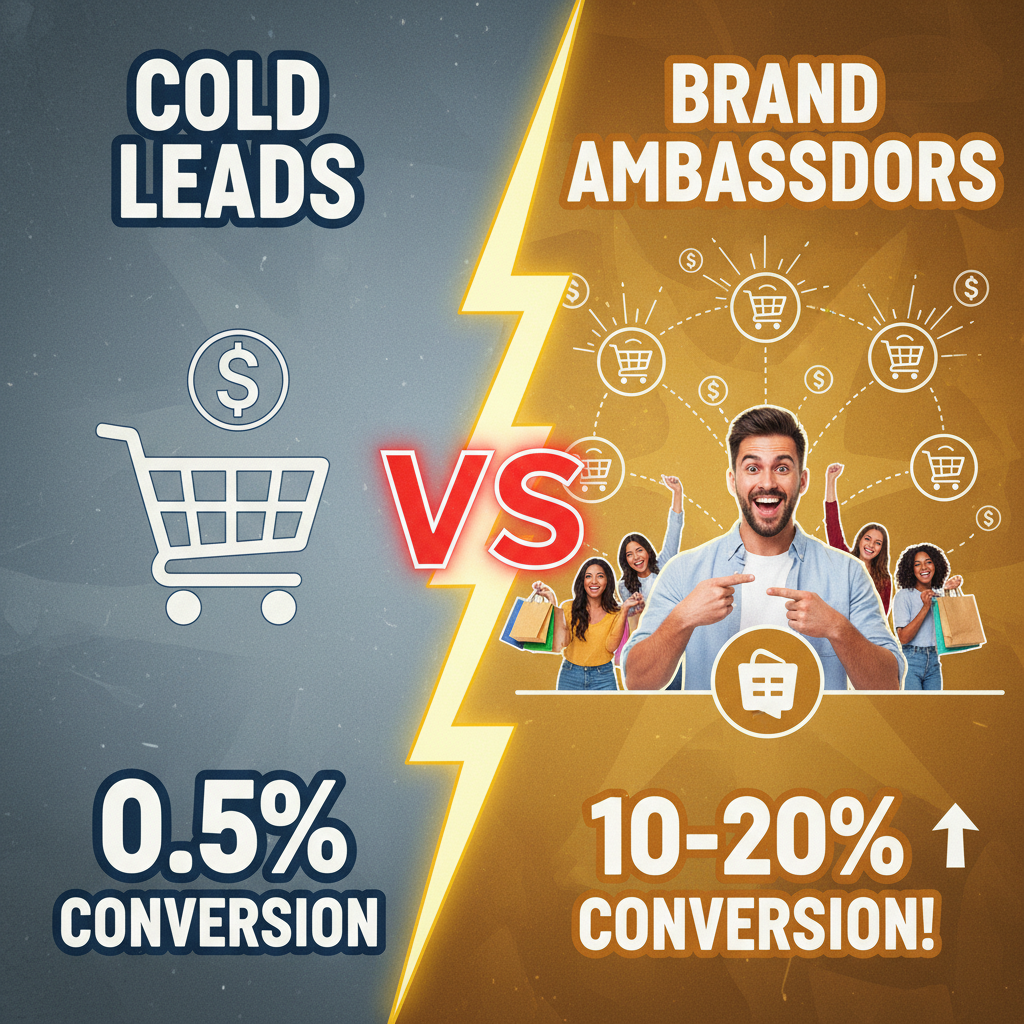
Why Referrals Are Your Highest-ROI Channel
Paid advertising is getting expensive. CAC inflation is real. But referral marketing—when structured correctly—generates customers at 1/3 the acquisition cost and 2x the lifetime value.
Here's why: a referred customer comes pre-sold. Their friend already vouched for quality, fit, and value. They're warmer leads with higher intent. They also stay longer (referred customers churn 16% less than paid traffic) and spend more (higher AOV).
Most DTC brands leave $500K+ annually on the table by treating referral as an afterthought. The brands that win treat it as a core channel, systematize it, and invest in making it frictionless.
The Mental Model: Why Customers Refer (and When They Don't)
Referral is not automatic. You need to understand the behavioral economics.
Why customers DON'T refer:
- Inconvenience — Sharing a link requires 3+ steps (copy, open email, paste, send)
- Weak incentive — "$5 off" doesn't justify the social energy
- No reminder — They forget you have a referral program
- Social awkwardness — Recommending a product feels like selling
Why customers DO refer:
- Genuine love for the product — They'd recommend it anyway; you just made it easy
- Meaningful incentive — Both referrer and referee get real value
- Effortless sharing — One click, and the link is copied to clipboard
- Milestone motivation — "Refer 3 friends, get $20 off" feels achievable
The winning formula: Product quality (non-negotiable) + Minimal friction + Meaningful incentive + Social proof.
Incentive Model That Actually Works
Most brands get this wrong. They offer $5 off to both referrer and referee. At volume, this kills margin. And $5 isn't motivating—it's not worth the social capital to share.
Here are the models that work:
| Model | Best For | Referrer Incentive | Referee Incentive | Economics | Risk |
|---|---|---|---|---|---|
| Tiered Rewards | Retention-focused DTC | $10 off 1st, $20 off 3rd, $50 off 5th | 15% off first order | Margin-friendly; compounds virality | Caps referrals at 5-10 per customer |
| Percentage Discount | High AOV (LUX, skincare) | 15% off next order | 10% off first order | Works for big baskets; margins protect | Unpopular for low AOV (under $50) |
| Exclusive Access | Community/subscription | Early access to drops | VIP community access | Zero marginal cost; high perceived value | Requires production capacity to deliver |
| Dual-Sided Cash | High CAC markets | $15 store credit | $15 store credit | Simple; fair to both | Expensive; can't scale past 10% of revenue |
| Hybrid (Discount + Exclusive) | Mid-market DTC | $10 off + 1 free item shipped | Free shipping + 10% off | Balances margin with perception | Requires SKU bundling planning |
The math on each:
Model 1 (Tiered): $50 AOV store, 40% margin
- Referrer gets $10, $20, $50 (average $20 across cohort)
- Referee gets 15% off first order (average -$7.50 margin per customer acquired)
- Effective CAC via referral: $27.50
- Paid CAC (Facebook ads): $45
- Result: 39% cheaper acquisition than paid, AND referral customers have 3x higher LTV
Model 2 (Percentage): $150 AOV luxury brand, 60% margin
- Referrer gets 15% off next order (-$22.50)
- Referee gets 10% off first order (-$15)
- Effective CAC: $37.50
- Paid CAC (Instagram luxury): $80
- Result: 53% cheaper, AND margins stay protected because 60% GP absorbs the discount
Your incentive model should:
- Cost less than your paid CAC by 30-50%
- Reward the referrer meaningfully (less than $50 for most categories feels cheap)
- Be simple (customers should understand it in 5 seconds)
- Align with margin (don't offer discounts on low-margin products)
The Behavioral Triggers That Drive Sharing
Customers don't naturally share referral links. You need to engineer moments when sharing feels natural.
Trigger 1: Post-Purchase (Highest Intent)
The best time to ask for referrals is 3-5 days after purchase. The customer just received the product, loves it, and word-of-mouth is top-of-mind. This is when sharing feels organic.
Implementation:
- Day 0 (Purchase): Order confirmation email (transactional, no referral ask)
- Day 3 (Post-receive): "Love it? Share it" email with referral link and incentive
- Day 7 (Check-in): "Your friends want to hear from you" re-engagement
Results: Post-purchase referral asks convert at 8-12% (vs. 1-2% for unsegmented list).
Trigger 2: Unboxing / Social Media Moments
Create Instagram/TikTok-friendly moments that naturally invite sharing. Aesthetically beautiful packaging, unexpected freebies, or surprise gifts trigger user-generated content.
Implementation:
- Include referral card in packaging with clean design
- Offer bonus credit for Instagram tags/mentions
- Create branded hashtag (e.g., #SneakersReferral)
- Incentivize the first 10 referrals per customer month
Example: Premium hoodie brand includes a gold card ("Refer and get $25") in packaging. Customers naturally post unboxing videos with the card visible.
Trigger 3: Milestone Achievement
When a customer hits a milestone (5th purchase, 1-year subscription anniversary, VIP tier), that's a moment of loyalty. Ask them to extend that loyalty by referring friends.
Implementation:
- After 3rd purchase: "You're a VIP—bring your friends" (unlock $25 referral bonus)
- After 1 year subscription: Anniversary email with special referral bonus (e.g., $50 off)
Results: Customers referred 5-7x more friends during milestone emails.
Trigger 4: Community Recognition
Public recognition is powerful. A leaderboard of top referrers (even just "Top Referrers" section on your site) drives competition.
Implementation:
- Monthly "Referral Champion" spotlight (feature their story)
- Tiered badges (Silver Referrer, Gold Referrer, Platinum Ambassador)
- Leaderboard visible on referral page showing top 10 referrers
Warning: Only show opt-in leaderboard (not all customers want public recognition).
Technology: Shopify Referral Apps vs. Custom Build
Shopify App Ecosystem
| App | Strength | Weakness | Cost |
|---|---|---|---|
| Refersion | Native Shopify integrations, clean dashboard | Limited customization, feels templated | $99-$299/mo |
| Smile.io | Multi-channel (referral + loyalty), good UX | Less powerful than custom; API limits | $99-$299/mo |
| Ambassador | High-powered, white-label, enterprise | Expensive, steep learning curve | $500-$2K+/mo |
| Custom Build | Infinite flexibility, complete control | Requires engineering, $20K-$100K build | One-time $20K-$100K + $2K/mo maintenance |
Decision framework:
- $0-$2M ARR: Refersion or Smile (app ecosystem is fine, good enough ROI)
- $2-$10M ARR: Custom build if margin allows (better UX, higher conversion)
- $10M+ ARR: Custom build (apps become bottleneck, need deep integrations with email/SMS/CRM)
Most mid-market DTC brands using apps report 2-5% of traffic from referrals. Custom-built programs see 10-15% because the UX is smoother, incentives are optimized, and integrations are tighter.
Building the Referral Flywheel
Here's how to structure a referral program that compounds:
Month 1: Foundation
- Set up app (Refersion) or custom build (if budget allows)
- Define incentive model (tiered discount works best)
- Create landing page with clear value prop
- Send first referral email to existing customers (day 3 post-purchase)
- Target: 1-2% of existing customers refer within 30 days
Month 2-3: Optimization
- A/B test referral incentives (is $10 better than 10% off?)
- Test trigger timing (day 3 vs. day 7 post-purchase)
- Add referral button to post-purchase flow (landing page → email → button)
- Target: 3-5% conversion rate on referral emails
Month 4+: Scale
- Add referral card to physical packaging
- Launch milestone-based triggers (anniversary emails, tier upgrades)
- Create leaderboard for top referrers
- Target: 10-15% of new customers from referrals
Metrics to track:
| Metric | Target | Why It Matters |
|---|---|---|
| Referral Conversion Rate | 3-8% | % of referred customers who complete purchase |
| CAC via Referral | 50-70% of paid CAC | Effectiveness vs. paid ads |
| Referral Participant Rate | 5-12% | % of customers who refer at least once |
| Avg Referrals per Customer | 1.5-3 | Viral coefficient; >1 = compounding growth |
| LTV of Referred Customers | 1.5-2x LTV of paid | Retention value |
Common Mistakes That Kill Referral Programs
Mistake 1: Weak Incentive
Brand: "Refer and get $3 off."
Reality: No one shares for $3. This wastes your email list and trains customers to ignore future referral asks.
Fix: Make referrer incentive meaningful ($15-30). Make referee incentive valuable but protect margin (15% off is better than flat discount for retention).
Mistake 2: Hard to Share
Brand: Referral link is 47 characters long, requires copy-paste.
Reality: Most customers give up after step 1.
Fix: One-click share button. Copy to clipboard auto-fills. SMS link option. QR code option. Every friction point you remove doubles participation.
Mistake 3: No Social Proof
Brand: Shows referral stats (nobody cares about abstract numbers).
Reality: "You've earned $27 in credit" feels good. "2,347 customers have referred" doesn't move anyone.
Fix: Show individual progress. "3 more referrals until you hit Gold Tier and get $50 off." Personalize the dashboard.
Mistake 4: Forgetting Existing Customers
Brand: Referral program launches, but existing customer base doesn't get an email.
Reality: You leave 40% of potential referrals on the table.
Fix: Email existing customers within 24 hours of launch. Grandfather in their referrals from day one. Reward early adopters (2x bonus for first 100 referrers).
Mistake 5: Incentive Fraud / Gaming
Brand: Offers $25 per referral, no verification. Customers create fake accounts.
Reality: You're paying fake CAC that doesn't convert.
Fix: Verify email domain (Gmail/Yahoo are okay, but flag corporate domains). Add bot detection (reCAPTCHA). Require purchase within 60 days. Manual review for suspicious patterns (10 signups from same IP in 1 hour = fraud).
Article FAQ
Q: What's the typical referral conversion rate?
3-8% is healthy for most categories. Luxury and premium brands see 8-15% (higher perceived value, smaller audience). Low-price categories ($10-20 products) see 1-3%. The key is that referred traffic should convert 2-3x better than cold paid traffic.
Q: Should I cap the number of referrals per customer?
Yes, usually at 5-10 per month. Uncapped programs create infinite liability and attract gaming. Caps also train you to improve the core product (if referrals are unlimited, your product becomes the acquisition lever, not the service).
Q: How do I prevent referral fraud?
Verify email domains, use bot detection (reCAPTCHA), require first purchase within 60 days, and flag patterns (5 signups from same IP = manual review). Most fraud is obvious—it'll look like 100 signups from identical emails in 1 hour.
Q: When should I sunset a referral program?
Never sunset it, but recalibrate incentives as you scale. Early-stage ($100K MRR), referrals are a growth hack—offer aggressive incentives ($25+). At scale ($1M+ MRR), treat it like a retention channel—maintain it at 5-8% of revenue, not growth-at-all-costs.
Q: Can I combine referral with affiliate?
Yes. Referrals are for customers (social, word-of-mouth). Affiliates are for publishers (content creators, bloggers). Stack them: "Share with friends (referral)" vs. "Partner with us (affiliate)." Different audiences, different incentive models.
Key Takeaways
- Referral CAC is 30-50% cheaper than paid CAC, and LTV is 2-3x higher. Building a referral program is one of the highest-ROI growth channels.
- Incentive design matters more than app choice. A mediocre app with good incentives beats a great app with weak incentives.
- Friction kills sharing. Make it one-click to share, copy, or refer. Test QR codes and SMS links.
- Timing triggers 80% of referrals. Post-purchase (day 3-5) is the highest-intent moment. Double down on that window.
- Existing customers are your biggest referral source. Don't launch a program without emailing them first. You'll leave money on the table.
Call to Action
Referral programs compound. The longer you run them, the more self-amplifying they become. Start now—even if your app is basic, the momentum compounds.
Contact Tenten to design and launch a high-converting referral program. We help DTC brands architect referral flywheels that grow from 1% to 10-15% of new customer acquisition.
Author Perspective
The best referral programs don't feel like marketing. They feel like customers naturally want to share your product. That's the signal you've got the product-market fit right. Make sharing effortless, incentivize genuinely, and watch it compound.