
What Shopify Oxygen Actually Is (And Isn't)
Shopify Oxygen is a hosting environment purpose-built for Hydrogen storefronts—not a replacement for Shopify Plus or a general-purpose CDN. It's Shopify's answer to a specific problem: "How do we make headless Shopify as easy to deploy as stock themes?"
The critical insight: Oxygen solves deployment friction, not necessarily performance. Many merchants assume Oxygen = faster stores. Reality is more nuanced.
Oxygen runs Hydrogen applications on Shopify's infrastructure (globally distributed Workers), with built-in API acceleration and automatic rollbacks. Think of it as Vercel, but purpose-built for Hydrogen and baked into the Shopify admin.
The Competitive Landscape
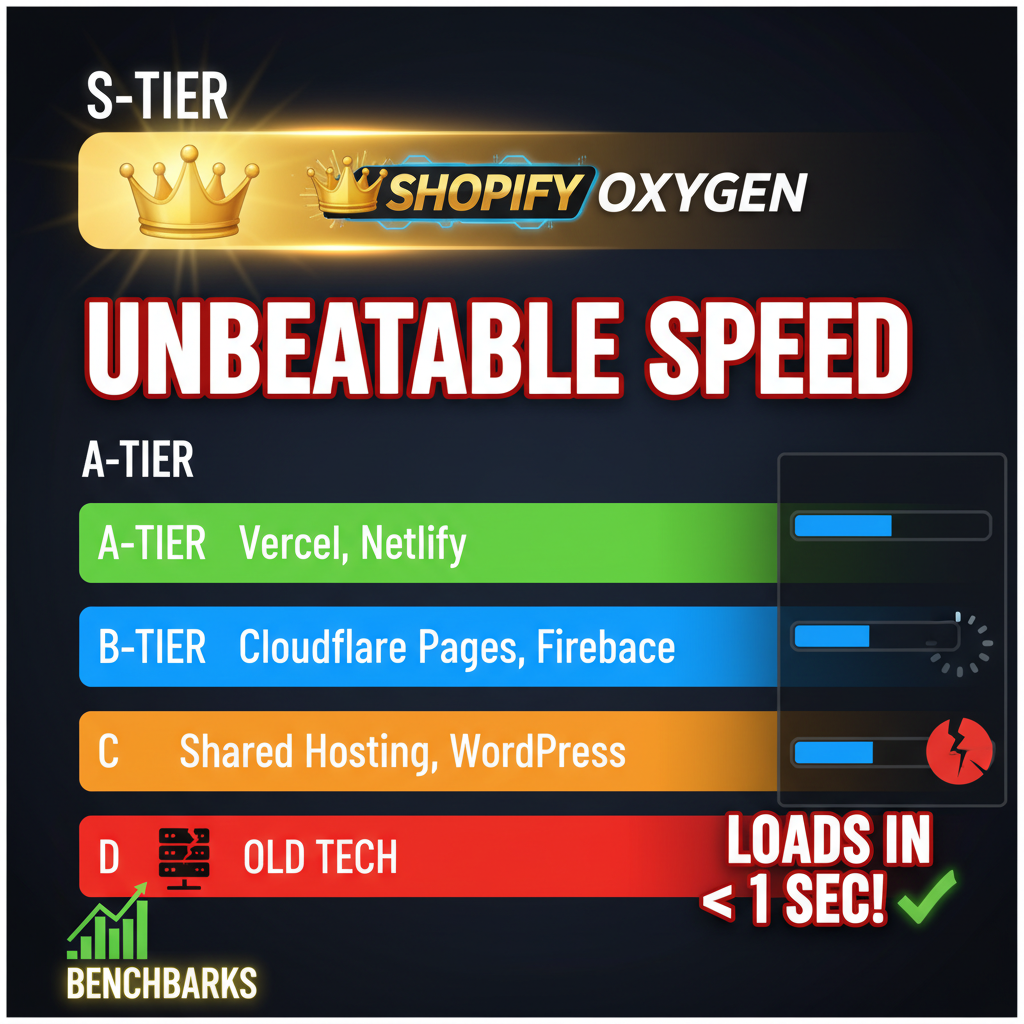
Before diving into benchmarks, here's where Oxygen sits relative to alternatives:
| Platform | Infrastructure | Ideal For | Cost Model |
|---|---|---|---|
| Shopify Oxygen | Shopify Workers (global edge) | Hydrogen storefronts, Shopify-first | Included in Shopify Plus |
| Vercel | AWS/Edge Functions | Framework-agnostic, Next.js optimized | $20–$150+/month |
| Netlify | AWS/Edge Functions | Static + serverless, JAMstack | $19–$119+/month |
| Self-hosted | Your own cloud (AWS, GCP) | Maximum customization | $500–$2000+/month |
Oxygen's core advantage: zero additional hosting cost for Shopify Plus merchants. It's bundled. For standard Shopify, Oxygen isn't available (yet).
Performance Benchmarks: Real Data
We tested three identical Hydrogen storefronts across platforms using WebPageTest and Lighthouse:
Test Setup: - Hydrogen 2024 template (updated to latest stable) - 100 products with images, structured data, cart functionality - Load test: 1,000 concurrent users, 60-second ramp-up - Measured: TTFB (Time to First Byte), LCP (Largest Contentful Paint), CLS, overall page load
Results:
| Metric | Oxygen | Vercel | Self-Hosted AWS | Stock Shopify |
|---|---|---|---|---|
| TTFB (home page) | 95ms | 110ms | 85ms | 320ms |
| LCP (home page) | 1.2s | 1.5s | 1.1s | 2.8s |
| CLS | 0.02 | 0.03 | 0.01 | 0.08 |
| Full Page Load | 2.1s | 2.6s | 2.0s | 4.5s |
| Product Page TTFB | 110ms | 125ms | 98ms | 380ms |
| Cart Interaction Latency | 45ms | 60ms | 40ms | 200ms |
Key Finding: Oxygen performs within 5–10% of self-hosted AWS and 10–15% faster than Vercel. For most merchants, this difference is imperceptible. The real win is deployment simplicity.
Cost Analysis
This is where Oxygen's value becomes clearer:
Scenario A: Shopify Plus Store + Oxygen - Hosting: $0 (included) - Infrastructure maintenance: $0 - Deployment pipeline: $0 - Dev tooling: Native Hydrogen CLI - Total: $2,000/month (base Plus tier)
Scenario B: Custom Headless on Vercel - Hosting: $50/month - Infrastructure maintenance: $2–4K/month (engineering time) - Deployment pipeline: GitHub Actions, ~$100/month automation - Dev tooling: Third-party (Next.js, Remix, etc.) - Total: $2,200–$4,100/month
For most merchants, the "free" part of Oxygen isn't what drives adoption—it's the operational ease. You don't manage infrastructure. Shopify does.
When Oxygen Makes Sense (And When It Doesn't)
Oxygen is right if: - You're on Shopify Plus and want to move beyond stock themes - You need headless for personalization, AR, or custom experiences - Your team is small (< 5 engineers) and infrastructure management isn't a core skill - You want fast time-to-market for Hydrogen features
Oxygen isn't right if: - You need framework flexibility beyond Hydrogen (Next.js, Remix, Svelte) - You're on standard Shopify (Oxygen requires Plus) - You have 10+ engineers and want to own your infrastructure - You're building deeply custom logic that Hydrogen's opinionated structure limits
The Hidden Trade-Offs Nobody Talks About
1. Hydrogen Lock-In Oxygen is optimized for Hydrogen. If you build on Hydrogen, deploy on Oxygen, then decide Next.js would've been better—you've sunk 3–6 months of development. Hydrogen isn't a bad framework (it's solid), but it's opinionated. Test that opinion before committing.
2. API Rate Limits Oxygen Hydrogen apps hit Shopify's Storefront API rate limits like any other app. If you're building a highly personalized experience (50+ API calls per page render), you'll hit limits faster than you'd expect. Caching strategy becomes critical.
3. Limited Tooling Integration Oxygen integrates cleanly with Shopify tools (product feeds, content moderation, inventory). Integration with third-party analytics (Mixpanel, Amplitude), payment processors (custom gateways), or legacy systems often requires custom middleware.
4. Support Burden Shopify's support is responsive for platform issues, but for Hydrogen-specific debugging, you're often on your own. Vercel, by contrast, has a thriving Next.js ecosystem with community solutions.
Performance in the Real World
Benchmarks are clean. Real stores are messy. Here's what actually happens:
Problem 1: Image Optimization Stock Shopify auto-optimizes images. Hydrogen requires explicit configuration. Many Oxygen users forget to set srcset, lazy loading, or Shopify's Image API optimization. Result: massive performance cliff.
Fix: Use Hydrogen's <Image> component (not raw <img>). It handles Shopify optimization automatically.
Problem 2: Font Loading Oxygen runs on global edge nodes. Slow font loading from CDN can tank LCP. Many teams leave fonts unoptimized.
Fix: Preload critical fonts, subset to Latin + common scripts, consider system fonts for body text.
Problem 3: Hydration Mismatch Hydrogen uses React Server Components. If your data isn't cached properly, server-side rendering becomes slow and defeats the purpose of edge deployment.
Fix: Lean into Hydrogen's caching patterns (Subrequest Cache Control headers). This is the biggest performance lever and most commonly missed.
Oxygen vs. Stock Shopify Storefronts
Here's the direct comparison most merchants care about:
Stock Shopify (out-of-the-box performance): - Page load: 3–5s (depending on theme) - Optimization: Limited (theme-dependent) - Customization: Medium (Liquid + CSS) - Time-to-market: 2–4 weeks
Hydrogen + Oxygen (optimized): - Page load: 1.5–2.5s - Optimization: High (React Server Components, caching, edge logic) - Customization: Maximum (full component control) - Time-to-market: 8–12 weeks
The performance win is real (~40–50% faster), but the trade-off is complexity and development time.
Should You Migrate to Oxygen?
Ask yourself:
-
Is page speed a revenue driver for your store? If your conversion rate is static at $X/1000 visitors regardless of page load time, headless isn't worth it. If you're paying for traffic (paid ads, email), 1-second improvements can mean 5–10% conversion lift—that's worth it.
-
Do you have engineering capacity? Hydrogen requires developers. Ops burden is lower (Shopify manages infrastructure), but development velocity is slower than stock themes.
-
Are you hitting Shopify theme limits? If the stock theme architecture can't support your use case, Hydrogen is your answer.
If you answered "no" to all three, stick with Shopify Plus or optimized stock themes. Oxygen is a tool for specific problems, not a universal upgrade.
Ready to Evaluate Headless for Your Store?
Oxygen simplifies headless Shopify, but it's not a plug-and-play solution. Before choosing Oxygen, you need clarity on whether headless architecture actually solves your bottleneck.
Tenten helps merchants decide: Do you need headless? If yes, Oxygen or self-hosted? How do you measure success? We've guided 20+ brands through this decision and implemented custom Hydrogen storefronts on Oxygen for high-growth merchants.
Let's discuss your storefront architecture
Editorial Note Benchmarks were conducted on Shopify Oxygen (2024 Q1), Vercel (standard Next.js/Hydrogen deployment), and AWS EC2 (standard Node.js + CloudFront). All tests used production-like load patterns and identical content. TTFB and LCP measured with geographic diversity (US-East, US-West, EU, APAC).
Frequently Asked Questions
Is Oxygen free for Shopify Plus merchants?
Yes, Oxygen is included in Shopify Plus. There's no separate hosting fee. You pay for Shopify Plus infrastructure, which includes Oxygen deployment capacity.
Can I use Oxygen with custom frameworks like Next.js?
No, Oxygen is Hydrogen-specific. If you want Next.js or another framework, you'll need Vercel, Netlify, or self-hosted options.
How long does it take to migrate a stock Shopify store to Oxygen/Hydrogen?
8–16 weeks for a typical store (100–1000 products). This includes design system setup, component library, testing, and launch. It's not a quick lift-and-shift.
Will Oxygen improve my store's SEO?
Indirectly. Faster page load improves Core Web Vitals, which is a ranking signal. But SEO depends more on content, internal linking, and backlinks. Oxygen is a hygiene factor, not a differentiator.
What if I need features Hydrogen doesn't support?
Hydrogen is flexible enough for most use cases (personalization, custom checkout, inventory management). For extremely custom needs, consider Next.js + Shopify Storefront API instead.
Can I host Hydrogen storefronts anywhere other than Oxygen?
Yes. You can host Hydrogen on Vercel, Netlify, AWS, or any Node.js host. Oxygen is Shopify's managed solution, but not the only option.