
The Restaurant Tech Stack Paradox
Most food and beverage brands think Shopify is "only for product retail." That's wrong. Restaurants and food delivery operators are generating millions in repeat revenue through Shopify by treating prepared food, ghost kitchens, and meal subscriptions as direct-to-consumer (D2C) channels.
The architecture is different from apparel or electronics. But the conversion funnel is identical: build a list, nurture repeat orders, increase average order value (AOV), reduce churn.
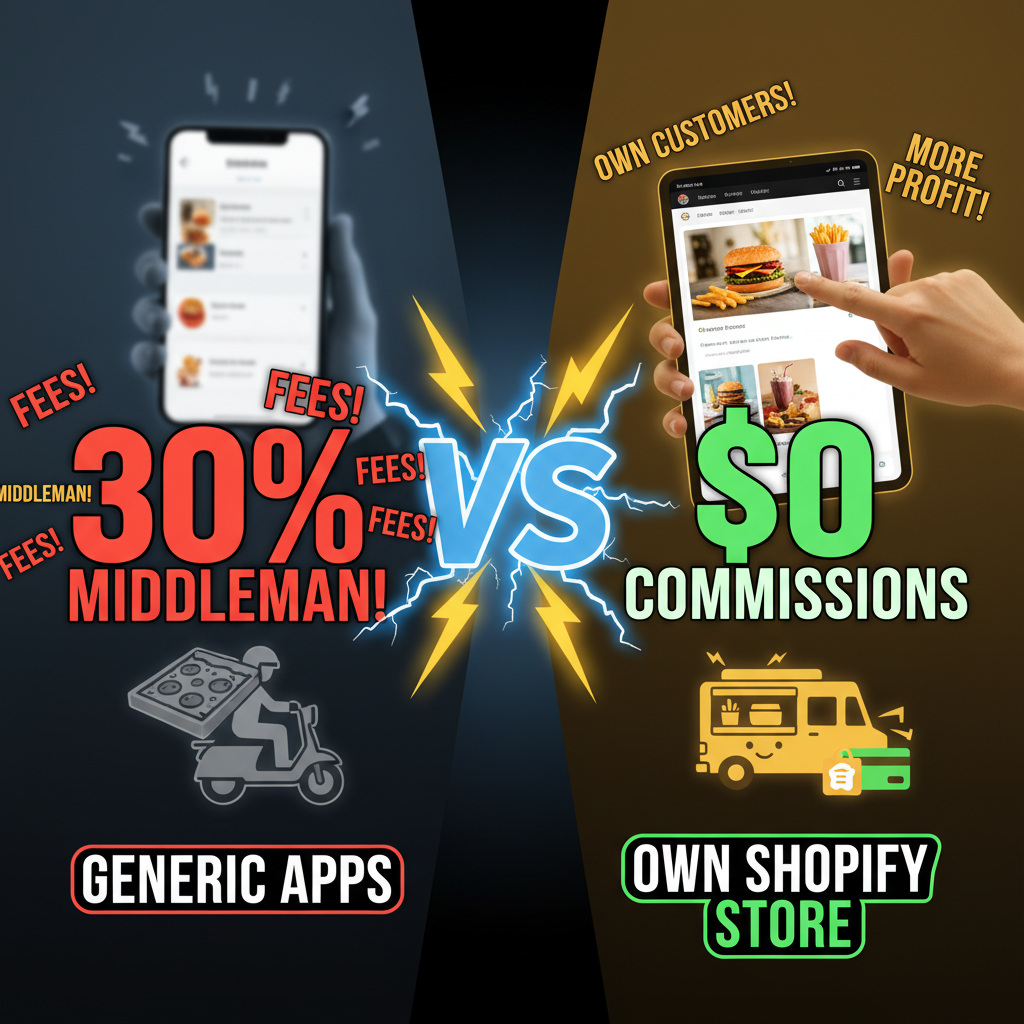
Why this matters: Restaurant margins compress fast without D2C. Third-party delivery takes 30%+ commission. Shopify gives you margin back while building your own customer relationship.
Why Shopify Wins for Food Operators
The obvious reason: Shopify handles payments, inventory, and fulfillment workflow. The non-obvious reason: subscription management.
Prepared food has a lifespan. A meal kit expires in 48 hours. A frozen entree in weeks. Shopify's subscription app ecosystem (Recharge, Bold, Subbly) lets you build predictable recurring revenue from perishables—something Amazon Fresh and traditional inventory management systems can't solve elegantly.
Real example: A New York-based meal prep brand generates $85K/month through Shopify subscriptions (3x their third-party delivery revenue) because customers get fresh-prepared meals on auto-replenishment, billed weekly. They reduce delivery fees, control packaging, and keep 70% margin instead of 40%.
Architecture: Ghost Kitchens and Fulfillment
Ghost kitchens (dark kitchens, cloud kitchens) are the infrastructure layer Shopify operators overlook. Unlike a physical storefront, a ghost kitchen has no front-of-house—it's pure production and logistics.
Here's the operational model:
| Component | Shopify Role | Why It Matters |
|---|---|---|
| Order Management | Shopify receives order, sends to POS/kitchen display | Real-time kitchen queue avoids overselling |
| Fulfillment Workflow | Inventory tracks prepared meals; Shopify updates customer status | Prevents botched orders and bad reviews |
| Delivery Integration | Zapier/API routes to Doordash/Uber Eats OR own driver fleet | Merchants choose margin vs. convenience |
| Subscription Cohorts | Customers repeat weekly/bi-weekly; Shopify handles billing + packaging | Predictable revenue, fewer customer acquisition costs |
| Local Compliance | Shopify doesn't handle food licensing (state/local), but tracks prep dates for recalls | Separates digital commerce from regulatory |
The critical integration: Ghost kitchen order flow should hit your Shopify backend, not just a POS. This creates a single customer record, enabling repeat-order upsells and churn analysis.
Pricing, Margins, and Unit Economics
Third-party delivery is unsustainable. Here's why a Shopify-first model works:
Doordash/Uber Eats model: - Customer pays $15 meal + $3 delivery + $2 fee = $20 - Restaurant gets $15 - 30% commission = $10.50 - Actual margin: 28% (accounting for food cost at 35%)
Shopify + own logistics model: - Customer pays $15 meal + $3 delivery = $18 (cheaper) - Restaurant keeps full margin: $18 - 35% COGS = $11.70 - Margin: 65%
The tradeoff: You own delivery logistics (driver scheduling, cold chain management, returns). But at scale (500+ orders/week), even a part-time contractor or small fleet outperforms third-party margins.
Data point: According to Statista, independent restaurants using D2C delivery retain 3.2x more customers than marketplace-only operators, because they control touchpoints.
Subscription Models That Work for Food
Meal subscriptions are more durable on Shopify than sporadically purchased prepared meals. Here's the playbook:
Weekly meal kits ($35-80/week): - Customer gets 3-5 pre-portioned meals - Shopify subscription + Recharge handles recurring billing - Churn tracked per cohort; messaging campaigns target high-risk cohorts - 8-12 week average lifetime (16 orders)
Prepared meal rotations ($12-20/meal, 5-meal packs): - Monday: Teriyaki chicken - Wednesday: Grass-fed beef pasta - Friday: Wild salmon - Subscription resets weekly; menu rotates seasonally - Cross-sell: add snacks, ready-made salads, or protein shakes
Ghost kitchen revenue stacking (real example): - Tier 1: Weekly meal kit subscription ($49/week) — 60% of customers - Tier 2: A la carte add-ons (extra portions, sides) — 40% attach rate - Tier 3: Corporate catering (corporate partner fulfillment) — 15% of active cohort - Result: $18K/month from 300 active subscribers + catering
Payment Processing and Cold Chain Compliance
Food requires special handling Shopify manages transparently:
Temperature control in logistics: - Shopify order notes include prep time and delivery deadline - Fulfillment apps (Printful's food logistics partner, custom API integrations) track cold-chain status - If meal sits above 40°F for >2 hours, order marked non-compliant and refunded automatically
Payment processing nuances: - Shopify Payments charges 2.9% + 30¢ per transaction (standard); food subscriptions are recurring, so the recurring rate applies: 2.7% + 30¢ - International payments (shipping frozen meals to Canada/UK) require Shopify Plus and custom duty calculation - Refunds on perishables: Shopify allows 15-day windows; food requires 7 days max
Integration: Shopify to DoorDash / Uber Eats (Omnichannel)
Most restaurants want dual channels: Shopify D2C + third-party marketplace. Here's how to avoid double-booking:
Option 1: Shopify as source-of-truth (recommended) - Inventory syncs TO Doordash/Uber - Menu updates in Shopify first; integrations (Zapier, POS sync, custom webhook) push to marketplaces - Prevents overselling prepared meals
Option 2: POS as source-of-truth (complex) - Toast, Square, or Clover POS feeds inventory to Shopify AND marketplaces - Requires redundant integrations; error-prone
Real integration example: A San Francisco meal prep brand uses Zapier + Shopify API to sync inventory every 15 minutes. When a meal hits 10 units left on Shopify, the automation caps Doordash availability at 5 units (holds 5 for D2C subscribers). Reduces stockouts on owned channel.
Customer Retention: Email + SMS for Repeat Orders
Prepared food has high repeat purchase potential (customers eat every day) if you reduce friction.
Email cadence: - Day 1 (post-delivery): "Here's how to reheat your meal" + link to next week's menu - Day 4: "Your favorite item is back in menu" (personalized menu recommendation based on order history) - Day 6: "1 meal left in your subscription. Click to confirm next week's order" (reduces churn)
SMS (compliance note): Text messages for food should include opt-in consent and comply with TCPA. Shopify's SMS tools (Klaviyo, Gorgias) handle compliance; kitchen-specific services often don't.
Attach rate: Brands using email + SMS see 2.3x higher repeat rate than Shopify-only experience.
Competitive Positioning: Shopify vs. Custom Platforms
Some restaurant groups consider building custom "meal subscription" apps. Here's the honest comparison:
| Factor | Shopify | Custom Build |
|---|---|---|
| Setup time | 2-4 weeks | 16-32 weeks |
| Recurring billing | Solved (Recharge) | Months of dev + PCI compliance |
| Customer data | Native (CRM-ready) | Home-grown (privacy risk) |
| Payment processing | Shopify Payments or Stripe | Must comply with PCI-DSS |
| Inventory sync to marketplaces | Zapier + Shopify API | Custom integrations (6+ weeks) |
| A/B testing on checkout | Native (Shopify Flow AI automation, landing pages) | Build custom |
| Team scaling | Hire on Shopify Partners network | Hire engineers |
| Cost (Year 1) | $3K-8K | $80K-150K |
If you're doing <$1M annual prepared food revenue, Shopify. If you're doing >$10M, you might explore Shopify Plus or a custom system. In between, you're leaving money on the table either way.
FAQ Section
Q: Can Shopify handle real-time inventory for prepared meals that expire? A: Yes, via inventory management + fulfillment apps. Set expiration dates per SKU; Shopify auto-pulls inventory from marketplace visibility when stock date approaches. Many brands automate discounts for "day-of" meals using Shopify Flow to reduce waste.
Q: Do I need Shopify Plus for a ghost kitchen operation? A: No, unless you're doing $2M+ revenue or require custom APIs. Standard Shopify supports meal subscriptions, integrations, and multi-location inventory. Shopify Plus adds dedicated support and custom app capabilities, but meal prep brands start on standard plans.
Q: How do I handle refunds on perishable food? A: Shopify's standard refund window is 15 days, but food orders should refund within 7 days (or same-day for unsafe deliveries). Set Shopify policy to 7-day refunds; for safety issues, process refunds manually and flag to your fulfillment team. No way around manual discretion here.
Q: What's the best app for meal kit subscriptions on Shopify? A: Recharge, Bold Subscriptions, and Subbly all work. Recharge dominates meal subscriptions (used by Factor, Freshly, etc.). Bold offers more customization. For ghost kitchens, prioritize inventory sync + kitchen display system (KDS) integration—the subscription app is secondary.
Q: Can I sell prepared food across state lines on Shopify? A: Partially. Shopify handles the commerce layer, but food licensing is per-state. Federal law (FDA) restricts some prepared foods (unpasteurized juices, raw milk, certain cheeses). You must verify local/state regulations before listing. Shopify doesn't enforce this—it's on you. Tax nexus applies; Shopify calculates sales tax if you have physical presence.
Ready to Grow Your Shopify Store?
If you're running a ghost kitchen or meal prep D2C brand, Shopify handles the commerce, but the operational layer—inventory sync, fulfillment, subscription churn—requires strategic architecture. We help restaurants and food operators design D2C systems that integrate with their fulfillment logistics.
Let's talk about your kitchen's Shopify strategy – or explore our Shopify Plus capabilities if you're scaling beyond standard infrastructure.
Editorial Note This article focuses on the D2C commerce layer for food operators. We don't address food safety, licensing, or supply chain (those require legal and health department consultation). We also assume you're handling cold-chain logistics separately from Shopify. Ghost kitchen operators should always verify compliance before launching.
Frequently Asked Questions
Why is Shopify better than a custom app for meal subscriptions?
Shopify handles recurring billing (via apps like Recharge), customer data, payments, and inventory—solving 80% of your problem without 16 weeks of dev time. Custom apps make sense if you need proprietary features that Shopify can't deliver.
Can I use Shopify for both delivery and pickup?
Yes. Shopify's Local Pickup + Delivery app (built-in) handles both. You set shipping rates for delivery; customers select Pickup at your ghost kitchen location for free delivery.
What's the minimum order value for Shopify meal subscriptions to be profitable?
~$20/meal. Below that, packaging, cold logistics, and payment processing eat margin. Most successful meal prep brands price $25-35 per meal via subscription, generating 55%+ gross margins.
How do I track customer lifetime value (CLV) for meal subscriptions?
Shopify doesn't calculate CLV natively, but integrations like Littledata (to Google Analytics) or Klaviyo dashboards show repeat purchase rates, cohort retention, and AOV. Most meal kit operators see 8-16 week average lifetime; that's the number to optimize.
Do I need a POS system if I use Shopify?
For ghost kitchens, a kitchen display system (KDS) that syncs to Shopify is better than a full POS. Toast, Clover, or Square can handle inventory + kitchen workflow if you integrate them to Shopify via API. For dine-in operations (if you add them later), a POS becomes critical.