Why Audits Matter More Than Testing
Most Shopify merchants jump straight to A/B testing. Different button colors. Different headline copy. Different checkout flow. But 80% of testing reveals micro-optimizations (1–2% lifts) because the foundation is broken.
A proper CRO audit finds the foundations. The problems that compound. A missing trust signal. A confusing value prop. A broken mobile checkout. These aren't "test" problems; they're structure problems. Fix them first.
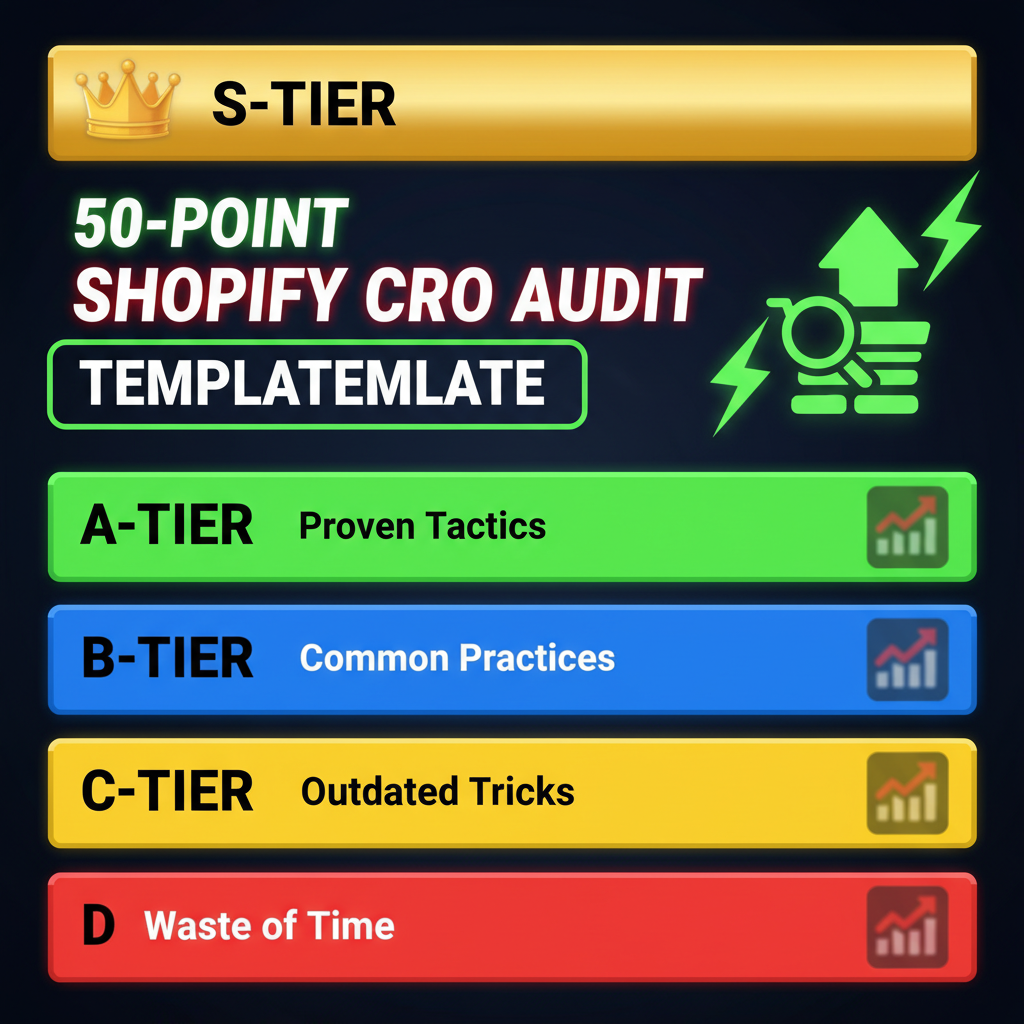
This 50-point template finds those structural gaps.
How to Use This Template
Step 1: Score each item. Use a simple system:
- ✓ = No issue
- ⚠ = Minor issue
- ✗ = Critical problem (blocking conversion)
Step 2: Weight by traffic. High-traffic pages first. Your homepage gets 2K visitors/week; your "about us" gets 50. Audit the pages that matter.
Step 3: Quantify impact. A conversion improvement on a high-traffic page moves revenue faster. A 2% lift on your homepage (2K visitors, 3% baseline conversion) = 12 additional customers/week. On low-traffic pages, you'll never see that signal.
Step 4: Prioritize ruthlessly. Fix the 3–5 critical problems first. 80% of your gains come from top 5 fixes.
The 50-Point Audit
SECTION 1: Homepage & Navigation (10 points)
| Item | Check | Why It Matters |
|---|---|---|
| 1. Above-the-fold CTA is clear | Is the main action obvious without scrolling? (Shop Now, Subscribe, etc.) | 35% of users leave without scrolling. CTA must be visible. |
| 2. Value prop is specific | Does it say what the product is and why in 5 seconds? | "Premium skincare" ✗. "Retinol serum formulated for sensitive skin, proven to reduce fine lines 40% in 8 weeks" ✓. |
| 3. Hero image/video is mobile-optimized | Does it load fast on 3G? Is text readable on mobile? | 65%+ of traffic is mobile. Slow hero = 25% bounce rate. |
| 4. Navigation menu is scannable | Can a user find top categories in 3 seconds? | Deep menus (5+ levels) create decision paralysis. |
| 5. Search is visible and prominent | Can users find search without scrolling? | 30% of users search instead of browse. Make it easy. |
| 6. Trust signals appear above fold | Badges, certifications, customer count visible? | "100K+ happy customers" or "Dermatologist recommended" moves trust. |
| 7. Product recommendations section exists | Do you surface "bestsellers" or "new arrivals"? | Reduces decision paralysis. Guides high-intent browsers. |
| 8. Call-out for main offer/discount | Is your primary offer front and center? | "50% off first order" moves email signups. Bury it, you lose it. |
| 9. Mobile menu doesn't hide essentials | Is checkout, cart, account accessible from mobile nav? | Mobile users should reach checkout in 2 taps. |
| 10. Footer has secondary CTAs | Email signup, chat, phone number visible? | Footer is prime real estate. Use it. |
Critical fixes: If items 1–3 are broken, you lose 30%+ of visitors before they explore. Fix these first.
SECTION 2: Product Pages (12 points)
| Item | Check | Why It Matters |
|---|---|---|
| 11. Product images show scale/context | Can users see the product size vs. hand/body? | 60% of returns are size/fit issues. Images that show scale reduce returns. |
| 12. Image quality is high (no JPEG artifacts) | Are images crisp at 2x zoom? | Mobile users zoom to inspect. Blurry images = distrust. |
| 13. Videos show product in use | Not just product shots—actual use case video? | Video increases conversion 25–35%. Unboxing or tutorial > static. |
| 14. Price is clear (no hidden fees) | Is final price with tax visible before checkout? | Hidden fees cause 35% cart abandonment. Full transparency wins. |
| 15. Shipping cost/time is transparent | "Shipping: Free" or "Ships in 2–3 days"? | Surprise shipping costs kill conversion. Disclose upfront. |
| 16. Reviews/ratings section is prominent | Star rating visible above fold on desktop? | 92% of users read reviews. Must be obvious. |
| 17. At least 10 reviews with photos | User-generated images boost trust 40%. | Text reviews are good. Photo reviews are trust bombs. |
| 18. "Why this product" section exists | Does copy explain the benefit, not just features? | "Made from organic glycerin" (feature). "Hydrates for 12 hours without greasiness" (benefit). |
| 19. FAQ section answers 5+ questions | "Is this vegan?" "Does it work on all skin types?" etc. | FAQ answers reduce support requests 30–40%. |
| 20. Variant selector is clear (size, color, etc.) | Can users select options without confusion? | Broken variant selectors = abandoned carts. |
| 21. "Add to cart" button is prominent | High-contrast color, obvious placement? | Button should dominate bottom third of product page. |
| 22. Related products appear below fold | "Customers also buy..." section? | Cross-sells boost AOV 8–12%. |
Critical fixes: Missing reviews (17–19) or unclear pricing (14) will tank conversion. Fix these.
SECTION 3: Checkout Flow (10 points)
| Item | Check | Why It Matters |
|---|---|---|
| 23. Guest checkout option is visible | Can users buy without creating account? | 60% of users abandon checkout if forced to register. |
| 24. Email is first field (not last) | Email requested before shipping info? | Users bail if asked for account before purchase. |
| 25. Shipping cost is shown early | Before customer fills full address? | Shipping shock kills 22% of carts. Show cost early. |
| 26. Form fields are minimized | Only essential fields (no "company name" if optional)? | 20 fields vs. 10 fields = 50% higher abandonment. |
| 27. Autofill works on mobile | Can users tap phone + address auto-fill? | Mobile checkout requires 2x fewer taps. Use autofill. |
| 28. One-page checkout (no multi-step) | Is entire checkout on one page (or smooth 1-click steps)? | Multi-page checkout = 30% higher abandonment. |
| 29. Payment options are diverse | Credit card + PayPal + Apple Pay + Google Pay? | 15% of users abandon if their preferred payment method isn't available. |
| 30. Security badges are visible | Stripe logo, SSL badge, trust marks? | Trust signals lower abandonment 3–5%. |
| 31. Coupon code field is accessible | Users can enter code without friction? | Assuming valid coupon, ease of entry matters. |
| 32. Order summary is visible side-by-side | Can users see what they're buying + price before payment? | Transparent order summary = fewer disputes, faster checkout. |
Critical fixes: Items 23–25 are abandonment killers. Fix these immediately.
SECTION 4: Post-Purchase & Retention (8 points)
| Item | Check | Why It Matters |
|---|---|---|
| 33. Order confirmation email is designed | Professional HTML, tracking info, next steps? | 80% of users check confirmation email. Bad design = support tickets. |
| 34. Shipping notification has tracking link | Direct link to tracking (not buried in long email)? | 60% of support emails are "where's my order?" Make tracking obvious. |
| 35. First email incentive for repeat (is sent within 72 hours) | Discount for next purchase or loyalty signup? | 72-hour window captures post-purchase euphoria. Act fast. |
| 36. Follow-up sequence exists (3–5 emails) | Onboarding → use case → testimonials → discount? | 30–day follow-up sequences boost repeat purchase 12–18%. |
| 37. Product review request is sent | Within 14 days of delivery? | 40% of users will review if asked. You're leaving UGC on the table. |
| 38. Upsell/cross-sell email is sent | "You bought serum—here's moisturizer recommendation"? | 8–12% of repeat revenue comes from smart upsells. |
| 39. SMS channel is set up (if using SMS) | Text offer within 24 hours? | SMS has 98% open rate. Underutilized by most stores. |
| 40. Loyalty program exists and is offered | Points, rewards, VIP tiers? | Loyalty programs increase repeat purchase 25–35%. |
Critical fixes: Items 33–37 affect repeat purchase. A single repeat customer is worth 3–5x a new customer. Don't neglect this.
SECTION 5: Trust & Psychology (8 points)
| Item | Check | Why It Matters |
|---|---|---|
| 41. About/Story section explains why brand exists | Founder story or mission statement visible? | Emotional connection increases brand loyalty. Spend 90 seconds here. |
| 42. Return policy is transparent (not hidden in footer) | 30-day returns? Full refund? Clearly stated? | 50% of hesitant buyers look for return policy before purchase. |
| 43. Social proof is scattered (not just reviews) | Customer testimonials + media mentions + follower count? | Varied social proof is stronger than reviews alone. |
| 44. Testimonials include customer photo + name | Not just "Jane D." but "Jane Davidson, Brooklyn, NY"? | Real faces beat anonymous reviews 3:1. |
| 45. Certifications/awards are displayed | Organic certification? Press mentions? Industry awards? | Third-party validation cuts purchase hesitation. |
| 46. Chat or support is accessible | Live chat, email, phone visible on every page? | 45% of browsers won't buy without support option visible. |
| 47. FAQ section is comprehensive (10+ Q&A pairs) | "What's your return policy?" "Do you ship internationally?" | FAQ answers 60% of pre-purchase questions, reducing support load. |
| 48. Privacy policy and terms are accessible | Links visible in footer or easy-to-find? | GDPR + legal compliance matters. Make these obvious. |
| 49. Refund policy is clear (not fine print) | No surprises. "30 days, full refund, no questions asked." | 22% of users abandon checkout if refund policy is vague. |
| 50. Contact info is real (not just contact form) | Phone number visible? Email listed? | Users trust real contact info. Forms feel like black holes. |
Critical fixes: Items 41–43 build trust. Trust = 15–25% conversion lift. Don't skip this section.
Scoring & Prioritization
After you've audited all 50 points:
- Count critical problems (✗). Each ✗ on high-traffic pages = top priority.
- Calculate estimated impact. A fix to your checkout (items 23–32) on 2K weekly visitors at 2% baseline conversion = 40 monthly customers. A fix to an obscure page footer = 1 customer monthly. Obvious priority.
- Pick top 3–5 fixes. Don't try to fix everything. The 80/20 rule holds: 20% of fixes drive 80% of gains.
Real Example: Skincare Brand Audit
Before: $1M revenue, 4% overall conversion rate (5K monthly visitors, 200 conversions)
| Area | Critical Issues | Estimated Impact |
|---|---|---|
| Checkout | No guest checkout, 3-step flow, no payment diversity | +2% conversion (10 additional customers/month) |
| Product pages | Missing photos, no video, minimal reviews | +1.5% conversion (7–8 additional customers/month) |
| Post-purchase | No email sequence, no upsell | +0.8% repeat purchase (8% uplift on existing customers) |
Implementation (4 weeks):
- Week 1: Add guest checkout + consolidate to 1-page flow
- Week 2: Shoot product videos, organize reviews section
- Week 3: Build email sequence (5 emails over 30 days)
- Week 4: Test and iterate
Result (8 weeks later): 4% → 4.8% conversion rate. 240 conversions/month (40 additional). Revenue impact: $60K+ incremental annual ($5K/month at $250 AOV).
Implementation cost: $5K (developer time) + $1.2K (video). ROI: 10x within 8 months.
Ready to Audit Your Store?
This template is a starting point. Every store is different. But the 50 points cover 90% of conversion problems most merchants face.
Start with your top-traffic pages. Work through the checklist. Prioritize ruthlessly. Implement the top 3 fixes in 4 weeks. Measure impact. This is how you move the needle.
At Tenten, we conduct full CRO audits for Shopify merchants and help prioritize fixes for maximum ROI. Whether you audit yourself or work with us, the checklist is the same. Let's improve your store's conversion rate. Contact us here.
Editorial Note
Most merchants hire agencies to run CRO audits and spend $15K–$25K for consultants to walk through these 50 points. You can do 70% of this yourself in a few hours. The real value is having a systematic checklist so nothing falls through the cracks. Use this. Don't hire until you've completed your own audit.
Frequently Asked Questions
Which of the 50 points move revenue the most?
Items 23–32 (checkout), 14–15 (pricing/shipping transparency), and 17–19 (reviews). Fix these first. These three sections account for 60–70% of conversion problems.
Should we fix all 50 points or just the critical ones?
Start with critical (✗ items). Get those to ✓. Then move to ⚠ items. You'll hit diminishing returns at 35–40 points. 80% of gains come from the first 15–20 fixes.
How often should we re-audit?
Quarterly. Your store changes. Competitors change. Run the audit every 90 days to catch drift.
Can we use this for mobile only?
Do a separate mobile audit. Mobile checkout (items 23–32) is critical—mobile converts at 1.5–2% vs. 3–4% desktop. Mobile deserves its own deep dive.
What's the timeline to implement all fixes?
4–8 weeks for top 5 fixes. 3–6 months to address all 50 points across your entire store. Don't try to do everything at once.
How much revenue uplift should we expect?
1–5% conversion lift from a full audit (depending on current state). For a $1M revenue store, that's $10K–$50K incremental revenue. ROI is typically 3–8x within 6 months.