
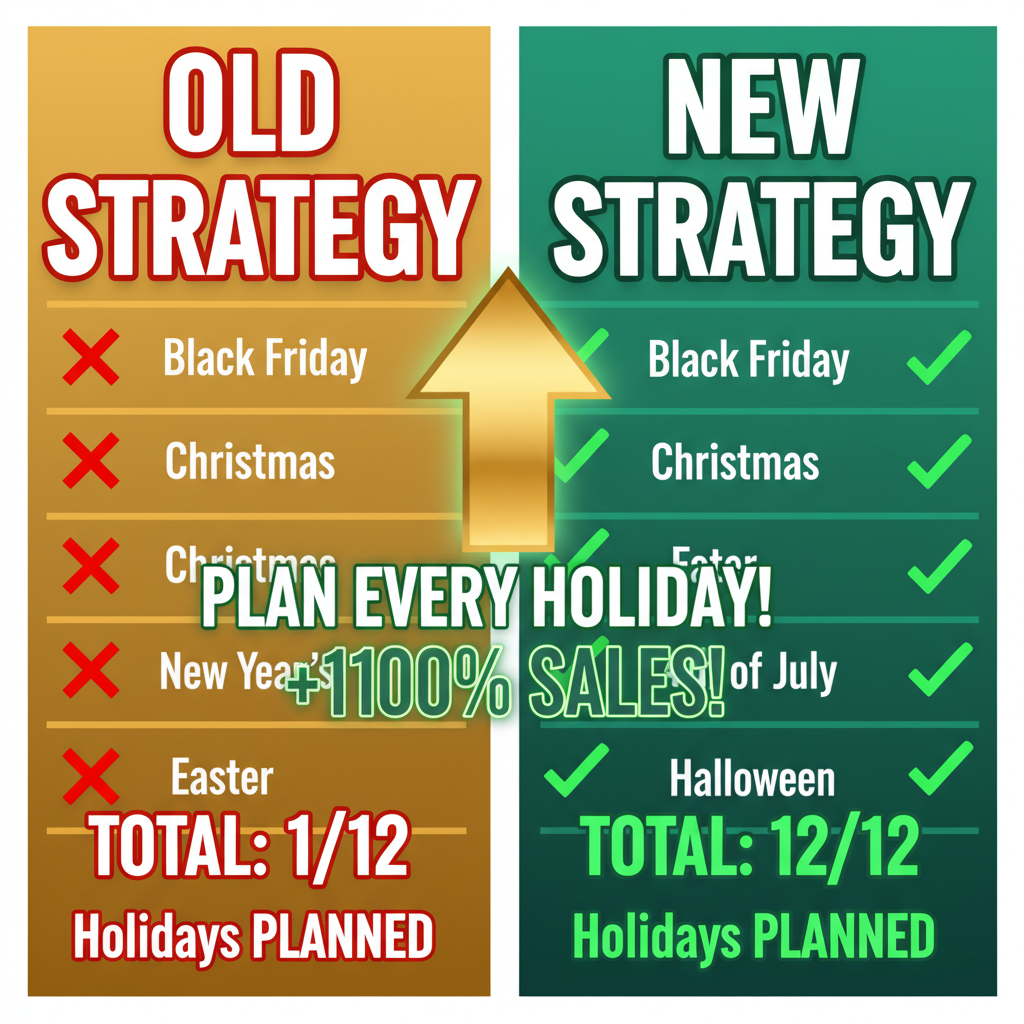
Why Seasonality Matters More Than You Think
For most e-commerce brands, 40-60% of annual revenue arrives in 4-6 weeks. If you're doing fashion, beauty, or gifts, Black Friday and holiday season dominate. If you're food or wellness, summer travel or New Year's resolution season move the needle.
The brands that win aren't the ones with the best products. They're the ones who planned their content and media 6+ months ahead.
Here's the operator insight: seasonal peaks aren't surprises. They're predictable, repeatable cycles. Every brand knows Black Friday arrives November 1st. The differentiator is who has content (blog posts, gift guides, email sequences, paid creative) ready on October 1st.
Most brands scramble in October. The winners are 80% done by August.
This guide covers the full playbook: mapping your seasonal revenue curves, building content 6 months early, and executing paid + organic simultaneously during peaks.
Your 12-Month Revenue Calendar
Every brand has seasonal peaks. Here's what they look like by category:
Category Revenue Distribution (Approximate)
| Category | Peak Season | Peak Share of Annual Revenue | Secondary Peak |
|---|---|---|---|
| Fashion/Apparel | Black Friday + Holiday | 35-40% | Summer sales (20-25%) |
| Beauty/Skincare | Holiday (gift-giving) + Summer | 30-35% | Mother's Day, Valentine's (15-20%) |
| Home/Furniture | Holiday + Spring (refresh) | 25-30% | Back to school (15%) |
| Food/Beverage | Holiday gift + Summer | 20-30% | New Year (health/detox) |
| Wellness/Supplements | New Year + Summer fitness | 25-35% | Holiday gift |
| Toys/Kids | Holiday + Back-to-school | 45-55% | Birthday season (spring) |
| Sports/Outdoor | Summer + Spring | 30-40% | Holiday gift |
| Luxury/Premium | Holiday | 35-50% | Anniversary/milestone (year-round) |
Action: Plot your own brand's revenue by month (last 12 months). You'll see the pattern immediately. That's your content calendar baseline.
Mapping Your Seasonal Content Plan
A seasonal content plan has three layers:
Layer 1: Pillar Content (published 8+ weeks early)
- Blog posts, guides, educational content
- Builds authority and captures search traffic
- Published 2-3 months before peak
Layer 2: Seasonal Campaigns (published 6-8 weeks early)
- Gift guides, curated collections, themed landing pages
- Captures commercial intent ("gift for men under $100")
- Published 1-2 months before peak
Layer 3: Paid + Email (published 2-4 weeks early)
- Promotional creative, email sequences, paid ads
- Drives urgency and conversions
- Published weeks-to-days before peak
Example: Black Friday (Nov 1-30)
August (Layer 1: Pillar):
- Publish blog: "Best Gifts for Men Under $100: The Complete Guide" (targets "best gifts for men")
- Publish blog: "How to Choose [Product Category]: Everything You Need to Know"
- Publish email nurture sequence (5-7 emails) teaching product value
September (Layer 2: Campaigns):
- Launch gift guide landing page ("50 Gifts Under $100")
- Publish collection pages optimized for gift search terms
- Create YouTube/TikTok educational content
- Email: "9 Ways to Use [Product] This Fall" (soft promotion)
October (Layer 3: Paid):
- Publish discount/promotion landing pages
- Email: "Black Friday Sneak Peek" (2-3 emails with preview pricing)
- Launch paid ads (Google Shopping, Facebook, TikTok)
- Publish user-generated content, reviews, testimonials
November 1-15 (Peak):
- Email sequences every 3-5 days ("Last call," "Midnight flash sale," etc.)
- Paid spend at max (2-3x budget)
- Real-time organic (TikTok, Instagram, Reddit engagement)
November 16-30 (Sustained Peak):
- Email: Urgency ("Sale ends Sunday")
- Paid: Extended promotion
- Blog: Holiday gift matching (tactical help for last-minute buyers)
The 12-Month Content Calendar Template
Use this template to plan your year:
| Month | Revenue Peak? | Pillar Content (Blogs) | Campaigns | Paid Themes | Email Themes |
|---|---|---|---|---|---|
| January | NEW YEAR | "New Year Wellness Guide" | Detox/cleanse landing page | "New You" offers | Resolution support |
| February | VALENTINE'S | "Gift for Your Partner" | Couple's bundles | Romantic angles | Love stories, pairs |
| March | No | "Spring Clean: [Category] Edition" | Refresh/renewal angle | Spring sales | Seasonal transitions |
| April | EASTER | "Easter Gifts for..." | Bundles, family picks | Family focus | Gathering themes |
| May | MOTHER'S | "Mothers' Day Gift Guide" | Mom-curated picks | Female audience | Appreciation |
| June | FATHER'S / SUMMER | "Father's Day Guide" + "Summer Prep" | Dad gifts + warm-weather | Male/family focus | Dad + leisure |
| July | SUMMER | "Summer Travel Essentials" | Vacation packing, outdoor | Adventure, travel | Escape themes |
| August | BACK-TO-SCHOOL | "Back-to-School: [Age Group]" | Student/parent bundles | Student/parent targeting | Back-to-school prep |
| September | No | "Fall Refresh: [Category] Guide" | Transition pieces | Renewal | Seasonal change |
| October | HALLOWEEN / EARLY BF | "Halloween Gift Guide" + "Early BF Preview" | Costume, gift ideas | Spooky + preview | Costume, early access |
| November | BLACK FRIDAY | "Ultimate Gift Guide" | 50+ curated picks, collections | Discounts, urgency | BF teasers + urgency |
| December | CHRISTMAS | "Last-Minute Gift Guide" | Emergency gifts, fast shipping | Holiday rush, gifting | Christmas countdown, FOMO |
Fill this in with your exact peaks and campaigns. This is your master calendar.
Writing Pillar Content for Search Authority
Pillar content (blog posts) published 8-12 weeks before a peak serves two purposes:
- Captures organic search traffic for high-intent keywords ("gift ideas for [type]," "[product] buying guide," "best [category]")
- Builds authority so you rank well during peak season
Pillar Content Strategy
For a November Black Friday peak, you'd publish in August:
Blog 1: "The Complete Gift Guide for [Category] in 2026" (3,000 words)
- SEO target: "gift guide [category] 2026"
- Covers 50+ options across price ranges
- Structured data: BreadcrumbList + Product schema
- Internal links to your best-selling products
- Goal: Rank in top 3 for "gift guide [category]"
Blog 2: "[Category] Buying Guide: How to Choose the Perfect [Product]" (2,500 words)
- SEO target: "how to choose [product]," "[product] buying guide"
- Educational deep-dive
- Subtle product placement (comparisons)
- Goal: Capture "research phase" traffic before purchase
Blog 3: "Best [Product Category] Brands in 2026: Comparison & Reviews" (2,000 words)
- SEO target: "best [category] brands," "[brand] review"
- Competitive comparison
- Include your brand prominently but objectively
- Goal: Capture competitive keyword traffic
Each pillar blog is 80-90% editorial, 10-20% promotional. Never hard-sell. Build authority first.
Internal Linking Structure for Seasonality
Link from your pillar blogs to seasonal landing pages and product collections:
Pillar Blog: "Complete Gift Guide for [Category]"
  ↓
Landing Page: "Gifts Under $100" (seasonal collection)
  ↓
Product Pages (with customer reviews, ratings, shipping info)
This structure teaches Google that your seasonal pages are authoritative because they're backed by substantial editorial.
Creating Seasonal Campaigns: Gift Guides, Collections, Landing Pages
Seasonal campaigns are your workhorse for conversion.
Campaign Type 1: Gift Guides
Gift guides are high-intent landing pages that convert 2-3x better than homepage links.
Structure:
- Hero Section: "50 Gifts for Men Under $100"
- Filtering: Price, category, use case (for travel, for home office, etc.)
- Curated Picks: 10-15 products with short descriptions (1-2 sentences)
- Trust Signals: Customer reviews, why we picked it, customer photos
- CTA: "Shop this gift" (takes to product page)
Content angle example for luxury brand:
"Luxury gifts don't need to be expensive. Here are 15 gifts under $100 that feel premium and taste like thoughtfulness."
Angle matters. "Luxury under $100" converts better than just "gifts under $100."
Campaign Type 2: Collections + Category Pages
Create themed collections during peaks:
- "Holiday Must-Haves" (top 20 products)
- "Black Friday Bestsellers" (top 30 sales)
- "Gift Ideas for [Persona]" (curated by customer type)
Update collections in real-time during peak (refresh bestsellers weekly).
Campaign Type 3: Email Sequences
Build 4-5 email sequences for seasonal peaks:
Sequence 1: Educational (6 emails, published 8 weeks early)
- Email 1: "Guide to choosing [product]"
- Email 2: "5 mistakes people make with [product]"
- Email 3: "[Customer story]: How X uses [product]"
- Email 4: "Seasonal tips for [product]"
- Email 5: "Our [product] ranking this season"
- Email 6: "Early access to our seasonal selection"
Soft promotion, focus on education.
Sequence 2: Urgency (5 emails, published 3 weeks before peak)
- Email 1: "Sale preview (24-hour exclusive)"
- Email 2: "Top picks under different budgets"
- Email 3: "Last call for [Free shipping cutoff]"
- Email 4: "Midnight flash sale (limited edition)"
- Email 5: "Final day—up to 40% off"
Hard promotions, create urgency and FOMO.
Sequence 3: Win-Back (2-3 emails, published after peak)
- Email 1: "You missed our sale—here's 15% off"
- Email 2: "Last chance: 20% off ends tonight"
- Email 3: "Next season preview for VIP members"
Recover lost sales.
Sequence 4: SMS/Push (if you have it)
- Day 1: Sale announcement
- Day 3: "48 hours left"
- Day 5: "Final day—midnight deadline"
SMS converts 3-5x better than email, so use it for peak urgency.
Paid Media Strategy for Seasonal Peaks
Paid media spend should follow your content calendar.
Budget Distribution
For brands with $50K monthly ad budget:
- June-September (off-season): $5-8K/month (brand awareness, retargeting)
- October (pre-peak): $12-15K/month (campaign testing, audience building)
- November (peak): $25-35K/month (max spend)
- December-January: $15-20K/month (sustained peak/holiday gift)
Channel Strategy by Timeline
Layer 1 (8-12 weeks early): Awareness + Authority
- Channels: Organic social, YouTube, email nurture
- Goal: Build awareness before commercial intent peaks
- Budget: 10-15% of peak budget
- Content: Educational, brand-building, lifestyle
Layer 2 (6-8 weeks early): Consideration + Intent
- Channels: Google Shopping, Pinterest, email campaigns
- Goal: Capture high-intent searchers
- Budget: 30-40% of peak budget
- Content: Gift guides, comparisons, buying guides
Layer 3 (2-4 weeks early): Conversion + Urgency
- Channels: Retargeting (Facebook, Google), paid email, direct mail
- Goal: Drive immediate conversions
- Budget: 40-50% of peak budget
- Content: Discounts, limited-time offers, flash sales
Peak (Week of event):
- All channels at max bid
- Budget: 100% (maximum spend)
- Content: Urgency, real-time optimization
- Refresh creative daily based on performance
Paid Creative Strategy
Creative angle 1: Problem-Solution
"Stuck on gift ideas? Here's our curated list of 50 gifts under $100."
Creative angle 2: FOMO
"Black Friday sale ends Sunday. 40% off." (countdown timer)
Creative angle 3: Social Proof
"Bought by 10K+ customers this season. See why."
Creative angle 4: Exclusivity
"VIP Early Access: Sale starts 24 hours before public."
Test all four angles. Rotate top performers.
Analyzing Seasonal ROAS: What Matters
Track these metrics by season:
| Metric | Off-Season Target | Peak Season Target |
|---|---|---|
| ROAS (Google + Facebook + Email combined) | 1.5-2.0x | 3.0-5.0x |
| ROAS by channel: Paid Social | 1.2-1.5x | 2.5-4.0x |
| ROAS by channel: Google Shopping | 1.8-2.2x | 3.5-5.5x |
| ROAS by channel: Email | 3.0-5.0x | 5.0-8.0x |
| ROAS by channel: Organic | 2.0-3.0x | 2.5-4.0x |
| Conversion Rate | 0.8-1.2% | 2.0-4.0% |
| CAC (paid only) | $30-50 | $15-25 |
| Email CTR | 2-3% | 4-6% |
| AOV (average order value) | $75-100 | $120-180 |
Compare your metrics to these benchmarks. If you're underperforming, it's usually:
- Content isn't ready early enough
- Paid creative is stale (same ads all season)
- Email sequences lack urgency
- Landing pages aren't optimized for mobile
Common Seasonal Marketing Mistakes
Mistake 1: Starting Too Late
Most brands start Black Friday content in October. Winners start in August. You need 8-12 weeks to rank for gift guide keywords.
Mistake 2: Treating Every Holiday the Same
Valentine's Day is romance-focused. Father's Day is practical/humor. Mother's Day is gratitude/luxury. Different messaging for each.
Mistake 3: Inventory Mismatch
You've planned amazing content for a holiday, but you under-stock inventory. Content drives traffic, but you can't fulfill. Coordinate content planning with inventory planning.
Mistake 4: Ignoring Shipping Cutoffs
During peak season, shipping is slower. Update your "fastest shipping" messaging accordingly. A gift guide that promises 2-day delivery when you ship 5-7 days ruins the sale.
Mistake 5: Not A/B Testing Creative
Using the same creative for 4 weeks is wasteful. Rotate top performers weekly. Test new angles every 3-4 days.
Mistake 6: Forgetting Mobile
60-70% of traffic during peaks is mobile. If your landing pages aren't mobile-first, you're leaving 30-40% of revenue on the table.
FAQ
How far in advance should I plan seasonal content?
Pillar content (blogs) should publish 8-12 weeks before peak. Seasonal campaigns (landing pages, gift guides) should publish 6-8 weeks before. Paid creative and email can start 4-6 weeks before. The brands winning at seasonality have 60-70% of content done by July/August for Q4 peaks.
Should I change my pricing for seasonal peaks?
Not drastically. Small discounts (10-15%) are fine. Aggressive discounts (40%+) train customers to expect them and damage brand perception. Better to raise prices 5-10% into peak demand, then discount 15-20%, landing at normal price. Signals that the discount is real.
How do I know if my seasonal revenue is low?
Compare to your historical peak (last year same month). If revenue is 20%+ below last year, your peak underperformed. Diagnose: Was content published late? Did competitors outbid you? Was there supply chain disruption? Use this analysis to plan better next year.
Can smaller brands compete during seasonal peaks?
Absolutely. Smaller brands often win because they can A/B test faster and pivot creative weekly. Big brands move slowly. Your advantage is agility. Use it to find winning creative early, then scale.
How do I handle inventory during peaks?
Build a forecast: estimate peak traffic × conversion rate × AOV = peak revenue. Work backward: revenue / margin = required inventory. Always stock 20-30% extra (peaks are unpredictable). Coordinate inventory planning with content/marketing calendar in Q1 for Q4.
Key Takeaways
Seasonal peaks aren't random—they're predictable levers you can pull. The brands winning are the ones planning content 6+ months early.
Map your revenue calendar. Publish pillar content 8-12 weeks before peaks. Launch campaigns 6-8 weeks early. Scale paid media 2-4 weeks into the peak.
The compounding effect is real. A blog published in August for a November peak continues to drive traffic for years. Each seasonal push builds authority and domain strength.
Start planning 2027's Q4 peaks right now (in April 2026). You'll have 8 months to write, test, and optimize. That's why the winners are always ready.
Ready to build a year-round seasonal strategy? Tenten specializes in DTC growth and content planning. Let's map your 2026 seasonal calendar together.
Frequently Asked Questions
When should I start planning seasonal content?
Plan 6+ months ahead. Pillar blog content should publish 8-12 weeks before peak (e.g., August for November Black Friday). Seasonal campaigns (gift guides, collections) publish 6-8 weeks early. Paid media starts 4-6 weeks before peak. Brands that plan in Q1 for Q4 peaks gain massive advantage over brands scrambling in October.
How do I identify my brand's peak seasons?
Review your revenue data from the last 12-24 months. Look for patterns month-by-month. Most brands have 1-3 major peaks (e.g., Black Friday, holiday, summer). Plot your revenue by month. That's your content calendar baseline. Peaks are predictable—use that to plan.
What type of content drives the most seasonal revenue?
Gift guides, buying guides, and curated collections convert highest during peaks. Educational blogs (2-3 months early) build authority and SEO ranking. Email sequences (urgency-focused 2-4 weeks before peak) drive immediate conversions. Paid retargeting during peak drives late-stage conversions. Combine all four for maximum seasonal ROAS.
Should I discount heavily during seasonal peaks?
Small discounts (10-15%) work. Aggressive discounts (40%+) train customers to expect them and damage margins long-term. Better strategy: subtle price increases into peak, then discount 15-20% off list price (landing near original). This signals scarcity and makes the discount feel real, without harming margins.
How do I coordinate content and inventory planning?
Build revenue forecast: estimated peak traffic × conversion rate × AOV = needed inventory. Work backward from revenue target to inventory needs. Add 20-30% buffer for unpredictability. Start this forecast in Q1 for Q4 peaks. Bad timing: great content with zero inventory. Good timing: coordinate both for maximum profitability.
FAQ JSON-LD Schema
{
"@context": "https://schema.org",
"@type": "FAQPage",
"mainEntity": [
{
"@type": "Question",
"@id": "faq-1",
"name": "When should I start planning seasonal content?",
"acceptedAnswer": {
"@type": "Answer",
"text": "Plan 6+ months ahead. Pillar blog content should publish 8-12 weeks before peak (e.g., August for November Black Friday). Seasonal campaigns (gift guides, collections) publish 6-8 weeks early. Paid media starts 4-6 weeks before peak. Brands that plan in Q1 for Q4 peaks gain massive advantage over brands scrambling in October."
}
},
{
"@type": "Question",
"@id": "faq-2",
"name": "How do I identify my brand's peak seasons?",
"acceptedAnswer": {
"@type": "Answer",
"text": "Review your revenue data from the last 12-24 months. Look for patterns month-by-month. Most brands have 1-3 major peaks (e.g., Black Friday, holiday, summer). Plot your revenue by month. That's your content calendar baseline. Peaks are predictable—use that to plan."
}
},
{
"@type": "Question",
"@id": "faq-3",
"name": "What type of content drives the most seasonal revenue?",
"acceptedAnswer": {
"@type": "Answer",
"text": "Gift guides, buying guides, and curated collections convert highest during peaks. Educational blogs (2-3 months early) build authority and SEO ranking. Email sequences (urgency-focused 2-4 weeks before peak) drive immediate conversions. Paid retargeting during peak drives late-stage conversions. Combine all four for maximum seasonal ROAS."
}
},
{
"@type": "Question",
"@id": "faq-4",
"name": "Should I discount heavily during seasonal peaks?",
"acceptedAnswer": {
"@type": "Answer",
"text": "Small discounts (10-15%) work. Aggressive discounts (40%+) train customers to expect them and damage margins long-term. Better strategy: subtle price increases into peak, then discount 15-20% off list price (landing near original). This signals scarcity and makes the discount feel real, without harming margins."
}
},
{
"@type": "Question",
"@id": "faq-5",
"name": "How do I coordinate content and inventory planning?",
"acceptedAnswer": {
"@type": "Answer",
"text": "Build revenue forecast: estimated peak traffic × conversion rate × AOV = needed inventory. Work backward from revenue target to inventory needs. Add 20-30% buffer for unpredictability. Start this forecast in Q1 for Q4 peaks. Bad timing: great content with zero inventory. Good timing: coordinate both for maximum profitability."
}
}
]
}