The 2026 Ecommerce Platform Landscape
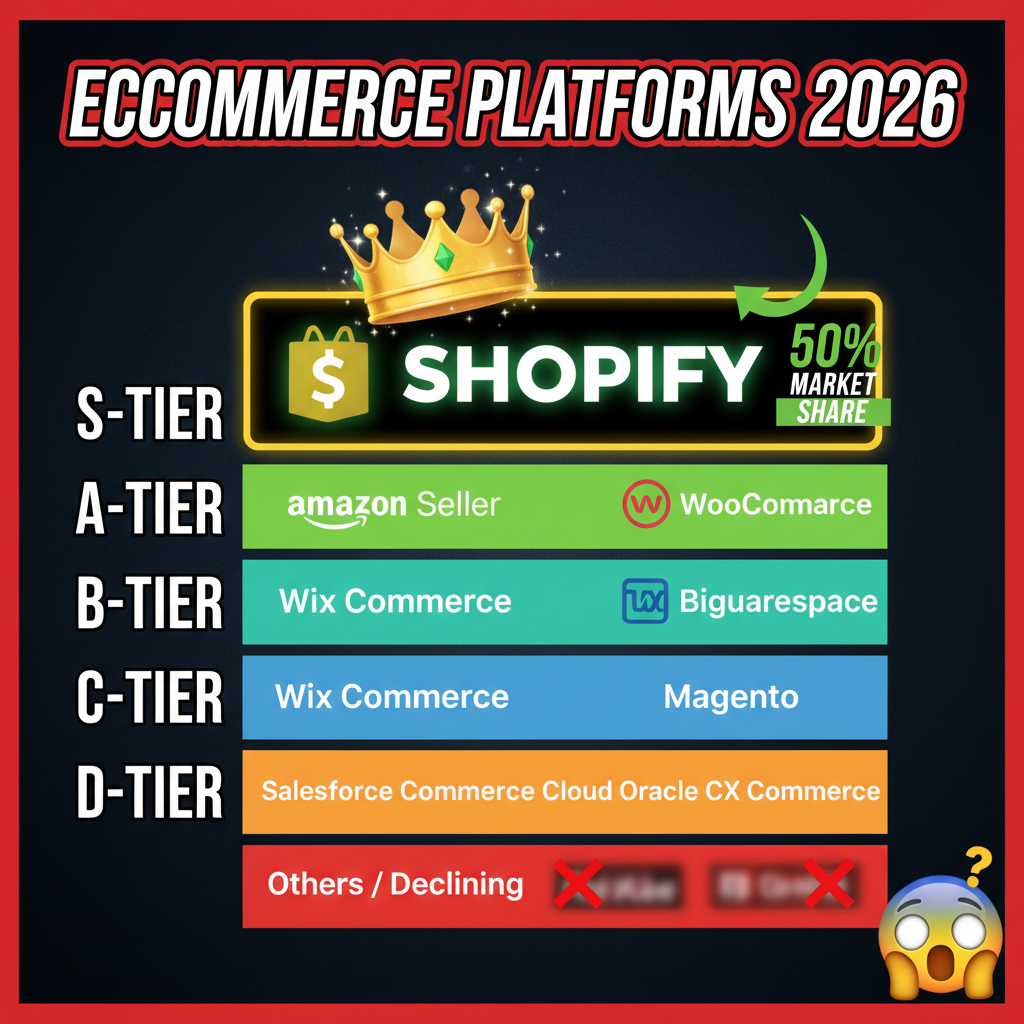
The ecommerce platform wars have consolidated. In 2015, 200+ platforms competed for merchant dominance. In 2026, five platforms control 75%+ of the market: Shopify, WooCommerce, BigCommerce, Wix, and Salesforce Commerce Cloud.
Market share data from Similarweb and Shopify's IPO filings shows clear stratification:
| Platform | Market Share (2026) | GMV Hosted | Merchants | Primary Segment |
|---|---|---|---|---|
| Shopify | 22-25% | $180-200B | 2.3M | SMB-to-Mid-Market |
| WooCommerce | 18-20% | $80-100B | 5.5M+ | SMB / Self-Hosted |
| BigCommerce | 8-10% | $25-30B | 70K | Mid-Market |
| Wix | 5-7% | $15-20B | 1.2M | SMB / DIY |
| Salesforce Commerce Cloud | 4-5% | $20-25B | 2K | Enterprise |
The rest: Drupal, Magento, Azucar, 3D Cart, and thousands of smaller platforms share the remaining 30%.
Shopify's Dominance: Why and How
Shopify leads because it solved three hard problems that other platforms struggled with:
1. Merchant Acquisition & Ease of Use
Shopify made creating an online store as easy as opening a Gmail account. No server setup, no coding required, signup-to-live in 24 hours. WooCommerce requires WordPress hosting knowledge. Salesforce requires enterprise IT teams. Shopify's no-infrastructure approach won the SMB market.
Data: Shopify's app ecosystem has 8,000+ apps. BigCommerce has 1,200. That network effect—merchants flock to Shopify because the app ecosystem is largest, which attracts more developers, which builds more apps—is defensible.
2. Flexible Pricing
Shopify's pricing ladder is accessible: $29-2,000/month for standard Shopify, $2,000-40K/month for Shopify Plus. Competitors force higher starting prices (BigCommerce: $30-500/month, but many features locked behind add-ons). Shopify's transparent pricing and upsell-friendly architecture win deals.
3. Global Expansion Tooling
Shopify Markets (launched 2022) enables merchants to sell internationally without setting up multiple stores. Multi-currency, tax compliance, local payment methods—all native. Competitors charge extra for these features. For DTC brands scaling to 10+ countries, Shopify's cost advantage is 2-3x over alternatives.
WooCommerce's Silent Strength
WooCommerce powers 43% of all WordPress sites with ecommerce. That's 4.2M storefronts. Yet WooCommerce is chronically underestimated.
Why? WooCommerce operates differently than Shopify. It's free open-source software. A developer installs WooCommerce on a WordPress server, configures plugins, customizes code. High upfront technical debt, but ultimate flexibility.
Merchants choose WooCommerce if:
- They already use WordPress (blog + ecommerce on one platform)
- They need custom business logic that Shopify doesn't natively support
- They want to avoid Shopify's transaction fees (Shopify charges 0.5% on top of payment processing; WooCommerce doesn't)
- They want full server control
For merchants, the WooCommerce TCO (total cost of ownership) is deceptive:
- Free software, but $200-500/month hosting
- No transaction fees, but $100-200/month in plugin licenses
- Developer time: 100+ hours for setup vs. Shopify's 10 hours
- Total 3-year cost: $8K-15K vs. Shopify's $15K-25K
The trade: WooCommerce wins on flexibility and TCO at scale; Shopify wins on speed to launch and support.
BigCommerce's Wedge: Mid-Market Focus
BigCommerce targets merchants doing $500K-10M in revenue—the "mid-market" gap between Shopify Standard and Shopify Plus pricing. BigCommerce charges $30-500/month, includes all features at every tier (no paywalling), and offers real human support.
BigCommerce's strategy is clear: "We're cheaper and more feature-complete than Shopify standard, but easier than WooCommerce's self-hosting."
In practice:
- For $1M revenue merchants: BigCommerce at $199/month is cheaper than Shopify at $299/month + $500 apps. But Shopify's ecosystem of apps is richer, and their merchant community is larger.
- For $5M revenue merchants: BigCommerce's mid-tier features (B2B, wholesale, API flexibility) compete with Shopify Plus's $2,000+ entry price. BigCommerce wins on price; Shopify Plus wins on customization and dedicated support.
BigCommerce's growth is steady (12-15% YoY) but not explosive. They lack Shopify's brand magnetism and app ecosystem depth. They compete on feature completeness and fair pricing, not innovation.
Salesforce Commerce Cloud: Enterprise Fortress
Salesforce Commerce Cloud is for enterprise merchants doing $50M+ in revenue. Cost: $15K-100K+/month. Features: unlimited customization, dedicated infrastructure, omnichannel fulfillment (physical retail + ecommerce).
Enterprise merchants choose Salesforce if:
- They already run Salesforce CRM (ERP integration is easier)
- They operate physical retail and need omnichannel inventory
- They have 500+ SKUs and need complex fulfillment workflows
- They need white-label deployments for B2B
Salesforce's advantage is enterprise sales, not product innovation. The platform innovates slowly. Shopify Plus innovates faster and costs 5-10x less for similar scale. Salesforce loses ground to Shopify Plus every year.
Market Consolidation & The "API-First" Trend
2024-2026 saw platforms shift from monolithic to "composable commerce"—use Shopify for payments, Vercel for frontend, Shopify Hydrogen for headless rendering, integrate third-party tools via API.
Shopify invested heavily in this (Hydrogen, Remix partnership, GraphQL API). BigCommerce offers "composable" solutions too. WooCommerce has no first-party composability offering (third-party tools fill the gap).
The trend: Merchants want best-of-breed tools, not monolithic platforms. Shopify's open API and app marketplace position them well for this shift. Salesforce, which historically required end-to-end implementation, struggles to keep pace.
Market Dynamics 2026: Three Threads
Thread 1: Shopify's Consolidation Play
Shopify is buying vertical SaaS companies (Deliverr for fulfillment, Soundtrack for audio, Unbox Logistics for shipping). Each acquisition deepens Shopify's moat in specific workflows. By 2028, Shopify will own the full DTC stack (payments, fulfillment, inventory, marketing).
Competitive implication: BigCommerce and WooCommerce can't compete with Shopify's acquisition velocity. They'll focus on niche segments instead.
Thread 2: WooCommerce's Managed Hosting Evolution
WordPress VIP and Kinsta are building "managed WooCommerce" offerings (hosting + support, $500-2,000/month). This blurs the lines with Shopify. In 5 years, managed WooCommerce becomes a legitimate Shopify alternative for mid-market merchants.
Thread 3: AI Agents Reshaping Commerce
Shopify's Sidekick AI (live in 2024) is now part of the competitive moat. Merchants who adopt AI agents for customer service, inventory management, and personalization will see 20-30% conversion lifts. Platforms that ship AI agent APIs first will win 2026-2027.
All platforms are building this, but Shopify ships faster.
Real Data: 2026 Market Share by Segment
| Segment | Leader | Market Share | Second Place | Notes |
|---|---|---|---|---|
| SMB (< $500K) | Shopify | 35% | WooCommerce (30%) | Shopify's ease of use wins |
| Mid-Market ($500K-$10M) | Shopify | 30% | BigCommerce (25%) | BigCommerce competitive, but Shopify app ecosystem larger |
| Enterprise ($10M+) | Shopify Plus | 40% | Salesforce (35%) | Shopify Plus gained share from Salesforce 2024-2025 |
| Marketplace (multi-vendor) | Shopify | 28% | WooCommerce (25%) | Marketplace is emerging segment; Shopify leading with Marketplace infrastructure |
Outlook: 2026-2028
Shopify's market share will likely grow to 26-28% by 2028. Reasons:
- AI agent features ship faster than competitors
- Shopify Plus is eating Salesforce's enterprise lunch
- International expansion (Shopify Markets) is accelerating
BigCommerce will stabilize at 8-10% (niche mid-market play).
WooCommerce will grow from 18% to 20% (benefiting from managed hosting providers like Kinsta).
Salesforce Commerce Cloud will decline from 4-5% to 2-3% (being replaced by Shopify Plus).
Ready to Leverage Your Platform's Position?
Understanding where your ecommerce platform stands in the market is key to strategic planning. Are you maximizing Shopify's ecosystem? Ready to migrate from WooCommerce or BigCommerce?
Contact tenten.co/contact to discuss your platform strategy.
Learn more about Shopify Plus features and positioning to determine if platform migration is right for your business.
Editorial Note: Platform market share isn't just a stat—it reflects merchant priorities. Shopify's dominance stems from solving speed and scalability simultaneously, something competitors can't match.
Frequently Asked Questions
What percentage of ecommerce goes through Shopify?
Shopify hosts approximately 22-25% of all ecommerce globally, representing $180-200B in GMV. This includes Shopify Standard, Shopify Plus, and Shopify Markets.
Is WooCommerce cheaper than Shopify?
WooCommerce's software is free, but total cost of ownership (hosting + plugins + development) is often similar to Shopify ($8K-15K over 3 years). For simple stores, WooCommerce is cheaper. For growing merchants, Shopify's convenience often saves money.
Should I migrate from BigCommerce to Shopify?
If you're under $5M revenue and need more app integrations, Shopify is better. If you're $5M-20M and want feature completeness, BigCommerce might fit. If you're $20M+, Shopify Plus is more flexible than BigCommerce. Analyze your specific needs, not just platform reputation.
Is Salesforce Commerce Cloud dying?
No, but it's declining in market share. Salesforce is strong for enterprise merchants requiring omnichannel fulfillment. But Shopify Plus undercuts Salesforce on price and innovation, so Salesforce's market share will continue to decline.
What's the best platform for a startup doing $0-500K in revenue?
Shopify. The ecosystem, support, and ease of use are unmatched for early-stage merchants. WooCommerce is second best if you need code customization or have strong WordPress knowledge.