A New Category is Emerging
The traditional e-commerce agency is dying.
This isn't hyperbole. Ask any merchant who worked with an agency in 2020 and hired one in 2026. The difference is stark.
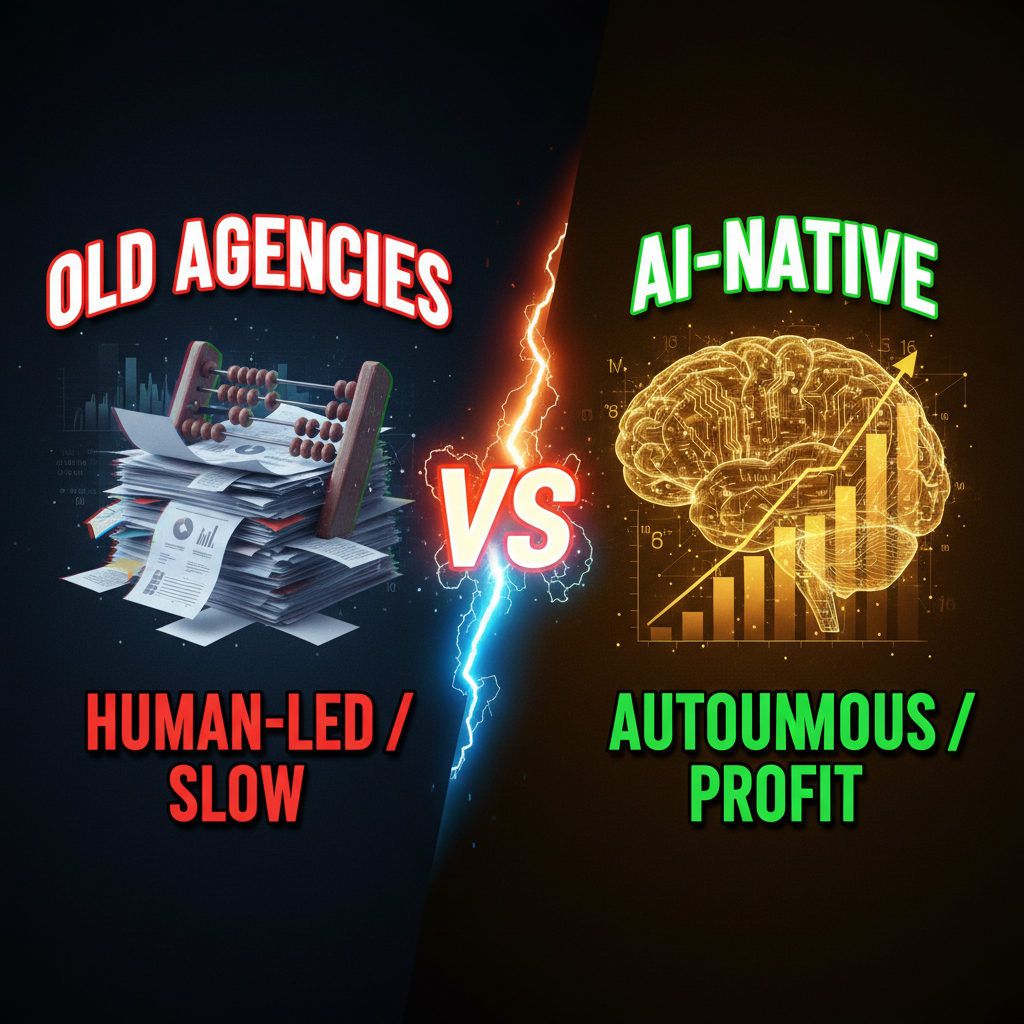
Old model: 50-person agency with 30% gross margins, managing projects in Asana, writing content in Google Docs, running paid ads through a junior specialist who's checked out.
New model: 8-person agency (or solo founder), 75%+ gross margins, automating 60% of implementation with AI, generating data-driven insights faster than old agencies could think.
The dividing line isn't talent. It's whether the agency has remade its entire operating system around AI.

Defining "AI-Native"
An AI-native commerce agency is one where:
-
AI is the infrastructure, not a feature. Prompting Claude or ChatGPT is not the business model. Using AI to remove labor-intensive work (content creation, ad copywriting, customer segmentation, reporting) is foundational.
-
Workflows are designed for AI + human collaboration. A human writes the strategy. AI executes 80% of the work. The human reviews, edits, and approves. This is faster and higher quality than either alone.
-
Margin structure changed. Old agencies: 35–40% gross margin. AI-native agencies: 70–85% gross margin. The economics are entirely different, which means they can undercut on price while making more money.
-
Output speed is 3–5x faster. A content calendar that took a week in 2023 takes 1–2 days in 2026. Paid ad creative that took 3 days now takes 6 hours.
-
Customer outcome focus. Because the agency can afford to charge less, the competitive lens shifts from "time billed" to "revenue generated." AI-native agencies are performance-obsessed.
This is a category shift, not just a tooling shift.
The Business Model Arbitrage
Let's do the math. Assume a 20-person traditional agency and a 5-person AI-native agency, both generating $500K in annual revenue.
Traditional agency (20 people): - Revenue: $500K - Team cost: 15–18 people @ $80K–$150K = $1.2M–$2.4M annually (totally underwater at $500K revenue) - Actual model: 20 people, 5–8 billable on client work, generating $25K–$50K per person annually - Gross margin: 30–40% (after people costs) - Profit: Negative to 10%
AI-native agency (5 people): - Revenue: $500K - Team cost: 5 people @ $120K–$180K = $600K–$900K (expensive hires, technical founders) - But: 3 people billable, 1 operations, 1 sales/founder - Output per person: $100K–$166K (much higher) - Gross margin: 75–80% - Profit: 40–50%
The AI-native model is not just leaner. It's profitable at revenue levels that starve traditional agencies.
And as AI improves, the gap widens. A traditional 20-person agency in 2026 is a liability, not an asset.
Winners: Who's Winning Now (2026)
Tier 1: Pure AI-native, built from scratch (2023–2025)
- Founder-first AI shop: Solo founders using Claude, Perplexity, and custom Python scripts to run entire Shopify Plus implementations. Margin: 80%+. Examples: Alex at Commerce Automation (personal brand, $10K/month projects), Various Shopify Partners using AI-augmented implementation.
- Niche vertical specialists: E-commerce agencies that picked one vertical (beauty, fashion, food) and built AI prompts/workflows specific to that space. Competitive advantage: They outrun generalists. Margin: 70%.
Tier 2: Traditional agencies that adapted (2024–2025)
- McKinsey, Deloitte consulting arms: Started offering "AI-augmented strategy" for e-commerce. Margin impact: Minor (they're not rearchitecting operations, just adding a "thinking AI" layer). Competitive threat: Medium (they have brand, but slow decision-making).
- Shopify Plus partners who automated: Agencies like Tenten, Mad Fellows, and others that implemented AI into their implementation workflows. Margin improvement: 20–40 percentage points. Staying competitive.
Tier 3: Struggling to adapt (2025+)
- 30–50 person agencies: Still staffed like 2020. Using AI sporadically. Losing deals to leaner competitors who do the same work for 40% less. Example: Traditional "full-service" agencies trying to sell $50K strategy projects when a startup can deliver the same in 2 weeks for $3K.
The Three Business Models (Who's Buying)
Not all AI-native agencies look the same. Three distinct models are winning:
Model 1: Productized Services (highest margin)
Agency builds one specific offering (e.g., "Shopify blog automation"), packages it at a fixed price ($3K–$10K), and delivers via AI + minimal human time.
Examples: - "AI Product Photography Tool" — merchant uploads product images, AI generates 50 lifestyle shots, done in 2 hours for $2K. Cost to deliver: $200 in API calls. - "Email Sequence Generator" — merchant describes brand, AI generates 12-email nurture sequences, copywriting takes 2 hours for $1.5K. Cost: $50.
Margin: 80–90% Why it wins: Repeatable, scalable, high conversion (merchants understand the value)
Model 2: AI-Enhanced Freelance (75% margin)
Freelancer/small firm takes on bigger projects than possible solo (because AI handles grunt work), charges traditional rates ($100–$300/hour), but delivers 3x faster.
Example: Paid ads specialist used to do $20K/month in revenue working 40 hours (5 clients × 8 hours/week). Now does $50K/month (same hours, AI writes ad copy, analyzes competitor ads, creates audience segments).
Margin: 70–75% Why it wins: Extremely efficient, customer gets quality at traditional pricing, freelancer makes more
Model 3: Performance-Based (variable margin)
Agency charges percentage of revenue generated (5–10%) or fixed fee + bonus (e.g., "$10K base + 2% of revenue uplift").
Example: AI-native agency helps Shopify merchant go from $100K/month to $150K/month. Base fee: $10K. Bonus: 2% × $50K increase = $1K. Total: $11K for 60 hours of work (human time).
Margin: 70–80% (if implemented right) Why it wins: Aligns incentives (agency only wins if merchant wins), merchants see the ROI immediately
What Merchants Are Actually Buying
Three buyer segments have emerged:
Segment 1: "I want to work lean" (40% of market)
Merchants already using AI (Claude, ChatGPT, Midjourney). They don't need an agency to do AI. They need an agency to strategize with AI and execute at scale.
They're buying: Prompt templates, workflow design, AI implementation architecture. They're not buying: Agency labor (they do the work themselves). Price tolerance: $2K–$10K per project, outcome-based.
Segment 2: "I want faster results" (35% of market)
Traditional merchants who couldn't afford to hire in-house teams. Now they can hire an AI-augmented agency that delivers 3x faster at 40% of old pricing.
They're buying: Speed and scale. A logo redesign used to take 2 weeks and cost $8K. Now: 2 days, $2K. Price tolerance: Same as before, but with faster delivery and higher quality (because AI generates 10 options, human picks best).
Segment 3: "I want a partner" (25% of market)
High-revenue merchants ($5M+) who want ongoing optimization, not project work. They're buying an "AI chief of staff" — someone who runs their entire commerce operations through AI.
They're buying: Strategy, monthly optimization, A/B testing automation, analytics architecture. Price tolerance: $5K–$20K/month (performance-based contracts).
The Strategic Implication for Tenten
Tenten is a traditional agency (50+ people, $8M+ revenue) that has adapted to AI.
You're in Tier 2 — traditional agency moving forward, not dying.
Your competitive advantages: 1. Shopify Plus expertise — Deep technical knowledge of enterprise platform (a moat) 2. Integrated services — Can do strategy, implementation, content, analytics (one-stop-shop advantage) 3. Merchant relationships — Existing customers trust you, refer you
Your vulnerabilities: 1. Margin pressure — Solopreneurs and small AI-native shops undercut on price 2. Speed disadvantage — 50-person structure is slower than 5-person shops 3. Commoditization risk — If your services become standardized (like Shopify blog automation), productized competitors will win
Strategic moves to consider: - Build productized AI services (blog automation, ad copy generation, email sequences) and sell at $2K–$5K (high volume, smaller deals) - Develop performance-based contracts for high-volume merchants ($5M+), charging percentage of revenue uplift (margin-neutral on price, but outcome-aligned) - Hire prompts/workflow engineers (not developers) — people who understand AI + e-commerce, can build reusable workflows
The Market Forecast
2026–2027 (next 18 months): - Traditional agencies lose 20–30% of junior implementation work to AI-native competitors - Solopreneurs capture 15–20% market share in productized services - Agencies that adapted win overall (margin improves, deal size increases) - Merchants increasingly expect AI to be part of any agency pitch
2027–2028: - AI-native becomes "native" (no longer distinguished) - Performance-based contracts become standard (fixed fees decline) - Agencies that haven't automated are acquired or shut down - Margin compression hits, triggering consolidation (big buying small)
The category isn't stable. It's moving. Fast.
Ready to Evolve Your Shopify Practice?
Whether you're a merchant shopping for better partners, or an agency navigating the AI transition, the key is: speed and outcomes.
AI-native doesn't mean "zero humans." It means humans focused on strategy, creativity, and optimization. Everything else is automated.
Tenten is building this model for enterprise Shopify Plus clients. Schedule a consultation to discuss how AI is reshaping your commerce operations.
For more on AI in e-commerce, visit our Shopify AI guide.
Editorial Note We're living through the professionalization of e-commerce. In 2023, agencies were still using Excel and manual reporting. In 2026, the baseline is: AI-first workflows, automated analytics, performance contracts. This shift is only accelerating.
Frequently Asked Questions
What's the difference between AI-native and AI-augmented?
AI-native: Built from first principles around AI. Every workflow assumes AI is handling 60%+ of the work. AI-augmented: Traditional business with AI tools bolted on. Different profitability models.
Should I hire an AI-native agency or a traditional agency that uses AI?
Depends on your need. Fast/small projects ($2K–$10K) → AI-native. Integrated strategy + implementation ($50K+) → Traditional agency with AI. Performance-based ($5M+) → Hybrid (AI-native founder + traditional agency partnership).
What skills do agencies need to transition to AI-native?
Prompt engineering, workflow design, basic Python/automation, understanding of API economics. Less important: Design, copywriting, paid ads expertise (AI handles these now).
Is the traditional agency model dead?
Not dead, but endangered. If you're a traditional agency, you must adapt. Margin pressure is real. Margin per employee should improve 30–50% in next 2 years, or you're uncompetitive.
Can a solo freelancer compete with a traditional agency?
Yes, if they use AI. Solo freelancer + Claude > 5-person traditional agency with no AI. AI levels the playing field, but only for those using it.
Where is the most money being made in AI-native right now?
Productized services (highest margin %, but smaller deals). Performance-based contracts (larger deals, alignment). Least money: Time-and-materials (losing to AI).