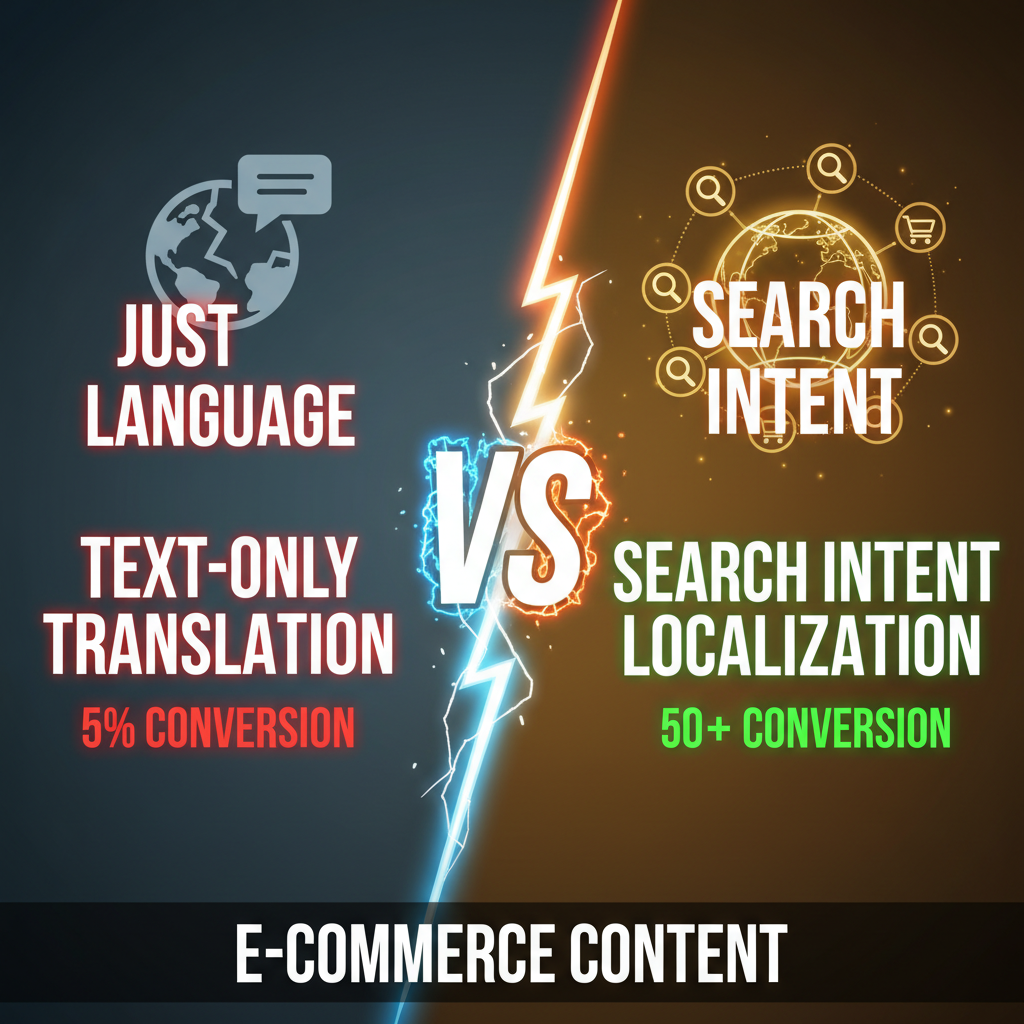
The Translation Trap That Costs $50K+
Most merchants expanding globally make the same mistake: translate everything and hope.
Product title in English: "Waterproof Running Backpack - 30L"
Google Translate Spanish: "Mochila de Running Impermeable - 30L"
Your Spanish customers search: "mochila para correr" (running backpack).
Result? Your Spanish page ranks for "impermeable" (waterproof) instead of "correr" (running). You're invisible in Spanish search.
This isn't a translation problem. It's a localization problem. Translation is language conversion. Localization is market adaptation.
A $3M store expanding to Spain, Mexico, and Argentina without localization loses 40-60% of potential search traffic. With proper localization, that same store gains 15-25% incremental revenue per market.
What Localization Really Means (The Framework)
Localization has four layers:
| Layer | Translation | Localization |
|---|---|---|
| Language | English → Spanish (word-for-word) | English → Spanish (intent-aware, cultural relevance) |
| Search Intent | Translate keywords | Research regional keywords (Mexicans search "chamarra," Argentines search "campera" for jacket) |
| Pricing | $99 USD everywhere | $99 USD in US, $1,899 MXN in Mexico, $24,500 ARS in Argentina (local currency) |
| Content Tone | Brand voice stays same | Tone adapts (Spain: formal "usted," Mexico: casual "tú"; Germany: direct/technical, France: elegant/stylish) |
| Trust Signals | US-based company info | Local payment methods, return policies, customer reviews in-language |
Most merchants nail language translation. Very few nail the other three layers. That's where competitive advantage lives.
Layer 1: Keyword Localization (The Hidden Goldmine)
Before you write a single word, research regional keywords. A word search tool doesn't cut it—you need native speakers and regional data.
Example: "Winter Boots"
| Market | English Keyword | Regional Keyword | Search Volume | Competition |
|---|---|---|---|---|
| United States | Winter boots | winter boots | 165K/mo | High |
| Spain | Winter boots (English) | botas de invierno | 12K/mo | Medium |
| Mexico | Winter boots (English) | botas para invierno | 8.5K/mo | Low |
| Germany | Winterstiefel | winterstiefel | 22K/mo | High |
| France | Bottes d'hiver | bottes d'hiver | 14K/mo | Medium |
Notice: Spain searches "botas de invierno" not "botas invierno." Mexico adds "para." Germany hyphenates differently. These aren't trivial differences—they're search algorithm expectations.
The tactic: Hire a regional native speaker (not Google Translate) to audit your top 50 product keywords. They'll identify:
- Semantic variations (Spain: "tenis," Mexico: "zapatos deportivos," Colombia: "zapatillas")
- Category differences (Spain: "ordenador," Mexico: "computadora" for computer)
- Regional slang (Argentina: "quilombo" for mess, Peru: "chamba" for job)
Cost: $500-1K per market. Payoff: +10-25% search traffic within 90 days.
Layer 2: Product Copy Localization (Not Just Translation)
Here's where brand voice meets culture.
Example: Luxury handbag
English original (US-targeted):
"Our premium leather tote carries your daily essentials in timeless style. Handcrafted with Italian leather and US-stitched hardware."
German translation (word-for-word):
"Unsere Premium-Leder-Tasche trägt deine täglichen Essentials in zeitlosem Stil. Handgefertigt mit italienischem Leder und US-genähter Hardware."
Problem: German customers care about engineering precision and material sourcing. US tone ("carries your daily essentials in timeless style") sounds vague to a German buyer.
German localization (rewritten for local intent):
"Hergestellt aus hochwertigem italienischem Vollrindleder mit verstärkten Nähten und medizinisch geprüftem Tragesystem. Konstruktion für tägliche Nutzung im Unternehmensalltag ausgelegt. Lebenslange Reparatur garantiert."
Notice the difference? German version emphasizes durability, engineering, and longevity. It's the same product, reframed for how Germans evaluate quality.
Regional tone frameworks:
- United States: Conversational, benefit-focused, lifestyle-driven
- Germany: Technical, material-focused, durability-emphasized
- France: Aesthetic, artisanal, heritage-emphasized
- Spain/Latin America: Warm, relational, community-focused
- Japan: Minimalist, quality-obsessed, process-focused
Layer 3: Pricing Psychology & Currency Localization
Displaying prices in local currency is table stakes. Smart localization goes deeper.
| Principle | US Approach | Localization |
|---|---|---|
| Price display | $99 | €89 (Spain), €99 (Germany), €114 (France) |
| Decimal convention | 99.99 | 99,99 (Germany), 99.99 (Spain) |
| Currency symbol placement | $99 | 99€ (France), 99 EUR (Germany) |
| Tax inclusion | Tax added at checkout | Tax included in displayed price (EU requirement) |
| Payment methods | Credit card, PayPal | iDEAL (Netherlands), Bancontact (Belgium), Sofort (Germany) |
The contrarian insight: Shopify Markets or similar multi-currency tools feel complete, but they're not. Most just convert USD to local currency at a flat rate. That misses the pricing psychology opportunity.
Example: A $99 handbag converts to €89 (fair conversion). But in Spain, a €99 handbag signals luxury and craftsmanship. €89 signals discount/lower quality. Reframe: €99 (higher margin, better perceived value) instead of €89 (lower margin, worse perception).
For premium brands, localize pricing psychology, not just currency.
Layer 4: Trust Signals & Payment Methods (The Closing Layer)
A French customer won't trust a US-only warranty. A German customer won't complete checkout without seeing SEPA or Sofort. These aren't nice-to-haves—they're conversion requirements.
Payment method localization:
| Market | Top Methods | Penetration |
|---|---|---|
| Germany | SEPA Direct Debit, Sofort, PayPal | 85% |
| France | PayPal, Carte Bancaire, Klarna | 80% |
| Spain | PayPal, Tarjeta de Crédito, Bizum | 75% |
| Mexico | OXXO Cash, Mercado Pago, Credit Card | 70% |
| Argentina | Mercado Pago, Credit Card, Bank Transfer | 65% |
Missing a top payment method = 15-20% checkout abandonment in that market.
Trust signal localization:
| Signal | US | Germany | Spain | Mexico |
|---|---|---|---|---|
| Return policy | 30 days | 14 days (legal) | 14 days (legal) | No legal standard |
| Warranty | Limited (1 year) | Extended (2 years, EU standard) | Extended (2 years, EU) | Limited (90 days) |
| Privacy | Privacy policy | GDPR compliance badge | GDPR badge | Local DPA compliance |
| Customer support | Email + phone | Phone + chat (live required) | Email + phone | WhatsApp (preferred channel) |
Layer 5: SEO Technical Setup (Multi-Market Foundation)
Before publishing localized content, configure your SEO foundation:
Option A: Subdomains (es.yoursite.com)
- Best for: Large multi-market expansion (10+ countries)
- SEO benefit: Each domain gets independent ranking authority
- Cost: Hosting, SSL certificates, duplicate content management
Option B: Subdirectories (yoursite.com/es/)
- Best for: 2-5 markets
- SEO benefit: Shared domain authority, easier to manage
- Cost: Lower
Option C: Shopify Markets (Native)
- Best for: Shopify Plus or higher
- SEO benefit: Built-in hreflang, multi-currency, local domain support
- Cost: Built into Shopify
Critical: hreflang tags
Tell Google which page is for which market:
<link rel="alternate" hreflang="es" href="https://es.yoursite.com/products/boots">
<link rel="alternate" hreflang="de" href="https://de.yoursite.com/products/stiefel">
<link rel="alternate" hreflang="x-default" href="https://yoursite.com/products/boots">
Missing hreflang = Google shows English page to Spanish searchers. You get traffic but wrong audience. Conversions collapse.
Implementation Timeline: 90-Day Localization Roadmap
| Phase | Timeline | Work | Output |
|---|---|---|---|
| Phase 1: Research | Week 1-2 | Hire native speakers, keyword research, market analysis | Keyword list per market, tone guide |
| Phase 2: Content | Week 3-6 | Rewrite product copy, category pages, brand messaging | Localized content in all markets |
| Phase 3: Technical | Week 7-8 | hreflang setup, Shopify Markets config, payment methods | Sites ready for traffic |
| Phase 4: Testing | Week 9-10 | A/B test pricing, CTAs, trust signals per market | Optimization data |
| Phase 5: Launch | Week 11-12 | Go live, monitor rankings, support readiness | Markets live, growing |
Cost estimate: $8K-15K labor + $3K-5K tools. ROI in first 90 days: 200-400% for a $2M+ store.
Ready to Expand Globally With Localization?
Translation is cheap. Localization is valuable. The merchants who win globally are those who reframe their products for local search intent, cultural values, and payment psychology.
Tenten helps e-commerce merchants launch in new markets with proper localization. We handle keyword research, copy adaptation, and technical SEO setup.
Editorial Note
Localization is unsexy compared to paid ads, but it's the highest-ROI expansion tactic available. A German or Spanish store localizing content properly grows 2-3x faster than one just translating. The gap is that wide. That's because localization respects your customer's language, culture, and buying behavior. Translation doesn't.
Frequently Asked Questions
Should I localize every market at once or one at a time?
Start with one market (highest revenue potential, English-speaking secondary market helps). Perfect that market, then expand. Perfecting one market > launching five poorly.
Is Shopify Markets sufficient for localization?
It's a good foundation (multi-currency, hreflang, local domains). But it doesn't handle keyword research, copy localization, or tone adaptation. Use it as infrastructure, not as your entire localization strategy.
How much does professional localization cost?
Native speaker keyword research: $500-1K per market. Copy rewriting: $2-5K per market. Technical SEO: $1-2K per market. Total: $3.5-8K per market (or $8-15K for 2-3 markets).
Can I use Google Translate for product copy?
No. Google Translate fails on nuance, cultural tone, and regional keyword expectations. Use it only for reference. Always hire a native speaker for final copy.