
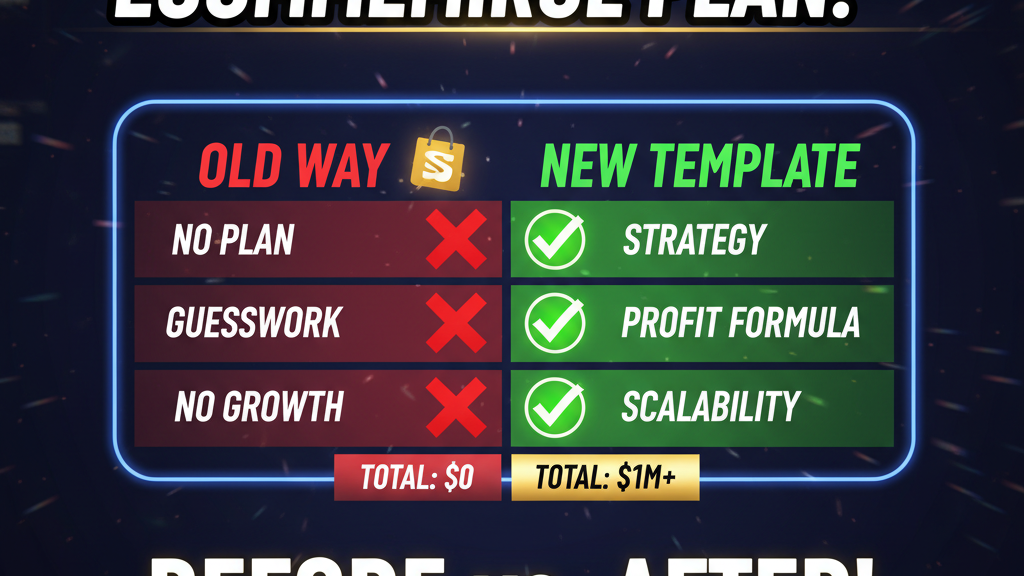
Why Entrepreneurs Skip the Business Plan (and Why They Shouldn't)
A founder launches a Shopify store. First month: zero sales. Second month: $2,000 revenue. Third month: $8,000. The momentum is exciting. Then month four: $6,000. Month five: $4,500. The store is decelerating.
If there had been a plan—a realistic financial model of customer acquisition cost (CAC), lifetime value (LTV), and cash burn—the founder would've spotted the problem in week 3: the product was profitable per unit but the customer acquisition cost ($85 per buyer) was too high relative to first-purchase margin ($120). The LTV:CAC ratio was 1.4:1. Sustainable LTV:CAC is 3:1 or higher.
Without a plan, the founder spent $12,000 on ads to acquire 140 customers, realized the unit economics were broken, and quit. With a plan, they would've known this in advance, adjusted pricing or product positioning, and hit sustainable growth.
This is the operator truth: a business plan isn't bureaucracy. It's insurance against bad unit economics.
What a Shopify Business Plan Actually Includes
A real business plan for Shopify has 5 core sections:
| Section | Purpose | Typical Length |
|---|---|---|
| Executive Summary | 1-page overview: business idea, market opportunity, financial highlights | 1 page |
| Market Analysis | Market size, target customer, competitive landscape | 3-5 pages |
| Unit Economics | Product cost, gross margin, CAC, LTV, payback period | 2-3 pages |
| Go-to-Market & Marketing | Launch strategy, customer acquisition channels, content/paid mix | 3-5 pages |
| Financial Projections | 24-month revenue, expense, and cash flow forecast | 2-3 pages + spreadsheet |
That's 11-16 pages + spreadsheet. Most entrepreneurs take 4-6 weeks to develop one properly. It forces hard conversations: "Is our target market big enough?" "Can we actually reach them for the CAC we're assuming?" "Do we have enough cash runway if growth stalls?"
Executive Summary Template
Business Name: [Your store name]
One-Sentence Pitch: [Product category] for [target customer] sold via [distribution channel].
Example: "Premium sustainable activewear for women 25-40 who prefer DTC brands over traditional retailers."
Market Opportunity:
- Total addressable market (TAM): $[X]B (top-down: industry size)
- Serviceable addressable market (SAM): $[X]M (subset you can realistically reach)
- Example: Activewear is a $50B market (TAM). Premium DTC activewear is $2.5B (SAM). Women-focused premium activewear is $800M (serviceable obtainable market / SOM).
Initial Product: [What you're selling]
- Average selling price (ASP): $[X]
- Unit gross margin: $[X]
- First-year revenue target: $[X]
Competitive Advantage: Why you, not Lululemon / competitor?
- Example: "Direct access to fabric manufacturer (uncle owns mill), 25% lower COGS than established brands, faster design-to-market (4 weeks vs 6 months)."
Founding Team: Experience, relevant skills, commitment level
- Example: "3 co-founders: ex-Patagonia product manager (15 yrs), operations manager (7 yrs supply chain), marketing director (12 yrs DTC)."
Financial Highlights (24 months):
- Revenue: Year 1: $[X], Year 2: $[X]
- Gross margin: [X]%
- Customer acquisition cost: $[X]
- CAC payback period: [X] months
- Cash needed to breakeven: $[X]
Market Analysis: Defining Your Beachhead
Most entrepreneurs fail because they're selling to "everyone." The plan forces specificity.
Total Addressable Market (TAM):
Look up industry reports. Apparel market: $382B globally. Activewear: $50B. Premium activewear: $8B. DTC premium activewear: $2.5B.
Start with an industry report (Statista, eMarketer, McKinsey). Pick the number most relevant to you. Write it down.
Serviceable Addressable Market (SAM):
Of that TAM, what can you realistically reach? Geographic focus, demographic focus, channel focus.
Example: "Of the $2.5B DTC premium activewear market, we'll target 2% market share in North America (population 580M, disposable income $40K+ avg), women 25-40. That's ~$50M SAM."
Competitive Landscape:
Who else is selling to your market? What are they doing? What's your edge?
| Competitor | Price Point | Strengths | Weaknesses |
|---|---|---|---|
| Lululemon | $128+ per item | Brand, scarcity, loyalty | High prices, inventory scarcity |
| Girlfriend Collective | $68-98 | Sustainable, ethical | Smaller brand recognition, longer lead times |
| Gymshark | $45-85 | Community, influencer power | Doesn't focus on 35-55 age group |
| Your Store | $72-104 | [Your advantages] | [Your limitations] |
This exercise clarifies your positioning. If you're more expensive than Lululemon, you need a better reason than "sustainable." If you're cheaper than Girlfriend Collective, you need better inventory or faster shipping.
Unit Economics: The Financial Core
Unit economics are the single most important section. They determine if you have a sustainable business or a money-burning toy.
Template:
| Metric | Value | Notes |
|---|---|---|
| Average Selling Price (ASP) | $78 | Weighted avg across all products |
| COGS (Cost of Goods Sold) | $28 | Fabric, labor, shipping to warehouse |
| Gross Profit per Unit | $50 | ASP - COGS |
| Gross Margin % | 64% | ($50 / $78) |
| Customer Acquisition Cost (CAC) | $32 | Paid ads, organic labor, estimated |
| CAC Payback Period | 19 days | Gross profit per unit / daily repeat rate |
| Customer Lifetime Value (LTV) | $240 | Avg 3.1 purchases over 18 months @ $78 ASP |
| LTV:CAC Ratio | 7.5:1 | ($240 / $32) — healthy (>3:1) |
| Repeat Purchase Rate | 18% | % of customers who buy again within 12 months |
| Average Order Frequency | 2.1 | # of purchases per customer over 18 months |
| Payback Period in Months | 0.6 | Time to recover acquisition spend |
This one table tells you everything. An LTV:CAC of 7.5:1 means for every dollar spent acquiring a customer, you make $7.50. That's sustainable. If your LTV:CAC were 1.2:1, you'd be burning cash and would never reach profitability.
Most Shopify entrepreneurs don't calculate this. That's why 90% of stores fail.
Customer Acquisition Strategy
How will you find customers? Be specific.
Channel Strategy (Example):
| Channel | Year 1 Spend | CAC | Monthly Growth | Rationale |
|---|---|---|---|---|
| Paid social (Instagram/TikTok) | $120K | $38 | 12% | High-intent audience; targeting 25-40F interested in fitness; proven DTC playbook |
| Content/SEO | $40K | $18 | 8% | Long-term; blog content targeting "best sustainable activewear," organic search cost $0 CPC |
| Influencer partnerships | $30K | $45 | 6% | Micro-influencers (50K-200K followers) in fitness niche; lower cost, better engagement than macro |
| Referral/community | $10K | $12 | 5% | Loyalty program (10% off friend referral); compound growth |
| Other | $0 | N/A | 0% | Placeholder for opportunistic channels |
| Total | $200K | $28 (blended) | ~10% monthly | Year 1 target: 7,150 customers at blended CAC $28 |
This forces hard questions: "Can we reach 25-40 year old women on Instagram for $38 per acquisition?" (Research: likely yes, based on industry benchmarks.) "Will our lifetime value of $240 justify $38 CAC?" (Yes: 6.3x LTV:CAC ratio.) "Is $40K on SEO realistic?" (Depends on your content team; if you hire a freelancer at $3K/month, that's realistic.)
Financial Projections: 24-Month Model
This is where most entrepreneurs get nervous. Here's a simplified monthly model:
| Month | Customers Acq'd | Total Customers | Repeat Sales | Revenue | COGS | Gross Profit | CAC Spend | OpEx | Contribution | Cumulative Cash |
|---|---|---|---|---|---|---|---|---|---|---|
| Month 1 | 50 | 50 | 0 | $3,900 | $1,400 | $2,500 | $1,600 | $5,200 | ($4,300) | ($4,300) |
| Month 2 | 56 | 106 | 9 | $6,630 | $2,380 | $4,250 | $1,792 | $5,200 | ($2,742) | ($7,042) |
| Month 3 | 63 | 169 | 19 | $10,700 | $3,850 | $6,850 | $2,016 | $5,200 | ($366) | ($7,408) |
| Month 4 | 71 | 240 | 30 | $15,200 | $5,470 | $9,730 | $2,272 | $5,200 | $2,258 | ($5,150) |
| Month 5 | 79 | 319 | 46 | $20,100 | $7,235 | $12,865 | $2,528 | $5,200 | $5,137 | ($13) |
| Month 6 | 89 | 408 | 68 | $25,700 | $9,250 | $16,450 | $2,848 | $5,200 | $8,402 | $8,389 |
| ... | ... | ... | ... | ... | ... | ... | ... | ... | ... | ... |
| Month 24 | 280 | 3,850 | 1,120 | $118,200 | $42,600 | $75,600 | $8,960 | $7,000 | $59,640 | $285,000 |
Key metrics:
- Payback month: Month 5 (cumulative cash turns positive)
- Year 1 revenue: ~$95K
- Year 2 revenue: ~$420K (annualized run rate)
- Burn rate (early): $4,300/month until Month 5
- Total cash needed to breakeven: ~$13K
This tells you: you need $15K-20K in startup capital to cover burn until Month 5, assuming no surprises.
Fundraising & Capital Requirements
If you need $100K to launch (inventory, team, ads), you need to know this before you start.
Typical Shopify store capital needs:
| Item | Cost | Notes |
|---|---|---|
| Product development | $5K-20K | Design, samples, manufacturing setup |
| Initial inventory | $15K-50K | First production run (MOQ usually 500-2000 units) |
| Shopify + tools | $500-2K | Store, apps, integrations |
| Marketing (first 6 months) | $30K-100K | Paid ads, content creation, influencers |
| Operations/team | $20K-50K | Fulfillment, customer service, back-office |
| Contingency | $10K-30K | Unexpected costs |
| Total | $80K-250K | Typical range for sustainable launch |
If your business plan shows you need $200K but you only have $50K, you're underfunded. Either bootstrap slower (smaller inventory, slower ads), raise capital, or rethink the model.
How Investors Use Your Business Plan
If you're fundraising, investors scrutinize unit economics obsessively:
- CAC vs LTV (must be 3:1+)
- Gross margin (must be 40%+)
- Payback period (must be <6 months)
- Cash runway (must last until next funding round)
- Market size (must be $500M+ to attract venture capital)
The business plan makes these visible. Investors don't care how good your product is; they care if the unit economics work.
Ready to Build Your Ecommerce Business Plan?
Most Shopify entrepreneurs treat the business plan as optional. But founders who run the numbers—who actually calculate CAC, LTV, gross margin, and cash runway—make better decisions. They know whether they're on a path to $1M or burning cash with no visibility.
We help Shopify entrepreneurs stress-test their business models, validate market assumptions, and build financial forecasts before they launch. Let's talk about your unit economics.
Editorial Note
The business plan isn't a document to show investors. It's a tool to think clearly about your own business. Run the numbers. Know your unit economics. If you're acquiring customers for $85 but they're only worth $120 in gross profit, you have a problem. The earlier you see this problem, the earlier you can fix it.
Article FAQ
Q: What's a healthy LTV:CAC ratio for a Shopify store?
A: Minimum 3:1, optimal 5:1 or higher. This means you make $3-5 in profit for every $1 spent acquiring a customer. Below 3:1, your unit economics are broken and you'll burn cash even at scale.
Q: How do I calculate lifetime value if I just launched?
A: Use industry benchmarks (repeat rate, AOV) if you don't have data yet. For most DTC apparel, expect 15-25% repeat rate, 1.5-2.5x purchases per customer. As you collect data (month 6+), update your model.
Q: Should I include operations and team costs in my CAC payback calculation?
A: No. CAC payback measures gross profit recovery. Operating expenses (rent, salary, etc.) are separate and affect overall profitability. CAC payback should be <6 months; total payback (including OpEx) is typically 12-24 months.
Q: What gross margin should I target for a Shopify store?
A: Minimum 50% for most direct-to-consumer brands. Apparel: 60-75%. Jewelry: 65-80%. Electronics: 40-50%. Below 40%, your unit economics likely don't support sustainable paid acquisition.
Q: How often should I update my business plan?
A: Quarterly. Your plan is a hypothesis; reality provides data. If actual CAC is $38 but you projected $28, update the plan. If repeat rate is 22% instead of 18%, update. Use the plan as a living model, not a static document.