
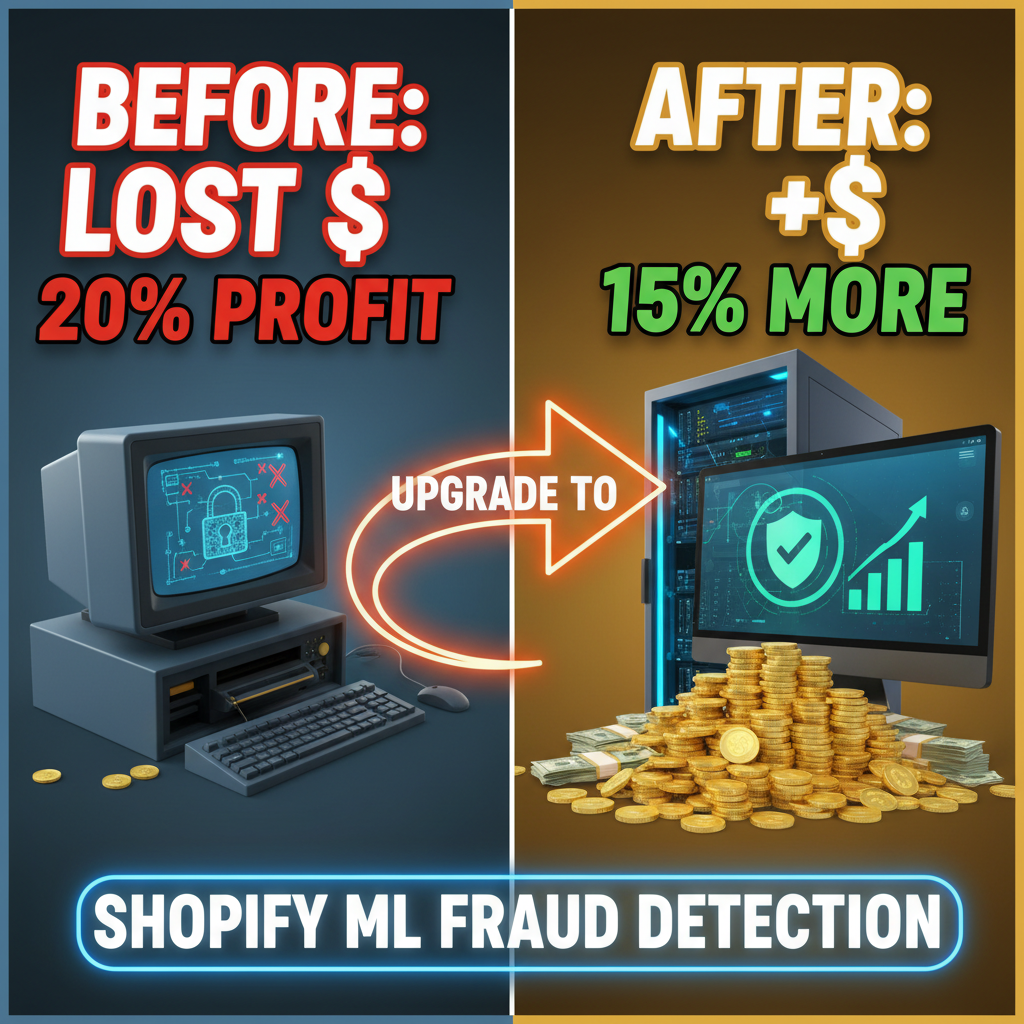
How Shopify's Fraud Detection Works (And Why Most Merchants Misunderstand It)
Most Shopify store owners treat fraud detection as a black box. An order comes in. Shopify tags it as "low," "medium," or "high" risk. Merchants either reject it outright or let it through, rarely understanding what triggered the flag.
Here's the truth: Shopify's built-in fraud detection is powered by machine learning models trained on billions of transactions. It's genuinely sophisticated. But it's also deliberately conservative. It minimizes chargebacks, albeit at the cost of false positives. For 90% of stores, it's sufficient. For the other 10%, third-party fraud apps extract pure margin.
The ML Feature Engineering Behind Shopify's Fraud Filter
Shopify's fraud detection evaluates orders across four primary feature categories:
| Feature Category | Key Signals | What Shopify Measures |
|---|---|---|
| Velocity Checks | Transaction speed, frequency | Multiple orders from same IP in < 1 hour; rapid account creation + purchase |
| Device Fingerprinting | Browser, device ID, OS | Known fraud patterns; spoofed device data; Tor/proxy usage |
| Behavioral Patterns | Checkout flow, time-to-purchase | Unusual cart additions; abandoned carts + sudden completion; checkout form changes |
| Network Analysis | IP geolocation, ISP reputation | VPN/proxy detection; known high-fraud IP ranges; mismatches between IP and shipping address |
Velocity checks catch the obvious stuff. A fraudster using a stolen card typically runs 5-10 test transactions in minutes to find working cards. Shopify's system flags this instantly.
Device fingerprinting catches the sophisticated stuff. Fraudsters use tools to spoof browser headers and device data. Shopify compares device claims against known patterns. Mismatches are red flags. Real customers rarely fake their device ID.
Behavioral patterns catch the human tells. A legitimate customer adds three items over five minutes, returns to review, then checks out. A fraudster: adds item, checks out immediately. The delta matters.
Network analysis catches geographic fraud. Someone in Lagos, Nigeria shipping to Portland, Oregon using a flagged ISP? The system scores this differently than a known Portland ISP. It's not perfect (legitimate international customers get dinged), but it works at scale.
The critical insight: These features overlap deliberately. Shopify doesn't flag on a single signal. It's an ensemble model. One velocity spike + one device flag + geographic mismatch = high risk. One geographic mismatch alone = low risk. The weighting is learned from historical chargeback data.
The Built-In Detection Rate (And Its Blind Spots)
Shopify's system catches roughly 85-92% of obvious fraud in real time. This means:
- Credit card fraud (stolen cards, test transactions): 90%+ catch rate
- Account takeover (hijacked accounts): 78% catch rate
- CNP fraud (card-not-present, clean details): 65-70% catch rate
- Friendly fraud (chargebacks from legitimate customers): 15% catch rate
That last number is the killer. Friendly fraud (when a customer receives a product, loves it, then claims they never authorized the purchase) happens after the order is placed. ML can't predict regret. Once the order is shipped and charged, Shopify's system is powerless.
This is where third-party fraud apps position themselves. They claim they'll catch what Shopify misses.
Third-Party Fraud Apps: What They Actually Do
Premium fraud platforms (Signifyd, NoFraud, Kount) don't have secret models. They use similar feature engineering (velocity, device, behavior, network) but with three key differences:
- Larger training datasets. They process billions of transactions across thousands of merchants. Their models generalize better.
- Richer data access. They integrate with payment processors (Stripe, Adyen, etc.) and dispute networks (Mastercard, Visa). They see chargeback outcomes faster.
- Human-in-the-loop. Some offer human review for borderline cases. NoFraud guarantees chargebacks. Humans review disputed orders. Signifyd uses ML plus optional human review.
Here's what they do NOT do: magic. Their false positive rates are still 3-8%. They still miss friendly fraud. Their accuracy advantage over Shopify is real but marginal (typically 2-5 percentage points on high-risk orders).
| Fraud App | Price/Month | Detection Improvement | False Positive Rate | Chargeback Guarantee |
|---|---|---|---|---|
| Shopify Native | Free | Baseline (85%) | 4-6% | None |
| Signifyd | $600–$2,000 | +2–4% → 87–89% | 5–7% | Optional add-on |
| NoFraud | $500–$1,500 | +3–5% → 88–90% | 3–5% | Yes (guaranteed) |
| Kount | Custom (Enterprise) | +3–6% → 88–91% | 4–6% | No |
The ROI math is simple: If you run a $500K/year store with 2% average fraud rate ($10K loss), upgrading to a premium app might save you $3K–$5K annually while costing you $7,200–$24,000 per year. You lose money. Your CAC goes down (you reject fewer good customers), but your fraud loss improvement doesn't justify it.
When third-party fraud apps make financial sense:
- You're processing $5M+ annually with a fraud rate above 2.5%
- You operate in high-risk categories (electronics, luxury, digital goods)
- You accept international orders where your chargeback rate exceeds industry benchmarks
- You've manually reviewed Shopify's flagged orders and noticed patterns Shopify misses
Most stores don't meet these criteria.
The Hidden Cost: False Positives
Here's what nobody talks about: Shopify's conservative fraud model rejects or holds for manual review ~7-12% of all orders. Most of those orders are legitimate.
Merchants face a choice: 1. Accept the false positives. Lose 10% of revenue to overconfident fraud filtering. This is rare. 2. Manual review mode. Flag orders as "pending" until you or a staff member manually approves them. This works until you hit 5,000+ orders/month. Then it breaks. 3. Auto-approve more orders. Reduce Shopify's fraud sensitivity. Accept slightly higher fraud rates for better customer experience.
Most stores implicitly do #3. They've calibrated Shopify's sensitivity to their comfort level. For $100K/month stores, a 0.8% fraud rate is acceptable. For $5M/month stores, 0.3% is the target.
The contrarian insight: The merchants making the most money aren't maximizing fraud prevention. They're optimizing the trade-off between fraud loss and customer experience. Every false positive rejection costs them $50–$200 in lost customer lifetime value (due to cart abandonment and brand perception). One chargeback costs them $50–$200 in fees and disputes. They'd rather accept slightly more fraud than deny slightly more good customers.
Premium fraud apps actually make this worse by being even more conservative. They flag more borderline orders. Higher accuracy doesn't mean lower cost if false positive rejection rates rise.
When to Stick with Shopify's Native System
Keep native Shopify fraud detection if any of these apply:
- You run a $100K–$1M/year store. Fraud loss in absolute dollars is still small. Manual review overhead outweighs premium app ROI.
- You sell low-fraud-risk products. Apparel, home goods, books. Fraud is rare. Keep Shopify's defaults.
- You operate in one geography (US). Shopify's IP geolocation works best for domestic US fraud. International expansion changes the equation.
- You have strong customer vetting. Subscriptions, B2B, or wholesale with pre-approved accounts. Orders are lower-risk by structure.
When to Upgrade to a Premium Fraud Platform
Switch to third-party fraud detection if:
- You're processing $3M–$10M+ annually. Fraud impact in absolute dollars justifies premium services. A 2–4% improvement = $60K–$400K in savings.
- You sell high-value or digital goods. Electronics, jewelry, software, digital downloads. Fraud rate is naturally 2–4%. Upgrading is ROI-positive.
- You operate internationally with volume. Cross-border orders have higher fraud rates. Signifyd and NoFraud's international data improves detection substantially.
- You've measured Shopify's miss rate. Analyze 3 months of chargebacks. If Shopify flagged <60% of them, a premium app will help.
- You're willing to implement post-purchase verification. Some premium apps offer 3DS (3D Secure) or velocity-based retries. These reduce fraud without rejecting orders upfront.
Building Your Fraud Strategy: A Practical Framework
The best fraud mitigation strategy combines native Shopify detection + operational practices:
Step 1: Understand your baseline. Export 90 days of orders. Measure: (chargebacks + disputes) / total orders. Calculate your fraud rate. Compare against industry benchmarks.
Step 2: Analyze Shopify's performance. Filter to orders Shopify flagged as "medium" or "high." Count how many actually chargebacked. Calculate: (flagged orders that chargebacked) / (total chargebacks). This is Shopify's hit rate.
Step 3: Calculate premium app ROI. Estimate the cost. Estimate the improvement (2–4 percentage points). Measure impact. If improvement < app cost, stay native.
Step 4: Optimize operational controls. For $50K–$1M stores, operational controls beat premium apps: - Require AVS (address verification) + CVV matches - Flag orders over 2x average order value for manual review - Use Shopify's native payment gateways (Shopify Payments integrates native fraud filtering) - Monitor customer emails and phone numbers for duplicate orders - Implement post-purchase 3DS for orders >$500
These operational controls reduce fraud 30–40% without rejecting legitimate orders.
Ready to Protect Your Store Without Overspending?
Your fraud strategy should match your scale. Most Shopify stores don't need premium fraud apps. They need better operational controls and a realistic understanding of the true cost of fraud versus the cost of rejecting good customers.
If you're processing millions annually and fighting fraud above industry benchmarks, Signifyd or NoFraud make sense. If you're optimizing for fast growth and customer trust, Shopify's native ML is sufficient.
Tenten helps merchants audit their fraud losses and implement the right controls for their scale. Contact us to review your fraud strategy and optimize for both security and customer experience.
Editorial Note
Fraud detection is one of the few e-commerce problems where more data doesn't always mean better results. Shopify's native system is stronger than most merchants realize because it's built on decades of payment network data. The temptation to buy a premium solution is natural. But it's also the exact moment to step back and do the math. The best fraud detection strategy is proportional to your actual fraud loss.