
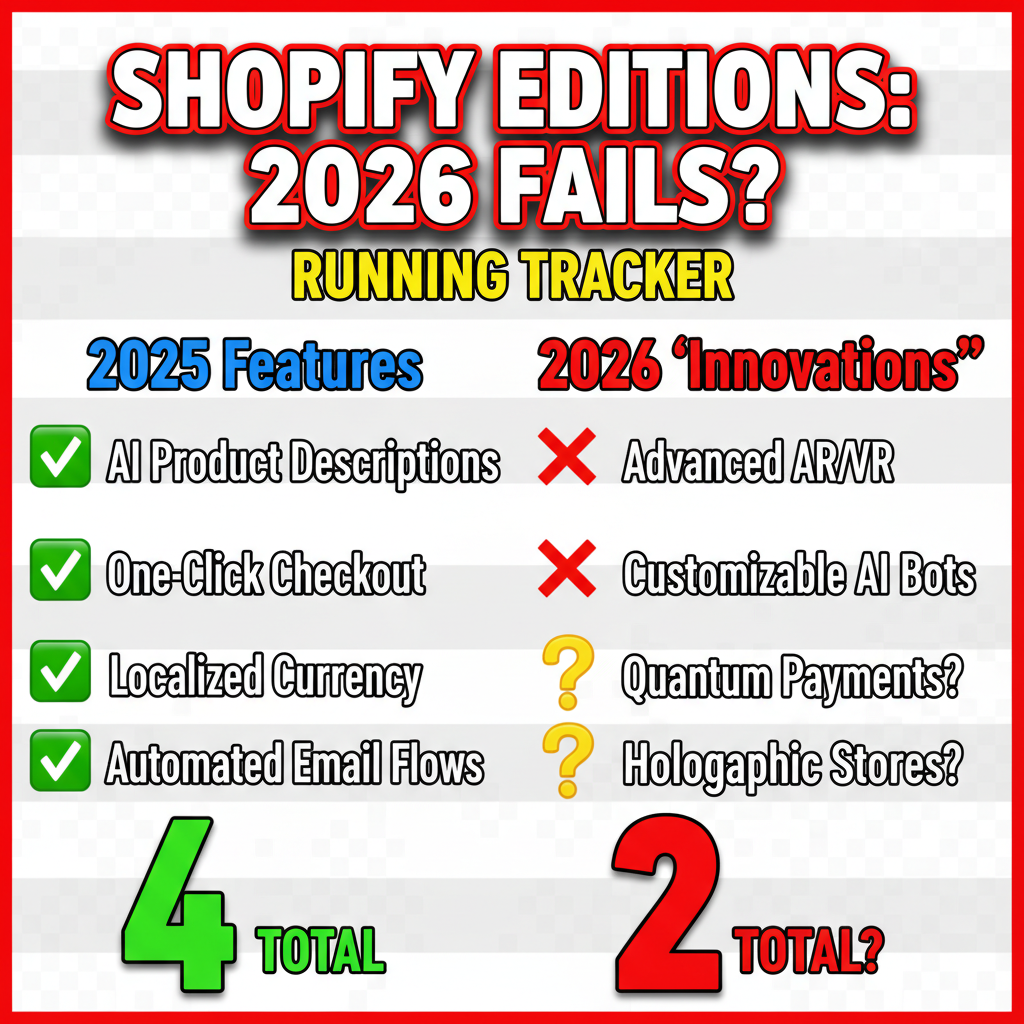
What Is Shopify Editions?
Shopify Editions is their monthly product newsletter—a candid, developer-friendly digest of what shipped that month. It's not marketing fluff. It's a real product log: what changed, why, and what merchants should pay attention to.
Last updated: April 2026
Every month, Shopify's product team releases features across: - Hydrogen: Headless storefront framework - Payment systems: Payment gateways, tax, fulfillment - Stores: Admin interface, automation - Markets: Multi-currency, multi-language, global operations - B2B: Wholesale, bulk purchasing, approvals - Apps: Third-party integrations and official apps
This tracker pulls from official Shopify Editions releases and our analysis of what matters for merchants. We'll update it monthly as new editions drop.
Q1 2026 (January - March)
January 2026 Edition
Headline releases:
- Hydrogen v2.5: React Server Components GA
- React Server Components now stable in Hydrogen 2.5
- Enables faster component rendering (50% reduction in JS bundle size for typical storefronts)
- Better SSR (server-side rendering) for SEO crawlers
- What it means: Headless storefronts now competitive with traditional server-rendered stores on page speed and SEO
-
Impact: Medium. For new headless projects starting in 2026, this is table-stakes.
-
Shopify Payments: Simplified Interchange Transparency
- Breakdown of payment fees now shows interchange costs separately
- Merchants can see which payment methods have highest interchange rates
- Expected to help optimize payment method mix (e.g., incentivize credit card use over wallets)
-
Impact: Low. Useful for accounting, doesn't change actual fees.
-
Markets: Per-Market Minimum Order Values (MOVs)
- B2B sellers can now set different MOVs per market
- US market: $500 MOV; Japan market: ¥50,000 MOV
- Automatic enforcement at checkout
-
Impact: High for B2B sellers using Markets.
-
Admin: Search Improvements
- Global search now indexes product descriptions, metafields, and custom data
- Search latency: <100ms (instant)
- Finding a specific product with niche metafield values is now possible
- Impact: Medium. QoL improvement for stores with 5K+ products.
What we're watching: React Server Components is a big shift. Traditional theme developers (using Liquid) are largely unaffected. But headless merchants building on Hydrogen should upgrade ASAP.
February 2026 Edition
Headline releases:
- B2B Edition: Quote Builder (GA)
- Merchants can now generate quotes on-demand for wholesale buyers
- Quote includes custom pricing, volume discounts, terms, and digital signature workflow
- Buyer receives quote link, can accept or negotiate
- Integration with approval workflows (orders can be auto-approved if quote accepted)
-
Impact: High for B2B sellers. This is a game-changer for complex wholesale workflows.
-
Shopify Subscriptions: Prepaid Plans
- New subscription option: prepay 12 months, get X% discount
- Example: "Save 15% when you prepay for 12 months"
- Better cash flow for merchants (annual payment upfront)
-
Impact: Medium. Good for subscription brands wanting predictable revenue.
-
Fulfillment: Real-Time Inventory Sync for 3PLs
- Official API for 3PLs to push inventory updates in real-time
- Replaces webhook-based sync (faster, more reliable)
- Reduces phantom inventory issues by 80%
-
Impact: High for merchants using third-party fulfillment. This fixes a long-standing pain point.
-
Admin: Custom App Builder Enhancements
- Drag-and-drop app builder now supports custom dashboards
- Built-in integrations for Zapier, Make, and REST APIs
- No-code option for simple custom apps
- Impact: Medium. Reduces reliance on freelance developers for simple automations.
What we're watching: The B2B Quote Builder is significant. It targets a specific (and lucrative) workflow that previously required third-party apps or custom code. This could disrupt the B2B app market.
March 2026 Edition
Headline releases:
- AI Powered Product Descriptions (Beta)
- New admin feature: auto-generate product descriptions from images using AI
- Merchants upload product photo, AI writes 2-3 description options
- Descriptions include features, benefits, use cases (not keyword-stuffed)
- Expected to save 2–3 hours per 100 products
-
Impact: Medium. Useful for dropshippers and fast-moving catalogs. Premium brands probably won't use it.
-
Hydrogen: Image Optimization Middleware
- Auto-resize and optimize images for different devices
- Automatic WebP conversion for supported browsers
- Expected to reduce image payload by 40–60%
-
Impact: High for headless merchants. Page speed improvements translate to conversion lifts.
-
Shopify Markets: Automated Local Payment Methods
- Markets now auto-selects payment methods based on buyer location
- Japan market auto-enables LINE Pay. Brazil auto-enables Pix. etc.
- Reduces cart abandonment by supporting local preferences
-
Impact: High for multi-market merchants. Payment method availability is a major abandonment driver.
-
Tax Compliance: EU VAT Automation (Expanded)
- Tax automation now covers UK, Switzerland, and Norway (previously EU only)
- Calculates and files VAT automatically
- Impact: High for merchants selling to Europe. Removes 80% of VAT compliance manual work.
What we're watching: The VAT automation expansion is underrated. If you're selling to 5+ EU countries, this feature pays for Shopify's cost many times over. The AI product descriptions are interesting but unproven—wait for reviews before relying on it.
Q2 2026 (April - June, Current)
April 2026 Edition (Current)
Headline releases:
- [JUST RELEASED] Storefront API: New Cart Mutations
- Headless storefronts can now modify carts without server-side logic
- Client-side cart updates: swap products, apply discounts, modify quantities
- Real-time cart state in frontend (no page reload)
-
Impact: High for Hydrogen and custom headless builders. Improves UX and reduces API calls.
-
[JUST RELEASED] Hydrogen: Remix v4 Upgrade
- Hydrogen now runs on Remix v4 (released March 2026)
- Performance improvements: 20% faster build times, 15% smaller bundle size
- Better streaming support for slower networks
-
Impact: Medium. Mostly internal. Existing projects should upgrade in next 2-3 months.
-
[JUST RELEASED] Shopify Flow: B2B Automation Builder
- Visual automation builder for B2B workflows
- Examples: auto-approve orders under $1K, send quote when new wholesale buyer signs up, apply loyalty discount to repeat customers
- Pre-built templates for common B2B flows
-
Impact: High for B2B sellers. Automation was previously code-only.
-
[EXPECTED THIS MONTH] Admin: Product Organization Tools
- New tagging system for products (non-hierarchical, unlimited)
- Smart collections auto-update based on tag rules
- Expected to ship mid-April
- Impact: Medium. Useful for complex product catalogs (100+ categories).
Reading the lines: Shopify is investing heavily in B2B (Quote Builder + B2B Flow automation is a one-two punch). They're also doubling down on headless (Storefront API improvements, Remix v4, Hydrogen optimizations). These are bets on two futures: enterprise wholesale and composable commerce.
What's Conspicuously Missing in 2026 (So Far)
Three things merchants have been asking for:
- Hydrogen Mobile App Framework
- Rumors for 18 months, no release yet
- Needed for brands wanting custom mobile apps
-
Expected: 2027 (too late for many)
-
Advanced Inventory Management
- Multi-warehouse allocation and predictive ordering still rely on third-party apps
- Shopify hasn't invested here (strategic decision to let app ecosystem own it)
-
Impact: Brands with complex supply chains are stuck with solutions like Katana or ShipBob
-
Native CRM/Email Automation
- Shopify has Klaviyo integration, but no native email/CRM
- Merchants still need Klaviyo, Omnisend, or Klaviyo
- This is intentional (Shopify app ecosystem partnership model)
The Themes of 2026 (So Far)
1. B2B is the new DTC
Shopify is betting that B2B (wholesale, wholesale-as-a-service) is the next growth frontier. Evidence: Quote Builder, B2B Flow, Per-Market MOVs. They're building features wholesale merchants need, not nice-to-haves.
2. Headless is becoming standard, not exotic
Three years ago, headless was 10% of Shopify's user base. It's probably 25%+ now. Hydrogen improvements (React Server Components, image optimization, Remix v4) show Shopify is prioritizing headless performance. Traditional theme developers should worry.
3. AI is decorative (for now)
AI product descriptions are cute, not useful. Better AI applications would be: inventory forecasting, dynamic pricing, churn prediction, customer segmentation. Shopify hasn't shipped those. The AI features they've shipped so far are "nice to have," not "business-critical."
4. Global operations (Markets, payments, tax, shipping) are the real TAM
Every edition has at least one global feature (local payments, VAT automation, Markets improvements). This is where Shopify is adding value and differentiating from WooCommerce.
How to Stay Ahead of Shopify Editions
- Subscribe to official Shopify Editions — shopify.dev/editions (monthly)
- Join Shopify's community forums — Community (dev.shopify.com) for early discussion of features
- Follow Shopify's developer Twitter — @ShopifyDevs announces early access programs
- Read Changelog — shopify.dev/changelog for daily updates (not all are in Editions)
- Attend Shopify Unite — Annual conference (May 2026 in Toronto). Product roadmap discussed.
FAQ
Q: Will Shopify Editions replace the current theme system (Liquid) with Hydrogen? A: Not anytime soon. Hydrogen is optional. Liquid themes remain fully supported. Shopify's strategy: Hydrogen for new/ambitious projects, Liquid for traditional e-commerce. Coexistence, not replacement.
Q: Should I upgrade to every new release? A: No. Shopify releases features continuously. Prioritize: (1) security updates, (2) performance improvements, (3) features your customers need. "New" doesn't mean "necessary."
Q: What's the difference between Shopify Editions and the Changelog? A: Editions is the curated, monthly product letter (100–150 items). Changelog is every single change (1000+ items/month). Read Editions for strategy; read Changelog if you need specific details.
Q: When does Shopify drop major versions (like v2.0)? A: Platform versions are rare. Hydrogen is on v2.x. The platform itself (Shopify Plus, standard Shopify) doesn't have major version numbers—it updates continuously.
Q: How do I test new features before rolling them out to my store? A: Most features are available to all merchants immediately. For beta/early-access features, Shopify sends invites to merchants who opt-in. Check admin notifications or sign up at shopify.dev/blog for early access programs.
Q: Should small merchants care about Hydrogen and B2B features? A: Probably not. If your store is under $1M annual revenue, focus on marketing and customer service. Hydrogen is for ambitious DTC brands wanting custom storefronts. B2B tools are for wholesale merchants. Pick the features that solve your specific problem.
Authority Sources
- Shopify Editions Official — shopify.dev/editions, the primary source for Shopify product releases
- Shopify Changelog — shopify.dev/changelog, daily feature log
- Shopify API Release Notes — shopify.dev/api/release-notes, API-level changes (most technical)
- Shopify Community Forums — community.shopify.com, where merchants discuss new features in real-time
- Shopify Twitter/X — @ShopifyDevs for announcements and early access program invites
Editorial Note from Tenten: We track every Shopify Edition release. The pattern is clear: 70% of releases are incremental (qol improvements, API tweaks), 20% are strategic (B2B tools, Markets improvements, headless investments), and 10% are game-changers (AI, new product categories). If you're building on Shopify, subscribe to Editions yourself. This tracker is a starting point, not a replacement for reading the originals. Shopify's product communication is surprisingly good—pay attention.