
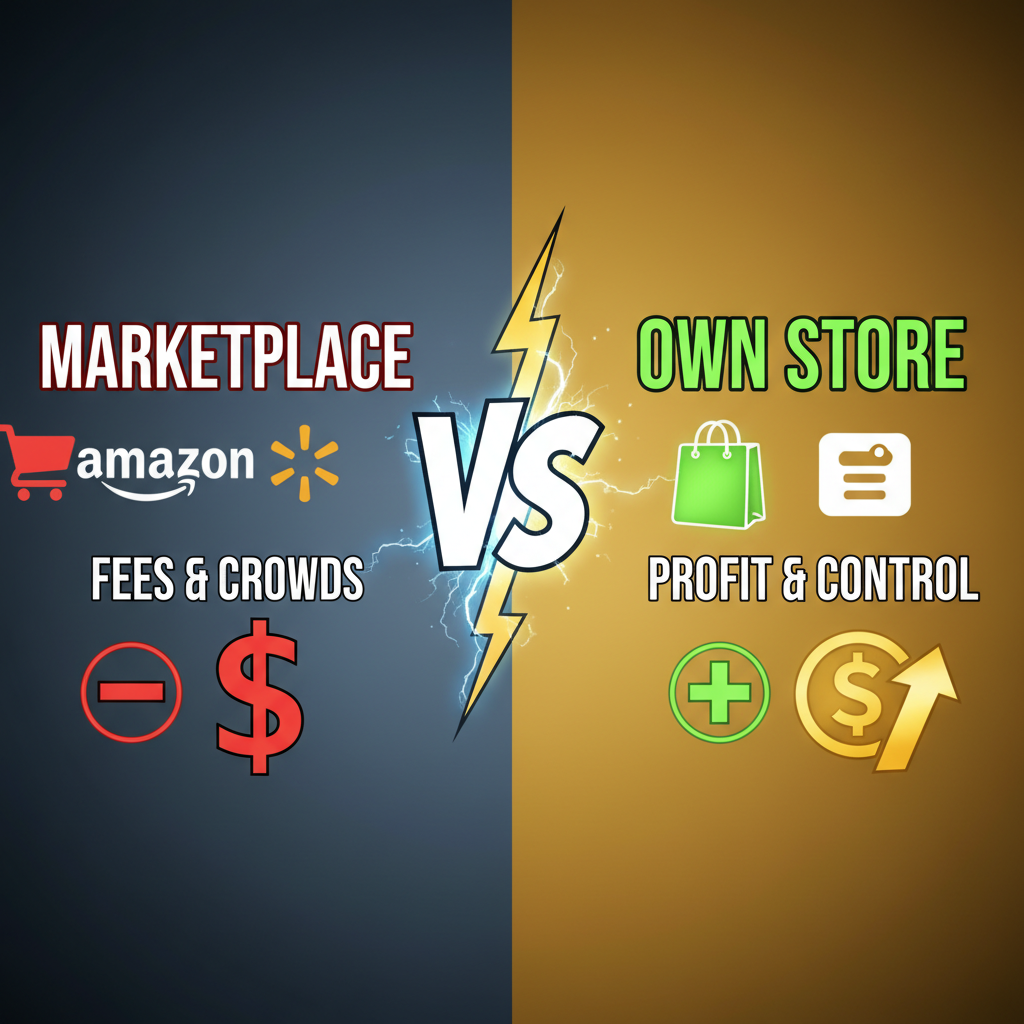
The D2C Math That Nobody Talks About
You're selling on Shopify. Revenue is growing. Then your CFO says: "Why aren't we on Amazon? They have millions of buyers."
The answer is NOT because Amazon reaches millions. The answer is: margin. And most D2C brands do this math wrong.
Here's the actual unit economics:
Shopify-only model ($100 sale): - Cost of Goods Sold: $35 - Shopify Payments: $2.90 - Shipping (Shopify): $5 - Gross margin: $57.10 / $100 = 57% - Payable margin after marketing: 32% (after 25% CAC)
Amazon FBA model ($100 sale): - COGS: $35 - Amazon FBA fees (fulfillment + transaction): $30 - Referral fee: $15 - Payable margin: ($100 - $35 - $30 - $15) / $100 = 20% - Real margin after marketing: 8% (CAC kills it on low-margin channels)
That 9% difference compounds fast. At $1M annual revenue, you're leaving $90K in margin on the table—pure oxygen for hiring, logistics, or paid ads.
When Marketplaces Make Sense
Not all D2C brands should ignore Amazon. Some SHOULD be there. Here's the matrix:
Sell on Amazon if: - You have a commodity product (vitamins, supplements, household items) competing on price discovery and review velocity - Your brand is NOT established; you're using Amazon reviews to build credibility (cold-start problem) - Your supply chain already supports Amazon FBA logistics (pallet-ready, 14-day restock cycles) - You're in a vertical where consumers expect Amazon (beauty, fitness, kitchen gadgets) - You can afford the margin haircut because volume compensates
Stay Shopify-only if: - Your product is branded or differentiated (you control the narrative, not reviews) - You have repeat-purchase potential (DTC software, fitness, meal kits, apparel subscriptions) - Your CAC on Facebook/Google/TikTok is <15% (which means Shopify margin supports profitability) - You're building a community or subscription model (Amazon prevents both) - Your product has customization (print-on-demand, personalization, build-your-own)
The Acquisition Cost Problem on Marketplaces
This is the hidden kill-shot on Amazon and Walmart.
When you sell on Shopify, you own the customer. You own their email. You can retarget them. You build a list.
When you sell on Amazon, you get a transaction. Jeff owns the customer. You can't email them. You can't retarget. You can't build a list. You're renting floor space.
Real data from Baymard Institute: Amazon sellers spend $0.60 per acquisition (their marketplace placement) but lose recurring revenue opportunity because repeat customers on Amazon go to Amazon search (not your store). Repeat AOV on marketplace = 1.2x vs. DTC repeat AOV of 3.4x.
Translation: A customer acquired on Amazon is 2.8x less valuable because you can't nurture them.
For D2C brands with <2 year history: Starting on Shopify-only makes sense. Amazon should be a secondary channel (5-20% of revenue) after you've built owned list and unit economics are ironclad.
Walmart Marketplace vs Amazon: A Closer Look
Walmart Marketplace gets less press than Amazon, but the unit economics are worse:
| Factor | Amazon FBA | Amazon FBM | Walmart+ | Walmart Marketplace |
|---|---|---|---|---|
| Referral Fee | 15% | 15% | 10% | 15% |
| Fulfillment Cost | $3-8 per unit | ~1.5% | $1-5 per unit | Seller-managed |
| Transaction Fee | Included | Included | Included | 2% |
| Seller Performance Score | Automated | Automated | Automated | Manual review |
| Merchant Protection | High | Moderate | High | Low |
| Returns Window | 30 days | 30 days | 30 days | 14 days |
The real penalty: Walmart seller support is slower; disputes take 3-6 weeks vs. Amazon's 2-3 days. If a customer claims an item never arrived, you're fighting it longer.
Who should use Walmart: Only if you have inventory sitting in a warehouse and need velocity on commodity SKUs. For D2C brands, it's a poor use of time. Amazon OR Shopify, not Walmart.
The Hybrid Model: Marketplace as "Test Channel" Only
Some brands use Amazon as a discovery + validation channel before building Shopify. This makes sense:
Phase 1 (Marketplace Launch): Launch 1 SKU on Amazon FBA for 60-90 days - Cost: Inventory prep, FBA logistics, Amazon ads = ~$3K - Goal: Validate demand, gather reviews, prove unit economics - Metric: 100+ reviews, $10K revenue, CAC under 30%
Phase 2 (Shopify Launch): Build Shopify store alongside Amazon - Optimize for repeat purchase (email list, SMS, subscription options) - Run Facebook/Google ads to Shopify (cheaper than Amazon ACoS) - Start reducing Amazon ad spend; let organic reviews carry it
Phase 3 (Rebalance): By month 6, if Shopify CAC < Amazon ACoS - Pull budget from Amazon - Scale Shopify to 70-80% of revenue - Keep Amazon as 20-30% passive revenue (brand awareness)
This is NOT "sell everywhere simultaneously." It's sequential validation.
Case Study: Why a $5M DTC Brand Dropped Amazon
A outdoor apparel brand (anonymized) was doing: - Shopify: $3.2M (62% margin after all costs) - Amazon: $1.8M (18% margin after all costs)
They cut Amazon entirely and reinvested in Shopify. Year 1 results: - Shopify: $4.8M (70% higher revenue, 65% margin—better margins because focus) - Marketing CAC: Dropped from 18% to 12% (consolidated spend) - Email list: 145K -> 340K (owned audience expansion) - Customer repeat rate: 32% -> 51% (email nurturing works)
Year 2 profits: Up 220% on same headcount. Amazon pulled traffic from Shopify's organic funnel; it wasn't incremental.
The lesson: Analyze your customer source. If Amazon brings customers who would have found you anyway (cannibalization), it's a tax on margin.
International: Shopify or Amazon's Seller Central?
If you're selling to the UK, Canada, or Australia, the calculus changes:
Amazon UK/CA/AU: - Fulfillment: £3-6 per unit (currency + VAT) - Customer base: Established, familiar with returns - Payment: Amazon handles, but slower remittance (14-21 days) - Expansion cost: Minimal (AWS ecosystem)
Shopify + international shipping: - Shipping: DHL/FedEx, $8-20 per package (you absorb or pass to customer) - Duties/VAT: You must calculate; customers see at checkout - Payment: Shopify Payments (2.9% vs. Amazon's 3.5% for international) - Repeat revenue: Owned customer; can build list in other markets
Winner: Shopify for international repeat revenue. Amazon for international validation. If you're doing 300+ units/month to UK, build Shopify UK store + Shopify Payments. Amazon is faster to launch but slower to own.
Building a Winning Hybrid Strategy
If you decide to sell on both Shopify and a marketplace, here's the architecture:
Inventory Management: - Single source-of-truth: Shopify + Inventory Planner (Scout, Finale) - Amazon inventory syncs FROM Shopify - Prevent overselling: Set Amazon max units = 60% of total available - Daily reconciliation: Automated sync 2x/day
Pricing Strategy: - Amazon prices set at minimum margin (break-even on CAC + 8%) - Shopify prices set at 40%+ margin - Discount on Shopify only via email/SMS (owned channel privilege) - Never discount on Amazon (kills margin, invites competitors)
Marketing Spend: - Shopify gets 80% of ad budget (email, SMS, Facebook, Google, TikTok) - Amazon ACoS cap: 25% (if ACoS exceeds 25%, pull budget, not negotiable) - Retargeting: Shopify customers via email; don't waste on marketplace retargeting
Returns & Fulfillment: - Shopify: 30-day return window, liberal restocking (build loyalty) - Amazon: 30-day returns, Amazon handles logistics (your cost = 15%) - Damage/defect rate target: <2% on both
The Real Opportunity Cost: What You Lose
Every hour spent optimizing Amazon listings is an hour NOT spent building: - Email sequences (worth 3.5x CAC savings) - Subscription mechanics (worth 5x retention boost) - Product innovation (creates pricing power) - Community (prevents commoditization)
Opportunity cost in year 1: If you're a $500K brand and devote 20% of energy to Amazon, you're trading $50K (10% revenue) for the chance that Amazon doesn't cannibalize your Shopify. Usually, it does.
Ready to Grow Your Shopify Store?
The marketplace trap is real. Most D2C brands that add Amazon actually LOSE profitability because the margin haircut and customer acquisition tax aren't offset by incremental volume.
Shopify lets you build owned channels, repeat revenue, and sustainable margins. If you're evaluating marketplace expansion, let's talk about whether it makes sense for your unit economics. Or explore our Shopify Plus capabilities for scaling owned channels profitably.
Editorial Note This article assumes you have validated product-market fit on Shopify first. If you're launching a new brand with zero customers, marketplace validation (Amazon) can make sense to gather initial reviews and de-risk inventory. The advice shifts once you have repeatable CAC and margins.
Frequently Asked Questions
Is selling on both Shopify and Amazon ever a winning strategy?
Yes, but only if Shopify margins support profitability independently. Amazon should be supplementary (15-25% of revenue max) and profitable at 25% ACoS. Don't use it as primary growth engine.
What's the break-even point where Amazon stops making sense?
When your Shopify CAC is below 15%, Amazon becomes a margin tax. At that point, every dollar you spend optimizing Amazon could be reinvested in Shopify (higher ROI). That's usually $300K-500K in annual Shopify revenue.
Should I build inventory specifically for Amazon FBA?
No. Build for Shopify demand first; treat Amazon as secondary inventory. If you overproduce for Amazon and don't sell, you're holding risk Shopify doesn't require.
How long should I test Amazon before deciding to scale or quit?
90 days minimum; 180 days recommended. You need 100+ reviews before Amazon algorithm stops penalizing you. If ACoS exceeds 30% and organic rank doesn't improve by month 6, it's not working.
Can I use Shopify to test products, then sell on Amazon once proven?
Yes, this is the "reverse validation" model. Prove demand on Shopify (owned channel, lower risk) then use Amazon for volume. Just watch for cannibalization—many customers will choose Amazon's 2-day shipping over your Shopify store.