
Coresight Research tracked $50 billion in live commerce sales in the US alone in 2025. That number is projected to hit $68 billion by end of 2026. Meanwhile, most Shopify merchants are still treating livestreams like a novelty — something influencers do, not a real revenue channel.
They're wrong. Live shopping converts at 15–40%, compared to 2–5% for standard social commerce and 1.5–3% for email. The mechanism is simple: real-time demonstration plus social proof plus urgency equals compressed purchase decisions. A viewer watches someone use a product for 60 seconds, sees 200 other people watching, and buys without leaving the app.
The question isn't whether live shopping works. It's which platform you should build on first, and how to avoid the mistakes that kill most merchants' early streams.
Instagram, TikTok, and YouTube: Three Platforms, Three Strategies
Each platform attracts a different buyer with different intent. Picking the wrong one wastes your first 90 days.
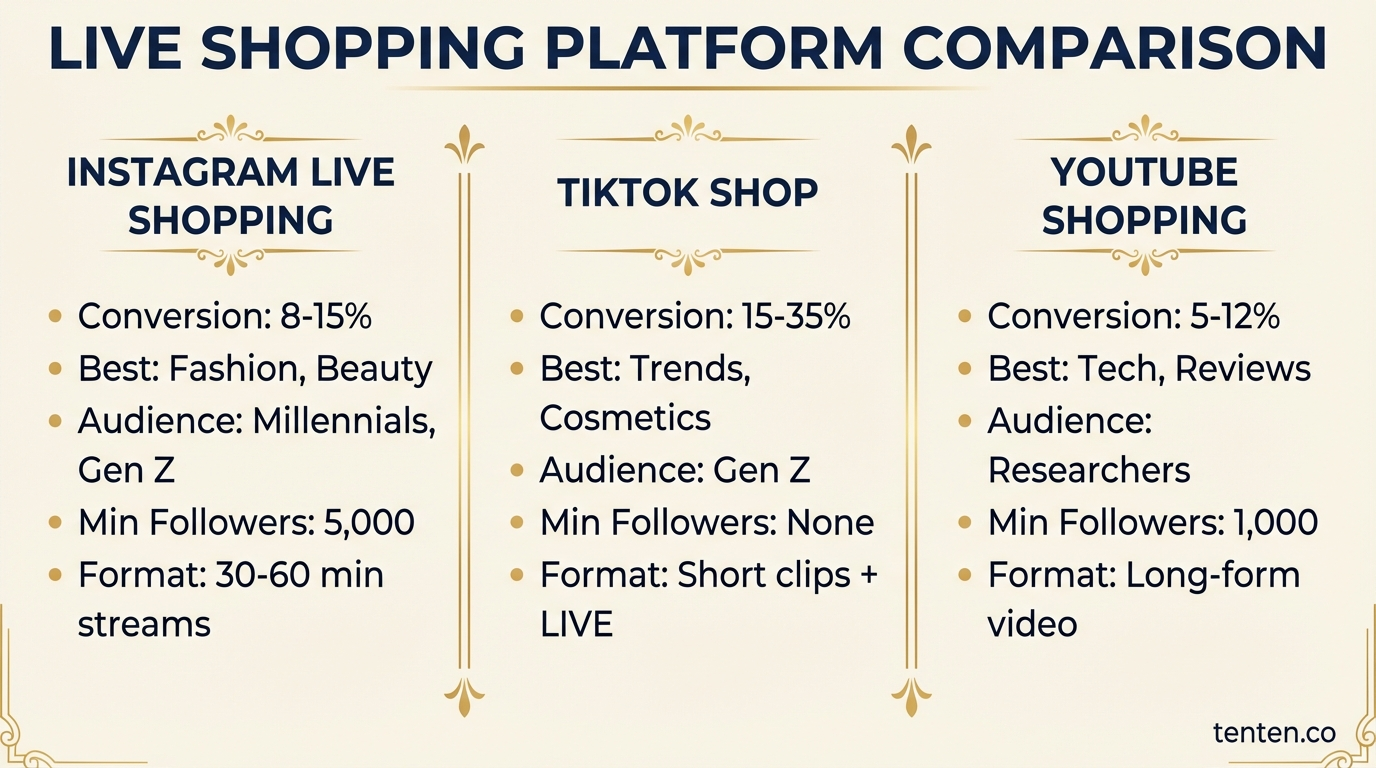
| Factor | Instagram Live Shopping | TikTok Shop | YouTube Shopping |
|---|---|---|---|
| Best for | Fashion, beauty, lifestyle, accessories | Trend-driven products, cosmetics, gadgets, food | Tech, long-form reviews, educational content |
| Primary audience | Millennials + Gen Z, female-skewed | Gen Z, algorithm-driven discovery | Research-oriented, older skew, high purchase intent |
| Content format | 30–60 min hosted livestreams | 15–60 sec clips + LIVE shopping | Embedded shopping cards + livestream panels |
| Conversion range | 8–15% on engaged audiences | 20–40% on viral content (lower on slow content) | 5–12% (but highest intent per viewer) |
| Platform commission | ~2–3% + payment processing | 5% flat | Varies by merchant program |
| Shopify integration | Native, free | Native, US fully live | Native via YouTube Commerce |
| Follower requirement | 5,000 minimum | None (algorithm-first) | 1,000 subscribers |
| Maturity | Most mature, proven playbook | Newest, least saturated | Underrated, growing fast |
The operator-level insight most guides miss: TikTok's 20–40% conversion numbers are real, but they're heavily skewed by viral hits. Median TikTok Shop conversion hovers around 8–12% — still excellent, but don't plan your P&L around the outliers. Instagram is more predictable. YouTube is the sleeper: viewers who click shopping cards have 3–5x higher purchase intent than random visitors because they've already invested 5–10 minutes watching your content.
If you have limited resources, start with Instagram Live Shopping. It's the most mature integration, has the most predictable conversion metrics, and Shopify's native sync is battle-tested. Once you've dialed in your format, expand to TikTok for reach and YouTube for high-intent buyers.
Instagram Live Shopping: Setup to First Revenue
Prerequisites you'll need before touching any settings:
- Shopify store on any plan
- Instagram Business Account connected to a Facebook Business Page
- Minimum 5,000 followers (Instagram's commerce threshold)
- Products listed and active on Shopify
Step 1: Enable the Instagram Sales Channel
Open Shopify Admin → Settings → Sales Channels → Add "Instagram" (free). Authenticate with your Instagram Business Account, then sync your product catalog. Instagram validates products within 24 hours — sometimes faster for established accounts.
Step 2: Curate Your Product Lineup
Cap it at 10–15 products per stream. Viewers get decision fatigue beyond that, and your conversion per product drops. Selection criteria that actually matter:
- Visual demonstrability — can you show it working in 60 seconds? Fashion, beauty, and home goods outperform.
- Margin above 50% — you'll offer 10–15% live-only discounts, and you need room for returns.
- In-stock inventory — nothing kills momentum like showing a product that's sold out.
- A story behind each item — why you picked it, how it's made, one surprising use case.
Step 3: Promote 24 Hours Before
Use Instagram Stories, a feed post, and direct DMs to your most engaged followers. The promotional post should include: exact time (with timezone), what you'll show, and the exclusive discount. "LIVE tomorrow at 7 PM PST — demoing our new resistance band set with 3 insider training hacks. 15% off only during the stream."
Step 4: Run the Stream
Open Instagram → Stories → Camera → Create → Live. Tag products before you start talking. Spend 2–3 minutes per product — demo it, explain the benefit, and call out the live-only discount. Answer questions from comments in real time.
| Stream segment | Duration | Purpose |
|---|---|---|
| Introduction | 2 min | Greet viewers, preview the lineup, build anticipation |
| Product demos (10 items) | 20–30 min | Show each product in action, highlight unique features |
| Live Q&A | 5–10 min | Address objections, build trust, engage comments |
| Closing + CTA | 2 min | Thank viewers, share discount code, direct to store |
| Total | 30–45 min | — |
Benchmarks for your first 5 streams: 500–2,000 viewers, 20–40 purchases per stream, $500–$2,000 revenue. These numbers improve significantly by stream 10 as the algorithm learns to promote your lives and your audience builds the habit.
TikTok Shop: Early-Mover Advantage Is Real
TikTok Shop is fully operational in the US, UK, and Southeast Asia as of 2026. It's less saturated than Instagram and the algorithm doesn't care about your follower count — it cares about watch time and engagement. That makes it the best platform for brands starting from zero.
Setup takes under 30 minutes:
- Shopify Admin → Sales Channels → Add "TikTok"
- Authenticate with your TikTok Business Account
- Sync products (Shopify auto-catalogs into TikTok Shop)
- Create a TikTok Shop storefront (optional but recommended for brand credibility)
- Start posting product-tagged videos
Content formula that converts on TikTok:
The format is ruthlessly simple: 15–60 second videos showing the product in use. Not sitting on a table — actually being worn, opened, assembled, or demonstrated. Use trending audio. Include a "shop now" overlay. TikTok's algorithm rewards content that keeps people watching, so front-load the most interesting visual.
A fitness brand might structure it: 0–2s product in hand with music, 2–5s demo in action, 5–8s close-up of material quality, 8–10s price and offer, 10–15s trending transition. That's it. Don't overthink it.
TikTok Live Shopping works similarly to Instagram but the algorithm promotes streams differently — TikTok pushes lives to non-followers if engagement is high. Average conversion on engaged TikTok livestreams: 15–35%. The variance is dramatic, which is why testing matters more here than on any other platform.
YouTube Shopping: The Long-Form Conversion Machine
YouTube's advantage is intent. People searching for "best wireless earbuds 2026" or "Shopify store setup tutorial" are ready to research and buy. They watch 10-minute reviews, compare options, and make considered purchases.
Setup:
- Enable YouTube as a Sales Channel in Shopify Admin
- Connect your YouTube channel
- Sync products
- Tag products in published videos via YouTube Studio
Three ways to surface products:
- Video descriptions — always include product links (this alone drives meaningful traffic)
- Shopping card overlays — appear during the video, viewers click without leaving
- YouTube livestream shopping — go live with a tagged product panel visible to viewers
YouTube viewers who engage with shopping cards convert at 3–5x the rate of cold traffic. The investment is the content itself — a single well-produced 10-minute product review can generate sales for months.
The Complete Live Shopping Tech Stack
| Tool | Purpose | Monthly Cost |
|---|---|---|
| Shopify (any plan) | Core store + product catalog | $39–$2,300 |
| Instagram / TikTok / YouTube | Sales channels + livestream hosting | Free |
| OBS or StreamYard | Professional stream quality, multi-camera | Free–$25 |
| Ring light + key light | Video quality (non-negotiable for conversion) | $30–$150 one-time |
| Backdrop or clean background | Professional appearance | $20–$100 one-time |
| Secondary device | Alternate camera angle during demos | $0 (use existing phone/tablet) |
Minimal viable setup: $0–$50 if you already own a smartphone with decent lighting. Professional setup: $200–$400 one-time investment that pays for itself in the first successful stream.
Five Practices That Separate High-Converting Streams from Dead Air
1. Stream on a fixed schedule. Shopify merchants who go live at the same time each week see 2x viewership within 4 weeks. The algorithm learns to promote your streams, and your audience builds the habit of showing up. Tuesday and Thursday evenings (7–9 PM local) consistently outperform other time slots.
2. Offer live-only discounts. "15% off only while we're live" creates genuine urgency. This isn't a gimmick — it's the primary purchase driver for 60%+ of live shopping buyers. Make the discount visible on screen throughout the stream.
3. Engineer engagement. "Type WATER in comments if you've tried our water bottle" isn't just community building — it's feeding the algorithm. Comments, shares, and watch time are the signals that determine whether the platform pushes your stream to new viewers.
4. Repurpose every stream. One 40-minute livestream becomes 10+ pieces of content: TikTok clips of best product demos, Instagram Reels of highlights, the full recording on YouTube, email content linking the replay. This is how you build an AI-powered content engine that compounds over time.
5. Track what actually converts. Which products moved? Which demo style got the most engagement? What time slot had the highest peak viewers? Build a simple spreadsheet tracking these metrics across streams. Within 5 sessions, patterns emerge that tell you exactly what your audience wants to buy.
What Most Merchants Get Wrong
The biggest mistake isn't technical — it's treating live shopping as a broadcast instead of a conversation. Streams where the host reads from a script convert at half the rate of streams with genuine audience interaction.
The second mistake: going live without mobile-optimized product pages. Over 80% of live shopping viewers are on their phones. If they tap "buy" and land on a product page that's slow or hard to navigate on mobile, you've lost the sale that the livestream worked so hard to create.
Ready to launch live shopping on your Shopify store? Brands that start now build audience habits and algorithm equity before the channel gets saturated. Talk to our team about setting up Instagram, TikTok, and YouTube shopping integrations — we help merchants go from first stream to predictable weekly revenue.
FAQ
What's the minimum follower count needed for live shopping on each platform?
Instagram requires 5,000 followers to access commerce features. TikTok Shop has no follower minimum — the algorithm promotes content based on engagement, not audience size. YouTube requires 1,000 subscribers for shopping features. If you're starting from scratch, TikTok is the fastest path to your first live shopping revenue.
How much does it cost to set up live shopping on Shopify?
The platform integrations (Instagram, TikTok, YouTube) are free through Shopify's native sales channels. Your only costs are equipment: a ring light ($30–$80), a clean backdrop ($20–$100), and optionally streaming software like StreamYard ($25/month). Many merchants start with nothing more than a smartphone and natural lighting. Total setup: $0–$200.
What conversion rates should I expect from live shopping?
Instagram Live Shopping typically converts at 8–15% of engaged viewers. TikTok Shop ranges from 8–12% (median) to 20–40% on viral content. YouTube Shopping converts at 5–12% but attracts the highest-intent buyers. For context, standard e-commerce email campaigns convert at 1.5–3% and regular social commerce at 2–5%.
How often should I go live to see results?
Start with once per week at a consistent day and time. The algorithm on every platform rewards consistency — merchants who stream weekly see 2x viewership growth within a month. Scale to 2–3 times per week once you've refined your format and confirmed conversion rates justify the time investment.
Can live shopping work for products that aren't visually exciting?
Visual products (fashion, beauty, home goods, fitness) naturally outperform on Instagram and TikTok. For technical, industrial, or less photogenic products, YouTube is the better channel — the longer format gives you time to explain value through demonstrations, comparisons, and customer testimonials rather than relying purely on visual appeal.
What's the best time to go live for maximum viewership?
Tuesday and Thursday evenings between 7–9 PM in your target audience's timezone consistently outperform other slots. Weekend afternoons (1–3 PM) are the second-best window. Avoid Monday mornings and Friday evenings. The most important factor is consistency — pick a slot and stick with it so your audience builds the habit.
How do I handle returns from live shopping purchases?
Expect a slightly higher return rate than standard e-commerce (12–18% vs. 8–12%) because impulse buying is higher during livestreams. Mitigate this by being transparent about sizing, materials, and limitations during the demo. Brands that address common objections live see 30–40% fewer returns than those that don't.